
Mobileye Shifts Gears with Strong Q1 Beat and Aggressive Capital Returns
Mobileye’s robust Q1 performance coupled with a $250 million buyback signals confidence amid semiconductor supply complexities.
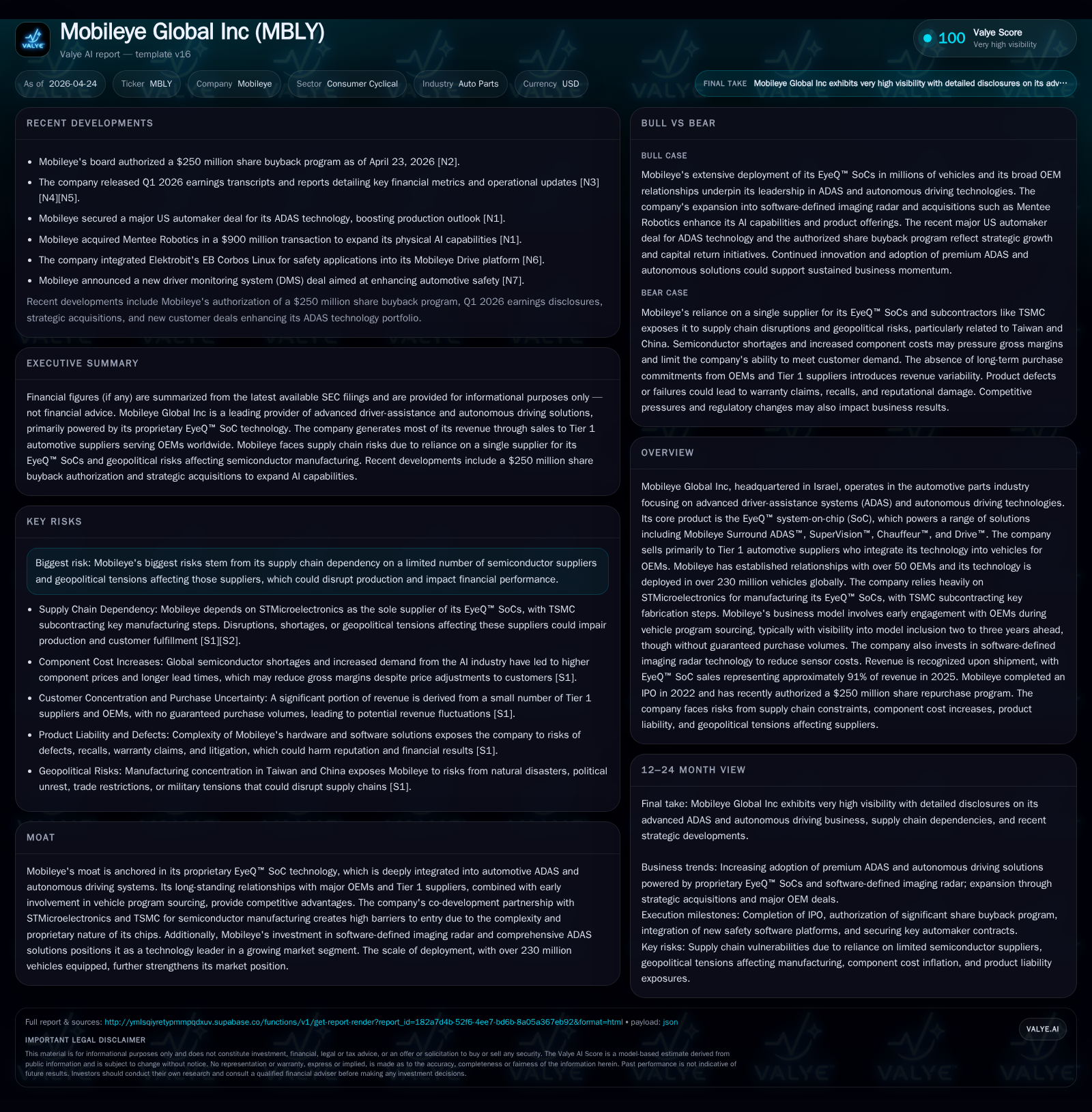
In its latest quarter ended March 28, 2026, Mobileye Global Inc delivered revenue growth above consensus and signaled strengthening OEM demand, supported by a new $250 million share repurchase authorization. The company’s business model centers on its proprietary EyeQ™ SoC technology powering advanced ADAS and autonomous driving solutions sold primarily through Tier 1 suppliers to OEMs globally. Mobileye’s moat is sustained by deep early engagement with automakers, a co-development foundry partnership with STMicroelectronics and TSMC, and a growing mix of software-driven bundled systems. However, supply chain vulnerabilities and concentrated customer dependencies remain key risks. Investors should monitor design-win momentum, supply normalization, and execution on product innovation as Mobileye seeks to expand its market penetration in an evolving automotive ecosystem.
Q1 2026 Operating Update: Outperformance and Capital Returns
Mobileye Global Inc reported first-quarter results for the period ending March 28, 2026, with top-line performance beating analyst expectations as detailed in the April 23, 2026 Form 10-Q [S2] and corroborated by the contemporaneous 8-K press release [S3]. The company confirmed an upward revision of guidance following solid revenue growth driven by increased shipments of its EyeQ™ system-on-chip (SoC) based solutions to Tier 1 automotive suppliers serving over 50 OEM partners worldwide [N1][N2]. Notably, Mobileye announced a new $250 million share buyback program approved by its Board on April 23, reinforcing executive confidence in both the company’s operational momentum and capital structure management [N7].
This strong quarterly showing aligns with growing industry demand for advanced driver assistance systems (ADAS) amid accelerating electrification and autonomous vehicle development trends. While Mobileye remains unprofitable on a GAAP basis—with trailing twelve months operating losses continuing around the previous fiscal year’s -$440 million mark [F1]—rising unit volumes are fostering better economies of scale and incremental gross profit expansion. This mixed cash flow profile underpins management’s decision to return capital via buybacks rather than dividends given no foreseeable payout plans [S1][S8].
Mobileye’s Business Model: EyeQ™ Ecosystem and OEM Partnerships
At the heart of Mobileye’s business model is its proprietary EyeQ™ SoC technology that drives a spectrum of ADAS and autonomous driving applications including Mobileye Surround ADAS™, SuperVision™, Chauffeur™, and Drive™ solutions [S10]. These chips are sold mainly to Tier 1 automotive suppliers who integrate them into vehicle platforms provided to OEMs. The company typically secures design wins through early involvement in vehicle programs—usually two to three years ahead—with significant visibility into product inclusion though no binding purchase commitments, creating a pipeline effect with lagging but relatively stable revenue recognition once programs ramp [S10][N2].
Differentiation arises from Mobileye’s decades-long leadership in computer vision-based ADAS, demonstrated by deployment across over 230 million vehicles globally spanning roughly 1,400 different model variants [S1]. The firm complements silicon products with evolving software stacks that enhance functionality and open new revenue opportunities through feature upgrades and data-centric services. Early engagement locks in switching costs for OEMs while broadening deployment scope across multiple vehicle lines.
The company also increasingly bundles hardware (software-defined imaging radar) alongside EyeQ chips within full ADAS systems like SuperVision™, which commands higher selling prices and dollar gross profits even as individual component margin percentages may compress [S4]. This strategy seeks to maximize per-unit profitability while expanding total addressable market penetration.
Competitive Dynamics in ADAS and Autonomous Vehicle Semiconductors
Mobileye maintains a formidable moat rooted in the specialized architecture of its EyeQ™ SoCs developed jointly with STMicroelectronics—the sole supplier—and subcontracted foundry operations performed at TSMC [S10][S1]. This exclusivity affords structural complexity that deters newcomer entrants due to the steep learning curve in embedded vision processing at automotive-grade reliability levels.
The supply chain interdependency introduces cyclical risks: global semiconductor shortages since 2020 have intermittently constrained production capacity, impacting inventory levels as documented during peak COVID-19 disruptions. Although inventory replenishment efforts throughout 2023 restored buffer stocks somewhat [S1], lingering geopolitical tensions involving key semiconductor regions elevate supply fragility risks [S20]. Pricing evolution is further complicated by rising raw material costs driven partly by AI chip demands elsewhere, forcing Mobileye to carefully balance modest ASP increases against competitive market pressures limiting full cost pass-through [S26][S4].
While legacy single-chip EyeQ sales remain core revenue drivers (>90% EyeQ contribution historically), the transition toward higher-complexity full bundled systems introduces margin dilution on a percentage basis due to third-party hardware incorporation. Yet these full systems secure greater OEM lock-in via comprehensive platform offerings that bundle safety-critical functionalities beyond basic perception tasks, reinforcing competitive positioning against traditional semiconductor peers pivoting into automotive domains.
Growth Drivers: Product Innovation, Adoption Curve & Market Expansion
Structural growth vectors for Mobileye revolve around accelerating penetration rates of sophisticated ADAS features within global vehicle fleets combined with nascent adoption curves for autonomous vehicle capabilities enabled by software-defined imaging radar technologies introduced recently [S10][N9]. Incremental feature additions sustain average selling price (ASP) resilience despite typical volume ramp discounts owing to legacy product commoditization effects.
Expanding collaboration across more than fifty OEMs places Mobileye well on track to grow unit shipments beyond approximately 35.7 million systems shipped in fiscal year 2025—a notable increase from prior years driven largely by normalized component supply chains after prior excess inventory drawdowns by Tier 1 customers [S10][F1]. Emerging markets offer further runway given varied regulatory timing globally favoring staggered rollouts of driver assistance mandates.
Additionally, autonomous driving deployments via chauffeur-level or robotaxi services represent longer-term transformational upside contingent on regulatory approvals and consumer acceptance trends. Mobileye's RSS safety model standardization efforts may accelerate adoption curves by providing verifiable risk parameters relevant across jurisdictional boundaries [S25].
Constraints: Semiconductor Supply Chain Risks and Geopolitical Factors
Reliance on a limited number of key suppliers poses ongoing operational constraints. STMicroelectronics is currently the sole source for EyeQ chips; any disruption there poses direct production bottlenecks exacerbated by extended lead times characteristic in wafer production cycles [S1][S7]. Earlier pandemic-induced shortages waned in late 2022/early 2023 but historical precedent highlights vulnerability to new waves affecting manufacturing or logistics.
Geopolitical tensions affecting semiconductor export controls or raw material access could interrupt component availability or inflate costs. While Mobileye has improved inventory planning strategies—including increasing buffer stock levels—to minimize sudden shortfalls [S1], risk remains nontrivial especially given the fast-evolving geopolitical landscape surrounding semiconductor technology.
Customer concentration also amplifies risk exposure: top three Tier-1 suppliers collectively contributed over 60% of revenue in recent periods (ZF at ~30%, Valeo ~17%, Aptiv ~15%) while eight OEM groups account for over 80% of total sales [S24][S14]. Losing or experiencing order reductions from any major customer would materially impact financial outcomes.
What Investors Should Watch Next: Guidance, Design Wins, and Execution
Key near-term indicators include quarterly guidance updates that will reveal whether post-supply normalization demand sustains momentum amid broader macroeconomic concerns [N2][S3]. Tracking changes in ASPs alongside product mix shifts toward higher-function bundled systems will offer insight into gross margin trajectory.
Design win announcements involving new models or expanded applications provide forward-looking signals given typical multi-year run rates tied to vehicle programs. Any updates on integration progress of new imaging radar modalities or autonomous capabilities under Chauffeur™ or Drive™ brands will help validate growth narratives.
Supply chain developments warrant continuous monitoring—both in terms of supplier capacity expansions or potential bottlenecks—as uninterrupted chip availability underpins ability to meet customer requirements promptly [N2]. Lastly, effective execution on R&D investments sustaining product leadership will remain critical for maintaining differentiation amid intensifying competition.
Financial Snapshot: Liquidity, Operating Losses, and Capital Deployment
Historical performance (annual)
|
| FY | Net ($bn) | CFO ($mm) | OpInc ($bn) | Capex ($mm) | Net YoY |
|---|---|---|---|---|---|
| 2025 | -0.4 | 602 | -0.4 | 79 | +87.3% |
| 2024 | -3.1 | 400 | -3.2 | 81 | -11344.4% |
| 2023 | -0.0 | 394 | -0.0 | 98 | +67.1% |
| 2022 | -0.1 | 546 | -0.0 | 111 |
Source: SEC companyfacts cache [F1].
Capital returns and efficiency (annual)
|
| FY | Div ($mm) | FCF ($mm) | ROE% |
|---|---|---|---|
| 2025 | 523 | -3.3 | |
| 2024 | 0 | 319 | -25.6 |
| 2023 | 0 | 296 | -0.2 |
| 2022 | 337 | 435 | -0.6 |
Source: SEC companyfacts cache [F1].
As of March 28, 2026 quarter end, Mobileye held cash and cash equivalents totaling approximately $1.21 billion alongside current assets near $2 billion versus current liabilities of roughly $419 million—translating into a robust current ratio of about 4.76 indicating comfortable near-term liquidity positions suitable for ongoing investment in R&D and operations [F1][S29].
Despite recurring operating losses reported at -$440 million for FY2025 reflecting continued upfront innovation costs balanced against early-stage commercialization scaling challenges, operating cash flow improved sharply by more than +50% year-over-year reaching over $600 million last fiscal year—highlighting improving cash generation capability amid growth phases [F1].
Capital expenditures remained steady around $79 million reflecting measured infrastructure expansion consistent with strategic priorities [F1][S19]. The newly announced $250 million share repurchase program announced contemporaneously with the Q1 release represents deliberate capital return signaling management’s confidence without compromising liquidity reserves further underscoring sound financial stewardship [N7][S3][S8].
|
| FY | Revenue (M USD) | OpInc (M USD) | NetInc (M USD) | CFO (M USD) | Capex (M USD) | Cash & Eq (B USD) | CurrRatio |
|---|---|---|---|---|---|---|---|
| 2025 | 1894 | -440 | -392 | 602 | 79 | 1.21 | 4.76 |
| 2024 | 1654 | -3225 | -3090 | 400 | 81 | N/A | N/A |
| 2023 | N/A | -33 | -27 | 394 | 98 | N/A | N/A |
Overall, Mobileye remains well-positioned as a leading-edge innovator within automotive ADAS/autonomy ecosystems supported by deep technical moats related to its proprietary SoC technologies and embedded software platforms. Near-term challenges emanate predominantly from external supply chain uncertainties combined with heavy customer concentration requiring vigilant execution oversight. Nonetheless, recent operational improvements coupled with proactive capital returns paint an optimistic intermediate outlook contingent on continued design win progression and market acceptance trajectories.
This analysis is informational only and does not constitute investment advice or recommendations regarding Mobileye Global Inc or securities mentioned herein.
Disclaimer: This is research-only, informational analysis and not investment advice. It may include AI-generated interpretation and general industry context. Always verify important details using primary sources.

Comments