
Webster Financial’s Strategic Evolution Ahead of Banco Santander Acquisition
Webster Financial reports stable Q3 2025 operations as it approaches a transformative acquisition by Banco Santander.
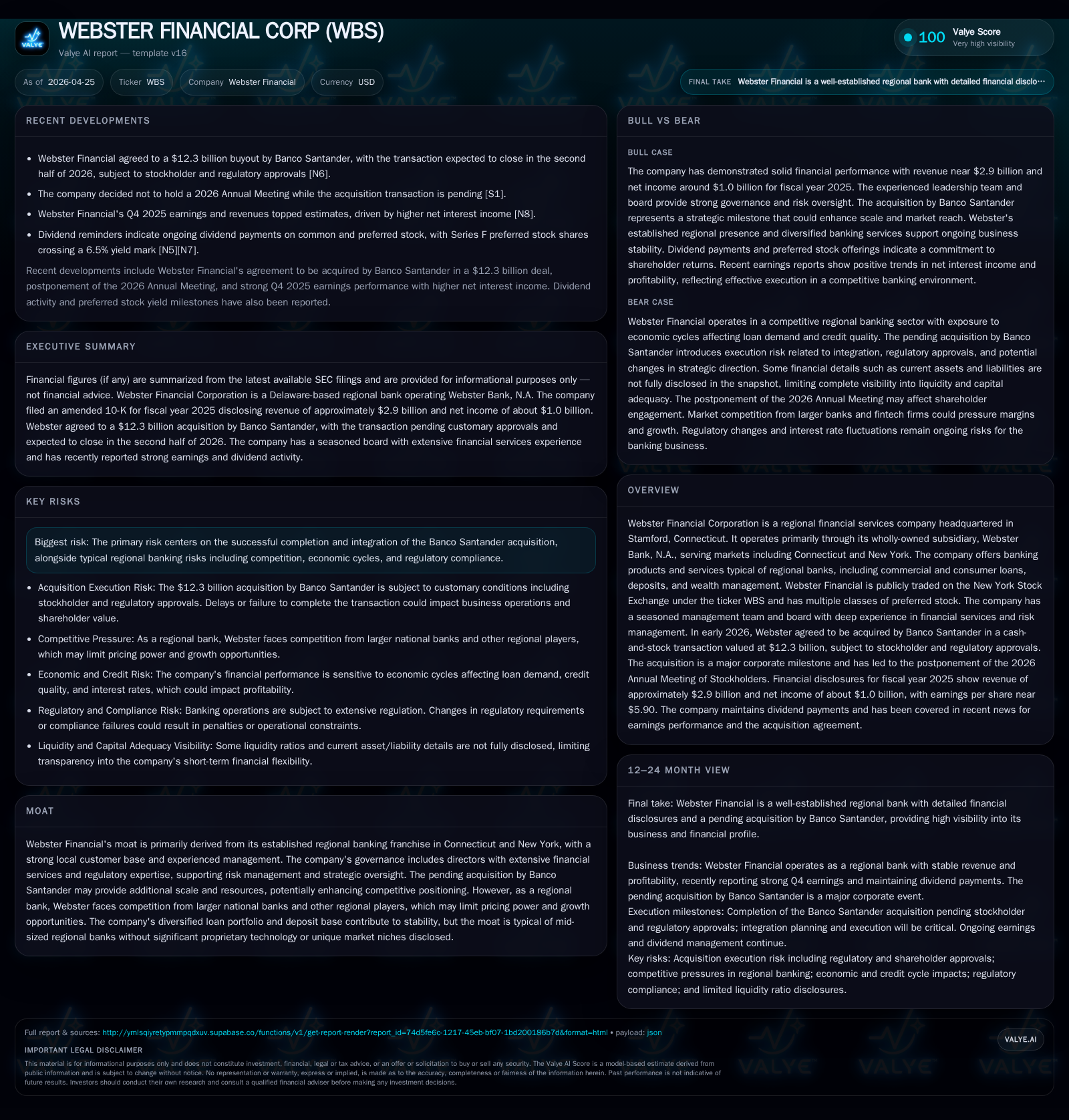
In its latest quarterly filing, Webster Financial reaffirmed operational stability with modest loan portfolio growth and solid deposit retention ahead of its acquisition by Banco Santander. The company operates a broad regional banking franchise focused on Connecticut and New York, generating revenues primarily from diversified commercial and consumer lending alongside fee-based wealth management. While the upcoming acquisition offers prospects for amplified scale, Webster faces typical regional banking challenges such as competitive pressures from national banks and regulatory oversight. Key growth drivers include cross-selling opportunities post-merger, though market cyclicality and credit risks remain constraints. Financially, Webster demonstrated healthy revenue and net income growth in FY2025 with a strong capital base and manageable debt levels supporting a stable profile as integration nears.
Latest Operating Update Reinforces Stability Ahead of Acquisition
Webster Financial's Q3 2025 Form 10-Q filing underscores consistent operating results during the run-up to its planned acquisition by Banco Santander [S2]. The company reported stable growth across key metrics such as core deposits — a vital measure of funding stickiness in regional banking — and a broadly sound loan portfolio with no material deterioration in asset quality indicators noted. Management continues to manage risk cautiously in a competitive lending landscape concentrating on commercial real estate exposure, asset-based lending, and multifamily residential loans [S2]. This steady near-term performance is critical as Webster navigates integration complexities associated with the announced $12.3 billion acquisition transaction set to reshape its strategic trajectory [S1].
The amended annual filing (10-K/A) dated April 24, 2026, provides further context on governance structures integral to overseeing risk through this transition, including a Risk Committee chaired by an expert former Deputy Comptroller deeply familiar with midsize bank supervision and merger reviews [S1]. This governance focus signals deliberate emphasis on mitigating potential dislocations during the merger process.
Core Business Model and Product Offering Dynamics
At its heart, Webster Financial operates a classic regional bank business model anchored by commercial lending — especially commercial real estate loans — complemented by consumer lending products such as residential mortgages and home equity lines [S1]. The loan portfolio is well diversified across asset-based lending segments and traditional financing receivables enabling some insulation against sector-specific shocks. On the liability side, Webster benefits from a robust base of core deposits representing stable funding sources less susceptible to volatility than wholesale or brokered deposits [S7],[S15]. Wealth management services round out fee income streams that diversify revenue beyond net interest margin dependence.
Customer relationships exhibit fairly high switching costs typical for regional banks embedded in local communities like Connecticut and New York markets. This enhances retention rates even amid pricing pressures. However, pricing power is circumscribed given competition from dominant national banks offering economies of scale that regional players like Webster can only partially offset [S1]. Operational economics benefit from scale efficiencies achieved through a balanced branch network complemented by digital channels aligned with evolving customer preferences.
Competitive Positioning within Regional Banking
Webster's footprint concentrates predominantly in Connecticut and adjacent New York regions where it holds meaningful local market shares among mid-market enterprises and retail consumers [S1]. Despite its embedded position, the company contends with industry headwinds common to midsized regional banks: intensified competition from major national banks armed with deeper pockets, technological innovations, and customer acquisition firepower. These competitors exert downward pressure on lending yields and deposit costs [S1].
Still, Webster's experienced senior leadership team possesses strong capabilities in managing credit exposures prudently while navigating regulatory frameworks that govern bank capital adequacy under evolving standards [S1]. Its governance structure includes directors with direct supervisory experience at large financial institutions which is advantageous during periods of consolidation like this pending acquisition [S1].
The upcoming Banco Santander merger could materially shift competitive dynamics by injecting scale advantages potentially improving product offerings via enriched technology platforms while also expanding geographic reach beyond traditional New England corridors. Yet integration execution will be pivotal in realizing such strategic benefits without sacrificing customer experience or financial discipline [S1],[N4].
Growth Catalysts Balanced by Market and Regulatory Constraints
Organic growth opportunities are tied closely to lending volume expansion – particularly within commercial real estate sectors benefiting from regional economic activity – alongside consumer loan originations reflecting ongoing housing demand [S1],. Fee income from wealth management may also grow through better cross-selling capabilities introduced post-merger leveraging Santander's broader product suite.
However, several constraints temper growth prospects. Economic cycles bearing on credit risk necessitate vigilant underwriting standards given cyclical exposure inherent in asset-based lending segments. Moreover, regulatory requirements centering on capital buffers limit aggressive leverage expansion mandated for mid-sized institutions under Regulation YY frameworks overseen by the Risk Committee chair's expertise [S1]. Competitive pricing environments constrain net interest margin improvements due to pressure on loan yields amid fragmented industry landscape.
Recent market commentary affirms expectations for moderate earnings growth but highlights uncertainties tied to macroeconomic volatility and integration risk inherent in sizeable acquisitions like the Banco Santander deal [N4]. Thus, while scale-afforded synergies represent upside potential structurally, near-term results hinge on execution precision.
Key Milestones and Signals to Monitor Going Forward
Looking ahead, critical milestones revolve around formal stockholder approval processes required for the Banco Santander transaction anticipated in mid-2026 followed by regulatory reviews encompassing antitrust considerations given the combination’s size relative to regional market shares [S1]. Post-approval phases will involve detailed integration planning implementation encompassing systems harmonization, brand alignment strategies, and retention plans for key client segments.
Investors should monitor quarterly earnings disclosures for shifts in loan portfolio trends including growth rates within commercial real estate versus asset-based lending buckets that could signal appetite or caution levels adopted by management during merger transition periods [S2]. Deposit cost trajectories will also provide insight into competitive deposit gathering efficacy under evolving interest rate conditions.
Further guidance updates around transaction timing or synergy realization targets will be essential execution signposts alongside any incremental commentary addressing credit quality or regulatory compliance adjustments arising from enlarged enterprise complexity post-merger.
Financial Profile and Capital Structure Analysis
Historical performance (annual)
|
| FY | Rev ($bn) | Net ($mm) | CFO ($mm) | OpInc ($mm) | Rev YoY | Net YoY |
|---|---|---|---|---|---|---|
| 2025 | 2.9 | 1003 | 1058 | 1470 | +11.9% | +30.5% |
| 2024 | 2.6 | 769 | 1404 | 1239 | -11.4% | |
| 2023 | 868 | 979 | 1235 | +34.7% | ||
| 2022 | 644 | 1336 | 1079 |
Source: SEC companyfacts cache [F1].
Capital returns and efficiency (annual)
|
| FY | Div ($mm) | Buybacks ($mm) | FCF ($mm) |
|---|---|---|---|
| 2025 | 267 | 594 | 1009 |
| 2024 | 275 | 65 | 1368 |
| 2023 | 278 | 108 | 938 |
| 2022 | 248 | 322 | 1307 |
Source: SEC companyfacts cache [F1].
From a financial perspective, Webster Financial displayed robust top-line expansion with FY2025 revenue reaching approximately $2.9 billion reflecting an 11.9% increase versus FY2024’s $2.59 billion [F1]. Operating income grew nearly 18.7% year-over-year to about $1.47 billion bolstered by improved operational leverage while net income posted a significant jump of over 30% to just above $1 billion highlighting profitability gains amidst controlled expenses [F1].
Operational cash flow moderated somewhat year-over-year by approximately 24.7%, a development attributable partly to working capital adjustments but free cash flow remained positive after accounting for elevated capex spending which increased 38% signaling reinvestment into technology or branch infrastructure enhancements aligned with strategic objectives [F1].
Balance sheet metrics reveal total debt amounted to roughly $745 million at year-end 2025 consistent with manageable leverage levels relative to equity capital totaling approximately $9.5 billion yielding an estimated return on equity near 10.6% indicative of solid capital efficiency within sector norms [F1],[S3]. Dividends sustained at elevated levels around $267 million reflect confidence in cash generation capability while share repurchases surged markedly suggesting shareholder return focus preceding ownership transition [F1].
|
| FY | Revenue ($M) | Op Income ($M) | Net Income ($M) | CFO ($M) | Capex ($M) | Dividends ($M) | Buybacks ($M) |
|---|---|---|---|---|---|---|---|
| 2024 | 2,590 | 1,239 | 769 | 1,404 | 36 | 275 | 65 |
| 2025 | 2,899 | 1,470 | 1,003 | 1,058 | 50 | 267 | 594 |
Overall, Webster maintains a financially solid profile characterized by revenue diversification across lending types and fee income sources while operating within prudent risk limits established by experienced governance elements. As integration with Banco Santander progresses towards closure anticipated next year, these foundational strengths serve as critical enablers for sustainable operational momentum amid structural transformation.
This analysis synthesizes publicly filed SEC documents including the recent Q3 Form 10-Q (11/10/25) and amended annual Form 10-K/A (4/24/26), supplemented by financial data as of year-end FY2025 without providing investment recommendations or opinions on stock performance.
Disclaimer: This is research-only, informational analysis and not investment advice. It may include AI-generated interpretation and general industry context. Always verify important details using primary sources.

Comments