
Baird Medical Faces Demand Contraction and Margin Pressure Amid Intensified R&D and Sales Investments
The latest quarterly update flags a pivotal shift in Baird Medical’s operating trajectory, marked by revenue declines and strategic spending increases.
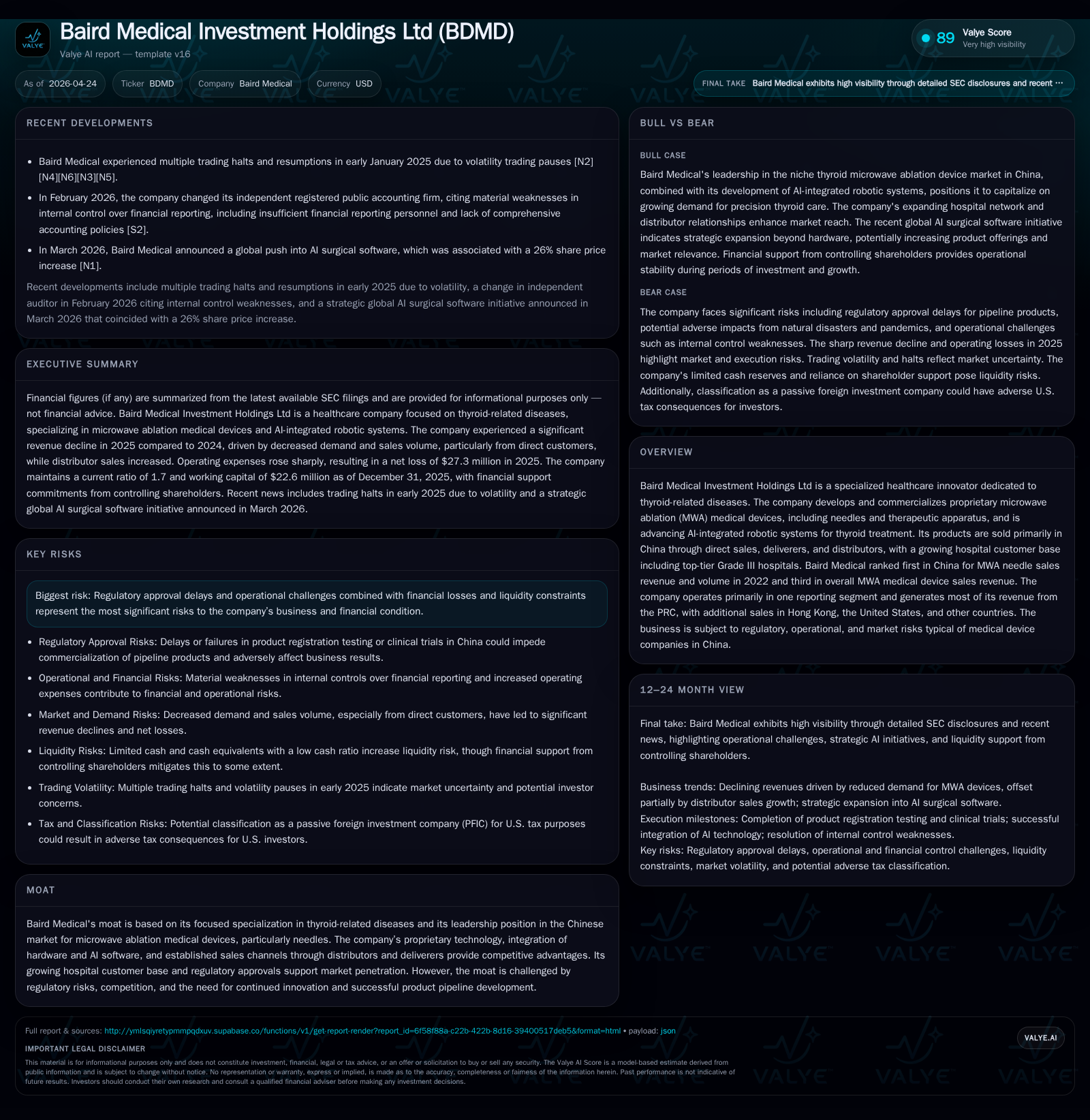
Baird Medical Investment Holdings Ltd reported a significant revenue drop in 2025 driven by reduced direct customer sales in its premier microwave ablation medical devices business focused on thyroid diseases. Despite its leadership position in China’s MWA needle market, the company’s gross margin contracted and operating expenses surged due to intensified R&D on AI-integrated robotic systems and expanded marketing efforts. Regulatory uncertainties and centralized procurement trends add to near-term headwinds. Baird Medical’s path to growth hinges on stabilizing demand, successful pipeline approvals, and balancing innovation with cost discipline.
Recent Operating Update
In February 2026, Baird Medical Investment Holdings Ltd changed auditors from Kreit & Chiu CPA LLP to Guangdong Prouden CPAs GP without any qualifications or disagreements on prior financials but with disclosure of material weaknesses in internal controls related to U.S. GAAP reporting [S2]. While this administrative change signals enhanced governance focus, the company’s operational update reveals substantial shifts in financial performance.
The most salient near-term development is a sharp falloff in revenues during the fiscal year ended December 31, 2025. Total revenue dropped by approximately 39% from $37 million in 2024 to $22.5 million in 2025 [F1], predominantly due to a collapse in direct customer sales, which plunged from nearly $20 million down to $4.1 million over the same period. This reflects lower volumes and pricing for Baird’s proprietary microwave ablation (MWA) needles and therapeutic apparatus targeted at thyroid nodules—a core market niche where they are recognized leaders [S1]. Distributor sales bucked the trend increasing modestly by about $1.2 million, highlighting channel tension between direct and indirect distribution routes [S3].
Concurrent with top-line pressures, gross profit fell by roughly 42%, though gross margin only declined moderately from 88.2% to 83.8%. This suggests pricing pressure combined with some operational leverage but also calls attention to shifts in product mix or cost base increases against falling sales [S20]. The degradation of margin is notable given the previously high profitability benchmarks for proprietary medical devices.
On the expense side, Baird notably ramped investment: research and development expenses ballooned from $6.2 million to over $20 million reflecting intensified efforts on AI-driven robotic systems for thyroid treatment integrated with MWA hardware [S20]. FDA certification costs and European CE marking fees contributed materially here, signaling a push for international regulatory approval beyond their historical Chinese market dominance [S1]. Selling and marketing expenses surged fivefold as share-based compensation programs expanded alongside additional hires—raising these costs close to half of total revenue at 45.5% versus just over 11% prior year [S20]. Administrative expenses similarly more than doubled primarily driven by compensation-related costs.
Despite these challenges, Baird expanded its hospital customer base—from approximately 579 hospitals in China in 2024 up to around 614 by end-2025—with an increase in top-tier Grade III hospital clients from about 310 to 329 supporting its penetration strategy within higher-end clinical environments [S1]. This broadening footprint provides a structural growth underpinning amid short-term demand volatility.
Business Model Overview
Baird Medical’s revenue model centers on the design, manufacture, and sale of proprietary microwave ablation medical devices targeted at thyroid-related diseases—specifically needles used for ablative procedures as well as therapeutic apparatus optimized for these treatments [S1]. The offering extends into an ecosystem that encompasses early diagnostics through robotic-assisted ablation technology enriched with AI capabilities—positioning the company beyond hardware into intelligent healthcare platforms.
Sales flows primarily occur via three channels: direct sales forces engaging hospitals outright; deliverers (multi-hospital agents distributing products); and independent distributors who leverage established regional networks [S1]. This multi-layered approach balances reach versus cost efficiency while facilitating access into China’s expansive hospital tiers.
Competitive advantage largely derives from Baird’s technological IP focusing exclusively on thyroid conditions—a highly specialized segment where precision matters—and its dominant market share within mainland China for MWA needles both by volume and revenue [S1]. The company actively leverages regulatory approvals (NMPA) and engages medical associations/leading clinicians for market adoption.
However, margins are exposed to pricing reforms introduced via centralized procurement pilots at provincial levels which aim to control medical device costs broadly across China’s healthcare system [S1]. These government initiatives could increasingly compress reimbursement rates or compel price concessions disproportionately affecting smaller innovators reliant on domestic sales.
Industry Structure and Competitive Position
The thyroid treatment device market is niche but technologically sophisticated given safety-critical interventions required during MWA procedures. Competitors include multinational medtech companies offering broader ablative technologies alongside domestic Chinese players focusing on incremental cost advantages.
Baird stands out through its full-stack integration—from hardware manufacturing of MWA needles (the highest selling segment) to early-stage deployment of AI-powered robotics systems under development with academic partners like Nanjing Forestry University [S1]. Its status as #1 in needle sales volume/revenue in China underscores strong clinical acceptance domestically.
Geographically, the firm has limited diversification with approximately 60%+ revenues still concentrated in mainland China but growing exports specifically to Hong Kong ($8M revenue contribution), United States ($0.9M), Malaysia, and Nepal: small but emerging markets for future scale-up [S3].
Regulatory risks loom large given evolving National Medical Products Administration (NMPA) guidelines that may delay or restrict new product approvals or impose rigid post-market oversight requirements [S11]. Additionally, downward price pressure from recent provincial centralized procurement trials could reshape competitive dynamics favoring scale economies or different product value propositions.
Growth Drivers and Constraints
Growth prospects revolve around four pillars:
- Expanding hospital network penetration particularly within high-tier Grade III facilities where procedural volume/billing is higher.
- Broadening distributor engagement across regions leveraging established seller networks mitigating direct sales overhead.
- Advancement of pipeline products involving AI-robotic systems that potentially create new usage paradigms beyond current manual MWA therapies.
- Geographic diversification targeting developed markets like U.S./Europe following necessary regulatory clearances enhancing global addressable market potential.
Conversely, growth faces structural constraints:
- Regulatory uncertainties delaying time-to-market causing capital-intensive R&D spans without immediate cash flow returns.
- Emerging price controls via centralized procurement lowering per-unit realization thus pressuring gross margins.
- Intensifying competition among chinese domestic rivals who could erode market share particularly if competitors develop substitutive non-MWA ablative technologies or bundle offerings more aggressively.
- Customer budget cycles susceptible to macroeconomic fluctuations impacting elective thyroid interventions which are partially discretionary medical procedures.
Demand dynamics appear partly cyclical reflecting procedural scheduling patterns—clinical adoption requires physician training and patient throughput ramping—but also structurally based on rising thyroid disease awareness linked with aging populations particularly within greater China.
What To Watch Next
Investors should monitor:
- Quarterly revenue trends segmented by channel (direct vs distributor) signaling stabilization or further erosion of core MWA device sales.
- Progress updates on AI-integrated robotic system development including clinical trial milestones and regulatory submissions internationally.
- Impact assessments related to provincial centralized procurement inclusion status post-August 2025 directives especially affecting ablation electrode classifications [S1].
- Management commentary regarding operating expense control initiatives given sharp rises witnessed in SG&A/R&D burden during most recent fiscal year.
- Liquidity trajectory including potential capital raises considering restricted cash dropping under $0.6 million while operating losses persist [F1], supported by shareholder financial backing declarations [S16][S17].
- Any filings or announcements regarding further governance improvements given recent auditor transition tied to accounting control weaknesses noted earlier this year [S2].
Financial Profile Summary
Historical performance (annual)
|
| FY | CFO ($mm) | OpInc ($mm) | Capex ($mm) |
|---|---|---|---|
| 2025 | -1 | -26 | 0 |
| 2024 | -6 | 15 | 3 |
Source: SEC companyfacts cache [F1].
Capital returns and efficiency (annual)
|
| FY | FCF ($mm) |
|---|---|
| 2025 | -1 |
| 2024 | -9 |
Source: SEC companyfacts cache [F1].
|
| FY | Revenue (USD) | OpInc (USD) | NetInc (USD) | CFO (USD) | Capex (USD) | % Rev YoY | % OpInc YoY | % CFO YoY |
|---|---|---|---|---|---|---|---|---|
| 2023 | 31,457,908 | 11,919,800 | 10,700,200 | -1,019,964 | 2,652,618 | |||
| 2024 | 37,037,108 | 15,315,038 | 12,628,000 | -6,313,115 | 2,853,678 | +17.7% | +28.5% | -518%* |
| 2025 | 22,537,016 | -25,630,805 | -27,278,005 | -1,344,032 | 42,315 | -39.2% | -267.4% | +78.7% |
*Note: CFO decline in percent is distorted due to negative operating cash flow baseline shift between years [F1].
Balance sheet strength is tempered by shrinking cash reserves ($178k as of Dec '25), moderate debt levels (~$1.7M outstanding end '24), yet working capital remains positive at approximately $22.6 million supported by current ratio ~1.7x indicating short-term liquidity sufficiency [F1]. Equity contracted last year reflecting cumulative losses though shareholder support mitigates refinancing risk short term.
This analysis synthesizes publicly filed disclosures as of April 2026 without providing investment recommendations or forecasts beyond stated evidence sources.
Disclaimer: This is research-only, informational analysis and not investment advice. It may include AI-generated interpretation and general industry context. Always verify important details using primary sources.

Comments