
Arcellx Surges Toward Commercialization After FDA Accepts Lead Therapy BLA
FDA acceptance of Arcellx's lead dcCAR therapy and merger with Gilead mark critical inflection points in clinical-stage biopharma growth trajectory.
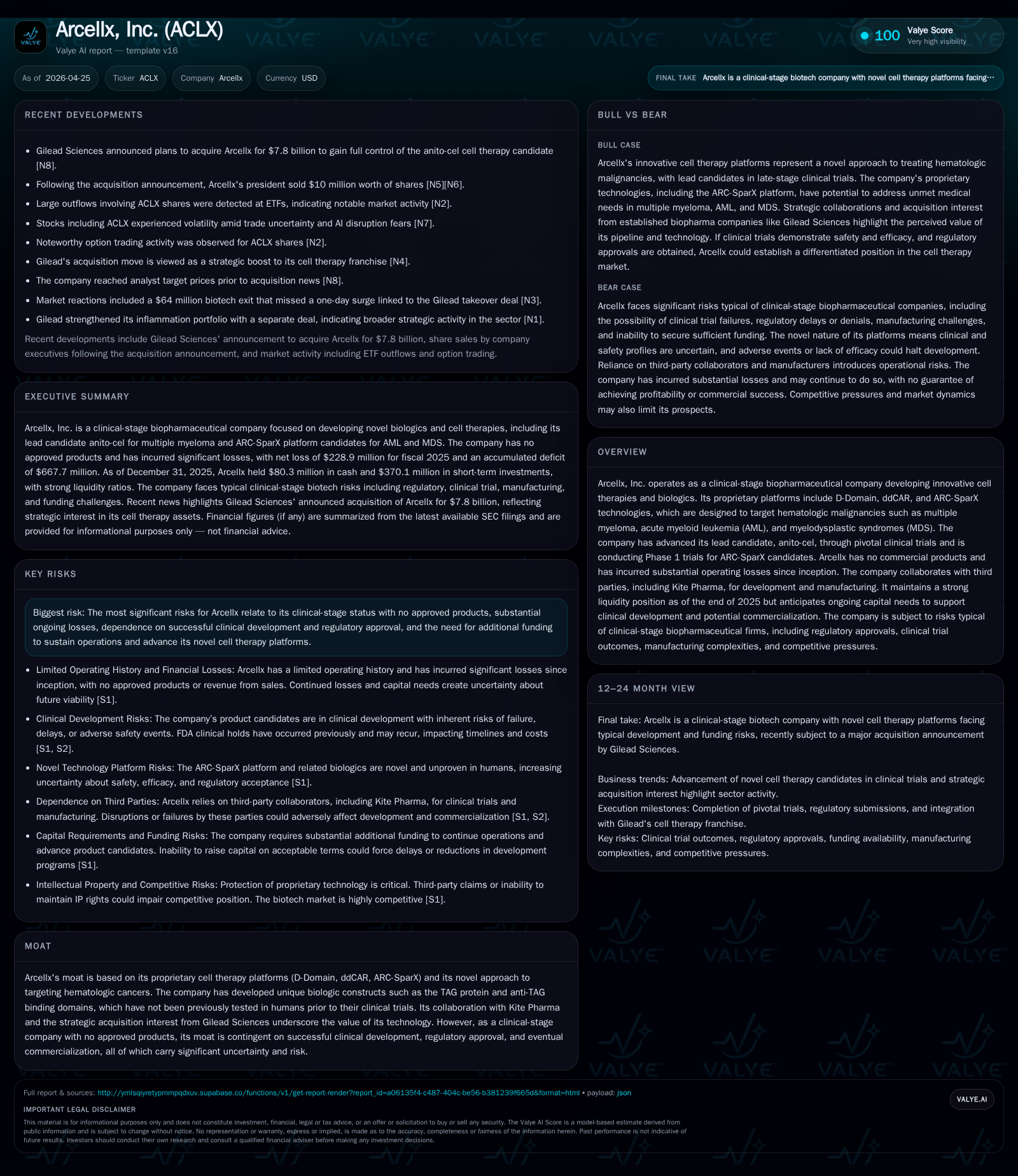
Arcellx, Inc. recently announced the FDA’s acceptance of the Biologics License Application (BLA) for its lead candidate anito-cel, a BCMA-targeting ddCAR therapy for relapsed or refractory multiple myeloma. This regulatory milestone coincides with Arcellx entering into a definitive merger agreement with Gilead Sciences, signaling strategic validation from a major industry player. The company’s proprietary cell therapy platforms—D-Domain, ddCAR, and ARC-SparX—position it distinctively within hematologic malignancy treatment, despite inherent clinical and regulatory risks. Financially, Arcellx maintains solid liquidity amidst rising operating losses, underpinning its near-term development and potential commercialization efforts.
Near-Term Operating Developments: FDA Acceptance and Merger Agreement
The most transformative recent development for Arcellx came with the U.S. Food and Drug Administration (FDA) acceptance of the Biologic License Application (BLA) for its lead product candidate anito-cel in February 2026 [S3]. Anito-cel is a BCMA-targeting ddCAR cell therapy designed to treat relapsed or refractory multiple myeloma—a patient population with significant unmet medical need due to limited durable therapy options. BLA acceptance is a critical regulatory milestone that ushers Arcellx closer to potential approval and commercialization.
Simultaneously, Arcellx entered into a definitive merger agreement with Gilead Sciences [S3], one of the largest global biopharmaceutical companies with extensive expertise in oncology and cell therapy through its Kite Pharma unit. This deal not only infuses Arcellx’s pathway toward commercial scale with strategic capital resources but also endorses the company’s proprietary technology platforms as clinically promising innovations deserving of integration within a broader industry franchise.
Together these two developments pivot Arcellx from purely clinical-stage risk toward becoming a commercial-stage enterprise contingent on regulatory approval success. The FDA’s acceptance can be interpreted as validation of not only anito-cel but also the underlying ddCAR platform technology and bioengineering constructs unique to Arcellx.
Business Model and Innovative Platform Technologies
Arcellx operates as a fully clinical-stage biotechnology developer whose business model currently centers on early- to late-stage investigational therapies without any products on market or revenue from sales [S1]. Its core value generation lies in proprietary cell therapy platforms:
- D-Domain: A modular protein engineering platform enabling novel biologic constructs such as TAG proteins—molecular adapters facilitating precise immune cell engagement.
- ddCAR (domain-drug chimeric antigen receptor): The basis of anito-cel that employs these TAG proteins for selective targeting of BCMA-expressing malignant plasma cells.
- ARC-SparX: An emerging platform advancing cell therapies against acute myeloid leukemia (AML) and myelodysplastic syndromes (MDS), currently in Phase 1 trials with multiple candidates [S1].
The company’s business strategy also involves collaborations—most notably manufacturing partnerships with Kite Pharma—which provide scalable production infrastructure as Arcellx advances toward commercialization [S1]. Early-stage scientific differentiation is derived from their unique anti-TAG binding domains which are untested prior to clinical trials but show potential for improved targeting precision and safety.
Given no approved products exist yet, present business activities focus almost exclusively on research and development expenditure aimed at reaching key regulatory approval inflections where licensing and eventual product sales can commence revenue generation.
Competitive Positioning in Cell Therapy for Hematologic Malignancies
Arcellx occupies a specialized niche within the highly competitive field of CAR-T and cell therapies targeting hematologic cancers. Its lead asset anito-cel competes against other BCMA-directed CAR-T therapies such as Bristol Myers Squibb's Breyanzi and Johnson & Johnson’s Carvykti but distinguishes itself through its DD-CAR construct potentially offering differentiated efficacy or safety profiles [N3].
The partnership with Kite Pharma underpins supply chain reliability—a pivotal competitive factor given cell therapy manufacturing complexity involving autologous T-cell extraction, ex vivo modification, and reinfusion logistics. Such complexities create substantial switching costs once therapies are adopted clinically but also demand high upfront capital investment.
Gilead Sciences’ acquisition interest elevates Arcellx’s position by leveraging Gilead's commercialization know-how and distribution networks while affording financial support to navigate uncertain regulatory pathways.
However, as a clinical-stage player with highly novel biological mechanisms (TAG proteins), persistent risks remain including obtaining extensive approvals across jurisdictions amid evolving regulatory landscapes and managing pricing pressures influenced by healthcare policy reforms that may restrict drug costs or reimbursement [S6], [S16].
Clinical Pipeline and Growth Catalysts
Beyond anito-cel nearing potential approval, Arcellx’s pipeline spans several promising vectors:
- Anito-cel (ddCAR): Completed pivotal trials for relapsed/refractory multiple myeloma; results from ongoing studies will shape label expansion opportunities [S2], [S3].
- ARC-SparX candidates (ACLX-001, -002, -004): In Phase 1 evaluation targeting AML/MDS indications which represent additional substantial markets due to poor prognosis under existing therapies [S1].
Pipeline success hinges on timely clinical data readouts demonstrating favorable efficacy-to-safety balance alongside gaining breakthrough designations or accelerated pathways with regulators.
Lifecycle management strategies will likely incorporate combination regimens or alternate target antigens enabled by modular D-Domain engineering—potentially prolonging patent life and improving competitive stance.
Commercial launch timing remains uncertain pending FDA decisions post-BLA acceptance; however, positive advisory committee input could expedite entry into market versus more protracted paths typical among novel cellular immunotherapies.
Development and Regulatory Risks Tempering Growth Potential
Despite promising advancements, Arcellx faces substantial risks:
- Historical partial clinical hold incidents emphasize ongoing safety vigilance required for anito-cel due to potential serious adverse events associated with CAR-T therapies [S2]. Future holds would materially delay development timelines.
- The novelty of ddCAR/ARC-SparX platforms implies unproven commercial viability; uncertainty remains around scalability, consistency of manufacturing batches, and long-term patient outcomes [S4], [S6].
- Financing needs are significant given accelerating losses: operating loss widened nearly 84% year-over-year to $253 million in FY 2025 from $138 million in FY 2024 reflecting expanded trial activity without offsetting revenues [F1]. Failure to secure sufficient capital could force program delays or cutbacks.
- Regulatory environment volatility heightened by changes such as the June 2024 U.S. Supreme Court ruling limiting agency deference introduces uncertainty regarding the FDA’s interpretative authority on approval standards affecting all novel biologics including those from Arcellx [S9].
- Pricing pressures may intensify due to legislative initiatives aimed at drug cost containment including Medicare negotiation policies impacting future profitability prospects [S25].
Capital Structure, Liquidity, and Recent Financial Trends
Historical performance (annual)
|
| FY | Net ($mm) | CFO ($mm) | OpInc ($mm) | Capex ($mm) | Net YoY |
|---|---|---|---|---|---|
| 2025 | -229 | -210 | -253 | 2 | -113.3% |
| 2024 | -107 | -83 | -138 | 13 | -51.9% |
| 2023 | -71 | 208 | -90 | 21 | +62.5% |
| 2022 | -189 | -99 | -191 | 2 |
Source: SEC companyfacts cache [F1].
Capital returns and efficiency (annual)
|
| FY | FCF ($mm) | ROE% |
|---|---|---|
| 2025 | -213 | -56.9 |
| 2024 | -97 | -23.6 |
| 2023 | 186 | -14.6 |
| 2022 | -102 | -92.1 |
Source: SEC companyfacts cache [F1].
According to latest available data through December 31, 2025 ([F1]), Arcellx held approximately $80.3 million in cash and equivalents alongside current assets totaling $462 million versus current liabilities of $104 million yielding a strong current ratio near 4.44—indicative of solid near-term liquidity.
However, these resources must contend against heavy operational cash burn: FY2025 delivered operating losses escalating to $253 million from $138 million FY-over-FY alongside net losses deepening over 113% YoY to roughly $229 million. Operating cash flow was negative $210 million compared with prior inflows in earlier years signifying intensifying research investment outlays not yet balanced by incoming revenue streams [F1]. Capital expenditures declined sharply but remain moderate relative to operational spend indicating emphasis remains on research activities over fixed asset buildup.
Emerging synergy potential from the Gilead merger may alleviate funding pressure if transaction closes but until then careful liquidity management remains critical to support pivotal regulatory processes and late-stage trials without disruption.
|
| FY | Operating Income (USD) | Net Income (USD) | Cash & Equivalents (USD) | Current Ratio |
|---|---|---|---|---|
| 2025 | -253M | -229M | 80.3M | 4.44 |
| 2024 | -138M | -107M | N/A | N/A |
| 2023 | -90M | -71M | N/A | N/A |
What Investors Should Monitor Next
Key upcoming milestones warrant close attention:
- Receipt of FDA review outcomes following BLA acceptance including advisory committee feedback potentially shaping final approval timing or additional data requests.
- Trial results update on Phase 1 ARC-SparX candidates which could validate pipeline breadth beyond multiple myeloma indication enhancing growth optionality.
- Integration progress following Gilead merger completion including evidence of resource synergies accelerating scale-up capabilities.
- Ongoing monitoring of capital consumption rates versus post-merger financing inflows defining operational runway.
- Regulatory environment shifts particularly concerning biologics approval processes or healthcare pricing reforms that might impact commercialization economics.
- Safety profiles emerging during late-stage testing essential for market confidence amid precedent serious adverse event concerns inherent in CAR-T modalities.
This analysis synthesizes SEC filings up to April 24th, 2026 ([S1],[S2],[S3]) supplemented by company financial disclosures ([F1]) along with sector insight from related news coverage ([N2],[N3]). It does not constitute investment advice but aims to provide comprehensive context around Arcellx’s recent operating developments within the evolving cell therapy industry landscape.
Disclaimer: This is research-only, informational analysis and not investment advice. It may include AI-generated interpretation and general industry context. Always verify important details using primary sources.

Comments