
Las Vegas Sands Advances Marina Bay Sands Expansion While Managing Macao Concession Investments
Q1 2026 results reveal growth momentum from Singapore development amid ongoing Macao investments and steady capital structure.
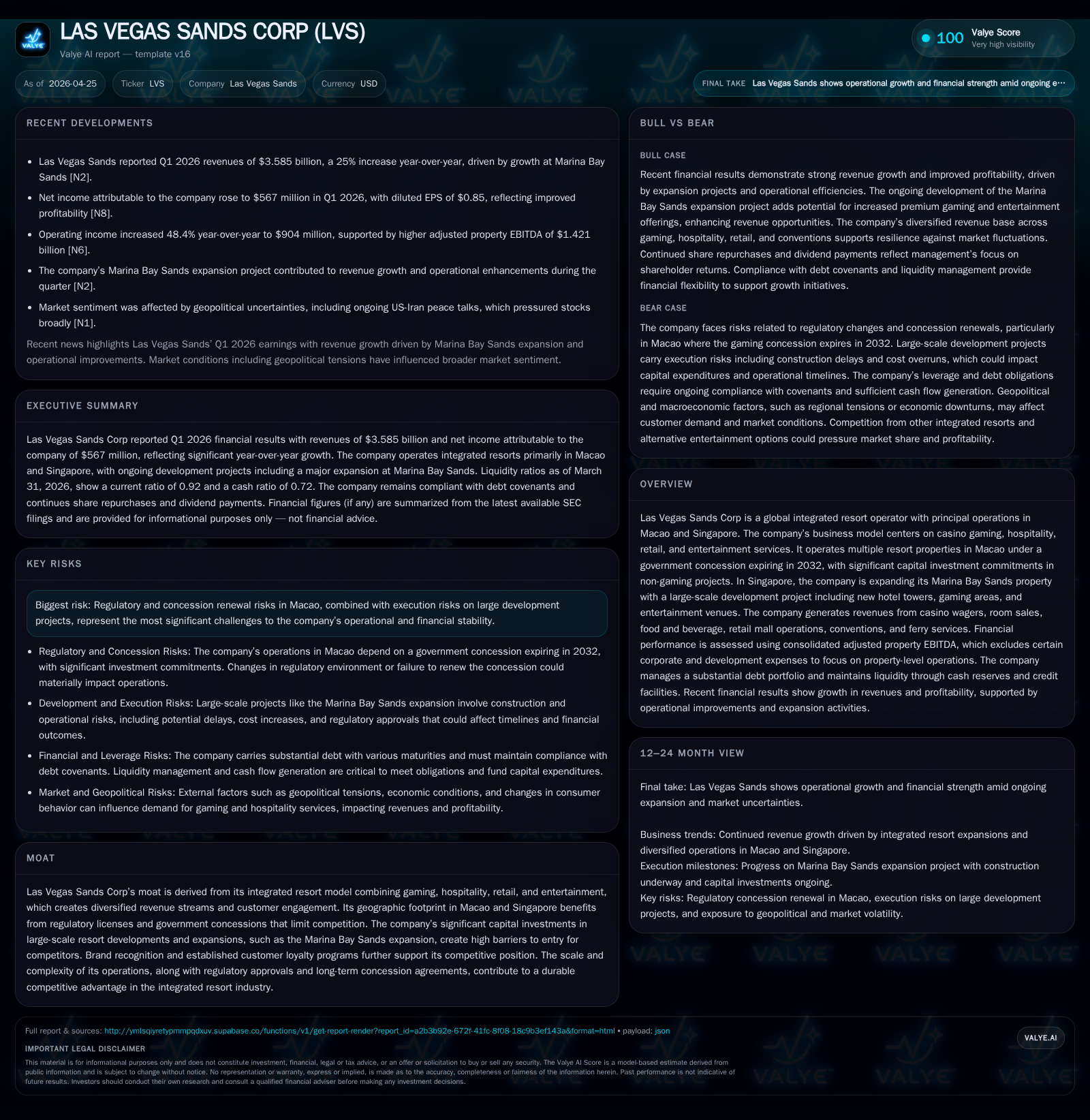
Las Vegas Sands Corp’s latest quarterly report highlights strong operational performance driven primarily by the expansion at its Marina Bay Sands (MBS) property in Singapore, alongside committed capital expenditures in Macao under a concession expiring in 2032. The company’s integrated resort model leverages diversified revenue streams including gaming, hospitality, retail, and entertainment, with regulatory concessions providing competitive insulation. Financially, LVS maintains substantial liquidity and manageable leverage with ongoing refinancing activities. Key risks remain regulatory uncertainty in Macao and execution complexity of large-scale developments. Upcoming milestones include progress on MBS expansion phases and Macao concession investment audits.
Recent Operating Update
Las Vegas Sands Corp's Q1 2026 filing ([S2] 10-Q) details operational segmentation emphasizing six major properties primarily divided between its core markets: Macao and Singapore. The Company's CEO acts as the Chief Operating Decision Maker (CODM), closely monitoring property-level performance given differing regional regulatory frameworks. The recent 8-K filed April 22, 2026 ([S3]) further affirms robust financial results for the quarter driven mainly by growth at Marina Bay Sands (MBS).
Profitability gains are tied to MBS's ongoing expansion—with additional hotel towers, gaming space, and entertainment venues—coinciding with higher minimum rents from mall operations reflecting renewed consumer activity [S7], [N1]. This momentum offsets structural pressure from constrained Macao gaming growth tied to limited government concession duration.
Business Model
LVS operates as a premier integrated resort operator combining casino gaming, hospitality services (rooms and food & beverage), retail mall management, conventions, and ferry operations into a single ecosystem. Revenues derive predominantly from casino wagers complemented by lodging sales and ancillary commercial ventures. This diversification creates stable volumetric flows insulating earnings against volatility in any standalone segment.
The company’s most substantial cash generation stems from property-level EBITDA focused metrics reported separately for each operating resort—Venetian Macao, Londoner Macao, Parisian Macao, Plaza Macao/Four Seasons Macao, Sands Macao in the SAR of Macao; plus the flagship Marina Bay Sands complex in Singapore [S2].
Significantly, LVS incurs massive capital investment commitments especially non-gaming related developments linked to maintaining long-term operating licenses under Macau’s government-issued concessions due in 2032 ([S19]). Concurrently, in Singapore the firm pursues an expansive strategy injecting nearly $8 billion into MBS’s infrastructure accretion ([S10]).
Industry Structure and Competitive Position
LVS's moat is anchored by regulatory licensing that caps operators within its geographic footprints—reducing competitive fragmentation while elevating entry barriers due to licensing costs and governmental approvals (). Additionally, integrated resorts reduce customer churn with wide-ranging amenities fostering loyalty beyond pure gambling.
Brand cachet combined with longstanding key relationships allocates LVS preferential treatment in license renewals (though these remain subject to official discretion). Legal challenges involving past concession bids have concluded favorably for LVS but underscore ongoing exposure inherent within Macau's volatile regulatory climate ([S17], [S20]).
Singapore offers a less politicized operating environment with broadly supportive government policies facilitating LVS’s sizeable expansions offering competitive scale advantages relative to smaller regional operators.
Growth Drivers and Constraints
Drivers:
- MBS Expansion: The flagship Singapore project’s phased development adds inventory across gaming tables/slots, hotel rooms, retail space, and entertainment offerings projected over several years ([S10]). This represents the foremost near-to-medium-term revenue driver.
- Macao Non-Gaming Investment Mandate: Capital deployment into mandated infrastructure upgrades under concession contracts supports license continuance while enhancing resort desirability ([S19]).
- Diversified Revenue Streams: Growth in non-gaming services such as conventions and retail malls provide stable income buffers against cyclical casino wagering fluctuations.
- Share Repurchase Programs: Active buyback initiatives may improve per-share economics supporting investor returns during free cash flow generation phases ([S8]).
Constraints:
- Concession Expiration & Regulatory Uncertainty: The approach toward 2032 Macau license renewal entails political risk potentially restricting long-term planning or requiring accelerated investment cycles (, [S20]).
- Execution Risk: Large-scale construction projects like the MBS expansion carry timing risks alongside cost overruns which could compress margins or delay benefit recognition ().
- Debt Service Obligations: Substantial leverage totaling approximately $15.7 billion gross as of March 31, 2026, requires steady cash flows; the company maintains about $3.33 billion in cash and equivalents and $1.5 billion of available borrowing capacity under its revolving credit facilities after accounting for outstanding letters of credit ([F1], [S2]). Recently executed refinancings include a HKD 6.2 billion draw under SCL revolving facilities used primarily to extinguish maturing senior notes due January 2026 ([S2]).
- Macau Market Cyclicality: Gaming volumes can be sensitive to regional economic fluctuations alongside travel restrictions potentially reducing tourist influx.
What to Watch Next
- Audit Confirmation on Macau Investments: Official reviews of qualifying spending against concession commitments could influence future capital requirements ([S19]).
- Phased Completion Updates on MBS Development: Milestones reached on adding new hotel towers or expanded gaming floors will directly impact incremental earnings capacity ([S10]).
- Regulatory Signals from Macau Government: Early discussions or statements regarding potential concession renewals or changes will materially affect LVS strategic orientation.
- Capital Structure Moves: Monitoring drawdowns under revolving facilities or debt maturities is critical given upcoming amortization schedules ([S2]).
- Consumer Demand Metrics: Attendance rates at resorts along with convention bookings will serve as demand proxies forecasting near-term revenues.
Financial Profile
Historical performance (annual)
|
| FY | Rev ($bn) | Net ($mm) | OpInc ($mm) | Capex ($mm) | Rev YoY | Net YoY |
|---|---|---|---|---|---|---|
| 2025 | 3.6 | 395 | 707 | 1168 | +26.0% | +21.9% |
| 2024 | 2.9 | 324 | 590 | 1567 | -0.7% | -15.2% |
| 2023 | 2.9 | 382 | 710 | 1017 | +161.0% | +326.0% |
| 2022 | 1.1 | -169 | -166 | 651 |
Source: SEC companyfacts cache [F1].
Capital returns and efficiency (annual)
|
| FY | Div ($mm) | Buybacks ($bn) | ROE% |
|---|---|---|---|
| 2025 | 833 | 2.2 | 24.8 |
| 2024 | 590 | 1.8 | 11.2 |
| 2023 | 305 | 0.5 | 9.3 |
| 2022 | 0 | -4.4 |
Source: SEC companyfacts cache [F1].
As of March 31, 2026, LVS reported $3.33 billion in cash and equivalents against total debt approximating $15.7 billion gross ([F1]). Net debt is near $12.4 billion reflecting liquidity juxtaposed with significant leverage mandates. The company maintains roughly $1.5 billion available borrowing capacity under its revolving credit facilities after accounting for outstanding letters of credit ([S2]). Recently executed refinancings include a HKD 6.2 billion draw under SCL revolving facilities used primarily to extinguish maturing senior notes due January 2026 ([S2]).
Operating cash flows have been robust historically with FY 2025 showing approximately $3 billion generation against capex around $1.17 billion resulting in solid free cash flow availability ([F1]). Share repurchases remain substantial as evidenced by the $746 million deployed in Q1 alone with an authorization balance of $817 million remaining—reflecting pro-shareholder capital allocation discipline during growth execution phases ([S8]).
Historical Annual Performance Snapshot
|
| FY | Revenue ($B) | Op Inc ($M) | Net Income ($M) | CFO ($B) | Capex ($B) | Dividends ($M) | Buybacks ($M) | Rev YoY % | Op Inc YoY % |
|---|---|---|---|---|---|---|---|---|---|
| 2025 | 3.65 | 707 | 395 | 3.02 | 1.17 | 833 | 2217 | 26% | 19.8% |
| 2024 | 2.90 | 590 | 324 | -- | 1.57 | 590 | 1750 | -- | -- |
The company showed strong top-line expansion driven largely by recovering demand volumes post-pandemic coupled with strategic asset improvements.
Conclusion
Las Vegas Sands Corp continues executing its long-standing integrated resort model anchored by two geopolitical hubs—Singapore’s Marina Bay Sands expansion leading near-term growth coupled with mandated sizeable investment commitments maintaining its entrenched position in Macau's regulated gaming landscape. While substantial regulatory risks associated with expiring concessions persist alongside execution risk from large development projects, the group preserves strong liquidity metrics supporting these initiatives.
Investors should monitor progress on high-capital projects alongside Macau government signals regarding future licensing as critical determinants shaping LVS’s strategic trajectory through this decade-long horizon.
This analysis is based solely on disclosed SEC filings and publicly available information as of April 25, 2026.
Disclaimer: This is research-only, informational analysis and not investment advice. It may include AI-generated interpretation and general industry context. Always verify important details using primary sources.

Comments