
Xenetic Biosciences Advances Proprietary Platforms Amid Strategic Collaborations
Recent leadership equity awards and ongoing partnerships underpin Xenetic’s development in biotechnology platforms.
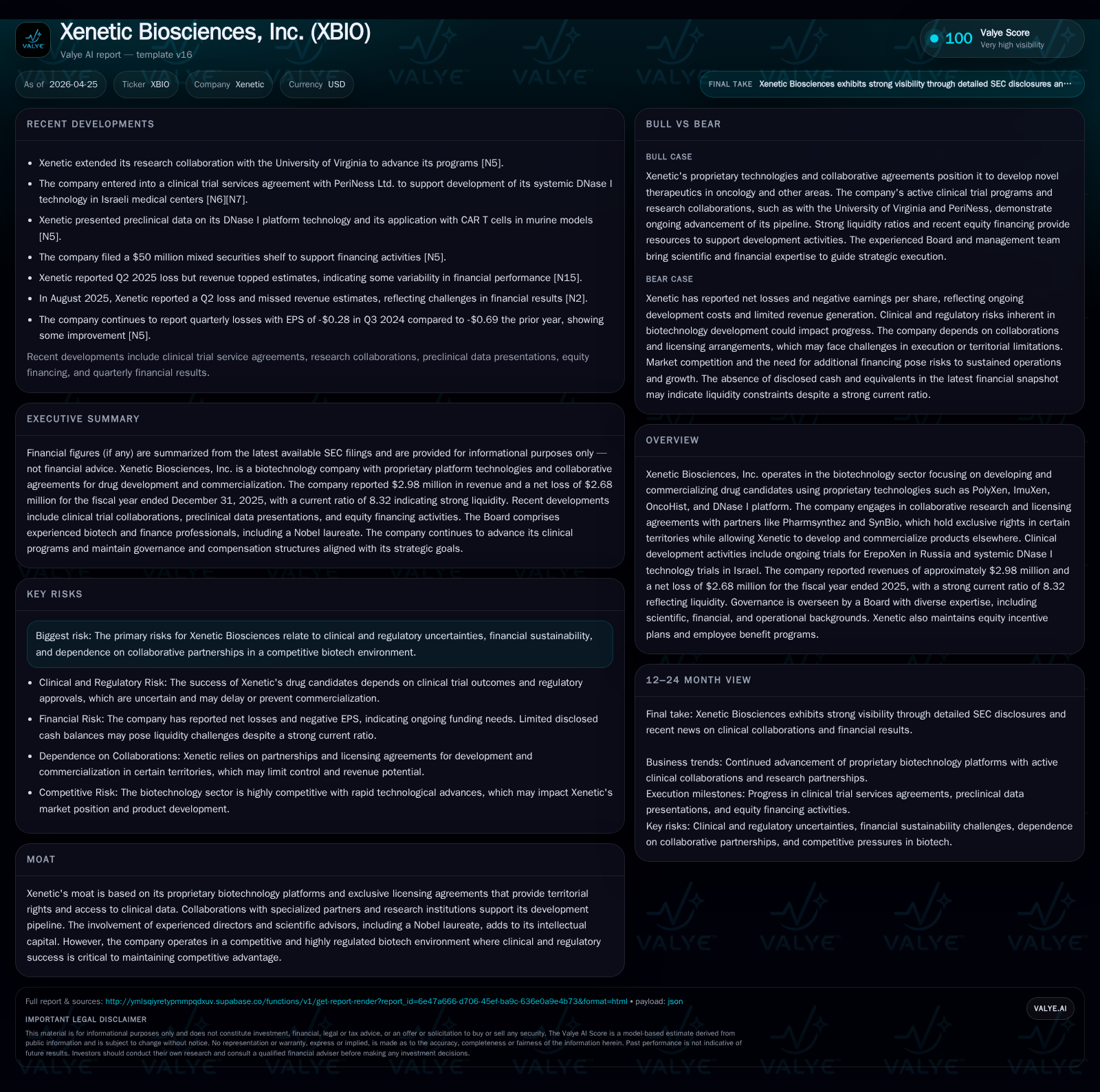
Xenetic Biosciences’ latest 8-K filing in April 2026 reveals significant equity incentives awarded to its interim CEO, signaling strengthened leadership focus. The company’s proprietary platforms—PolyXen, ImuXen, OncoHist, and DNase I—are supported through collaboration agreements granting exclusive territorial rights to partners like Pharmsynthez and SynBio. These partnerships both mitigate financial burdens and introduce dependencies critical to clinical development and commercialization efforts. Xenetic’s clinical pipeline includes advanced trials in anemia treatments and oncology, yet risks remain due to regulatory uncertainties and sustained net losses. The company maintains solid liquidity with a current ratio of 8.32 and continues refining its governance structure to align incentives.
Latest Operating Update: April 2026 Event Filing Highlights
The most immediate development at Xenetic Biosciences emerged from the April 21, 2026 Form 8-K [S3], where the Compensation Committee granted Interim CEO James Parslow a restricted stock award totaling 100,000 shares. Notably, an upfront vesting of 7,000 shares was coupled with annual vesting over the subsequent three years. This equity incentive indicates a strategic effort to solidify executive commitment during a pivotal stage of advancement amidst ongoing clinical initiatives. The filing clarifies that the grant is governed by the company's Amended and Restated Equity Incentive Plan.
Complementing this leadership alignment, broader governance arrangements confirm separation of the Board Chair (held by Dmitry Genkin) from the CEO role (held by Parslow), emphasizing differentiated accountabilities for oversight versus daily operational leadership [S1][S23]. These structural refinements provide context for coordinated decision-making as Xenetic maneuvers through evolving partnership negotiations and developmental milestones.
Xenetic’s Business Model and Proprietary Platform Technologies
Xenetic Biosciences operates at the confluence of cutting-edge biotechnology innovation and collaborative commercialization strategies [S1]. Its business model centers on leveraging proprietary platforms:
- PolyXen technology: A proprietary polymer conjugation platform designed to improve pharmacokinetics of biologics.
- ImuXen: An immuno-oncology drug delivery technology.
- OncoHist: Targeted oncology therapy platform.
- DNase I platform: Employs systemic DNase I enzymes aimed at modulating tumor microenvironment for therapeutic effect.
These technologies underpin several drug candidates that are either under clinical investigation or licensed out. Revenue mechanisms include direct development efforts combined with royalties stemming from exclusive licensing agreements covering specific geographies such as Russia, CIS countries, and parts controlled by partners like Pharmsynthez [S1].
Xenetic retains rights outside partner territories, allowing it to simultaneously pursue commercialization elsewhere at its own expense—a hybrid approach blending risk-sharing with control retention.
Collaborative Licensing Structure Supporting Market Access
Central to Xenetic's operational strategy are its licensing agreements with Pharmsynthez and SynBio [S1][S14]. Pharmsynthez holds exclusive rights to develop, commercialize, and market six products based on PolyXen/ImuXen technology within designated regions. SynBio originally held similar exclusivities in Russia and CIS but assigned the Co-Development Agreement to Pharmsynthez in late 2021 [S14][S16].
These partners fund their own research activities independently; Xenetic does not pay milestone payments but receives royalties post-commercialization—an arrangement that supports revenue predictability while scaling externalized R&D investment burden. However, this dependency links Xenetic’s commercial success tightly to partner execution efficiency.
Additionally, Xenetic entered into a clinical trial services agreement with Peri-Ness Technologies Ltd., an Israeli entity linked via board members to certain directors [S16], advancing DNase I systemic trials locally—further illustrating reliance on collaborative networks for pipeline expansion.
Competitive Environment in Biotechnology Platforms
Within the competitive biotech landscape, xenetic confronts challenges endemic to drug development: rigorous regulatory frameworks require demonstration of safety and efficacy through multi-phase clinical trials; successful navigation demands significant capital allocation and expert scientific management.
Xenetic's defensive moat is structured around its unique intellectual property portfolio safeguarding multiple platforms alongside licensing exclusivities established by geographical territories [S14]. The company's strategic advantage benefits from strong scientific advisory presence—including involvement of distinguished scientists such as Nobel laureates—which aids credibility in validating complex molecular therapies.
Despite substantial IP protection, pricing power is moderated by competition in specialty biologics markets where therapeutic equivalency claims arise frequently; moreover, adoption cycles depend heavily on regulatory approvals and payer acceptance dynamics.
Growth Catalysts and Clinical Development Trajectory
Clinical progression remains Xenetic's primary growth vector. Notably:
- ErepoXen (Epolong): Utilizing PolyXen technology targeting anemia among chronic kidney disease patients; conducted Phase II(b)/III human trials in Russia through Pharmsynthez with patient recruitment completed in 2020 [S14][S16]. Despite receipt of initial positive data reported in late 2020, Pharmsynthez encountered regulatory dossier deficiencies requiring mitigation strategies presently underway.
- DNase I Systemic Oncology Technology: Progressed via collaborations in Israeli medical centers supported by Peri-Ness under clinical services agreement signed late 2024 [S16].
Successful clinical readouts or regulatory approvals could catalyze new product launches opening revenue streams from royalties alongside probable milestone opportunities intrinsic to partnering agreements.
However, timeline variability typical in biotech pipeline maturation introduces execution risk; regulatory feedback loops can delay approvals potentially compressing near-term commercialization expectations.
Potential Risks and Constraints in Regulatory Landscape
The overriding risks for Xenetic revolve around uncertainties characteristic of early-stage biotechnology firms [S4][S7]:
- Unpredictable outcomes from ongoing clinical trials may impede program advancement or necessitate costly additional studies.
- Regulatory authority responses—such as those received for ErepoXen’s Russian dossier—can create delays impacting expected revenue timelines.
- Financial sustainability remains challenged by operating losses ($2.83 million loss FY2025) despite improving top-line trends; continued capital consumption underscores ongoing need for funding raising or partnership expansions.
- Heavy reliance on external partners introduces concentration risk; setbacks or altered partner priorities could disrupt research continuity or commercialization campaigns.
These factors collectively demand ongoing management vigilance amid competitive pressures from larger pharmaceutical companies advancing parallel modal therapies.
Upcoming Milestones and Key Execution Focus Areas
Attention should center on upcoming developments including:
- Regulatory dialogue updates on ErepoXen marketing approval status within Russian Federation leveraging completed Phase III study data [S16].
- Clinical trial progress for DNase I systemic programs in Israel reflecting safety/efficacy endpoints testing per protocol timelines.
- Potential new licensing deals or amendments impacting territorial rights or royalty structures announced via SEC disclosures or press releases.
- Monitoring management execution of incentive plans awarded in April 2026 aimed at aligning leadership towards delivery targets [S3][S24].
Effective navigation through these execution junctures will be instrumental in validating strategic plan assumptions outlined by the Board.
Financial Profile: Liquidity, Capital Structure, and Performance Overview
Historical performance (annual)
|
| FY | Rev ($mm) | Net ($mm) | CFO ($mm) | OpInc ($mm) | Rev YoY | Net YoY |
|---|---|---|---|---|---|---|
| 2025 | 3 | -3 | -2 | -3 | +19.0% | +32.3% |
| 2024 | 3 | -4 | -3 | -4 | -1.6% | +4.2% |
| 2023 | 3 | -4 | -4 | -5 | +48.8% | +36.9% |
| 2022 | 2 | -7 | -5 | -7 |
Source: SEC companyfacts cache [F1].
Capital returns and efficiency (annual)
|
| FY | ROE% |
|---|---|
| 2025 | -36.2 |
| 2024 | -65.9 |
| 2023 | -42.2 |
| 2022 | -48.0 |
Source: SEC companyfacts cache [F1].
According to latest fiscal year results ended December 31, 2025 ([F1]), Xenetic Biosciences reported:
- Revenue of approximately $2.98 million—a year-over-year increase of about 19% compared to FY2024 ($2.50 million).
- Operating losses narrowed significantly to around $2.83 million from $4.20 million year prior (~32.6% improvement), reflecting cost control or operational efficiencies.
- Net income loss also improved by ~32%, posting a net loss near $2.68 million indicating a trajectory toward reduced cash burn levels.
- Operating cash flow was negative roughly $2.29 million but showed an improvement versus prior years’ trend; capex was negligible.
- Total debt was approximately $586 thousand as per best available metric dating from August 2016, suggesting limited leverage burden relative to asset base.
- Current assets ($8.05 million) far exceed current liabilities (~$968 thousand), yielding a robust current ratio of approximately 8.32 supporting short-term liquidity adequacy.
- Equity stood at $7.40 million providing capitalization buffer despite accumulated losses; return on equity calculated negatively at approximately -36% given net losses yet showing improvement versus prior periods [F1].
Execution discipline around capital allocation will remain critical going forward as pipeline maturation demands intensify.
|
| FY | Revenue ($M) | Op Income ($M) | Net Income ($M) | Current Ratio | Total Debt ($K) |
|---|---|---|---|---|---|
| 2025 | 2.98 | -2.83 | -2.68 | 8.32 | ~586 |
| 2024 | 2.50 | -4.20 | -3.96 | - | - |
Disclaimer
This analysis is based exclusively on publicly available documents specified herein including SEC filings through April 24, 2026 ([S1], [S2], [S3]) and companyfacts data ([F1]). It aims to provide an informed industry perspective without investment recommendations or price guidance.
Disclaimer: This is research-only, informational analysis and not investment advice. It may include AI-generated interpretation and general industry context. Always verify important details using primary sources.

Comments