
First Business Financial Services Charts Steady Growth Amid Regional Market Reliance
FBIZ leverages SBA Preferred Lender status and a commercial real estate-heavy loan portfolio to sustain growth within its concentrated Midwestern footprint.
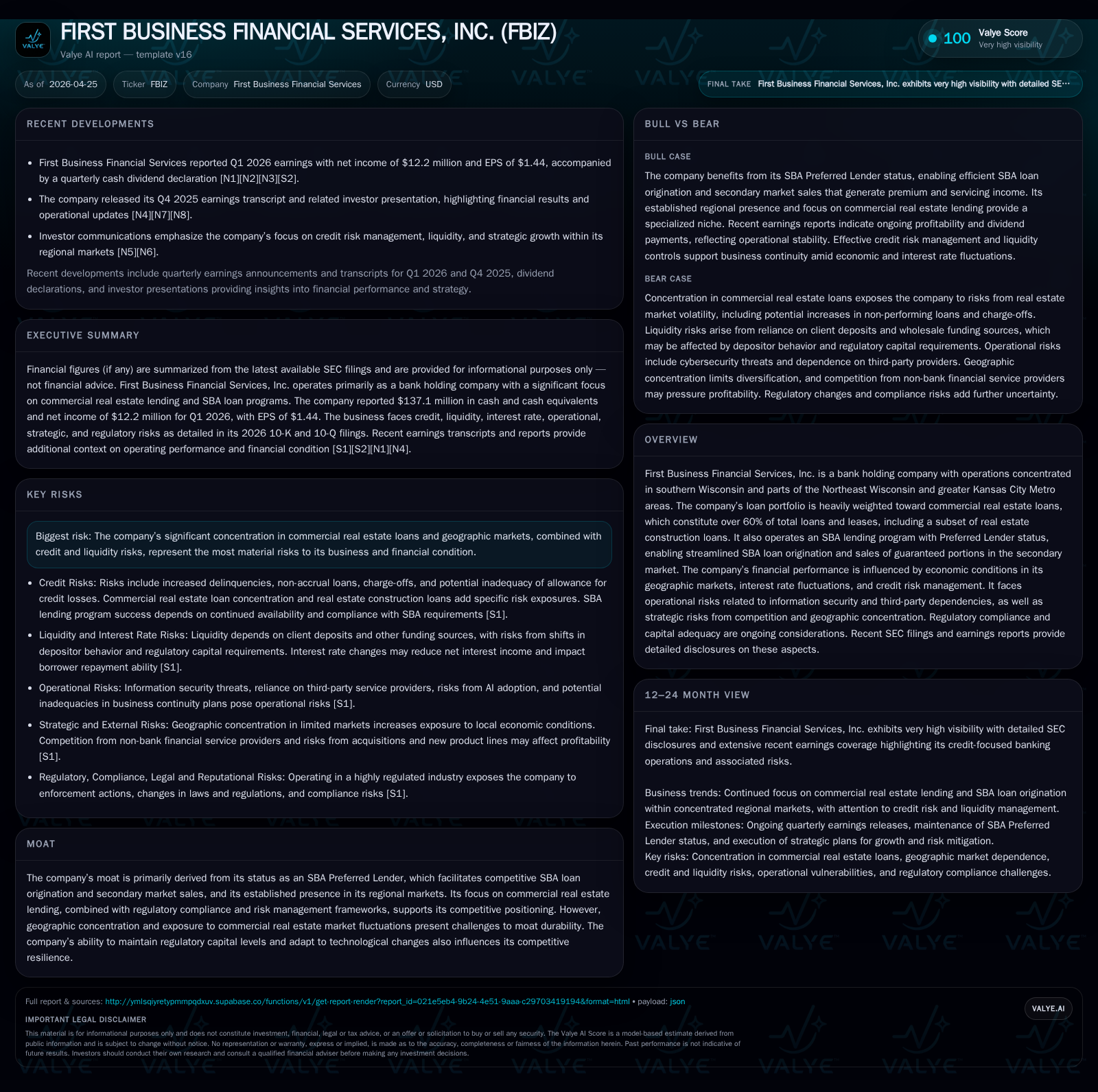
In its latest quarterly report, First Business Financial Services, Inc. (FBIZ) posted steady operating performance driven by disciplined credit management amid a largely regional commercial real estate (CRE) lending focus. The company’s SBA Preferred Lender status remains a strategic asset, supporting fee income and portfolio diversification through guaranteed secondary market loan sales. Geographic concentration in southern Wisconsin and parts of Kansas City exposes FBIZ to regional economic cycles and CRE market fluctuations. Near-term growth hinges on balancing credit risk in construction loans, sustaining deposit funding stability, and navigating regulatory compliance pressures. A strong liquidity position, modest leverage, and stable profitability underpin its capacity to execute despite competitive and operational challenges.
Latest Quarterly Operating Update and What It Means Now
The April 24, 2026, Form 10-Q filing [S2] provides a clear picture of First Business Financial Services’ (FBIZ) operating status entering the year. The company reported continued loan portfolio growth driven primarily by commercial real estate (CRE) loans constituting more than 60% of total loans and leases. Notably, real estate construction loans represent a significant subset within this category—a segment known for elevated risk due to reliance on project completion values which remain inherently uncertain until finalization [S1], [S13].
Credit quality metrics showed mixed but generally stable signals with non-accrual loans at $43.9 million (approximately 1.30% of gross loans as of December 31, 2025) remaining consistent with prior periods [S15]. Provision for credit losses was adjusted upward in Q1 relative to prior quarters reflecting cautious underwriting during regional market uncertainties [N1], [N3]. Deposit bases remained solid without significant turmoil despite broader sector deposit outflow risks highlighted since the banking failures in early 2023—FBIZ reported no notable withdrawal spikes during those periods [S20]. The company declared quarterly dividends on both common stock and preferred shares in the recent event filing dated April 23, 2026 [S3], signaling confidence in capital adequacy.
Interest income benefited from incremental loan growth but faced pressure on net interest margin (NIM) from changing interest rate curves—a common dynamic for regional banks with concentrated loan books that have limited scope for rapid repricing [N2]. Management commentary underscored disciplined balance sheet management centered on preserving liquidity during industry-wide margin compression concerns.
Overall, this quarter reaffirms FBIZ’s measured approach balancing growth opportunities against rising credit vigilance influenced by evolving CRE market conditions in its core geographies.
Business Model and Product Offering Quality: Commercial Real Estate Focus and SBA Lending Program
FBIZ operates largely as a traditional bank holding company focused regionally in southern Wisconsin along with Northeast Wisconsin and parts of the Kansas City Metropolitan area, [S16]. Its revenue primarily derives from interest income on loans coupled with fee income predominantly generated through its small business administration (SBA) lending activities—where it holds Preferred Lender status under SBA programs [S1].
The loan portfolio's heavy tilt (>60%) toward commercial real estate ties FBIZ’s fortunes closely to the local property markets' health—a double-edged sword providing strong client relationships but also amplifying exposure to CRE cyclicality [S13]. Construction loans within CRE require keen risk assessment given uncertainties around cost overruns or market value shifts before project completion. These factors elevate the need for stringent underwriting standards and active portfolio monitoring.
FBIZ’s SBA borrowing program is a cornerstone differentiator enhancing its competitive moat. As a Preferred Lender, FBIZ enjoys streamlined SBA loan approval processes enabling quicker origination turnarounds—critical for small business clients seeking timely financing solutions. Furthermore, the ability to sell guaranteed portions of SBA loans into secondary markets reduces post-origination credit exposure while generating fee revenue streams that complement interest earnings [S15]. However, these benefits are contingent on maintaining compliance with evolving SBA program requirements; any regulatory changes or loss of preferred status would materially impair this strategic advantage.
From an operational standpoint, increased emphasis on digital adoption including artificial intelligence tools is underway yet brings attendant risks around error rates, fairness concerns, and fraud vulnerability that the company acknowledges requires ongoing controls enhancement [S21]. Overall integrity of risk frameworks across CRE lending and SBA segments is vital to preserving earnings quality given inherent credit loss potential.
Competitive Environment and Industry Structure in Regional Banking
FBIZ faces competition primarily from local community banks alongside regional lenders sharing overlapping service footprints across Wisconsin and Missouri’s Kansas City metro region [S17]. These competitors range from well-capitalized traditional banks with broader geographic reach to tax-exempt credit unions aggressively pricing deposits—a factor compressing FBIZ’s margins on liability costs.
Fintech players pose increasing competitive pressure as well by offering cost-efficient digital lending platforms gaining traction particularly among smaller borrowers accustomed to self-service convenience outside conventional banking channels [S17]. This shift challenges FBIZ’s ability to attract tech-savvy clientele without heavy investment in technology upgrades—a barrier where scale economies favor larger institutions.
Funding structures underscore deposit competition intensity; FBIZ relies heavily on client deposits supplemented by brokered deposits subject to regulatory constraints tied to capital adequacy levels [S5],[S6]. The bank must maintain “well capitalized” status per Federal Reserve rules to retain access to low-cost brokered deposits which are otherwise restricted—failure here would increase funding costs markedly.
Geographic concentration limits diversification benefits compared to national banks while exposing FBIZ more acutely to localized economic downturns affecting residential/commercial construction and business cash flow cycles that feed demand for loans, [S16]. Regulation also shapes competitive positioning through capital requirements influencing balance sheet capacity growth rates relative to peers.
The interplay of these factors indicates pricing power that is somewhat constrained though partially offset by entrenched local relationships driven by reputation in niche SBA lending markets.
Growth Catalysts and Operational Constraints for FBIZ
Future growth trajectories hinge critically on several fronts. Sustaining Preferred Lender status within the SBA framework enables sustained origination volume growth complemented by fee income diversification which otherwise remains limited by regional reliance on CRE loan demand [S15],. Selective product innovation—particularly within specialty finance or SBA-related offerings—could unlock incremental fee streams if managed prudently alongside expanded risk controls [S19].
Constraints are palpable: regulatory capital mandates potentially curtail balance sheet expansion especially if non-performing assets rise requiring higher allowance coverage impacting earnings capacity [S13],[S19]. Rising interest rates historically squeeze NIM while also increasing borrower repayment stress particularly among speculative construction projects—heightening provisions for credit losses materially impacting net income metrics.
Operationally, escalating cybersecurity threats combined with third-party vendor dependence represent growing vulnerabilities necessitating substantial ongoing investments in IT infrastructure security controls and vendor risk audits [S23],[S28]. The increasing use of AI-powered decision modules amplifies exposure to errors or regulatory scrutiny over fairness issues requiring sophisticated governance mechanisms.
These dynamics underscore the importance of execution discipline coupled with proactive risk management. Potential expansions beyond current geographic confines remain speculative but offer a medium-term avenue toward reducing concentration risk if feasible acquisition targets or branch openings materialize without dilutive effects.
Near-Term Milestones and Key Performance Indicators to Monitor
Investors and stakeholders should monitor several critical indicators emerging from ongoing disclosures:
- Non-performing loan (NPL) ratios especially within CRE construction portfolios serving as an early barometer of credit stress emerging from local real estate markets [S2], [N3].
- Trends in provision for loan losses reported quarterly which reflect management’s evolving outlook on credit environment stability or deterioration [S2], [N2].
- Updates regarding maintenance or loss of SBA Preferred Lender designation directly impacting loan pipeline velocity and secondary market sales activities.
- Regulatory examination results spread intermittently across banking agencies gauging compliance efficacy especially AML/CFT adherence plus IT security safeguards following intensified supervisory focus post-2023 sector disruptions [S4],[S19],[N1].
- Net interest margin (NIM) trajectories influenced by balancing deposit costs against asset yields amid fluctuating interest rate environments.
- Dividend declarations linked closely with capital adequacy reviews signaling management’s confidence in buffer sufficiency versus earnings retention trade-offs [S3],[N5].
- Local housing starts/investment activity statistics within Wisconsin/Kansas City regions providing macroeconomic context relevant to underlying CRE exposures.
Overall execution against these performance markers will shape investor perceptions regarding FBIZ’s resilience and adaptability moving forward.
Current Financial Profile: Capital, Liquidity, Profitability, and Risk Metrics
Historical performance (annual)
|
| FY | Net ($mm) | CFO ($mm) | Capex ($) | Net YoY |
|---|---|---|---|---|
| 2025 | 13 | 62 | 595000 | -7.5% |
| 2024 | 14 | 57 | 223000 | |
| 2022 | 10 | 39 | +4.0% | |
| 2021 | 10 | 52 |
Source: SEC companyfacts cache [F1].
Capital returns and efficiency (annual)
|
| FY | Div ($mm) | Buybacks ($mm) | FCF ($mm) |
|---|---|---|---|
| 2025 | 10 | 1 | 61 |
| 2024 | 8 | 1 | 57 |
| 2022 | 7 | 6 | |
| 2021 | 8 | 3 |
Source: SEC companyfacts cache [F1].
First Business Financial Services maintains a robust liquidity position highlighted by cash & equivalents totaling approximately $137.1 million as of March 31, 2026 ([F1]). This ample cash buffer supports operational flexibility amid funding volatility risks documented across sector peers following recent banking upheavals.[S2],[F1]
Debt levels remain modest relative to balance sheet size—with best-effort total debt estimates significantly below cash balances resulting in a net leverage position reflecting financial conservatism ([F1]). This structural liquidity advantage allows FBIZ access mostly dependent on core deposits supplemented cautiously by brokered deposits under regulatory oversight demanding well-capitalized status maintenance ([S5],[S6]).
Profitability registered a net income of $13.3 million for FY2025 representing a decrease of approximately 7.5% year-over-year driven mainly by increased provisioning for credit losses particularly tied to cautious underwriting in CRE construction segments ([F1]). Return on equity stands around 3.6%, reflecting margin pressures faced by regional institutions amidst rising funding costs ([F1]). Operating cash flow remains healthy at roughly $61.7 million FY2025 enabling ongoing investment into infrastructure while capital expenditures remain minimal (~$0.6 million annually) supporting steadiness rather than aggressive expansion ([F1]).
Dividend payouts increased moderately aligned with earnings trends showing prudent shareholder return policy balanced against capital conservation needs ([F1]). Buybacks remained limited indicative of cautious capital allocation reflecting prevailing regulatory environment sensitivities ([F1]).
Credit risk reserves were enhanced during recent quarters consistent with underlying portfolio mix emphasizing commercial real estate risks combined with operational diligence required due to uncertainties embedded in multi-state geographic coverage ([S2],[F1],). Overall financial metrics affirm solid foundational strength albeit accompanied by earned caution respecting cyclical headwinds endemic in core industries served.
This analysis leverages the latest SEC filings alongside current financial data points without extrapolating beyond available evidence. It underscores the importance of continued vigilance over credit risk dynamics within commercial real estate concentrations juxtaposed with the strategic value derived from SBA Preferred Lender status supporting sustainable revenue streams within a competitive Midwestern regional banking environment.
Disclaimer: This report is provided solely for informational purposes reflecting data as of April 2026 without offering any investment advice or recommendations regarding securities issued by First Business Financial Services, Inc.
Disclaimer: This is research-only, informational analysis and not investment advice. It may include AI-generated interpretation and general industry context. Always verify important details using primary sources.

Comments