
SkyWest Strengthens Revenue Amid Capacity Growth and Pilot Availability Improvements
Q1 2026 results reflect operational scale and contract stability, while pilot supply and fleet growth shape near-term outlook.
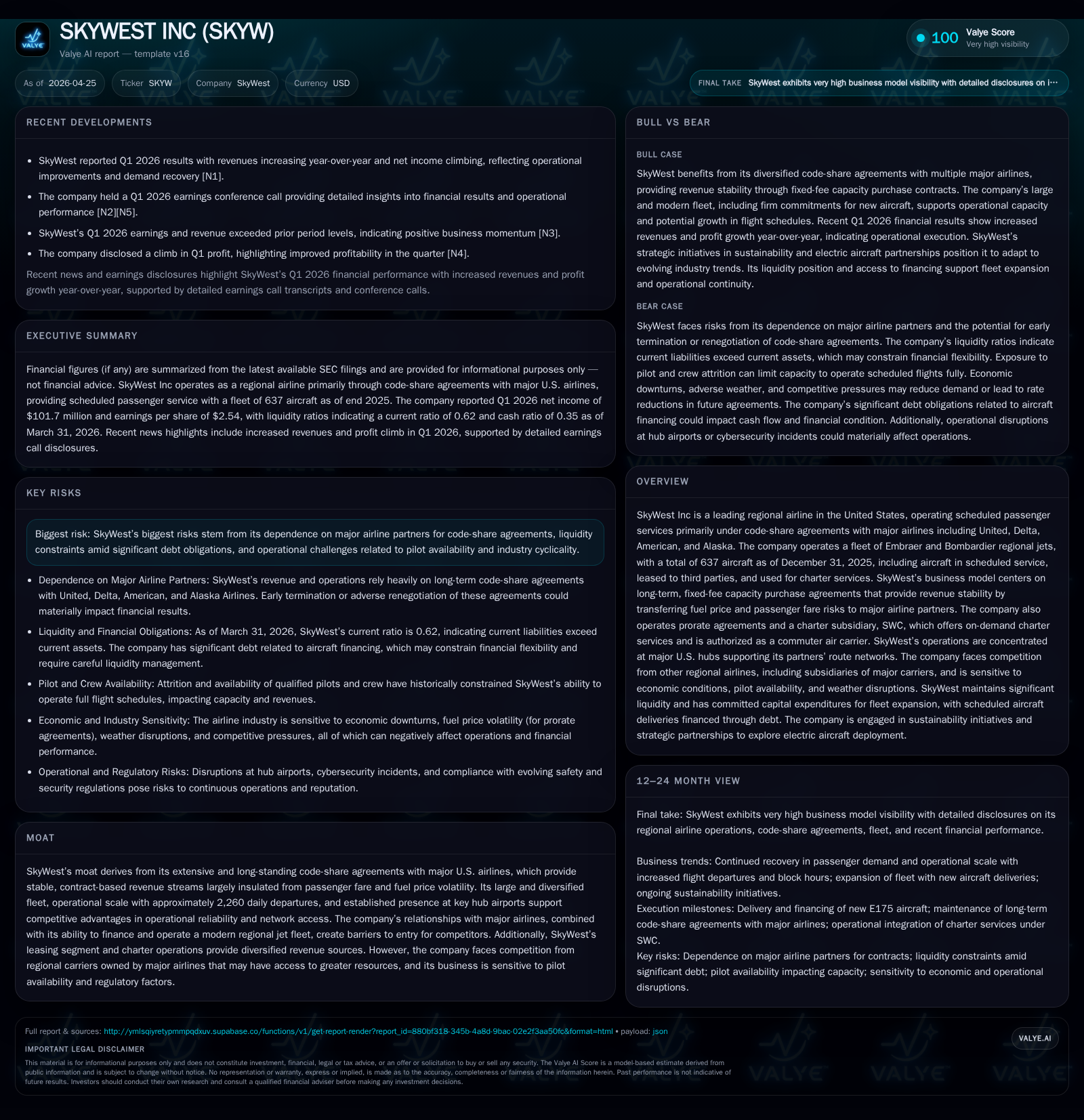
SkyWest Inc’s latest quarterly filing shows continued revenue growth driven by increased capacity and improving pilot availability, enabling fulfillment of flight schedules for major airline partners. The firm’s fixed-fee capacity purchase agreements underpin revenue stability despite industry cyclicality. While challenges persist in labor supply and regulatory environment, SkyWest’s extensive code-share network and fleet modernization position it well within the competitive regional airline sector. Financially, the company maintains substantial leverage but generates strong operating cash flow supporting fleet expansion and strategic investments.
Recent Operating Update: Q1 2026 Highlights
SkyWest reported Q1 2026 results anchored by increased operational completion rates following easing pilot shortages that constrained schedules in previous years [S2]. Revenues grew year-over-year as the company executed more flights under its long-term contracts with major U.S. airlines — United, Delta, American, and Alaska [N1][N3]. The company’s continued ability to fulfill partner flight schedules reflects successful management of labor availability risks that have been a notable industry-wide issue since post-pandemic recovery efforts began.
The firm also flagged ongoing plans to expand use of sustainable aviation fuel in partnership with major carriers and evaluated deployment opportunities for electric vertical takeoff and landing (eVTOL) aircraft through an arrangement with Eve Holding Inc., emphasizing innovation initiatives aligned with evolving environmental standards [S1][S22]. Meanwhile, SkyWest’s on-demand charter business under subsidiary SWC gained authorization as a commuter air carrier offering additional growth avenues beyond core regional flying [S4].
Business Model: Revenue Stability through Capacity Purchase Agreements
SkyWest operates predominantly under capacity purchase agreements (CPAs) wherein it provides aircraft operation services on behalf of major airlines who handle scheduling, pricing, ticketing, and passenger revenue risk [S21][S15]. This model delivers predictable fixed-fee payments calculated based on completed flights, block hours, and monthly aircraft counts rather than exposure to ticket pricing or fuel cost volatility.
The company’s substantial fleet — totaling 637 aircraft at the end of 2025 — consists primarily of Embraer E175s and Bombardier CRJ series jets configured for sub-76 seat markets [S21]. These aircraft profiles comply with major airlines’ scope clauses limiting regional jet seat counts to avoid cannibalization of mainline flying labor agreements.
Complementing CPAs are prorate agreements with some partners where SkyWest shares passenger fares directly but assumes risk on schedule control and fuel costs [S15]. Additional diversification comes from SWC’s charter operations targeting niche corporate or institutional air transportation demand — a segment less correlated with scheduled service cycles.
Such contractual arrangements transfer fare and fuel price risk mostly to partner airlines, insulating SkyWest's top-line from passenger yield fluctuations yet constraining margin upside during favorable market conditions. The business enjoys contractual revenue stability but remains sensitive to utilization levels; reductions in partner flight schedules materially impact results [S19][S23].
Industry Structure and Competitive Position
The regional airline industry is marked by intense competition including multiple subsidiaries owned directly by major carriers such as Endeavor (Delta), Envoy/PSA/Piedmont (American), Horizon (Alaska), along with independent players like CommuteAir and Republic Airways [S4]. These airline-owned regionals typically access greater capital resources but may be constrained in footprint or scope clause adherence.
SkyWest maintains a leadership position as the largest independent regional operator in the U.S., leveraging scale advantages at key hubs such as Chicago O’Hare, Dallas/Fort Worth, Denver, Salt Lake City, Seattle, San Francisco among others [S21]. Its longstanding code-share agreements foster high barriers to entry given integration complexity including airport facilities access, IT systems interoperability for reservations/ticketing/dispatching, and strict performance metrics monitoring.
Operational reliability remains a crucial differentiator amidst an ecosystem where completion rates influence partner contracts renewal. The company invests heavily in maintenance infrastructure and vendor relationships to mitigate risks posed by third-party parts or service delays—a material concern noted due to technician shortages industry-wide impacting fleet return-to-service timelines [S1].
Growth Drivers and Constraints
Drivers:
- Pilot Availability Recoveries: The industry-wide seasonal pilot shortages have improved through late 2025 into early 2026 enabling SkyWest to meet contractual flight schedules fully again after prior capacity cuts owing to attrition [S9].
- Fleet Modernization & Expansion: Firm commitments for nearly 70 new Embraer E175 jets reflect confidence in sustained demand as older CRJ200s phase out; these additions enhance fuel efficiency and align capacity with partners’ evolving route strategies [S5][S21].
- SWC Charter & New Ventures: DOT approval for commuter air carrier status expands potential for SWC beyond ad hoc charters toward more scheduled commuter service opportunities offering incremental growth [S4][S12].
- Environmental Initiatives: Collaborations on sustainable aviation fuels (SAF) adoption and electric ground support equipment signal responsiveness to regulatory environment shifting towards carbon reduction mandates [S22].
Constraints:
- Code-Share Partner Dependence: SkyWest’s financial health depends on maintaining long-term contracts which major airlines can terminate under certain clauses or may reduce flying tied to economic cycles or strategic shifts such as hub consolidation or mainline aircraft deployment [S24][S25].
- Labor Cost Inflation & Scope Clause Limits: Increasing pilot compensation pressures margins under fixed-price CPAs; additionally scope clauses cap maximum seat sizes restricting expansion options [S13][S24].
- Regulatory Compliance & Operational Risks: FAA certifications impose ongoing compliance costs; disruptions caused by weather or system failures at hub airports can create flight cancellations or delays materially impacting earnings [S18][S27].
- Third-Party Vendor Reliance: Delays in parts availability due to supplier workforce challenges add operational risk potentially slowing fleet utilization improvements especially when reactivating parked aircraft [S1][S28].
What to Watch Next
Key areas for monitoring include:
- Execution on new aircraft deliveries aligned with firm purchase commitments influencing capacity availability.
- Renewal discussions or renegotiations of capacity purchase agreements especially with United and Delta which account for a majority share of contracted flying.
- Trends in pilot recruitment/retention metrics that impact full utilization potential.
- Regulatory developments around emissions standards that may force operational cost changes.
- Progress in SWC’s transition toward expanded commuter route offerings under new DOT authority.
Financial Profile: Operating Strength Amid Leverage
Historical performance (annual)
|
| FY | CFO ($mm) | OpInc ($mm) | Capex ($mm) |
|---|---|---|---|
| 2025 | 940 | 618 | 32 |
| 2024 | 692 | 495 | 45 |
| 2023 | 736 | 104 | 13 |
| 2022 | 480 | 181 | 13 |
Source: SEC companyfacts cache [F1].
Capital returns and efficiency (annual)
|
| FY | FCF ($mm) |
|---|---|
| 2025 | 908 |
| 2024 | 648 |
| 2023 | 723 |
| 2022 | 467 |
Source: SEC companyfacts cache [F1].
SkyWest remains financially leveraged typical of captive regional carriers reliant on capital-intensive fleet ownership yet exhibits healthy underlying operational cash flows. As of March 31, 2026, cash plus equivalents totaled $65.8 million against total debt approximating $2.41 billion implying net debt near $2.34 billion with a current ratio of 0.62 reflecting typical liquidity tightness in the sector given working capital dynamics [F1].
For fiscal year 2025 ended December 31:
- Revenue hit approximately $2.97 billion growing substantially compared to prior years driven by increased flight volume and stable CPA rates.
- Operating income reached nearly $618 million representing about a 25% increase year-over-year indicating operating leverage benefits after recovering from pandemic disruptions.
- Net income stood at $428 million yielding a return on equity around 15.6% illustrating profitable deployment of invested capital.
- Operating cash flow was robust at over $940 million providing ample coverage over capital expenditures which amounted to just over $32 million primarily related to fleet additions.
The company undertakes disciplined capital allocation balancing debt servicing requirements with funding growth initiatives including its sizeable backlog for new jets valued at $2.3 billion at end FY25 [S5], while suspending dividends since the pandemic period yet engaging in share repurchases contingent upon market conditions [S8][F1].
This analysis focuses solely on publicly available regulatory filings and company disclosures as of April 2026. It does not constitute investment advice nor imply any recommendation regarding SKYW stock.
Disclaimer: This is research-only, informational analysis and not investment advice. It may include AI-generated interpretation and general industry context. Always verify important details using primary sources.

Comments