
Jazz Pharmaceuticals’ Oxybate Franchise Faces Intensifying Competition and Regulatory Pressures
Recent SEC updates highlight challenges to Jazz’s core products amid evolving market dynamics and ongoing patent litigation.
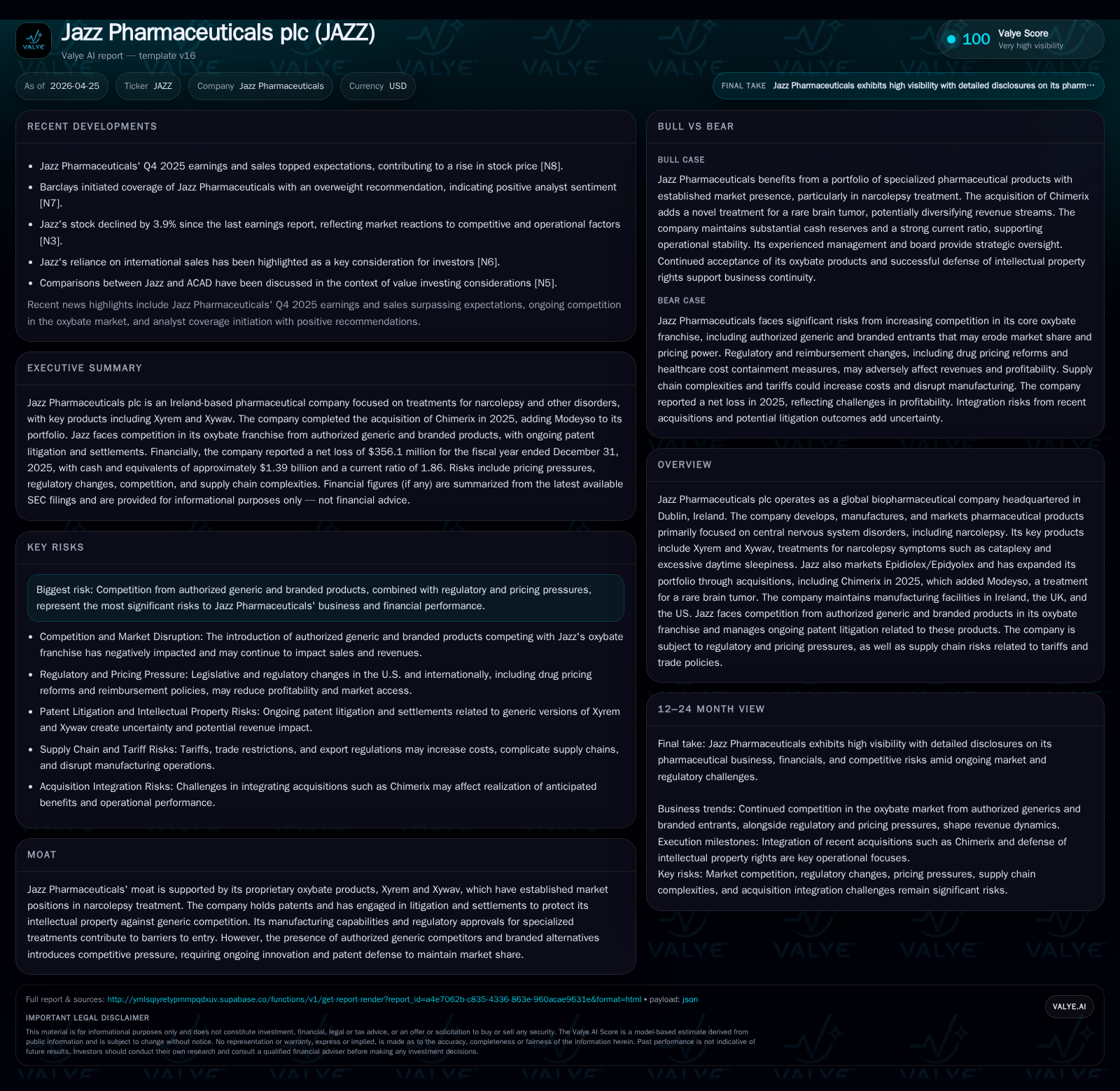
Jazz Pharmaceuticals continues to grapple with sustaining revenues from its oxybate franchise, notably Xyrem and Xywav, amid rising competition from authorized generics and branded alternatives. The company’s recent filings reflect heightened regulatory scrutiny, pricing pressures, and patent litigation risks that could materially affect its leading narcolepsy treatments. While Jazz has bolstered its pipeline via acquisitions like Chimerix, ongoing integration challenges and external market constraints create uncertainty for near-term growth prospects.
Recent Operating Developments Anchor Near-term Risks
In Jazz Pharmaceuticals’ latest SEC filings culminating in the Q3 2025 10-Q [S2] and a February 2026 8-K update [S3], key themes revolve around intensifying competition for their oxybate franchise—Xyrem and Xywav—the cornerstone of their narcolepsy portfolio. Despite Xywav holding the leading branded oxybate treatment position based on Q3 revenue data, the company flagged material risks including erosion of revenues due to authorized generics (AGs), branded competitors like Avadel’s Lumryz, increasing payer pressure on pricing and reimbursement access, as well as active patent litigation challenges. Notably, a generic version of high-sodium oxybate gained FDA approval in September 2025 (Amneal), signaling imminent amplified market disruption.
The February 2026 event filing highlighted ongoing efforts to navigate these headwinds while also integrating the recently acquired Chimerix business—an acquisition adding Modeyso for rare diffuse glioma indications—with attendant operational integration risks acknowledged [S3, S24]. These documents collectively demonstrate that Jazz remains at a pivotal juncture where sustaining dominance in narcolepsy will require robust defense of intellectual property (IP), strategic investments in pipeline expansion, and maneuvering through an increasingly stringent regulatory environment.
Business Model: Revenue Concentration Around Oxybate Treatments
Jazz Pharmaceuticals generates the majority of its revenue from therapies targeting central nervous system disorders—particularly narcolepsy—with Xyrem historically pivotal. The company transitioned focus toward Xywav (low-sodium oxybate) as a more differentiated product offering with fewer cardiovascular warnings due to significantly reduced sodium content (~92% lower than traditional oxybates). This shift was designed to sustain their franchise relevance as generic threats materialized.
Product-wise:
- Xyrem: Sodium oxybate with comprehensive patents but facing generic entry following patent settlements granting licenses to multiple ANDA filers.
- Xywav: Proprietary low-sodium version with a competitive edge due to safety profile; gaining adoption but challenged by emerging AGs.
- Epidiolex/Epidyolex: Cannabidiol-based treatments expanding neurology portfolio but facing generic competition risks.
- Modeyso: Recently acquired oncology asset addressing rare pediatric brain tumors (H3 K27M-mutant diffuse glioma).
Jazz leverages proprietary IP protection frameworks supplemented by REMS (risk evaluation and mitigation strategy) programs that control distribution channels—a barrier for unauthorized generics. However, given the complex ANDA patent litigations settled with multiple generic manufacturers allowing staggered launches starting around end of 2025 [S21], maintaining price discipline and market share is becoming increasingly onerous.
Manufacturing facilities across Ireland (Athlone), UK (Kent Science Park), Italy (Villa Guardia), and reliance on certain suppliers in China suggest significant global supply chain breadth but also subject Jazz to tariffs, export regulations uncertainty, and geopolitical risk impacting cost structures [S16–S18].
Industry Structure and Competitive Environment
The specialty pharmaceutical industry segment where Jazz operates is typified by:
- High barriers to entry due to rigorous regulatory demands,
- Dependence on strong IP portfolios,
- Need for REMS stewardship particularly in controlled substances like oxybates,
- Increasing interference from legislative pricing reforms globally,
- An evolving landscape where authorized generics complicate exclusivity periods.
Competitors include:
- Authorized Generic Entrants: Hikma launched its AG version of high-sodium oxybate in January 2023; Amneal followed in July 2023; others have licensed rights to launch AGs or full generics post-patent settlement timelines [S21–S23].
- Branded Alternatives: Avadel’s Lumryz offers a once-nightly high-sodium oxybate treatment alternative aiming at the narcolepsy space.
- New Molecules: Harmony Biosciences markets pitolisant for EDS/cataplexy indications impacting prescriber choice; pipeline compounds attempting similar indications are underway but yet unproven commercially [S27].
This competitive mix compresses Jazz’s ability to command premium prices or volume exclusivity within the U.S., historically the largest market. Moreover, payor-driven formularies increasingly mandate step therapy protocols preferring other cataplexy/EDS agents prior to oxybates limiting patient uptake dynamics [S27].
Growth Drivers and Constraints
Drivers:
- Continued adoption of Xywav for idiopathic hypersomnia (IH) indication—pending commercial uptake success.
- Pipeline diversification through inorganic growth such as Chimerix acquisition broadening oncology exposure beyond CNS-focused drugs.
- Potential lifecycle management innovations around existing platforms leveraging intellectual property extensions or reformulations.
Constraints:
- Heightened competition from AGs and authorized branded entrants significantly eroding revenues from traditional high-sodium oxybates.
- Pricing pressures stemming from Medicare Drug Price Negotiation mandates under the IRA effective 2026 plus removal of rebate caps increase rebate liabilities reducing net sales realization [S7–S8].
- Legislative threats including international reference pricing schemes aimed at tethering U.S. prices to lower foreign drug costs jeopardize future pricing power.
- Patent challenges on product formulation/use patents may accelerate generic competition ahead of patent expirations.
- Elevated tariffs on APIs/manufacturing supplies raise input costs unpredictably affecting margins [S16–S18].
- Regulatory uncertainties due to FDA resource constraints post government shutdowns could delay submissions or approvals hindering launch timelines for new assets or label expansions [S10–11].
What to Watch Next
Key upcoming milestones will decisively influence Jazz's trajectory:
- Monitoring the uptake momentum of Xywav in IH indication will reveal broader commercial viability beyond narcolepsy.
- Status updates on patent litigation outcomes involving ANDA filers post-license periods—especially after December 31, 2025 when multiple generics might launch uninhibited.
- Pricing negotiation impacts seen from initial IRA-driven Medicare negotiations beginning in calendar 2026 fiscal year cycles.
- Integration progress regarding Chimerix acquisition including rollout pace of Modeyso will test management execution capability.
- Competitive product launches or trial readouts by companies marketing alternative treatments like pitolisant or novel agents shaping treatment guidelines.
- Global regulatory adjustments affecting manufacturing tariffs or supply chains that could impact product availability or costs materially.
Conclusion
Jazz Pharmaceuticals stands at an inflection point where defending its legacy businesses amidst intensifying competition must be balanced against cost management amid regulatory headwinds and innovation-led diversification. The company’s proprietary oxybate franchise maintains foundational importance but faces structural revenue challenges—not transient cyclicality—as generics gain footholds supported by patent settlements. Pricing pressures driven by evolving healthcare policy reforms globally add another layer constraining growth potential. Jazz’s strategic acquisitions represent logical moves toward mitigating concentration risk but underscore integration complexity inherent in biopharma M&A. Overall, Jazz must navigate a complex mosaic of IP defenses, market competition shifts, reimbursement environment tightening, and operational execution precision to sustain its commercial relevance going forward.
This analysis is based solely on publicly available SEC filings as cited. It does not constitute investment advice or recommendations.
Disclaimer: This is research-only, informational analysis and not investment advice. It may include AI-generated interpretation and general industry context. Always verify important details using primary sources.

Comments