
Coterra Energy’s Strategic Scale-Up Hinges on Merger Execution and Multi-Basin Portfolio Strength
Coterra Energy’s recent filings highlight operational momentum and set the stage for its transformative merger with Devon Energy.
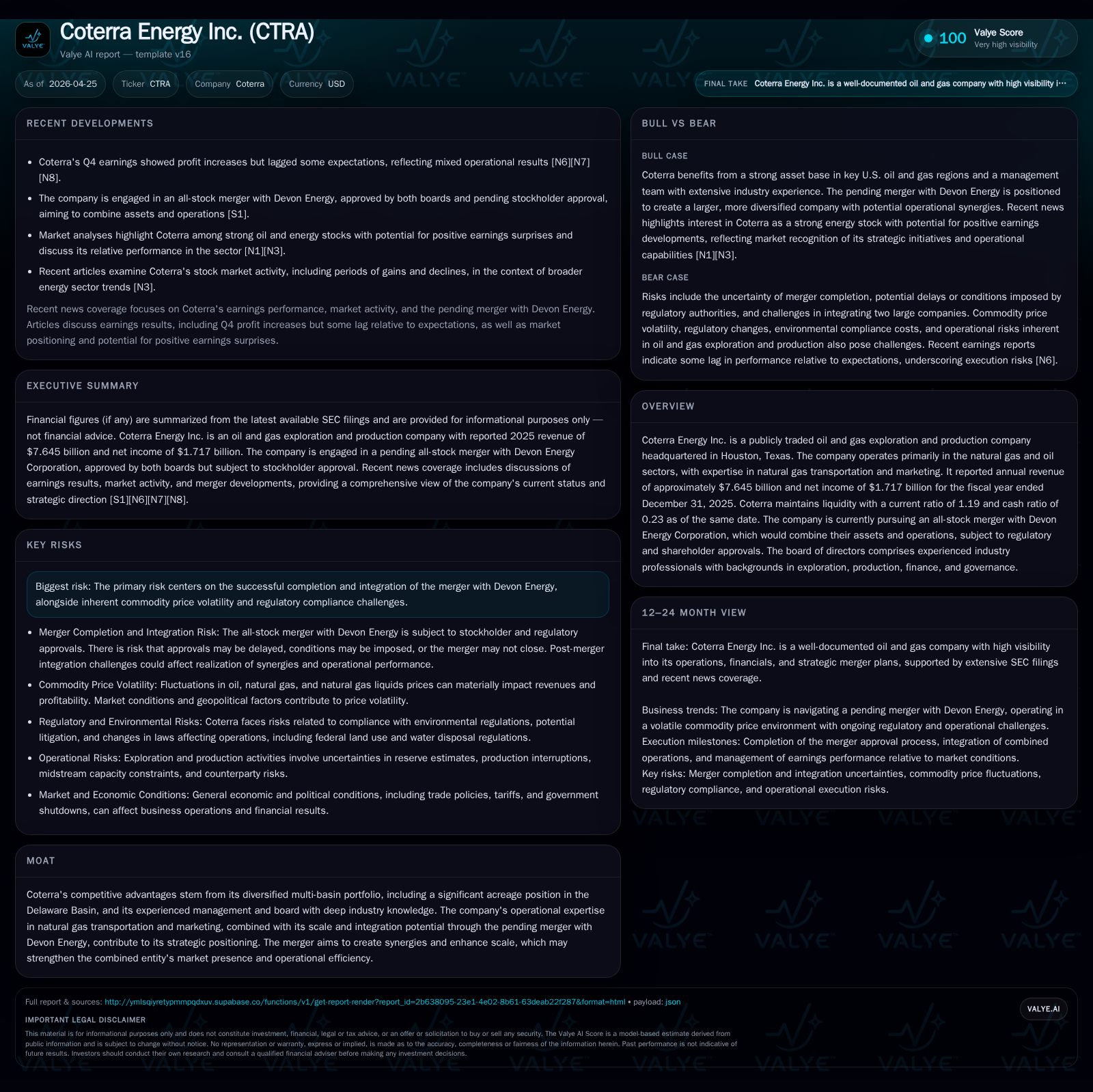
In its latest 10-Q and subsequent 8-K filings, Coterra Energy detailed solid operational results underpinning its $7.6 billion revenue base in 2025 and confirmed ongoing merger discussions with Devon Energy. The company’s business model is anchored in multi-basin upstream oil and gas production, complemented by natural gas transportation and marketing expertise. The pending all-stock merger aims to create a pro forma entity with enhanced scale and efficiency, potentially strengthening market positioning amid a competitive and regulated industry landscape. Key growth drivers include resource diversification and synergies from the merger, while risks center on integration complexities and commodity price volatility.
Recent Operating Update
Coterra Energy’s latest quarterly report filed on November 4, 2025 ([S2]) encapsulates a period of operational strength highlighted by production exceeding guidance targets. The company’s focus on cost reduction is evident in its drilling cost per foot settling below target levels—a reflection of longer lateral lengths and improved completion efficiencies. These factors contributed to Coterra surpassing its annual production guidance by delivering approximately 782 MBOE/day for fiscal 2025, marking a notable step-up relative to prior years.
Further, as detailed in the April 24, 2026 event filing ([S3]), Coterra formalized an all-stock merger agreement with Devon Energy Corporation signed February 1, 2026. This strategic transaction anticipates combining their upstream assets into a larger entity estimated to have a pro forma net debt position exceeding $9 billion in fiscal year 2026. Financial advisor Goldman Sachs provided valuation analyses indicating substantial synergy potential through scale efficiencies. This update is critical as it defines both near-term financial standing and longer-term market footprint for Coterra.
Business Model Overview
Coterra operates primarily as an upstream oil and gas company centered on exploration and production (E&P) activities across multiple U.S. basins—most notably holding sizable acreage in the Delaware Basin—while also leveraging operational expertise in natural gas transportation and marketing ([S1]). Revenue generation is driven by the physical extraction of hydrocarbons sold into commodity markets, supplemented by midstream services optimizing gas delivery.
The firm's multi-basin approach intentionally diversifies resource risk and geological variability. This strategy affords more stable output profiles relative to pure-play entities concentrated in single basins prone to localized disruptions or regulatory pressures. Cost management is a further pillar of the model; drilling optimization practices, such as longer laterals and artificial lift deployment noted in recent filings ([S1], [S2]), contribute to improving well economics.
Interestingly, Coterra’s corporate governance reflects seasoned industry leadership with executives experienced both domestically and internationally ([S1]). This complements technical capabilities with strategic oversight aligned toward shareholder value creation via disciplined capital allocation.
Industry Structure & Competitive Position
The U.S. E&P sector remains competitive yet fragmented across various geographies and operating scales. Coterra distinguishes itself through a sizable portfolio spanning key resource-rich basins—particularly Delaware Basin assets known for high-margin production potential—and by integrating midstream capabilities that reduce third-party transportation dependencies.
Competition comes from integrated majors as well as pure-play independents competing for acreage, capital deployment efficiency, and technological innovation such as enhanced recovery techniques. Regulatory constraints related to environmental compliance—including flare reduction initiatives evidenced by Coterra’s emissions improvements ([S1])—and approvals for onshore activity shape operating costs and expansion feasibility.
Market dynamics also involve cyclical commodity prices with occasional intense volatility due to geopolitical events or demand swings. As such, firms like Coterra maintain hedging programs (implied but not detailed explicitly in filings) alongside flexible capital strategies to mitigate downside risk.
Growth Drivers & Constraints
Growth stems principally from increasing production volumes supported by development drilling in existing acreage positions coupled with acquisition opportunities—of which the Devon merger represents a paramount example. The combination promises asset rationalization, overhead consolidation, optimized capital spending programs, and scale-enhanced marketing power that could improve pricing realizations.
Operational improvements like reduced costs per foot drilled (reported at $915/ft vs target $931/ft) signal structural margin enhancements potentially sustainable beyond cyclical peaks ([S1],[S2]). Additionally, prioritized ESG initiatives targeting emission reductions both respond to stakeholder expectations and may preempt regulatory costs.
Constraints include potential delays or adverse rulings from regulatory agencies around environmental permitting. Midstream infrastructure limitations—an acknowledged industry-wide bottleneck—could constrain throughput growth despite production ramp-ups ([S21]). Furthermore, success hinges on seamless integration post-merger: combining corporate cultures, aligning IT systems, managing personnel transitions—all underpinned by stable price environments necessary to justify ongoing investment.
What to Watch Next
Immediate upcoming milestones principally involve shareholder votes slated for May 4, 2026 ([S25]) necessary to approve the Devon merger. Regulatory reviews will also play crucial roles; any conditions or delays may materially affect timing or benefits realization.
Monitoring execution against synergy targets announced during valuation appraisals will provide insight into management’s integration competence. Operational metrics such as drilling costs, production rates across key basins (Delaware outperforming peers notably), emissions data related to flaring intensity reductions will indicate resilience amid evolving regulatory frameworks.
On the external front, commodity price trends remain vital: sustained higher oil/gas prices would amplify free cash flows enabling aggressive capital return policies versus defensive stances under more bearish scenarios.
Financial Profile
Historical performance (annual)
|
| FY | Rev ($bn) | Net ($bn) | CFO ($bn) | OpInc ($bn) | Rev YoY | Net YoY |
|---|---|---|---|---|---|---|
| 2025 | 7.6 | 1.7 | 4.0 | 2.5 | +40.1% | +53.2% |
| 2024 | 5.5 | 1.1 | 2.8 | 1.4 | -7.7% | -31.0% |
| 2023 | 5.9 | 1.6 | 3.7 | 2.2 | -34.7% | -60.0% |
| 2022 | 9.1 | 4.1 | 5.5 | 5.2 |
Source: SEC companyfacts cache [F1].
Capital returns and efficiency (annual)
|
| FY | Div ($mm) | Buybacks ($mm) | ROE% |
|---|---|---|---|
| 2025 | 170 | 141 | 11.6 |
| 2024 | 156 | 455 | 8.5 |
| 2023 | 405 | 12.5 | |
| 2022 | 1250 | 32.1 |
Source: SEC companyfacts cache [F1].
Based on fiscal year-end data reported December 31, 2025 ([F1]), Coterra generated $7.645 billion in revenue—a strong rebound reflecting a +40% increase year-over-year—and operating income stood at $2.452 billion (+76.5% YoY). Net income of $1.717 billion marks a substantial improvement over prior periods (+53%).
Operating cash flow was robust at $4.021 billion with capex slightly down (~-11%) allowing free cash flow above $3.8 billion annually—underpinning shareholder returns including $170 million dividends paid alongside $141 million share repurchases in 2025 amid tighter capital discipline post-pandemic recovery.
End-of-year leverage reflected total debt of approximately $3.8 billion against cash reserves of $114 million producing net debt near $3.7 billion; current ratio stood healthy at 1.19 indicating short-term liquidity adequacy ([F1]). These figures align with filings evidencing careful balance-sheet management pre-merger commencement ([S3],[S19]).
Goldman Sachs’ valuation methodologies applied discount rates ranging from ~7.5%–9%, terminal EBITDA multiples of approximately 4.25x–5.25x on forecasted EBITDA around $5.2 billion led to illustrative present equity values supporting the exchange ratio range disclosed ([S14],[S15],[S27]).
Altogether financial metrics exhibit robust earnings quality combined with prudent leverage levels conducive to navigating the integration phase while sustaining operational investments.
Disclaimer
This analysis is based exclusively on publicly available SEC filings and company disclosures without any forecasting assumptions beyond stated source content. It does not constitute investment advice but aims solely to inform on business model dynamics, industry context, recent developments, risks, and financial positioning of Coterra Energy Inc.
Disclaimer: This is research-only, informational analysis and not investment advice. It may include AI-generated interpretation and general industry context. Always verify important details using primary sources.

Comments