
Paramount Skydance’s $24 Billion Financing Milestone Anchors Warner Bros. Discovery Merger Plans
The strategic syndication of senior secured credit facilities and expanded revolver bolster Paramount Skydance’s financial foundation for the pending Warner Bros. Discovery acquisition.
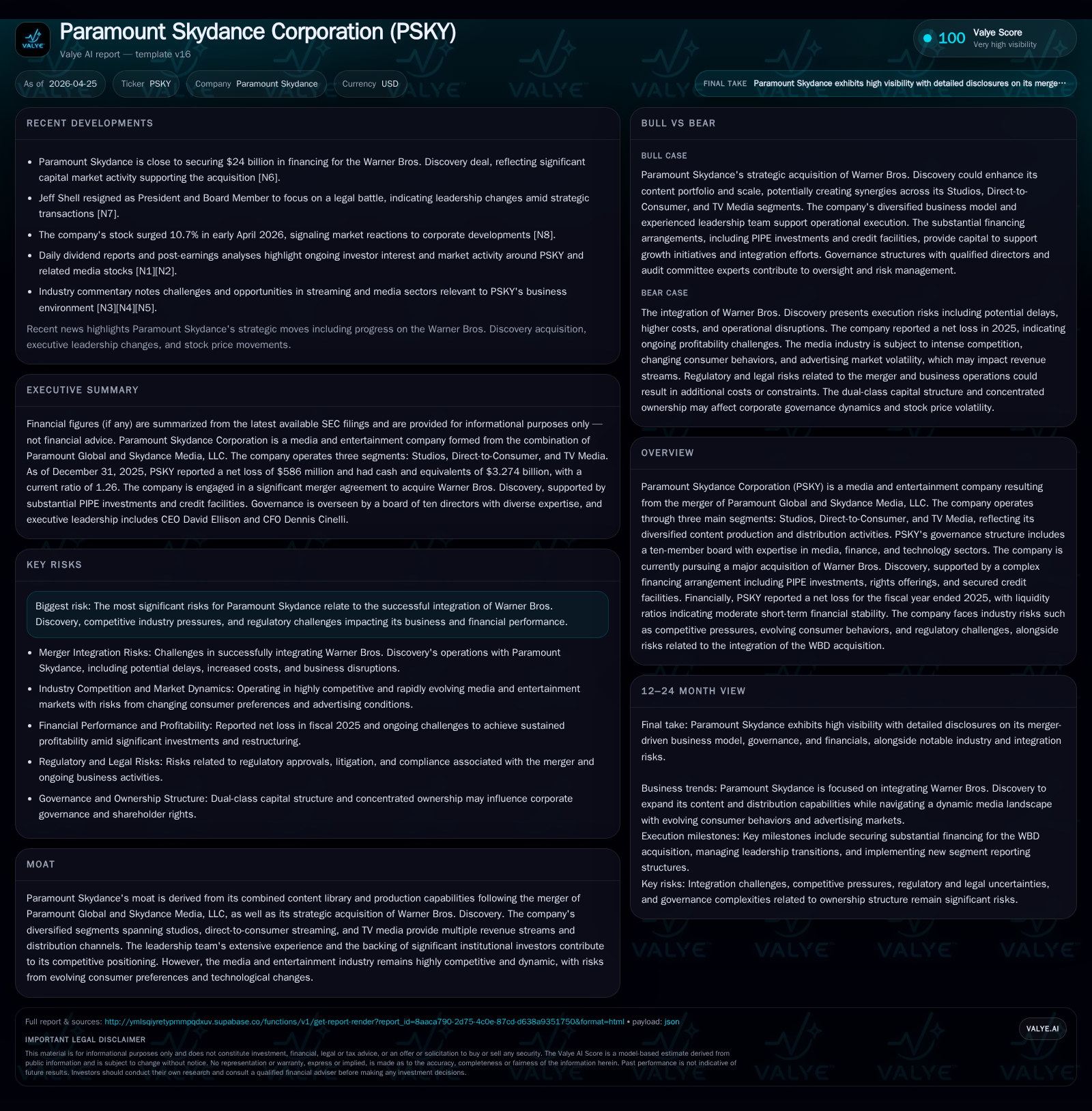
Paramount Skydance Corporation (PSKY) recently finalized a pivotal financing package, including a $5 billion revolving credit facility expansion and $7.5 billion in term loan commitments, reinforcing its liquidity position ahead of the anticipated Warner Bros. Discovery (WBD) merger close. This financing structure is secured on a first lien basis over substantial corporate assets, aligning with covenant profiles designed to sustain operational flexibility amid integration risk. Originating from a 2024 merger of Paramount Global and Skydance Media, PSKY now stands poised as a diversified media conglomerate spanning studios, direct-to-consumer streaming, and TV media. While the merger promises scale and content dominance, successful integration, competitive dynamics, and evolving consumer behaviors pose ongoing challenges. Investors should monitor merger progress, leverage ratios under new credit agreements, and content monetization trends as material execution metrics.
Recent Operating Update
Paramount Skydance Corp (PSKY) marked a significant operational milestone on April 7, 2026 by entering into the Pro Rata Credit Agreement establishing permanent senior secured financing arrangements crucial for supporting its pending acquisition of Warner Bros. Discovery (WBD) [S3]. The agreement amends existing credit agreements by expanding the senior unsecured revolving credit facility commitments from $3.5 billion to $5 billion while simultaneously syndicating previously disclosed bridge loans into $2.5 billion three-year term A-1 loans, $2.5 billion five-year term A-2 loans, plus $5 billion five-year revolving commitments structured under senior secured terms [S3][S6][S7].
This financing conversion effectively reduces the bridge facility’s size from $54 billion down to $49 billion drawn down permanently while dissolving prior revolving commitments under the bridge [S7]. These facilities provide PSKY with enhanced liquidity ahead of closing the mega-merger with WBD expected within the coming months.
The credit facilities are backed by first-priority liens covering essentially all assets across PSKY and its key U.S.-based subsidiaries including legacy Paramount Global operations, Skydance Media LLC’s production entities, as well as the forthcoming WBD portfolio upon consummation [S3][S6].
Financial covenants dictate that consolidated total net leverage should not exceed 5.50x EBITDA initially but are designed to fall away or tighten once PSKY achieves investment-grade rating thresholds – re-setting maximum allowable consolidated leverage to 4.50x subsequently [S8]. This tiered approach balances investor protections with operational flexibility during integration phases.
Business Model Analysis
PSKY operates three main business segments – Studios, Direct-to-Consumer (DTC), and TV Media – representing an integrated value chain in content creation through distribution channels [S1]. The company emerged from a prior combination of Paramount Global (legacy CBS/Viacom entities) which brought extensive content IP libraries and broadcast capabilities together with Skydance Media’s strong foothold in blockbuster film production since its founding in 2010 led by David Ellison [S1].
Studios segment focuses on film and TV production leveraging leading franchises; DTC delivers subscription streaming services alongside advertising-supported offerings; TV Media manages distribution through cable networks/settings optimizing ad sales revenues.
Strategically, merging with WBD is expected to solidify PSKY's competitive moats by combining complementary content assets such as HBO Max’s premium streaming service brands alongside DC Comics universe IPs with Paramount's deep catalogues enabling multi-platform monetization synergies. However integration risks remain notable given differences in organizational cultures and platform competition.
The company benefits from established relationships with top creative talent producers which help secure exclusive deals — critical as consumer preferences evolve increasingly towards on-demand digital TV consumption instead of traditional pay-TV bundles. This helps maintain pricing power on proprietary content licensing despite theatrical window disruptions.
Industry Structure & Competitive Position
The global media landscape is dominated by a handful of large-scale conglomerates operating vertically integrated ecosystems spanning content libraries/proprietary shows to platform distribution—Netflix being the archetype disruptor whose recent Q1 earnings revealed continued subscriber growth but also stock price volatility driven by shifting investor expectations around monetization cadence and margin pressures [N1][N2][N9].
PSKY positions itself as a diversified competitor straddling legacy broadcast/tv advertising segments while aggressively pursuing scale in streaming through multi-brand strategies following industry trends that favor omni-channel consumption.
Competitive differentiators include:
- Scale: The combined entity post-WBD would be among largest holders of premium scripted IP with cross-segment reach.
- Distribution versatility: Ownership over traditional cable channels plus direct stream platforms provides multiple revenue vectors mitigating risk concentration.
- Leadership team with industry expertise and strategic banking relationships enabling complex capital structuring for transformational acquisitions.
Constraints include regulatory scrutiny focused on anti-trust considerations related to content bundling practices seen in consolidation trends among top media groups thereby potentially delaying transactional approvals or imposing conditions. Moreover rising costs for premium original programming amid inflationary cost pressures could compress studio margins absent efficient cost control.
Growth Drivers & Constraints
Key growth drivers shaping PSKY’s trajectory include:
- Streaming growth: Subscription video-on-demand offers structural subscriber growth opportunities internationally offsetting slowing traditional pay-TV penetration.
- Content franchising: Leveraging blockbuster tentpole films and series IPs across sequels/spin-offs drives sustained monetization across theatrical releases, licensing deals, merchandise and theme park tie-ins.
- Expanded advertiser base: TV Media adapts ad formats using data-driven targeting improving yield in fragmented audiences compared to linear models.
- Synergies from WBD transaction: Cost savings via operational integrations plus cross-platform bundling enhance scale economies providing cost rationalization upside.
Constraints revolve mainly around:
- Integration complexity risks including retention challenges of key talent disturbed by merger uncertainties as exemplified by recent resignation of former President Jeffrey Shell who stepped down citing legal distractions linked to these processes in April 2026 [N14].
- Leverage burden from significant debt funding requiring disciplined free cash flow generation especially given reported FY2025 net loss position reflecting ongoing investments in content production or restructuring costs [F1].
- Consumer behavior volatility towards emerging formats such as short-form video platforms competing for screen time could dilute long-term loyalty.
- Regulatory headwinds that might impose operational constraints or divestitures due to anti-monopoly assessments.
What to Watch Next
Going forward critical milestones will be:
- Closing date for WBD acquisition currently conditional on shareholder approval votes followed by regulatory clearance; delays or adverse modifications from antitrust authorities could materially impact strategy timelines [S11][N11].
- Achievement of investment grade ratings triggering relaxation or modification of loan covenants affecting capital flexibility metrics post-merger close [S8].
- Execution against announced cost synergies promises articulated in merger disclosures along with management commentary on integration progress.
- Market reception post-merger reflected in stock price reaction tied to clearer visibility on combined entity’s revenue growth rates driving valuation updates among investors.
- Customer adoption levels for bundled streaming services integrating multiple legacy platforms which will signal cross-selling success potential beyond basic subscriber numbers.
Financial Profile Summary
As of December 31, 2025 per latest annual filing data [F1], PSKY reported:
- Net income loss was approximately -$586 million reflecting transitional expenses related to merger activities.
- Operating income stood at negative $95 million underscoring margin compression during corporate transformation phase.
- Cash & equivalents totaled roughly $3.27 billion supporting manageable near-term liquidity needs.
- Total debt was approximately $13.23 billion indicating elevated leverage consistent with funding mergers/acquisitions strategies.
- Current assets exceeded current liabilities yielding a current ratio near 1.26 suggesting reasonable short-term solvency buffer despite capital-intensive operations.
- Approximate net debt (total debt minus cash) stood near $9.95 billion emphasizing reliance on ongoing cash flow generation for deleveraging initiatives.
- Company achieved free cash flow after capex estimated around $323 million providing modest cushion towards servicing debt obligations amid investment outlays.
In context of recent credit amendments [S3][S6], these figures portray a firm actively managing capital structure to support transformational growth initiatives while balancing financial discipline required for sustainable operations post-WBD merger closing.
Disclaimer: This analysis is provided solely for informational purposes based on currently available filings and public domain information without expressing any investment view or recommendation regarding PSKY securities or related transactions. Readers should conduct their own due diligence before making any decisions involving this company or sector exposure.
Disclaimer: This is research-only, informational analysis and not investment advice. It may include AI-generated interpretation and general industry context. Always verify important details using primary sources.

Comments