
CEMEX's Q1 2026 Performance and Strategic Outlook Amid Regulatory Shifts
CEMEX reported Q1 2026 results highlighting key regulatory and operational developments shaping near-term growth.
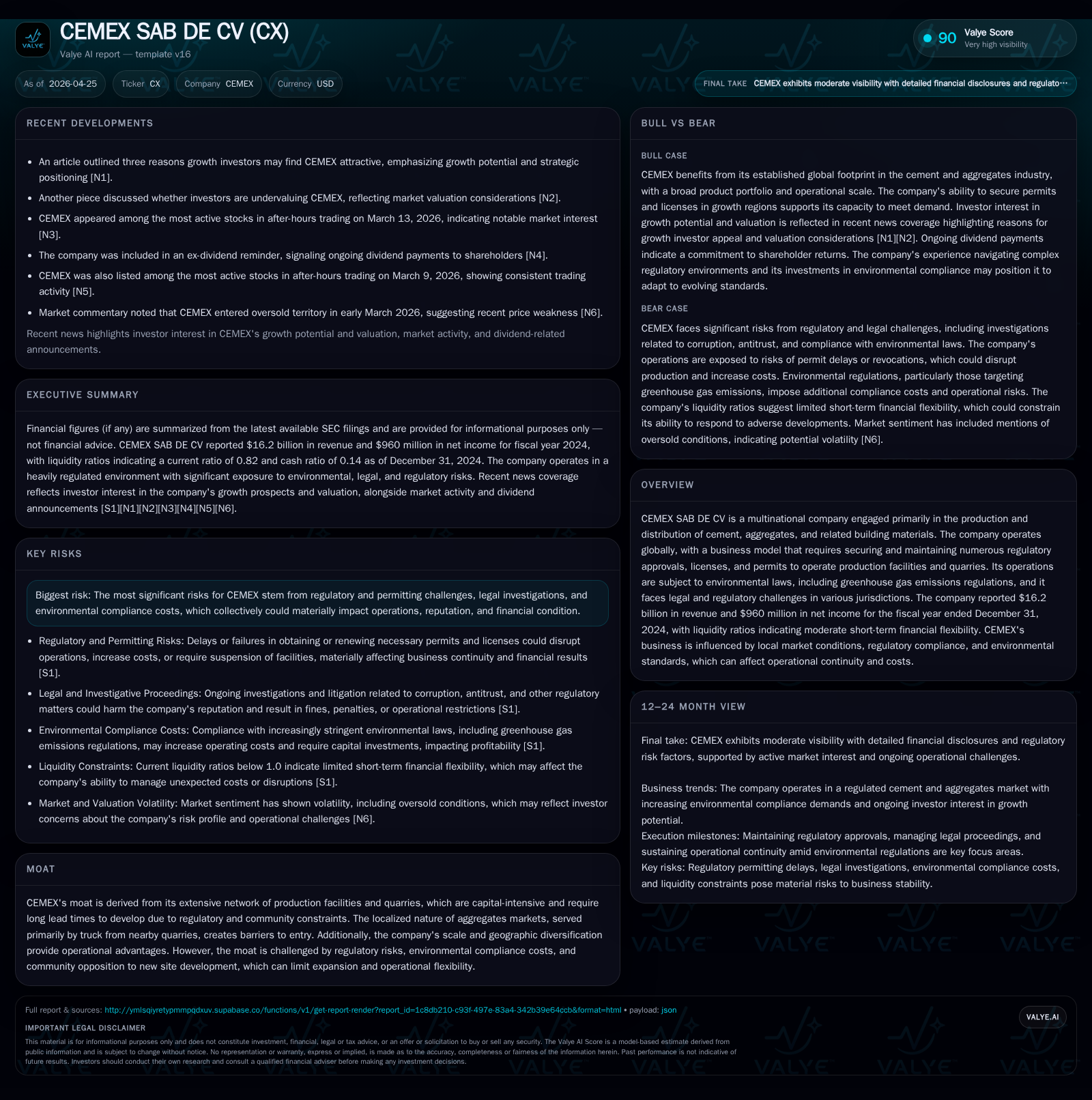
In Q1 2026, CEMEX's latest filings reveal ongoing lease negotiations in Nicaragua and a robust global trading network that cushions against cyclical volatility. The company's business model leverages a capital-intensive asset base in cement and aggregates combined with extensive logistics infrastructure, supporting a diversified global footprint. Regulatory headwinds, particularly EU emission allowance phase-outs and permitting challenges for quarry expansions, weigh on growth but are balanced by urbanization-driven demand and strategic capital allocation including dividends and share repurchases. Financially, the company maintains solid profitability and liquidity despite margin pressures from regulatory compliance costs.
Q1 2026 Operating Update: Key Takeaways from Latest Filing
CEMEX's most recent quarterly disclosures filed in April 2026 ([S2], [S3]) present an operational snapshot marked by pivotal developments impacting its near-term trajectory. Notably, negotiations to extend the lease of the Nicaragua cement plant remained unresolved as of December 31, 2025, introducing uncertainty around this asset's future contribution. While no immediate production disruptions were reported, such leasing terms are critical given the capital intensity and localized nature of cement production facilities.
The filings reaffirm CEMEX’s expansive trading network managed during 2025, which moved roughly 12 million tons of cementitious materials across more than 65 countries. About two-thirds of this volume involved internal exports from operations in Spain, Germany, Mexico, Trinidad and Tobago, among others, while the remainder comprised third-party purchases across diverse continents. This trading capability enables CEMEX to optimize capacity utilization globally and mitigate cyclicality endemic to the cement sector by reallocating excess production to higher-demand markets efficiently.
Capital allocation remains a priority with confirmed plans to distribute $180 million USD in dividends to shareholders via four equal installments beginning June 2026 ([S4]–[S6]), alongside a sizeable $500 million USD share repurchase authorization running through early 2027. These signals underscore management's confidence in cash flow generation despite regulatory and market headwinds.
Business Model Essentials: Cement, Aggregates, and Logistics
CEMEX’s core business centers on producing and supplying cement and aggregates—critical inputs for construction markets—via a geographically diversified portfolio of plants primarily domiciled across Mexico, the United States, Europe, Latin America, and select Caribbean locations ([S1]). The company operates numerous cement plants with capacities ranging from under one hundred thousand tons to multi-million tons annually; for example, the Huichapan plant in Hidalgo alone accounts for over three million tons of used capacity. This broad asset base supports significant economies of scale but demands constant capital expenditure—invested at $128 million in SCA&C region in 2025—to maintain competitive operations.
A distinctive feature is CEMEX's reliance on marine terminals and integrated maritime logistics allowing globally coordinated freight management that lowers transport costs significantly relative to industry norms ([S1]). Given the heavy weight-to-price profile of aggregates—primarily transported locally by truck—CEMEX’s aggregated quarry assets tend to serve constrained regional markets where permitting new sites faces community resistance. Thus, the company’s value chain is a mosaic balancing local markets’ logistical particularities with international trading flexibility.
Additionally, the grinding mills in islands like Guadeloupe and Martinique augment product mix diversity enabling tailored solutions while expanding revenue streams through subsidiary stakes in distinct geographies.
Industry Positioning: Competitive Landscape and Regulatory Environment
The global cement industry CEMEX operates within is characterized by substantial capital requirements for plant development alongside lengthy permitting cycles exacerbated by increasing environmental scrutiny ([S1]). This effectively raises entry barriers reinforcing the company’s moat derived from owning strategically located quarries that face few direct competitors within their trucking catchment zones.
However, regulatory pressures mount materially; the EU’s phase-out schedule of free Emissions Allowances (EUAs) starting at 2.5% reduction in free allocation in 2026 escalating to complete elimination by 2034 presents rising cost headwinds that will compress margins unless countered by efficiency or pricing strategies. Moreover, ongoing Polish antitrust investigations remain a remote but non-trivial risk concerning market conduct allegations.
Such factors impose a dual challenge: while asset localization limits competition geographically improving pricing power in captive markets, external requirements elevate operating costs and complicate expansion options especially where community opposition hinders quarry permits or expansions.
Growth Catalysts and Limiters in Core and Emerging Markets
Structural demand growth drivers include urbanization trends fueling residential construction alongside government infrastructure investment programs fueling commercial and civil works. Cement consumption aligns closely with GDP trajectories supporting medium-term volume increases particularly in emerging markets where urban sprawl continues unabated.
Conversely, growth is moderated by caution around environmental impacts notably linked to carbon emissions during clinker production necessitating costly compliance measures aligned with evolving legislation ([S1]). The localized nature of aggregate sales means new supply sources must anticipate broader urban planning challenges where community resistance delays or prevents quarry establishment.
Importantly, CEMEX’s trading clout allows strategic responses to freight cost volatility by contracting timely maritime transport services using owned or chartered vessels reducing exposure relative to competitors reliant solely on spot freight markets.
Environmental Compliance and Community Relations as Operational Factors
Environmental regulation stands as a principal constraint shaping operating economics going forward with the EU Emissions Trading Scheme notably phasing out free EUA allocations while implementing Carbon Border Adjustment Mechanisms (CBAM) potentially raising input costs for exported materials ([S1]). Compliance demands propel ongoing investments into cleaner technologies or alternative fuels consumed by subsidiaries across multiple regions.
Community opposition remains a persistent hurdle when developing new quarries or expanding existing ones especially near urban centers constraining capacity development plans. The protracted nature of obtaining permits coupled with social license requirements elongates project lead times forcing advance planning well ahead of anticipated demand surges.
These factors cumulatively elevate operational risk profiles compelling rigorous governance oversight including sustainability-focused board committees integral to risk management strategies ([S1]). Margin pressures attributable to GHG regulation thus represent an emerging strategic frontier necessitating innovation alongside prudent capital deployment.
Upcoming Milestones and Market Signals to Track
Key near-term events include finalizing Nicaragua lease extension deliberations given expiry was scheduled for February 2026—crucial for maintaining production continuity there ([S1]). Monitoring developments regarding Polish antitrust proceedings could also indicate legal cost or reputational risk materializations impacting regional operations.
EU draft emission benchmarks slated for confirmation during Q2 2026 may clarify compliance cost trajectories while dividend installment payments commencing June through March next year provide tangible financial returns reflecting operational confidence ([S4]–[S6]). Share repurchase activities authorized up to $500 million USD over the next year merit observation as indicators of capital return dynamics amid earnings normalization post-pandemic recovery phase.
Financial Overview: Recent Metrics Underpinning Operational Strategy
Historical performance (annual)
|
| FY | Rev ($bn) | Net ($mm) | Rev YoY | Net YoY |
|---|---|---|---|---|
| 2024 | 16.2 | 960 | -6.8% | +382.4% |
| 2023 | 17.4 | 199 | +11.6% | -77.5% |
| 2022 | 15.6 | 885 | +7.1% | -45.3% |
| 2021 | 14.5 | 1618 |
Source: SEC companyfacts cache [F1].
Capital returns and efficiency (annual)
|
| FY | ROE% |
|---|---|
| 2024 | 7.7 |
| 2023 | 1.6 |
| 2022 | 8.1 |
| 2021 | 15.8 |
Source: SEC companyfacts cache [F1].
Using the latest annual snapshot ending December 31, 2024 ([F1]), CEMEX reported revenue at approximately $16.2 billion USD marking a near -6.8% decline year-over-year likely reflecting macroeconomic pressures balanced against operational gains elsewhere. Notably net income rebounded strongly to $960 million USD from previous subdued levels representing over a threefold increase attributed partly to operational efficiencies or one-time adjustments.
Liquidity remains moderate with current assets totaling about $5 billion USD against $6.1 billion USD current liabilities yielding a current ratio near 0.82 underscoring tight short-term coverage though typical within heavy industrial segments relying on long-cycle capital investments ([F1]). Cash & equivalents stand at roughly $864 million USD facilitating working capital needs alongside capex commitments which totaled $128 million USD in relevant regions during fiscal year end.
Dividend payouts totaling $180 million USD divided into quarterly segments scheduled throughout remainder of FY26 reinforce shareholder returns reflecting underlying cash flow confidence ([S4]–[S7]). Share repurchase programs authorized up to half a billion dollars provide additional avenues for capital recycling during uncertain market periods.
|
| FY | Revenue ($B) | Net Income ($M) | Current Ratio |
|---|---|---|---|
| 2024 | 16.2 | 960 | 0.82 |
| 2023 | 17.4 | 199 | -- |
| 2022 | 15.6 | 885 | -- |
| 2021 | 14.5 | 1618 | -- |
Overall financials depict resilience augmented by diversified geographic operations partially insulating earnings from local downturns but also highlight sensitivity to regulatory cost inflation which may pressure margins absent successful mitigation strategies over coming years.
This analysis synthesizes recent SEC filings [S1]-[S24] alongside available financial metrics [F1], focusing strictly on documented developments without extrapolation beyond stated data points or issuing any form of investment recommendation.
Disclaimer: This is research-only, informational analysis and not investment advice. It may include AI-generated interpretation and general industry context. Always verify important details using primary sources.

Comments