
Latest Operating Insights from AXIA Energia Spotlight Renewable and Transmission Dynamics
AXIA Energia’s April 2026 filings reveal tariff adjustments, regulatory rulings, and strategic innovation projects reshaping revenue and operational outlook in Brazil’s electricity sector.
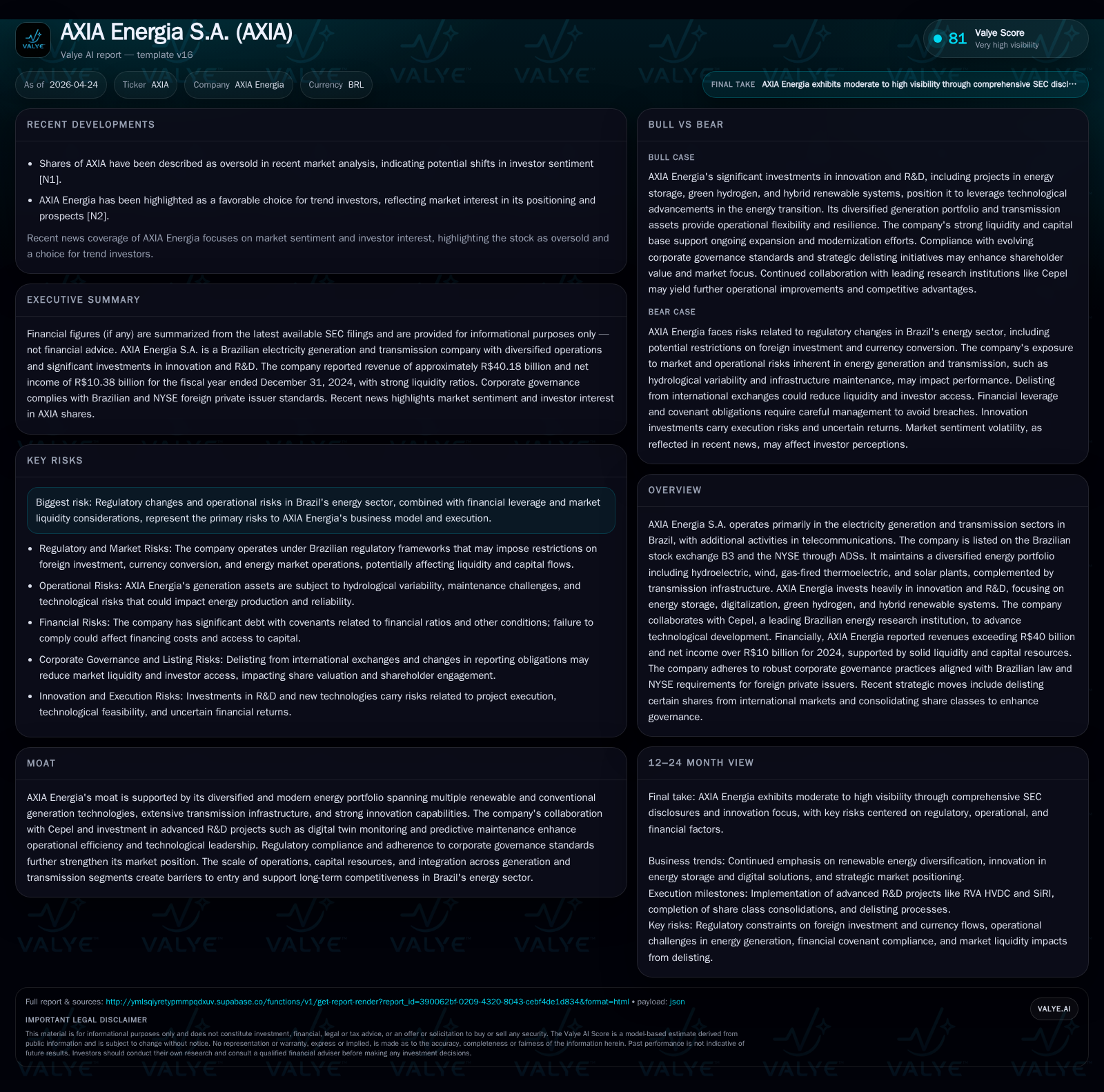
The company’s latest quarterly disclosures highlight ANEEL-approved tariff revisions impacting transmission revenues in the 2025-2026 cycle, alongside expenses linked to RBSE financial components. AXIA Energia’s business model leverages a balanced portfolio of hydroelectric, wind, solar, and gas-fired generation assets integrated with regulated transmission infrastructure, underpinned by long-term concession contracts. Its competitive edge is reinforced through substantial R&D investments targeting hybrid renewable systems and predictive maintenance technologies developed with Cepel. Growth is catalyzed by Brazil’s rising power demand and government auction programs but constrained by regulatory uncertainties and capital-intensive projects. Near-term milestones focus on public bidding outcomes and adherence to debt covenants supporting liquidity and funding for expansion.
Key Highlights from AXIA Energia’s 1Q/2026 Interim Report
AXIA Energia's recent dual Form 6-K filings on April 24, 2026 ([S2], [S3]) provide fresh clarity on the company’s operational trajectory into the 2025-2026 tariff cycle. Most notably, ANEEL issued Dispatch No. 1,228 in April 2025 revising the Annual Allowable Revenue (RAP) for transmission concessions under contract No. 061/2001 held by AXIA Energia Nordeste — a segment central to the firm’s regulated asset base. This revision led to a downward adjustment of approximately R$406 million on certain RAP components relative to original homologated figures ([S1]). Concurrently, resolutions (No. 3,462/2025 et al.) brought about a new revenue flow linked to the RBSE financial component concerning capital costs not previously compensated between 2013-2017. AXIA recorded an expense of roughly R$4.17 billion related to these regulatory remeasurements across its transmission agreements—substantially affecting short-term cash flows but reflecting resolved administrative appeals that cap ongoing uncertainty ([S1], [S2]).
Additionally, shareholder meetings conducted in mid-April ratified governance matters such as management approval of annual financial statements for FY2025 and a corporate name amendment process to 'AXIA Energia S.A.', signaling institutional alignment with evolving strategic directions ([S2], [S3]).
AXIA Energia’s Business Model: Diverse Generation and Transmission Capabilities
At its core, AXIA Energia monetizes through two tightly linked streams: electricity generation from a diversified portfolio comprising hydroelectric dams, wind farms, solar plants, and gas-fired thermoelectric facilities; alongside revenues from transmission infrastructure operated under long-term concession contracts grounded in the Brazilian regulatory framework ([S1], [F1]).
A distinctive feature of its transmission business lies in recognizing Contractual Transmission Assets—capitalized investments in grid infrastructure tracked as present value receivables accruing construction revenues plus embedded financial income discounted at rates near 6.5% annually—with amortization aligned to concession terms ([S1]). Approximately R$24.4 billion of these assets relate specifically to the RBSE segment arising from concession renewals under Law No. 12.783/2013. Adjustments to RAP directly influence cash flow timing and risk profiles tied to these regulated assets.
This integrated approach balances merchant risk inherent to variable renewable generation with the steady income stream from regulated transmission tariffs (RAP), thereby stabilizing aggregate operating cash flows while enabling incremental growth through investments in newer renewable projects or capacity expansions.
Competitive Positioning within Brazil’s Energy Sector Ecosystem
AXIA Energia competes among Brazil's foremost electric utilities benefiting from scale economies across both generation mix breadth and transmission network depth. Its partnership with Cepel—a premier research institution—anchors an innovation ecosystem that accelerates applied R&D efforts in areas such as digital twin simulation for HVDC systems (RVA HVDC) and AI-driven predictive maintenance platforms exemplified by the SiRI project implemented at the Tucuruí Hydroelectric Plant ([S10], [S14]).
These technological advantages translate into operational efficiencies that mitigate downtime risks across diverse assets while enhancing predictive insights critical given Brazil’s complex hydro-climatic conditions impacting hydro plant availability.
Moreover, adherence to evolving corporate governance standards—including transitioning toward Novo Mercado compliance enhancing shareholder rights—fortifies investor confidence amid a maturing yet politically nuanced regulatory environment ([S1], [S8]).
Growth Drivers and Challenges in Renewables and Transmission Infrastructure
Brazil's steadily increasing electricity demand driven by industrialization trends and distributed generation integration incentivizes utility-scale expansions—both generation and transmission—which AXIA is positioned to capitalize on via public auction participation enabled through subsidiaries ([S1]). These auctions underpin key revenue visibility drivers alongside government incentives favoring green hydrogen pilot projects and hybrid solar-wind-battery deployments as evidenced by Casa Nova initiatives backed with over R$90 million investments ([S14], [S20]).
Nevertheless, growth faces constraints inherent in regulatory volatility around tariff structures (e.g., RTP timetable revisions) and associated RBSE compensation debates which can introduce lumpy cash flows or unexpected expense spikes ([S1], [S9]). Capital intensity remains a hurdle given large-scale infrastructure needs where financing costs sensitive to macroeconomic shifts impact capital deployment rhythm.
Furthermore, covenants embedded within debt agreements place limits on leverage ratios such as Net Debt/EBITDA that require rigorous monitoring to preserve access to credit lines crucial for sustaining capex momentum ([S4], [S11]).
Regulatory Environment and Its Impact on AXIA Energia’s Operations
Recent decisions by ANEEL instituting revised RTP tariffs—effective April 2025—and clarified recognition of financial components pertaining to undepreciated RBSE assets have materially influenced revenue recognition patterns for AXIA's transmission concessions ([S1]). The adjustment decreased expected RAP receipts by nearly R$400 million yet resolved protracted administrative appeals providing clarity for future cash flow projections.
Understanding these technical regulatory levers is vital as they dictate not only near-term operating results but also the valuation of Contractual Transmission Assets recorded on balance sheets. They further underscore asymmetric risks investors bear given shifts can be retroactive or subject to legal contestation within Brazil’s complex regulatory system.
Innovation and R&D Investments as Catalysts for Future Growth
AXIA Energia’s commitment to innovation remains profound; in 2025 alone it allocated nearly R$630 million towards R&D initiatives integrating cutting-edge technologies such as augmented reality visualization for valve monitoring (RVA HVDC) and real-time sensor networks enabling condition-based maintenance (SiRI), supported strategically by Cepel resources ([S10], [S20]).
Investments into emerging green technologies including concentrated solar power with integrated thermal storage systems illustrate its forward-looking pivot toward dispatchable renewables mitigating intermittency challenges prevalent across wind and photovoltaic sources ( [S20]). This enables enhanced energy security which has become critical amid rising decarbonization mandates shaping Brazil's power sector roadmap.
Such technology-driven efficiencies are expected to gradually improve operating margins while delivering intangible benefits related to asset longevity extension and reduced outage risks.
Near-term Milestones and Risk Factors to Monitor
Key milestones ahead include ACE participation outcomes—for auctions awarding new generation/concession rights—assessed carefully against prevailing financing conditions due to substantial upfront CAPEX requirements ([S1], [S12]). Also monitored closely are periodic tariff adjustment announcements by ANEEL impacting RBSE remuneration flows alongside potential judicial developments stemming from ongoing civil litigations highlighted in filings related principally to indemnification claims arising from past operations ([S9], [S21]).
Financial covenant compliance warrants continuous oversight given net debt levels near R$47 billion at end-2025 after recent refinancing activities maintaining gross debt near R$74 billion but offset partially by robust operational free cash flow generation exceeding R$14.5 billion yearly ([F1], [S5], [S13]). Any disruptions here could affect liquidity position or borrowing costs.
2024-2025 Financial Overview Supporting Strategic Execution
Historical performance (annual)
|
| FY | Rev ($bn) | Net ($bn) | Rev YoY | Net YoY |
|---|---|---|---|---|
| 2024 | 40.2 | 10.4 | +8.1% | +136.2% |
| 2023 | 37.2 | 4.4 | +9.1% | +20.8% |
| 2022 | 34.1 | 3.6 | -9.4% | -36.3% |
| 2021 | 37.6 | 5.7 |
Source: SEC companyfacts cache [F1].
Capital returns and efficiency (annual)
|
| FY | ROE% |
|---|---|
| 2024 | 8.5 |
| 2023 | 3.9 |
| 2022 | 3.3 |
| 2021 | 7.5 |
Source: SEC companyfacts cache [F1].
AXIA Energia demonstrated resilient top-line growth with revenues surpassing R$40 billion for fiscal year ended December 31, 2024—a roughly 8% increase year-on-year—and net income more than doubling year-over-year to reach over R$10 billion driven largely by operational efficiencies combined with favorable market conditions ([F1]).
Liquidity remains solid evidenced by cash & equivalents exceeding R$26.5 billion at end-2024 along with a conservative current ratio of approximately 2.04 ensuring ample coverage for short-term liabilities totaling around R$31.6 billion ([F1]). Long-term indebtedness stood near R$61 billion as of end-2025 after scheduled amortizations per contractual maturities confirming manageable leverage around 28% total capital structure according to internal definitions ([F1], [S5]).
Capital expenditures maintained elevated levels exceeding R$8.5 billion annually focusing predominantly on transmission upgrades supported by innovative expansion projects aligned with sustainability mandates preemptively positioning AXIA across multiple segments convergent with Brazil’s evolving energy matrix ([S14],[F1]). Meanwhile authorized share repurchase plans complement capital return strategies balancing reinvestment imperatives against shareholder value goals through mid-2027 horizon ([S7],[S18],[F1]).
This analysis synthesizes publicly disclosed information as of April 24, 2026; it reflects operating developments anchored predominantly on recent quarterly filings supplemented by annual reporting without presenting investment recommendations or price forecasts.
Disclaimer: This is research-only, informational analysis and not investment advice. It may include AI-generated interpretation and general industry context. Always verify important details using primary sources.

Comments