
Equity LifeStyle Properties Inc: Diversified Residential REIT Navigating Growth and Market Dynamics
Equity LifeStyle Properties (ELS) operates a specialized residential REIT platform focused on RV resorts, manufactured home communities, and marinas, leveraging a diversified portfolio and stable revenue streams.
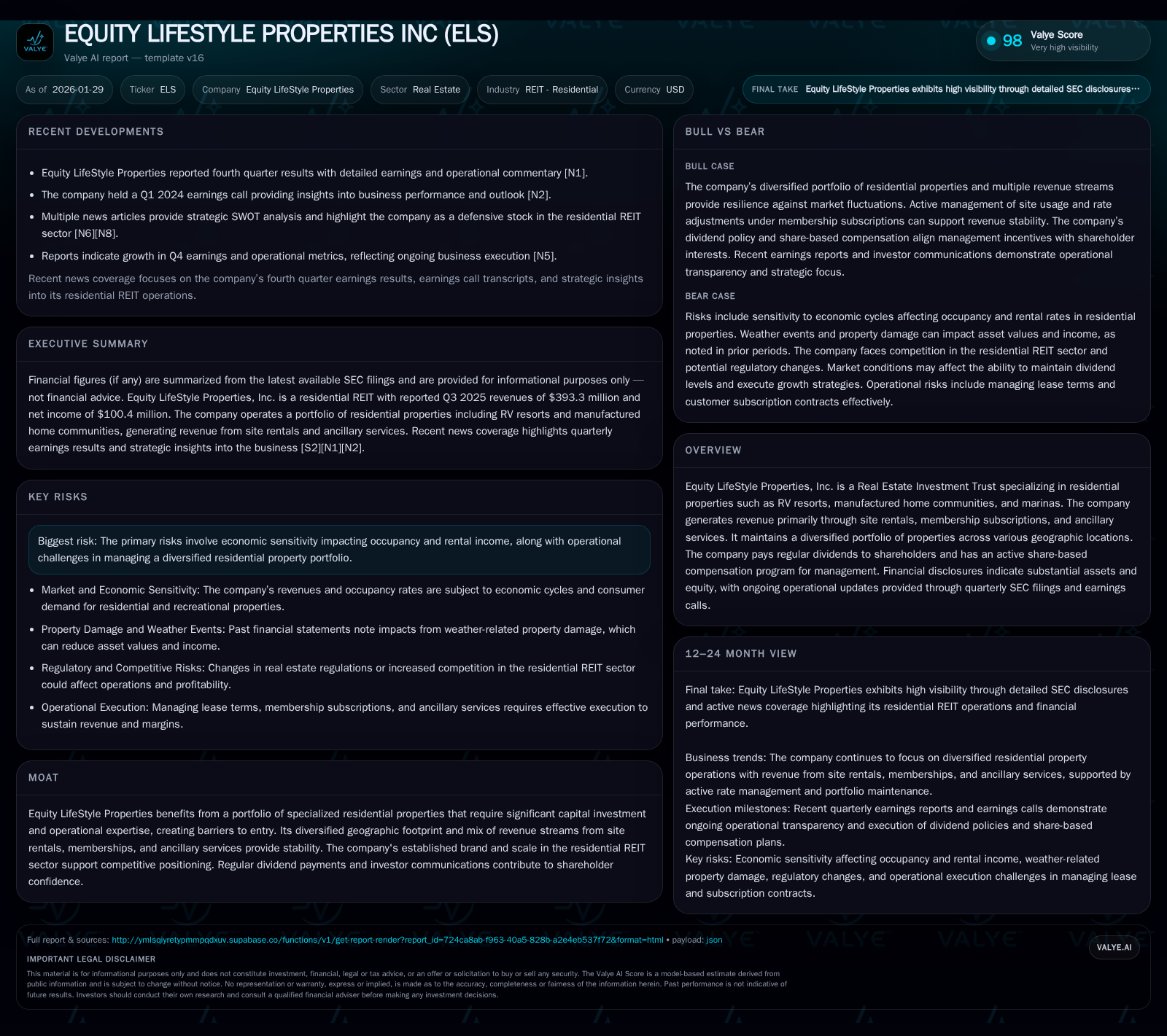
Equity LifeStyle Properties reported solid Q4 2025 results highlighting growth in site rental income and robust operational performance across its RV resorts, manufactured home communities, and marinas. The company’s business model centers on long-term site rentals supplemented by memberships and ancillary services, underpinned by a geographically diversified portfolio. ELS’s competitive moat derives from significant capital requirements and operational expertise, though economic sensitivities and operational complexity remain key risks. Capital structure and dividend policy reflect an emphasis on shareholder returns and disciplined financial management. Key diligence areas include occupancy trends, rate-setting flexibility, and impact from weather-related events.
What Changed Recently
Equity LifeStyle Properties (ELS) reported its Q4 2025 earnings with key highlights including growth in RV and marina base rental income, membership subscription revenue, and ancillary services. The company demonstrated operational resilience amid ongoing macroeconomic uncertainties, with improved occupancy trends and successful rate increases at many properties [N2][N3][N5]. The earnings call transcript emphasized ongoing strategic initiatives to optimize portfolio mix and capitalize on demand shifts in outdoor and lifestyle-oriented residential spaces [N1]. The company also updated investors on its capital deployment, including share issuance programs and disciplined acquisition activity [N1][S1]. Overall, the recent results reinforced ELS’s ability to navigate competitive and economic pressures while maintaining a stable dividend policy.
Business Model as a System
Equity LifeStyle Properties functions as a Real Estate Investment Trust (REIT) that owns and operates a diversified portfolio of specialized residential properties: RV resorts, manufactured home communities, and marinas. The core of the business model is leasing sites to residents or transient customers under various lease structures, often long-term with provisions for rental rate escalations tied to the Consumer Price Index (CPI) or market adjustments [S2][S17].
Revenue streams include:
- Site Rentals: Base rental income from leased lots or slips, which form the majority of revenue.
- Membership Subscriptions: Particularly in resorts and marinas, memberships provide recurring fee income with benefits and access privileges.
- Ancillary Services: Such as utility fees, maintenance, and on-site amenities that enhance customer experience and contribute incremental revenue [S2].
The portfolio’s geographic diversification spreads risk and captures demand heterogeneity across regions, with properties strategically located in growth markets and lifestyle destinations [S7][S8]. Operational management focuses on maintaining high occupancy rates, managing lease renewals, and optimizing pricing to balance yield and retention. Capital expenditures are directed toward property improvements, infrastructure upgrades, and compliance with regulatory standards, supporting both asset preservation and value creation [S18][S19].
Equity issuance through at-the-market (ATM) programs supplements financial flexibility for acquisitions and development, while a conservative capital structure supports consistent dividend payouts [S1][S2]. The company’s brand recognition and scale confer competitive advantages in sourcing deals and managing operations efficiently.
Industry Map & Competitive Battlefield
Equity LifeStyle Properties occupies a niche within the broader residential REIT sector, focusing on lifestyle-oriented properties that require specialized operational know-how and capital intensity. The primary competitors include other publicly traded REITs specializing in manufactured housing communities and RV parks, smaller private operators, and emerging lifestyle real estate platforms.
Key industry dynamics include:
- Barriers to Entry: High capital requirements for land acquisition, development, and ongoing maintenance limit new entrants. Operational expertise to manage diverse property types and regulatory compliance also constrains competition.
- Demand Drivers: Increasing consumer interest in affordable and flexible living options, growth in RV travel, and lifestyle preferences favoring outdoor and community living.
- Regulatory Environment: Zoning laws, environmental regulations, and tenant protections vary by jurisdiction, impacting development and operational costs.
- Technology & Experience: Investment in property management systems, customer engagement platforms, and amenity upgrades are increasingly important to differentiate offerings.
The competitive battlefield is thus characterized by scale advantages, portfolio quality, geographic presence, and the ability to innovate in service delivery. ELS’s diversified footprint helps mitigate localized downturns or regulatory shocks, while its brand and operational scale support premium pricing and retention [valye_report_excerpt].
Where the Economics Become Real
The unit economics of ELS hinge on maximizing site utilization, optimizing rental rates, and controlling operating expenses. Key levers include:
- Occupancy & Utilization: High occupancy rates translate directly to steady rental income. The company targets occupancy well above 90%, balancing transient and long-term tenants [S3].
- Rental Rate Increases: Contracts often include CPI-linked escalations and periodic market rate adjustments. Rate-setting power depends on local supply-demand dynamics and property differentiation [S2].
- Ancillary Revenue Margins: Upselling memberships and services with favorable margin profiles enhances overall profitability.
- Capex & Maintenance: Ongoing capital expenditures, including property improvements and regulatory compliance, are necessary to sustain asset value and tenant satisfaction. These investments, while significant, can drive higher rates and occupancy over time [S18][S19].
- Leverage & Financing Costs: The company maintains a capital structure balancing debt and equity to fund acquisitions and growth, with interest rates and refinancing risk influencing net income volatility [S13][S16].
Operational bottlenecks include the availability of attractive acquisition targets, local regulatory hurdles, and weather-related disruptions that can cause asset damage and temporary income loss [S10][S21]. Effective management of these factors determines the sustainability of cash flows and dividend coverage.
Diligence Questions / Disconfirming Signals
Several areas warrant closer scrutiny to better understand underlying risks and validate assumptions:
- Occupancy Trends: Are occupancy rates stable across all sub-segments and geographies? How sensitive are occupancy levels to economic cycles?
- Pricing Power & Lease Terms: What is the cadence and magnitude of rental rate increases? How flexible are lease renewal terms under different market conditions?
- Impact of Weather Events: Given exposure to marinas and outdoor resorts, what is the historical and potential impact of storms or other climate events on asset values and income?
- Capital Allocation Effectiveness: How efficiently is capital deployed in acquisitions, capex, and share repurchases? Are acquisition yields accretive to cash flow per share?
- Regulatory and Legal Risks: How do local regulations affect operations, development, and tenant disputes? What is the company’s track record managing these risks?
- Competitive Positioning: How does ELS maintain differentiation relative to peers? Are there emerging competitors or disruptors in the residential lifestyle REIT space?
- Financial Flexibility: What is the status and capacity of ATM equity programs and debt facilities? How is liquidity managed under stress scenarios?
- Dividend Sustainability: Are dividend payouts consistently covered by funds from operations (FFO)? What are the contingencies if cash flow declines?
Understanding these factors will better clarify the operational resilience and growth prospects of Equity LifeStyle Properties amid evolving market conditions.
This analysis is based on publicly available information as of January 29, 2026, including company disclosures and recent news. It is intended for informational purposes only and does not constitute investment advice.
Disclaimer: This is research-only, informational analysis and not investment advice. It may include AI-generated interpretation and general industry context. Always verify important details using primary sources.

Comments