Paramount Gold Nevada Corp.: At the Crossroads of Regulatory Triumph and Financial Challenges
A junior miner poised to advance its Grassy Mountain project amid a transformative phase marked by federal approvals, leadership changes, and tight liquidity.
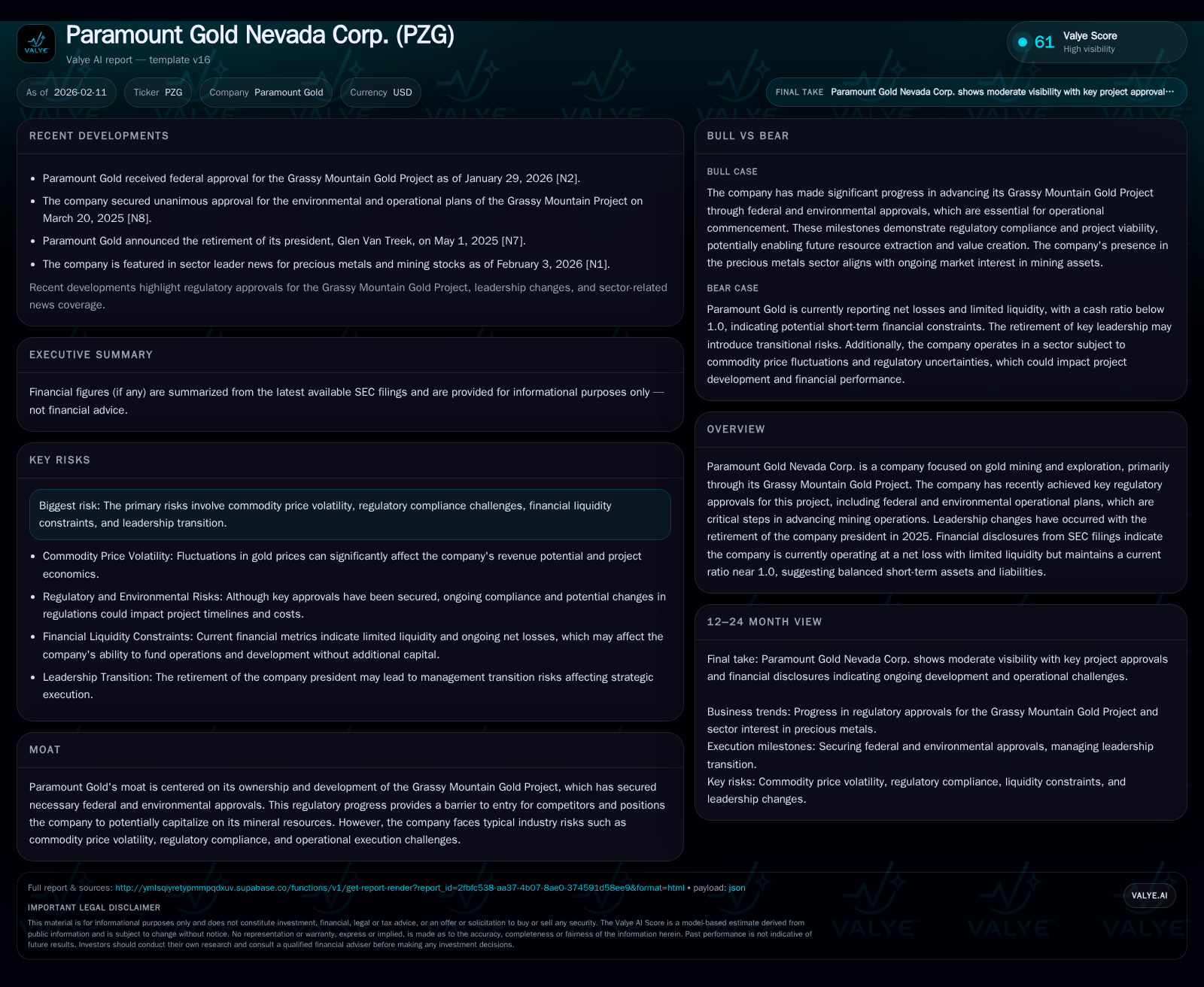
Paramount Gold Nevada Corp. has secured pivotal federal and environmental regulatory approvals for its flagship Grassy Mountain Gold Project, a crucial gateway toward potential gold production. This milestone establishes a regulatory moat that could shield the company’s assets from competitive pressures but also coincides with challenges including the retirement of its president in 2025, ongoing net losses, and constrained liquidity levels. While the company balances short-term assets and liabilities with a current ratio near parity, its path forward will hinge on managing operational execution risks and navigating volatile commodity markets.
Grassy Mountain Greenlight: What Federal Approval Really Means
Paramount Gold Nevada Corp.’s recent acquisition of essential federal permitting for its Grassy Mountain Gold Project marks more than just a regulatory checkpoint—it's a strategic lever in a capital-intensive industry where such clearances form formidable barriers against competitors. The formal approval announced in late January 2026 [N2] complements the company’s longstanding environmental planning efforts, effectively transforming exploration ambitions into actionable mine development prospects. This governmental nod not only affirms compliance with stringent operational mandates but also cements Paramount Gold’s unique positioning within the Nevada mineral landscape.
Through this lens, the regulatory greenlight constitutes Paramount Gold’s most tangible moat to date—an asset immaterial in conventional terms but critical in limiting alternative entrants’ access to these deposits. It reflects successful navigation through complex federal processes historically known to throttle junior mining endeavors. Yet, this advantage carries implicit operational risk; holding permits is merely the preamble to successful extraction.
From Boardroom to Mine Shaft: Leadership Transition and Its Implications
In tandem with its regulatory accomplishments, Paramount Gold experienced notable leadership changes when its company president retired during 2025 [valye_report_excerpt; S1]. Though no successor details were disclosed in recent filings, departures at such senior levels naturally prompt market watchers to assess potential shifts in strategic direction or execution capabilities.
The retiring executive presumably stewarded critical regulatory milestones; hence, his absence places further emphasis on management’s ability to sustain momentum at this pivotal juncture. Historically, transitions within junior miners can introduce operational friction or re-evaluations of project prioritization. Paramount Gold’s SEC disclosures articulate no immediate upheaval but thoughtful investors must monitor how such internal dynamics interact with external headwinds.
Balance Sheet Realities: Liquidity, Losses, and the Current Ratio Balancing Act
Turning attention to Paramount Gold’s financial health reveals the tightrope upon which it currently walks. The latest consolidated results indicate a net loss exceeding $4.4 million for calendar year 2025 [F1]. This level of operating loss aligns with expectations for a predominantly development-stage entity yet underscores persistent earnings pressure.
Meanwhile, cash and equivalents totaled roughly $3.54 million as of December 31, 2025, balanced against nearly $4.13 million in current liabilities [F1]. A resulting current ratio near 1.01 suggests only marginal coverage of near-term obligations by liquid assets—a delicate equilibrium that constrains discretionary spending while highlighting vulnerability to unexpected expenses or delays.
This financial posture necessitates rigorous cash management as Paramount progresses from approval toward potential production. Given that revenue streams remain negligible ($210k last reported in early 2022), bridging financing needs remain central considerations absent internal operating cash flow generation [F1].
Regulatory Moat or Tightrope? Exploring Barriers and Industry Volatility
Paramount Gold’s unique possession of fully permitted resource rights at Grassy Mountain establishes a form of competitive moat seldom attained by peers still entangled in lengthy environmental reviews or contested land claims [valye_report_excerpt]. In an industry fraught with unpredictable compliance timelines and community relations complexities, such clearances confer tangible value.
However, this moat is far from impregnable. The company remains exposed to fluctuating gold prices—affecting project economics—and must uphold ongoing regulatory standards during construction and operation phases. Failure to do so risks permit revocation or costly remediation efforts.
Hence while Paramount’s approved status restricts direct new entrants locally, maintaining permit integrity amidst volatile commodity cycles transforms regulatory advantage into continuous operational vigilance—a tightrope walk balancing opportunity against exposure.
Operational Blueprint: Advancing from Regulatory Nod to Gold Production
With permits secured as of January 29th, 2026 [N2], Paramount Gold enters an operational phase historically characterized by substantial lead times before revenue realization. The company has not publicly outlined definitive commencement dates for mining or production ramp-up; such silence is typical given technical studies, capital raising efforts, equipment procurement, and contractor mobilization phases common across juniors.
Industry experience suggests that actual extraction could remain years away depending on financing success and permitting conditions attached during approval—a point emphasized in Valye’s overview highlighting standard gestation hurdles still ahead [valye_report_excerpt]. Precise timelines remain speculative absent concrete company statements.
Industry Backdrop: Precious Metals Momentum and Market Positioning
Against Paramount Gold’s microcosm sits a broader precious metals sector exhibiting intermittent surges driven by inflation fears, geopolitical uncertainty, and investor flows into metal-centric ETFs [N1; N3]. Notably, metals & mining stocks have surfaced periodically among sector leaders on major exchanges as recently as early February 2026 [N1], while ETFs related to silver miners (SILJ) demonstrated meaningful trading interest at year start [N3].
This backdrop suggests that market appetite for precious metals exposure persists—supportive context for juniors like Paramount seeking valuation uplift upon moving from exploration milestones toward production realities.
Risk Radar: Commodity Cycles, Compliance Challenges, and Financial Constraints
No material changes have occurred in Paramount Gold’s articulated risk factors since the prior annual report [S2], reinforcing persistent concerns around fluctuating gold prices that could suppress project feasibility or delay investment decisions. Beyond pricing volatility lies regulatory risk—not simply at initial permitting but through ever-evolving environmental and social governance requirements demanding sustained compliance.
Additionally, limited liquidity coupled with continuing net losses presents capital adequacy concerns with direct implications on operational continuity unless offset by timely external funding or partnership arrangements. Leadership changes compound uncertainties relating to strategic continuity under these stressors [valye_report_excerpt; S1; S2].
Shareholder Stakes and Capital Strategies: Sustaining the Journey
Paramount Gold Nevada Corp.’s financial disclosures implicitly hint toward imminent capital strategies necessitated by narrow liquidity buffers juxtaposed against negative earnings trends [F1; valye_report_excerpt; S1]. While explicit fundraising plans are undisclosed most juniors in similar stages typically resort to equity offerings or joint ventures to finance construction and transition toward cash flow-positive operations.
This phase inherently raises potential dilution risks for existing shareholders alongside execution risks tied to operator capacity and market conditions dictating fundraising feasibility. Navigating this landscape demands astute balance between preserving shareholder value while ensuring sufficient capital deployment necessary for unlocking Grassy Mountain’s assets—a complex endeavor underscored by recent leadership shifts.
Disclaimer: This analysis is for informational purposes only and does not constitute investment advice or recommendations. Readers should conduct their own due diligence before making any financial decisions.
Disclaimer: This is research-only, informational analysis and not investment advice. It may include AI-generated interpretation and general industry context. Always verify important details using primary sources.

Comments