
PBF Energy Inc.: Navigating Operational Challenges Amidst Refining Sector Volatility
An incisive review of PBF Energy's recent operational hurdles, financial posture, and sector dynamics shaping its refining business.
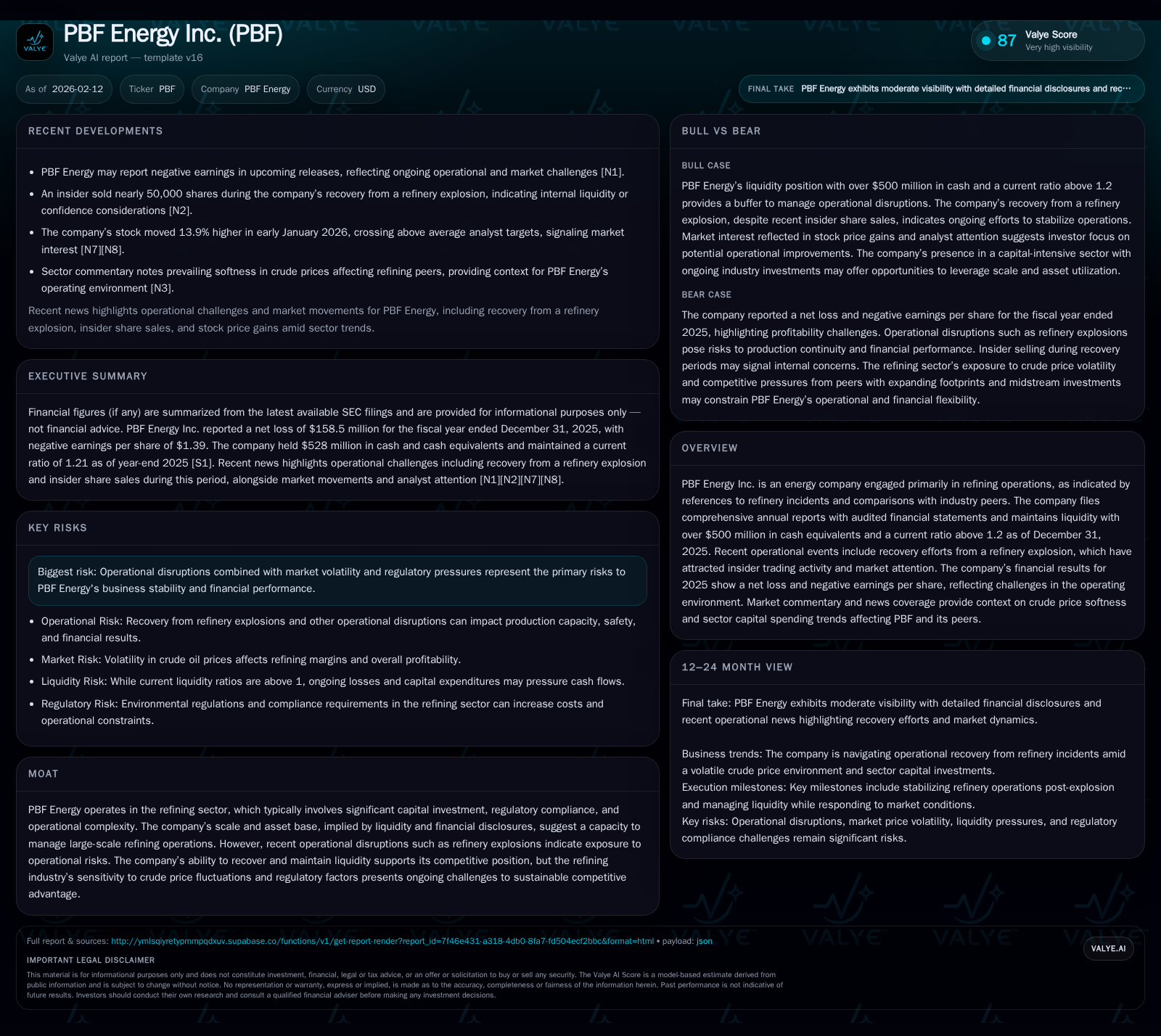
PBF Energy Inc. operates as a key player in the U.S. refining industry but faced significant operational disruption from a recent refinery explosion affecting near-term performance. The company reported a net loss for 2025, underscoring ongoing challenges from market volatility and crude oil price softness, compounded by sector-wide capital spending pressures. Despite these headwinds, PBF maintains solid liquidity and a current ratio above 1.2, supporting its capacity to manage recovery efforts and operational complexity. Evolving cybersecurity governance and regulatory risks add layers of complexity that PBF must continue to navigate amid an uncertain macro environment.
Company Overview
PBF Energy Inc. remains one of the prominent independent refining companies in the United States, operating assets characterized by high capital intensity, sophisticated process complexity, and notable regulatory oversight. Its portfolio focuses on converting crude oil into refined petroleum products critical to domestic energy supply chains.
Recent disclosures from its latest annual Form 10-K emphasize both the company’s operating scale and the significant risks particular to performance in this segment [S1]. Liquidity metrics highlight $528 million in cash equivalents at the end of 2025 alongside current assets totaling $4.45 billion against current liabilities of $3.67 billion, translating to a current ratio of approximately 1.21 — a figure that underlines financial flexibility despite near-term industry headwinds [F1].
Operational Incident: Refinery Explosion Impacts
A defining event shaping PBF’s short-term outlook has been a refinery explosion occurring prior to year-end 2025 that resulted in both operational disruptions and safety concerns [N3]. This incident triggered intensive recovery efforts, requiring strategic resource allocation amidst already softening crude markets.
Market observers noted insider sales totaling nearly 50,000 shares following this accident, indicating potential recalibration of insider expectations surrounding operational recovery timelines [N3]. Such insider behavior can often signal management confidence or the necessity for liquidity during uncertain periods.
Financial Performance Summary
The fiscal year 2025 culminated with a net loss close to $158.5 million, pertaining directly to the compounded effects of the operational disruption coupled with deteriorating market conditions [F1]. Negative earnings per share accompanied this loss, driving concern over profitability sustainability.
Revenue figures from earlier periods demonstrate sizeable top-line throughput; however, margin compression driven by lower demand spreads and subdued crude pricing have pressured earnings consistently throughout the year [N1]. Declines in benchmark crude prices further complicated refining margins industry-wide [N4][N6], exacerbating challenges for PBF's asset utilization.
Industry Environment Analysis
The downstream refining sector continues to wrestle with structural changes including fluctuating product demand patterns linked to global economic cycles, evolving regulatory emissions standards, and geopolitical tensions influencing crude feedstock availability and cost.
Peer companies such as Valero Energy (VLO) have drawn attention for their capacity to absorb ongoing market softness yet still face similar margin pressures [N4][N10]. Likewise, Phillips 66’s push into midstream assets exemplifies attempts to enhance resilience via vertical integration — an area where PBF’s positioning remains less emphasized [N11].
Capital expenditure restraint across the sector reflects caution amid uncertainty about future demand durability and potential transitions toward lower carbon intensity fuels.
Risk Profile Considerations
PBF's Form 10-K prominently illustrates risk factors surrounding cybersecurity threats which could materially affect business continuity if exploited [S1]. This domain has received organizational prioritization through the appointment of an experienced Chief Information Officer with extensive expertise managing security risks at comparable industrial enterprises.
Operational risks extend beyond cybersecurity. The refinery explosion starkly revealed vulnerabilities inherent in aging infrastructure or complex process environments requiring rigorous maintenance and emergency preparedness protocols.
Regulatory risks are ever present given tightening emissions controls and environmental policies targeting refineries as significant pollutant sources.
Market volatility—both in commodity prices and broader capital markets—adds layers of unpredictability affecting earnings forecasts and investment planning.
Competitive Position & Strategic Posture
Maintaining competitiveness involves balancing investment in facility upgrades against preserving capital amid volatile cash flow profiles. PBF’s liquidity position affords it some cushion; nonetheless, managing discretionary spending prudently is critical during crisis recovery phases.
While some peers diversify revenue streams through expanded petrochemical capacities or integrated midstream services, PBF appears more concentrated on core refining functions—a strategic choice influencing its risk-reward calculus.
The company’s ability to recover operational normalcy post-incident will critically influence investor sentiment and customer confidence going forward.
Recent Market Sentiment & Analyst Views
Trading behavior exhibited a rebound in early January 2026 with approximately 13.9% gains noted after stabilization signals emerged post-explosion [N7]. However, skepticism persists about sustaining momentum amid persistent macroeconomic pressure points.
Coverage indicates analysts have adjusted downward earnings expectations heading into release windows coinciding with reported losses yet recognize potential opportunities should refining margins improve or operational issues resolve swiftly [N1][N2][N8].
Collectively, market narratives underscore caution tempered by guarded optimism hinging largely on how efficiently PBF manages repair timelines and controls fixed costs during recovery.
Cybersecurity Governance Deep Dive
Governance excerpts reveal structured reporting lines for cybersecurity risk management extending up to the Board Audit Committee, suggesting mature frameworks aimed at preemptive identification and mitigation of IT threats [S1]. Quarterly reviews complement annual internal audit assessments foster iterative improvement.
Given escalating cyber risks globally—and expanding digitalization across refining operations—such emphasis is critical to guarding proprietary operational data flows as well as ensuring safety instrumentation network integrity.
Forward-Looking Considerations (Analysis)
Looking ahead through an industry lens, refiners like PBF must navigate dual imperatives: adapting infrastructure for evolving fuel mixes aligned with energy transition goals while safeguarding profitability under lingering commodity price volatility.
Recovery from discrete adverse events like refinery explosions inherently demands time-bound capital infusion and workforce mobilization yet also imposes reputational strain translating into possible tightened credit terms or insurance costs.
Successful navigation will hinge on disciplined financial stewardship paired with strategic operational improvements including potential technology upgrades or expansions adopting emissions-reducing innovations.
Finally, intensifying regulatory landscapes—whether related to environmental standards or cybersecurity mandates—will require sustained investment balanced carefully against immediate economic realities.
This analysis is based on publicly available documents including SEC filings [S1][S2], industry news reports [N1-N11], and proprietary company fact extracts [F1] provided as of February 12, 2026. It is intended solely for informational purposes without making any recommendations regarding investment decisions.
Disclaimer: This is research-only, informational analysis and not investment advice. It may include AI-generated interpretation and general industry context. Always verify important details using primary sources.

Comments