
In-Depth Analysis of NorthWestern Energy Group, Inc.: Strategic Positioning within the Regulated Utility Landscape
An examination of NorthWestern Energy’s operations, strategic initiatives, regulatory environment, and financial performance through 2025.
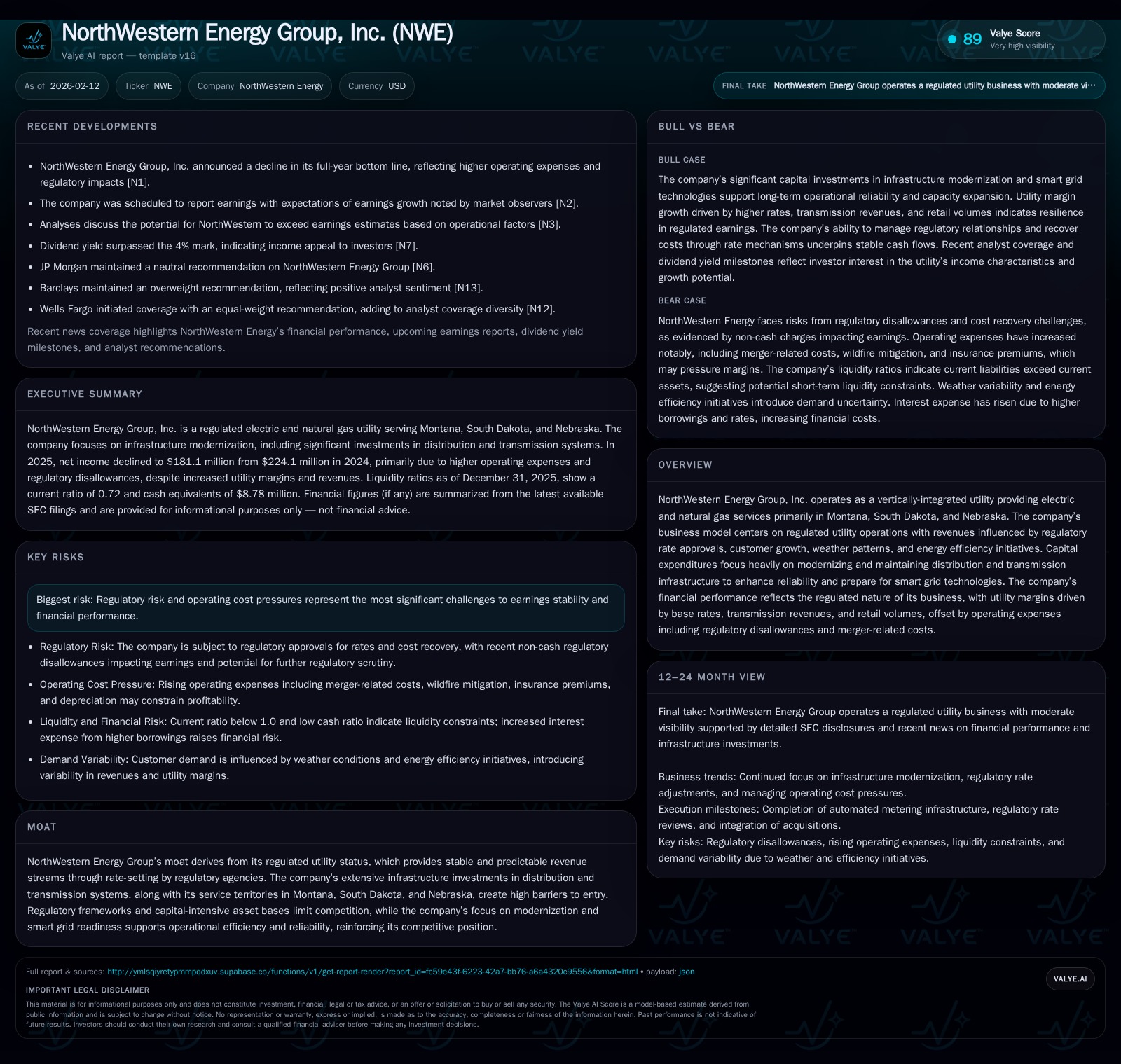
NorthWestern Energy Group operates as a vertically-integrated utility focused on electric and natural gas services across Montana, South Dakota, Nebraska, and Yellowstone National Park. The company’s regulated business model offers stable revenues underpinned by infrastructure investments targeted at modernizing their grid and advancing smart technology readiness. Despite facing regulatory risks and rising operating costs in 2025 that pressured earnings, NorthWestern remains committed to sustainability goals including net zero carbon emissions by 2050 and is navigating a pending merger with Black Hills Corporation to enhance scale and operational expertise. Weather patterns and regulatory decisions continue to materially influence its financial outcomes, alongside ongoing capital expenditures driving long-term resilience.
Company Overview
NorthWestern Energy Group, Inc. (ticker: NWE) operates as a vertically integrated electric and natural gas utility serving roughly 850,300 customers primarily concentrated across Montana, South Dakota, Nebraska, along with servicing Yellowstone National Park through subsidiaries NW Corp and NWE Public Service [S1]. Its business model largely rests on regulated operations where state public utility commissions establish rates allowing recovery of costs plus an authorized return.
The company’s competitive moat stems from its regulated status creating high barriers to entry via capital-intensive networks that require ongoing maintenance. Regulatory oversight not only limits new entrants but also governs rates to balance utility financial health with community affordability considerations.
Strategic Focus and Infrastructure Investment
Central to NorthWestern's strategic vision is investing in the modernization of its electrical transmission and distribution systems. Approximately $2.3 billion—roughly 70% of the company's recent capital budget—is earmarked for system upgrades aimed at reversing aging infrastructure trends while embedding automation technologies such as advanced metering infrastructure (AMI), which was completed across Montana in 2025 [S1].
This investment trajectory supports multiple objectives: enhancing grid reliability and safety; enabling future smart grid applications; increasing system capacity; reducing outage durations; and supporting two-way communication between utilities and customers.
Operational Performance Analysis
NorthWestern's revenue profile bears sensitivity to regulatory decisions as well as load variability driven by weather conditions measured through heating and cooling degree-days—a statistical proxy for temperature-driven energy demand [S1].
Fuel costs and purchased supply expenses are largely passed through customers under regulatory cost recovery mechanisms. Therefore, the firm emphasizes Utility Margin—defined as operating revenues net of fuel, purchased supply, and direct transmission expenses—as a non-GAAP measure offering clearer insight into operational profitability excluding cost pass-through volatility.
In the fiscal year ending December 31, 2025, NorthWestern reported revenues of approximately $414 million but saw net income decline significantly to about $44.7 million from prior years due chiefly to elevated operating expenses related to regulatory disallowances on capital costs at its Yellowstone Gas Complex facility plus merger-related charges tied to an all-stock transaction with Black Hills Corporation [F1,S1].
Environmental Stewardship & Energy Transition
Aligning with the broader utility sector's transition imperative, NorthWestern reported that over half (52%) of its owned or contracted generating resources came from carbon-free sources in 2025—exceeding the average U.S. electric power industry figure of roughly 41% [S1]. The company has publicly committed to reaching net zero carbon emissions by mid-century.
Planning efforts include integrating renewable sources alongside conventional generation assets balancing reliability needs with sustainability ambitions.
Corporate Developments: Merger with Black Hills Corporation
A defining corporate event is NorthWestern’s August 2025 signing of a merger agreement with Black Hills Corporation initiated as an all-stock 'merger of equals.' Under this arrangement (expected closing pending approvals), Black Hills will be the accounting acquirer resulting in a combined entity named Bright Horizon Energy offering greater scale access to capital markets along with operational synergies [S1].
The integration outlook includes optimizing regional service territories covering complementary geographies with enhanced financial stability projected through diversified asset bases.
Risk Profile Considerations
NorthWestern navigates several risk dimensions attendant to the utility sector:
- Regulatory Risks: Earnings hinge significantly on timely rate case approvals by state commissions which may alter allowed returns or disallow certain costs, directly impacting net income [S1].
- Operating Cost Pressures: Maintenance costs for aging infrastructure alongside new technology deployments can squeeze margins if not carefully managed within regulated frameworks.
- Weather Dependency: Variability in temperature extremes influences consumption patterns for heating or cooling causing revenue fluctuation despite pass-through mechanisms.
- Merger Integration Risks: Realizing anticipated efficiencies from the merger depends on successful consolidation efforts without operational disruptions or regulatory delays.
Financial Condition Snapshot
By end-2025 reporting:
- Revenues stood near $414 million;
- Net income declined substantially compared to prior periods due to one-time charges;
- Cash & equivalents were modest at around $8.8 million;
- Current assets totaled approx. $504 million versus current liabilities of $697 million yielding a current ratio near 0.72, indicating typical liquidity tightness seen across capital-intensive electrical utilities yet sufficiently supported by predictable cash flows under regulation [F1].
Industry Context & Competitive Dynamics (Analysis)
Utility companies like NorthWestern operate in frameworks designed for stable cash flows supported by monopoly service territories but must balance evolving demands such as decarbonization mandates, technology adoption (smart metering/grid automation), cyber-security imperatives, and rate pressures sparked by inflationary cost environments.
The emergent trend toward integrated energy solutions combining gas and electric services positions companies like NorthWestern uniquely given its dual-fuel customer base — potentially enabling smoother transitions towards distributed energy resources or hybrid system models.
Moreover, mergers among regional utilities reflect strategic responses aiming at scale economies and risk diversification amid rising capital investment demands.
Conclusion
NorthWestern Energy represents a solid example of a midwestern U.S.-focused integrated utility balancing legacy regulatory structures with progressive modernization initiatives. While recent earnings have been impacted by elevated expenses including those stemming from regulatory rulings and merger transaction activities, the company’s firm commitment to renewing its distribution infrastructure coupled with sustainability ambitions establishes a foundation for long-term operational resilience within a tightly regulated sector.
With the pending merger forming Bright Horizon Energy, NorthWestern aims for amplified capability in delivering affordable energy solutions despite underlying market uncertainties shaped by regulation shifts and climate variability. Investors evaluating this space should weigh NorthWestern’s geographic footprint scale-up strategy alongside inherent risks common in electric-gas utility verticals.
This analysis is prepared solely for informational purposes based on publicly available data as of early 2026. It does not constitute investment advice or recommendations regarding securities or issuer strategies.
Disclaimer: This is research-only, informational analysis and not investment advice. It may include AI-generated interpretation and general industry context. Always verify important details using primary sources.

Comments