
Welltower Inc.: Strategic Positioning and Challenges in Healthcare Real Estate
Welltower Inc. leverages its healthcare-focused REIT model to navigate complex operational and macroeconomic dynamics while pursuing growth.
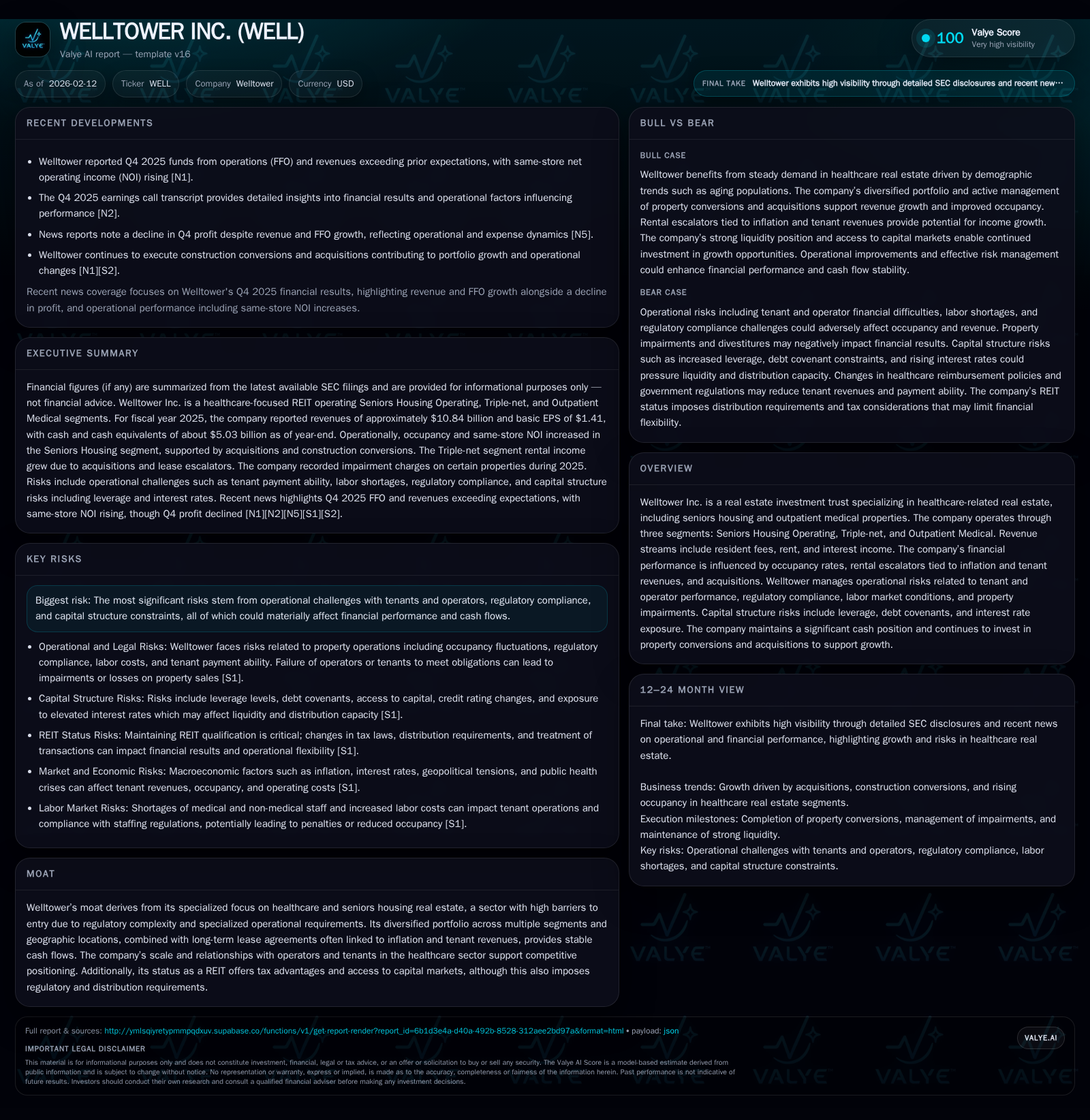
Welltower Inc. stands out as a specialized healthcare real estate investment trust with a durable moat anchored in regulated seniors housing and outpatient medical assets. Despite navigating recent net income pressures, the company reported strong fundamental growth in funds from operations (FFO) and same-store NOI in Q4 2025, supported by diversified revenue streams, long-term lease structures, and strategic capital deployment. Operational and regulatory complexities inherent to healthcare real estate remain a substantial risk, as does capital structure management amid inflation and interest rate fluctuations. Welltower’s scale and sector expertise position it well for continued growth amid evolving market conditions and emerging technological trends in healthcare delivery.
The Healthcare Real Estate Horizon: Welltower’s Industrial Niche
Welltower Inc. differentiates itself via an exclusive focus on healthcare-related real estate—a niche characterized by distinctly high barriers to entry owing to the highly regulated environment across its core seniors housing and outpatient medical segments [valye_report_excerpt; S1]. These barriers stem not only from the demanding operational landscape but also from long-term lease arrangements typically indexed to inflation measures or directly tied to tenant revenues, fostering durable cash flow visibility.
This business model establishes a robust moat grounded in deep sector specialization. Welltower operates across three primary segments—Seniors Housing Operating, Triple-net leased properties, and Outpatient Medical—which collectively diversify risk exposure both geographically and functionally. The interplay of these segments helps smooth earnings cycles common within broader real estate markets while leveraging the aging demographic trend favoring seniors housing demand [valye_report_excerpt].
Regulatory complexity introduces nuances that inhibit casual market entrants: federal and state reimbursement program shifts (e.g., Medicare/Medicaid), licensure requirements for operators, and federally mandated inspections all complicate property operations. Such intricacies discourage commoditization of this asset class, compelling investors to recognize Welltower’s competitive positioning as distinctive rather than replicable.
Q4 2025 Recap: Navigating Earnings Beyond the Numbers
The fourth quarter of 2025 marked a period where Welltower extended its track record of solid top-line growth while grappling with profitability headwinds [N1; N3; N10; S2; F1]. Key metrics revealed same-store net operating income (SSNOI) increase of 14%, coinciding with a 30% rise in funds from operations compared to the prior year’s quarter—a testament to operational fundamentals strengthening amidst an uncertain economic backdrop.
However, net income declined by approximately 38%, driven largely by non-cash impairments and increased interest expenses reflecting debt portfolio adjustments [N11; S2]. This divergence underscores the necessity of examining cash flow-based metrics like FFO over GAAP net income when assessing Welltower’s core earnings power.
Same store NOI surges were buoyed by resilient occupancy levels within seniors housing operating assets alongside steady rent escalations embedded in triple-net leases. Interest coverage ratios remained healthy at above six times EBITDA interest expense during the quarter, signaling sustained financial flexibility despite market rate pressures [S2].
Altogether, Q4 results portray a company adept at growing recurring revenues though contending with capital structure costs and deferred asset write-downs that temp profitability in the short term.
Dissecting Revenue Streams: Seniors Housing, Triple-net, and Outpatient Medical
Welltower’s revenue composition illustrates a calibrated balance between active operations in seniors housing and more passive income from triple-net lease contracts as well as outpatient medical facilities [valye_report_excerpt; S2].
The Seniors Housing Operating segment leads revenue generation through resident fees and services, which grew impressively year-over-year by about 36% in Q3 2025 alone—signaling both increased occupancy rates and rising care-level intensity [S2]. Operating expenses rose commensurately but at a lower pace than revenues, contributing to an outsized improvement in NOI.
Triple-net leases contribute stable contractual rental income with escalators typically pegged to Consumer Price Index adjustments or operator revenue thresholds. This affords protection against inflationary erosion yet subjects some risk if tenant financial health deteriorates.
Outpatient Medical properties provide diversified exposure less correlated with seniors housing cycles since they house ambulatory care providers benefiting from broader healthcare system shifts toward outpatient services. Leasing terms here tend to be longer duration with creditworthy tenants bolstering cash flow visibility.
This tripartite revenue structure mitigates earnings volatility inherent to solely operational asset portfolios while leveraging structural demographic trends fueling demand across each segment.
Operational Risks in a Regulated Landscape: Tenant & Lease Dynamics
Welltower’s niche invites operational vulnerabilities deeply embedded in its tenant ecosystem [S1; valye_report_excerpt]. Tenant payment discipline is crucial given the sector's dependence on third-party reimbursements subject to governmental policies.
Regulatory compliance challenges permeate operators’ licensure maintenance, adherence to quality standards inspected by multiple agencies, and navigating restrictions tied to Medicare/Medicaid admissions management—factors that can delay payments or trigger penalties impacting tenant viability.
The COVID-19 pandemic experience underscored susceptibility to public health crises disrupting occupancy rates; likewise, severe flu seasons present headwinds influencing resident turnover or admission slowdowns. Operationally intensive segments expose Welltower’s portfolio to impairment risks should tenants encounter bankruptcy or precipitous revenue declines.
Moreover, onboarding new operators requires diligent due diligence given the specialized nature of care delivery environments paired with stringent state-by-state regulatory contexts. Managing these risks demands sustained monitoring efforts alongside proactive lease structuring including escalation clauses tied closely to tenant financial performance metrics.
Financial Fortitude: Capital Structure, Leverage, and Interest Coverage Analysis
Welltower maintains a resilient financial profile offering substantive liquidity buffers suitable for pursuing strategic growth amid uncertain macroeconomic conditions [S1; S2; F1]. As of year-end 2025, cash and cash equivalents totaled $5.03 billion—providing ample runway for ongoing acquisitions or redevelopments.
Leverage ratios have been managed prudently relative to sector peers given the capital-intensive nature of specialty healthcare assets. Although interest expense rose considerably due in part to refinancing activities during the year—interest coverage ratios held firm above six times EBITDA for Q3 2025 establishing adequate cushion to service obligations without compromising operational investments.
Debt covenants constitute an important watchpoint due to their potential constraint on flexibility; however, management has disclosed no current covenant breaches or near-term risks thereof [S1]. The company’s access to diversified capital markets instruments—including unsecured bonds and equity offerings—is facilitated by its REIT status affording favorable tax treatment but imposing distribution requirements as stipulated by regulation.
Balancing leverage with liquidity remains critical as rising global interest rates create cost challenges for future capital raises without dampening return prospects.
Growth Strategy Insights: Acquisitions, Conversions, and Portfolio Diversification
Capital deployment strategies reflect Welltower’s methodical approach emphasizing both accretive acquisitions in targeted geographies as well as property conversions augmenting operating segment yield profiles [valye_report_excerpt; N6; N7].
Recent acquisition activities have focused on expanding scale within seniors housing communities possessing modern infrastructure suited for high acuity care—assets commanding premium valuations given aging population trends but encountering intense investor competition inflating pricing multiples.
Simultaneously, selective conversions of existing triple-net leased properties into operating formats aim at capturing higher yields albeit at increased operational complexity. This balance hedges income stability against growth aspirations aligning portfolio composition with evolving sector demand drivers.
Maintaining diversification across property types helps insulate against localized market downturns or sector-specific disruptions while sustaining capabilities for cross-segment synergistic opportunities where outpatient facilities co-locate adjacent support services enhancing overall value proposition.
Macroeconomic & Regulatory Crosscurrents: Inflation, Compliance, and Labor Markets
External forces pose layered challenges shaping Welltower's operating environment [S1; valye_report_excerpt]. Inflationary pressures have raised input costs across labor-intensive seniors housing operations impacting operator margins; fortunately lease escalation provisions linked explicitly or implicitly to inflation indexes provide partial recourse for rental income adjustments mitigating margin compression risk.
Labor market tightness represents a salient constraint especially given specialized clinical staffing shortages amplifying operator costs further risking occupancy deterioration if resident care quality declines. This interplay demands continuous collaboration between landlord and tenants ensuring aligned incentives around staffing stability.
On the regulatory front, evolving compliance obligations maintain pressure on operators necessitating ongoing investments in facility upgrades or procedural adaptions. Changes in Medicaid or Medicare reimbursement formulas may materially influence tenant revenue bases cascading through rent collection capacity directly affecting Welltower’s financials.
Navigating these macroeconomic crosscurrents requires flexible lease structures complemented by active engagement with regulatory affairs keeping anticipation ahead of material policy shifts potentially influencing demand or cost curves.
Future-Proofing Amid Technology & Healthcare Innovation
While traditional real estate narratives emphasize location and demographics, Welltower increasingly engages technological innovation trends reshaping healthcare service delivery paradigms with indirect implications for its asset classes [N9].
The surge of AI-driven diagnostics and telemedicine expands outpatient medical service throughput potentially boosting demand for ambulatory care spaces optimized for technology integration rather than raw inpatient capacity expansion.
Moreover, innovations enabling remote monitoring or robotics-assisted rehabilitation may transform seniors housing operations—allowing better resident outcomes while moderating staffing burdens thus improving operator financial health supporting stronger lease compliance probability over longer horizons.
By positioning itself at this intersection of real estate ownership serving technologically progressive healthcare providers, Welltower acquires optionality capturing future growth vectors beyond pure brick-and-mortar considerations alone.
Investor Takeaways: Balancing Upside Potential Against Embedded Risks
For stakeholders focused on stable yet innovative income sources within real estate sectors permeated by demographic tailwinds but hampered by systemic complexity, Welltower represents a compelling case study combining sector specialization with measured risk management [valye_report_excerpt; S1; N3; F1].
Strong FFO growth alongside enhanced same-store NOI confirms well-anchored operational execution driving underlying profitability even as headline net income fluctuates due largely to non-operational charges needing investor contextualization.
Risks remain material primarily around tenant/operator credit quality linked tightly to regulatory funding environments alongside capital structure vigilance necessitated by refinancing cost sensitivity amid higher global rates environment.
Ultimately, understanding Welltower requires appreciation of an intricate balancing act: pursuing accretive growth while managing multifaceted operational risks embedded within regulated healthcare property ownership—a dynamic arena where traditional REIT principles merge with healthcare sector idiosyncrasies creating both resilience opportunities and volatility exposures alike.
This analysis is based exclusively on publicly available information including company SEC filings up to February 12th, 2026 ([S1], [S2]) and recent news transcripts ([N1]-[N13]). It intentionally refrains from forward-looking investment advice or price forecasts.
Disclaimer: This is research-only, informational analysis and not investment advice. It may include AI-generated interpretation and general industry context. Always verify important details using primary sources.

Comments