
Kraft Heinz's Strategic Pause and Profitability Challenges in a Shifting Packaged Foods Landscape
Amid a halted corporate breakup and falling organic sales, Kraft Heinz navigates operational headwinds with bold turnaround commitments.
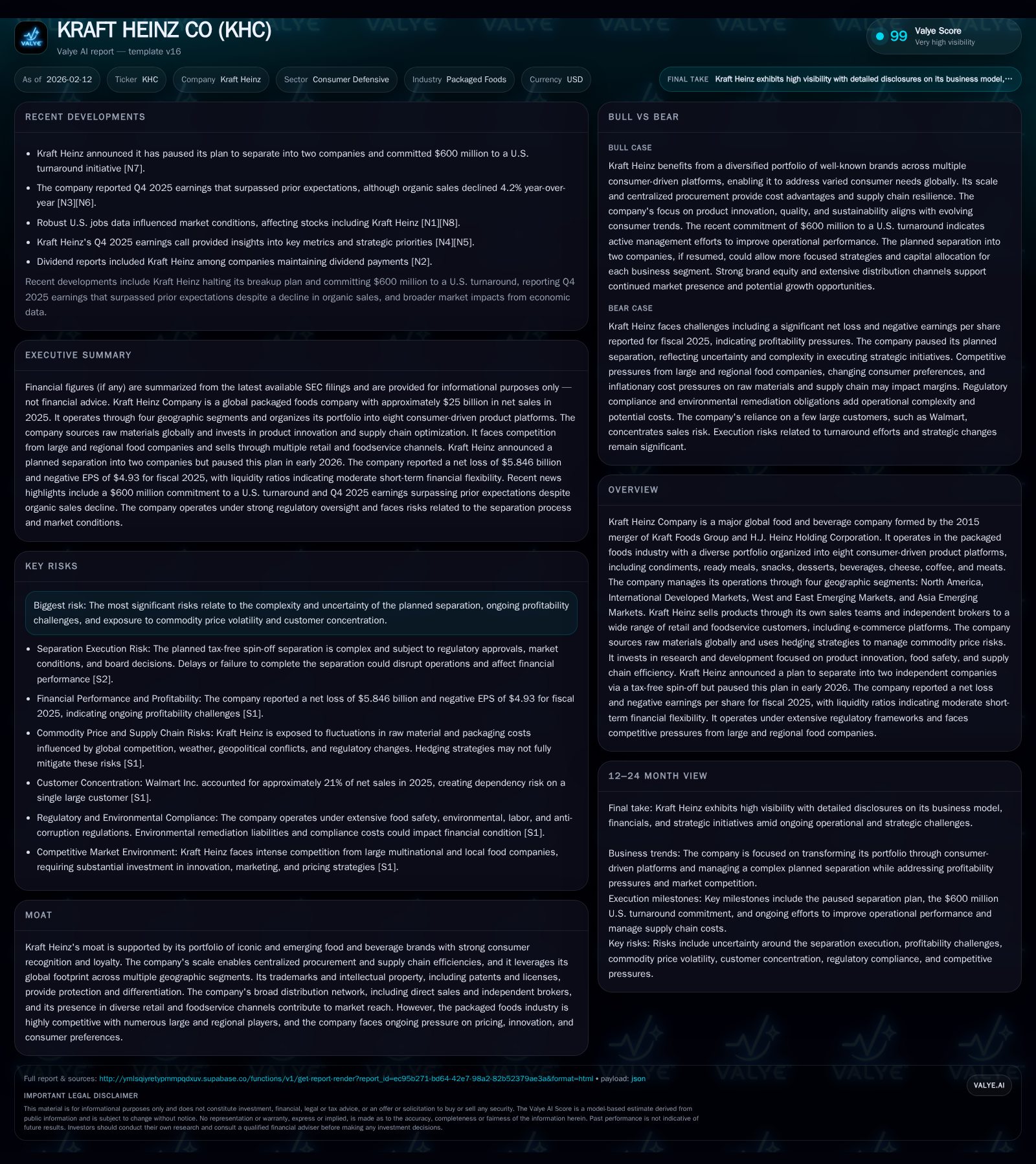
Kraft Heinz, the steward of iconic global food brands, recently paused its ambitious spin-off plan following complexity and cost concerns, signaling strategic recalibration. Despite an earnings beat in Q4 2025, the company faces shrinking organic sales, culminating in a sizeable net loss for the fiscal year. Balancing its vast geographic reach and supply chain challenges, Kraft Heinz embarks on a substantial $600 million turnaround initiative targeting core U.S. operations. The evolving competitive dynamics and shifting consumer preferences pose ongoing tests to its growth and profitability trajectory.
From Promise to Pause: The Halted Spin-Off and Strategic Implications
Kraft Heinz's bold plan to bifurcate into two distinct publicly traded companies via a tax-free spin-off — initially announced in September 2025 — has encountered an abrupt pause announced in February 2026[ N9 ][ S1 ][ S2 ]. The move underscores the formidable challenges embedded in disentangling a conglomerate that straddles multiple geographies, regulatory regimes, and product platforms. Beyond the technical hurdles around favorable tax opinions and SEC clearances, management disclosed significant resource drag and shareholder reaction uncertainties affecting the desirability of proceeding immediately.
This cautionary halt reflects keen awareness that such structural realignments could divert vital management bandwidth from ongoing business priorities. It also reveals exposure to unfavorable market conditions that might dilute anticipated benefits or extend timetables substantially. The Board's reservation injects ambiguity over near-term strategic direction even as it leaves open the possibility of revisiting the separation should circumstances improve.
Iconic Brands under Pressure: Navigating Shrinking Organic Sales
Despite Kraft Heinz's portfolio hosting stalwarts like Heinz condiments and Kraft cheeses entrenched deeply in consumer consciousness[ S1 ], the company faced a 4.2% year-over-year decline in organic sales during Q4 2025[ N1 ][ N3 ]. This contraction signals more than episodic softness; it highlights underlying shifts in consumer habits and intensifying competitive incursions.
Private label proliferation coupled with evolving health trends challenge Kraft Heinz’s traditional value proposition. The company’s risk disclosures candidly acknowledge the imperative to interpret fast-changing consumer preferences accurately or risk losing market traction[ S1 ]. While legacy brands confer nostalgic resonance, the marketplace decries complacency. New product innovations must compete not merely on heritage but increasingly on nutritional profile, convenience, and brand relevance.
Profitability at a Crossroads: Decoding the Q4 Earnings Beat Amid a Net Loss
Kraft Heinz posted an earnings beat relative to consensus estimates for Q4 2025 but paradoxically reported a startling full-year net loss surpassing $5.8 billion (USD)[ N1 ][ F1 ]. This dichotomy exposes complex financial engineering beneath headline figures. Operational profitability metrics benefited from non-recurring items or accounting adjustments that masked broader margin erosion.
The juxtaposition of beating earnings expectations against sustained losses suggests transitional pains—where cost inflation, restructuring charges, or impairment write-downs weigh heavily on comprehensive results yet fail to disrupt quarterly operating income benchmarks entirely. This financial tension places pressure on management credibility to demonstrate durable bottom-line recovery beyond transient gains.
Global Operations Landscape: Balancing Scale and Regional Challenges
Operating across four principal regions—North America; International Developed Markets; West and East Emerging Markets; Asia Emerging Markets—Kraft Heinz enjoys extensive geographic diversification[ S1 ]. However, this broad footprint demands delicate balancing acts involving regional customization amid standardized efficiencies.
Supply chains remain complex entities vulnerable to geopolitical disruptions, tariffs, or localized economic shocks. Managing raw material sourcing globally necessitates sophisticated hedging strategies but cannot fully immunize against inflationary pressures[ S1 ][ S2 ]. Moreover, consumer appetites diverge markedly by region; developed markets face stagnation or premiumization demands while emerging markets offer growth avenues clouded by currency volatility and infrastructural constraints.
Consumer Tastes and Competitive Currents: Innovation versus Market Realities
Innovation at Kraft Heinz is more urgent than ever given a marketplace crowded with nimble startups and retailer-controlled private labels challenging category incumbents[ S1 ]. Company disclosures emphasize dedication to R&D targeting product innovation aligned with health trends and food safety enhancements.[ S1 ][ F1 ] Yet significant hurdles persist: consumers increasingly scrutinize ingredient transparency, seek wellness attributes, or opt for plant-based alternatives.
Price elasticity is constrained by intensifying discounting wars exacerbated by retailer pressures aiming to protect own-label margins. Consequently, Kraft Heinz must execute innovation strategies that justify premium positioning without alienating value-conscious shoppers—a nuanced balance few legacy players navigate seamlessly.
Supply Chain and Commodity Headwinds: Managing Costs in Uncertain Times
Raw materials represent one of Kraft Heinz's largest input costs subject to uncontrollable external price fluctuations[ S1 ][ S2 ]. The company employs hedging mechanisms designed to buffer adverse movements in commodities such as dairy, meat products, coffee beans, and packaging materials.
Nonetheless, pervasive inflationary environments limit these tools’ effectiveness over extended periods. Escalating transportation costs further burden supply chain economics potentially compressing margins absent offsetting price increases which themselves are spotty due to competitive constraints.[ S1 ] The interaction between procurement efficiency programs and persistent inflation underscores continuous operational vigilance requirements.
Financial Health Check: Liquidity, Leverage, and Risk Outlook
At fiscal year-end 2025, Kraft Heinz maintained $2.615 billion in cash and equivalents alongside $10.13 billion of current assets versus $8.78 billion of current liabilities—a current ratio near 1.15 reflecting adequate short-term liquidity[ F1 ]. Nonetheless, the magnitude of net losses imparts caution regarding balance sheet robustness amid ongoing operating challenges.
Investor sentiment appears cautious as evidenced by detectable large ETF outflows including those holding KHC shares[ N12 ], underscoring market skepticism about medium-term recovery prospects or capital structure adequacy under volatile conditions.
Risk factors are tightly interwoven—from commodity exposure through customer concentration risks—to macroeconomic downturns potentially amplifying financial strain.[ S1 ][ N12 ]
Management’s Game Plan: Investments, Transformation, and Turnaround Strategies
Following the decision to halt the breakup process, management detailed commitment of $600 million dedicated specifically toward revitalizing U.S. operations[ N9 ][ S1 ][ N6 ]. This sizeable allocation aims at strengthening marketing execution, accelerating product innovation pipelines, modernizing supply chains for greater agility and cost control.
Such focused investment gestures reflect recognition that returning growth momentum will rest heavily on operational excellence within core North American markets where profit pools remain meaningful albeit highly contested.[ N9 ] However execution risk remains palpable given past challenges with turnaround initiatives historically extending over multi-year horizons without guaranteed outcomes.[ N6 ]
Looking Ahead: Potential Catalysts and Risk Factors on the Horizon
With an indefinite pause on separation proceedings carrying inherent strategic uncertainty,[ S2 ] external economic variables compound complexity facing Kraft Heinz’s path forward. Robust labor markets indicate likely persistence of inflationary cost burdens which may dampen discretionary consumer spending impacting packaged foods volumes.[ N8 ][ N11 ]
In parallel, competitive disruption is unlikely to abate as private label penetration expands alongside evolving health-centric dietary trends reshaping category structures.[ S1 ][ N8 ] These dynamics mandate heightened vigilance around price setting strategies amid shrinking margins.
Furthermore, unfinished separation plans restrict strategic optionality present previously thus confining flexibility until clarity returns regarding corporate structure decisions.[ N9 ]
Ultimately Kraft Heinz confronts intertwined challenges involving managing entrenched legacy brand equity while adapting nimbly to fast-evolving market currents within an intensifying contest over consumer dollars globally.
This report is for informational purposes only; it does not constitute investment advice or recommendations.
Disclaimer: This is research-only, informational analysis and not investment advice. It may include AI-generated interpretation and general industry context. Always verify important details using primary sources.

Comments