
Inside S&P Global: Navigating Data Moats, AI Innovation, and Cybersecurity Risks Amid Earnings Miss
A deep dive into S&P Global’s extensive data-driven moat, AI-led innovation, and cybersecurity challenges following a recent earnings miss that rattled markets.
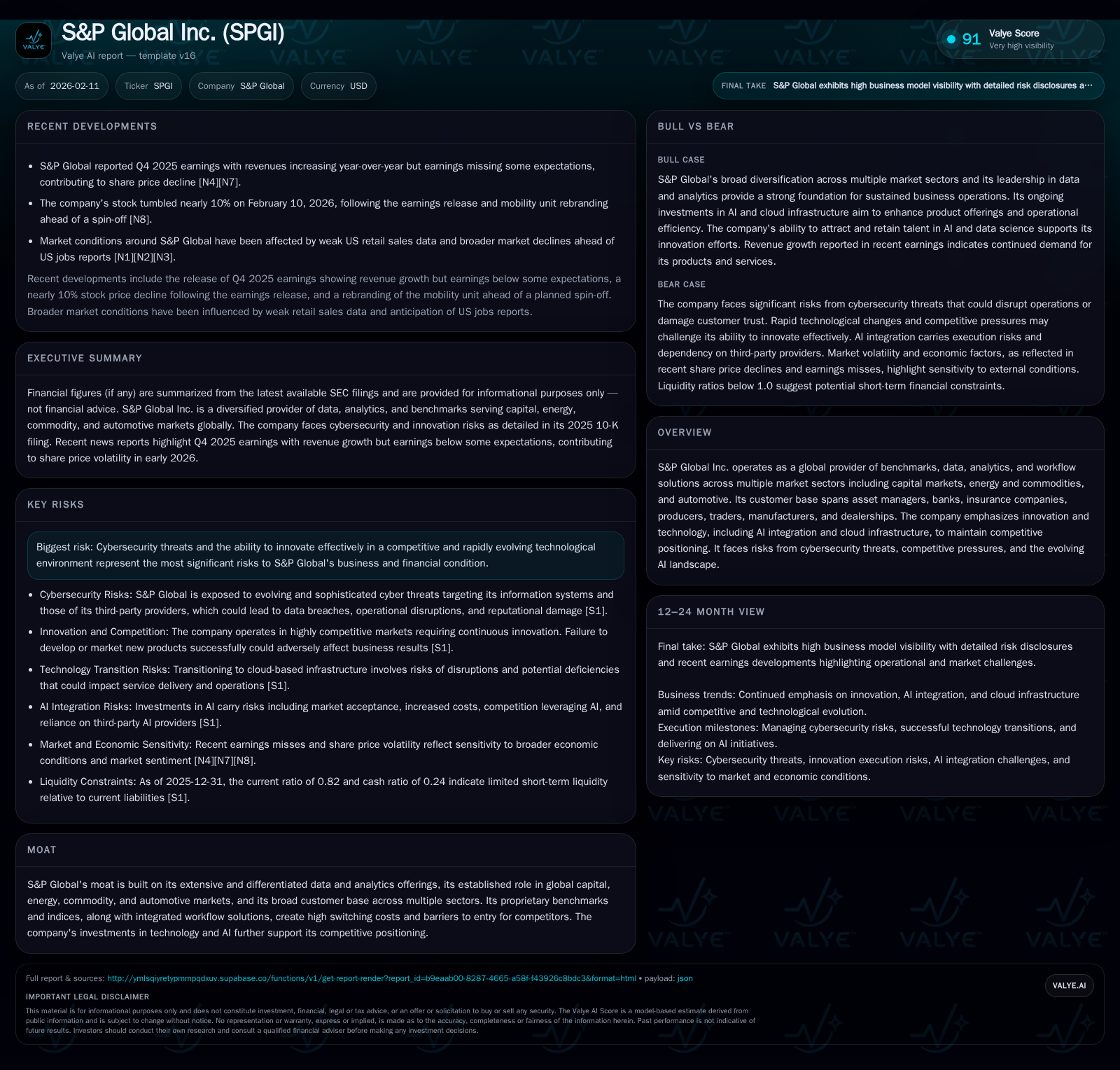
S&P Global Inc. experienced a stock drop close to 10% after missing Q4 earnings estimates despite revenue growth, highlighting investor concerns over profitability pressures amid heavy investments in technology and rising cybersecurity risks. The company commands a leading role across capital markets, energy, commodities, and automotive sectors by leveraging proprietary benchmarks and comprehensive data analytics that foster strong customer loyalty. However, evolving cyber threats pose a material risk given the sensitivity of its data, underscoring the challenge of balancing innovation with security. Moving forward, S&P Global’s ability to innovate in AI while safeguarding critical information will be pivotal to sustaining its competitive edge.
The Backbone of Global Insights: S&P Global’s Data and Market Footprint
S&P Global (SPGI) stands as a titan in providing benchmarks, data, analytics, and evolving workflow solutions within the global capital markets, energy/commodities sectors, and automotive industries. Its clientele spans the spectrum from asset managers and commercial banks to producers in energy markets and automotive manufacturers — illustrating the breadth of its domain. This multi-sector reach is not superficial; rather it reflects deep integration within these ecosystems through proprietary indices such as credit ratings on sovereigns and corporations, commodity pricing benchmarks, and automotive supply chain analytics [valye_report_excerpt; S1].
The company's role in these intertwined markets arguably sets a foundation for resilient revenues insulated from singular market disruptions. Cross-sector applications of their benchmarks bolster strategic relevance — for example, energy traders rely on timely commodity pricing data that feed into risk models developed by financial institutions using SPGI analytics.
This expansive footprint is matched by an extensive dataset encompassing historical price points, issuer creditworthiness evaluations, emissions metrics in commodities markets, and vehicle production forecasts. It is this scale combined with differentiation across segments that creates formidable operational leverage.
Technology and AI: The Double-Edged Sword Driving Innovation and Risk
SPGI’s strategic emphasis on innovation centers heavily around artificial intelligence integration and deployment of cloud infrastructure for enhanced workflow automation [valye_report_excerpt; S1]. Over recent years, investments have escalated toward developing AI models to parse vast datasets into actionable insights faster than traditional means. These technological enhancements aim to deepen data richness while improving user experience for clients demanding real-time analytics.
However, this technological leap introduces nuanced risks. Rapid AI developments necessitate continuous adaptation — missteps or lagging innovation could erode competitive advantages given the intense technological race among data providers. The firm's disclosures underscore that these innovation initiatives coexist amid heightened cybersecurity threats [S1]. Cloud adoption increases surface areas vulnerable to attack vectors requiring advanced defense mechanisms.
Hence the duality: technology fuels growth but simultaneously expands exposure to risks including data breaches or system disruptions which could tarnish customer trust—a core intangible asset.
Financial Pulsecheck: Parsing the Latest Earnings and Market Reaction
The Q4 2025 earnings release marked a pivotal moment where top-line growth was accompanied by an earnings miss versus estimates [N1; N3; N4]. Revenue increased year-over-year reflecting strong demand yet operating margins appeared pressured possibly linked to ramped-up R&D spend alongside cybersecurity investments.
Investors reacted swiftly — shares fell nearly 10% on February 10th as highlighted by market commentators pointing to the disconnect between solid revenues but softness in profitability metrics [N9]. Such moves illustrate how buy-side participants weigh profitability signals heavily even within dominant franchises like SPGI.
Market commentary also relayed concerns about cost inflation against a backdrop of macroeconomic uncertainty impacting client budgets despite robust usage patterns for SPGI’s services [N3]. This episode punctuates how financial results can act as a litmus for balancing growth ambitions against margin sustainability.
Competitive Moat Analysis: Barriers, Benchmarks, and Customer Stickiness
SPGI’s moat manifests most clearly through its differentiated offerings — exclusive access to proprietary data feeds coupled with integrated service suites across distinct industries [valye_report_excerpt; S1]. Customers face high switching costs given reliance on embedded workflow tools interwoven with SPGI's benchmark products such as credit ratings or energy price indices.
Furthermore, the company's entrenched position within multiple regulated markets (e.g., securities exchanges using SPGI indexes) establishes regulatory-created barriers. This confers an additional durability layer because alternatives must not only compete on quality but also compliance reliability.
Customer stickiness arises from SPGI's capacity to provide holistic perspectives spanning financial instruments valuation through environmental commodity tracking to automotive manufacturing forecasts — a breadth difficult for new entrants to replicate efficiently at scale.
This multifaceted moat partly explains resilience through various economic cycles — diversified exposure dampening segment-specific shocks while ongoing product innovation helps maintain relevance.
Risk Radar: Cybersecurity Challenges in a Data-Intensive World
The company's latest Annual Report vividly details an intensifying cybersecurity landscape fraught with escalating risks directly tied to SPGI’s stature as a primary processor of confidential market-moving information [S1]. Attackers range widely – from financially motivated criminals deploying ransomware to state-sponsored actors seeking sensitive sovereign debt ratings or index methodology changes parameterized within SPGI platforms.
SPGI’s reliance not only on internal systems but also on third-party vendors expands attack surfaces considerably. Increased sophistication in threats including phishing variants (smishing/vishing), denial-of-service attempts, code injections via malware or worms compound defensive complexity.
More than operational disruption risk exists; unauthorized disclosure of material non-public information could have cascading effects on customer trust and broader market functioning – particularly when such data influences trading decisions of major institutional participants.
Regular breaches or security lapses would severely damage SPGI’s reputation with challenging customer attrition consequences given heightened regulatory scrutiny surrounding data protection standards globally.
Market Sentiment & Stock Dynamics Post-Earnings Miss
The nearly 10% share price decline following SPGI’s announcement cannot be divorced from broader sector weakness observed concurrently in financials and energy segments [N11]. Analysts largely cited disappointment over margin pressure rather than outright top-line concern implying recognition of underlying franchise strength but wary cost trends [N9].
Options market activity around this event showed increased put buying interest signaling hedging or bearish positioning likely driven by short-term uncertainty [N10]. Meanwhile institutional commentary considered valuation levels appealing albeit conditional on visible margin recovery prompting some volatility overshoot hypotheses [N13].
In sum, trading dynamics reflect a classic post-earnings sell-off scenario complicated by macroeconomic jitters including forthcoming US jobs data releases impacting general sentiment [N6]. Such context frames SPGI’s stock move within both company-specific execution concerns plus external environment flux.
Strategic Outlook: Innovation, Competition, and Growth Prospects
Looking ahead, management narrative stresses remaining at the forefront of AI-driven analytical advancement while simultaneously strengthening cybersecurity defenses as core imperatives underpinning sustainable growth [valye_report_excerpt; S1; N2]. The CEO underscored ongoing efforts to refine methodology frameworks embedded within indices aiming for transparency enhancements coupled with tailored product innovations to meet evolving client demands [N2].
Competitive intensity remains high due to emerging fintech entrants leveraging niche technologies alongside established rivals expanding their digital capabilities. Thus maintaining pace requires relentless R&D investments balanced with prudent risk controls particularly concerning data integrity preservation amidst escalating cyberthreats.
Overall strategic posture reflects dual commitment: harnessing transformative technologies like AI not just as productivity tools but as substantive differentiators while mitigating attendant operational vulnerabilities through rigorous security protocols—critical factors shaping their trajectory amidst complex global marketplace dynamics.
This report synthesizes publicly available information including recent SEC filings (Form 10-K), earnings call transcripts, sector analysis, and news reports without offering investment recommendations. Readers should consider underlying risks carefully when forming independent views.
Disclaimer: This is research-only, informational analysis and not investment advice. It may include AI-generated interpretation and general industry context. Always verify important details using primary sources.

Comments