
Highwoods Properties: Navigating Office Real Estate Cycles with Strategic Agility and Liquidity
Highwoods Properties demonstrates adaptive portfolio management and liquidity strategies to counter persistent office sector headwinds.
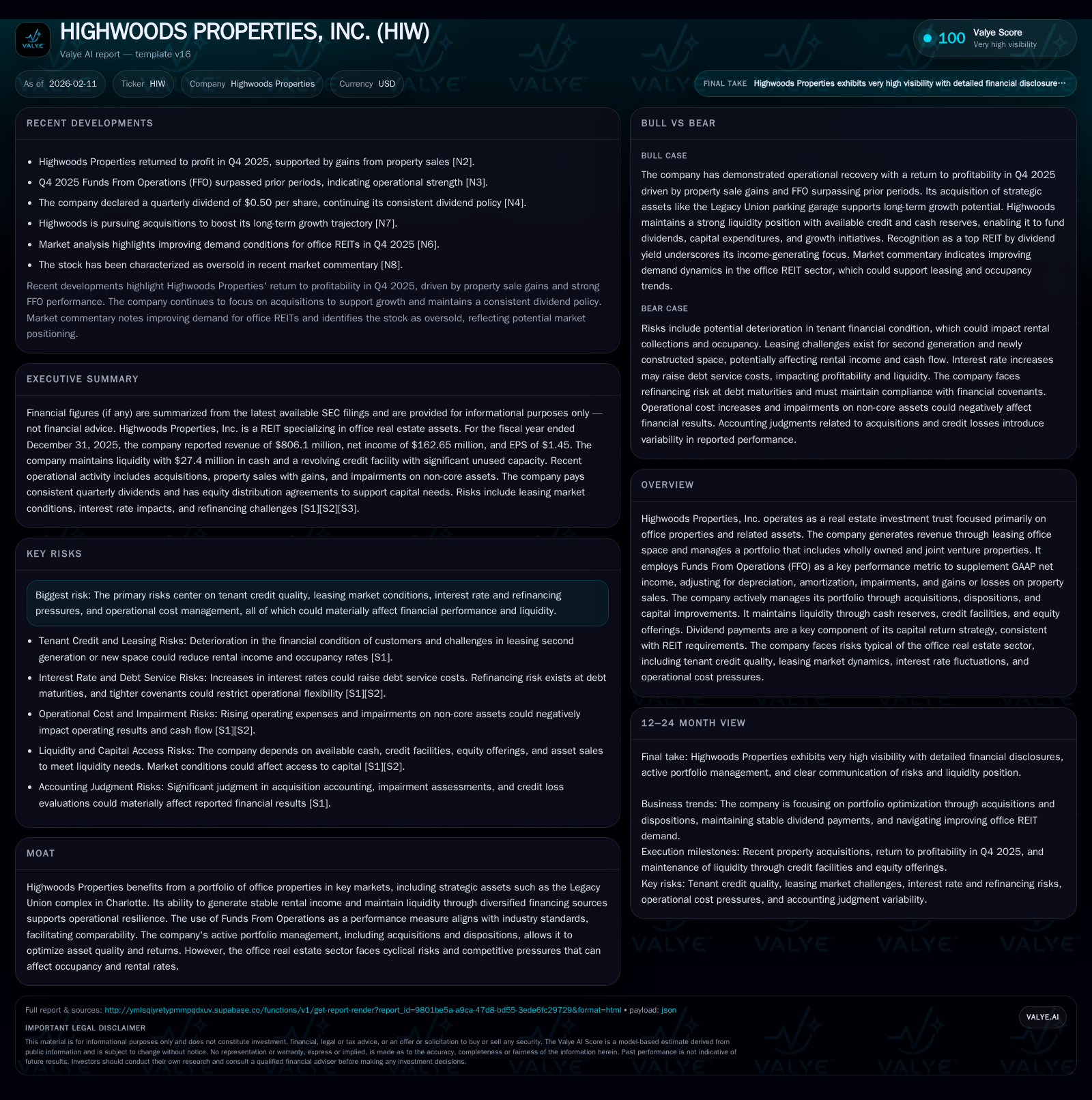
In an office real estate market still grappling with cyclical pressures and evolving tenant demands, Highwoods Properties, Inc. (HIW) has showcased a notable turnaround in its Q4 2025 financials, marked by earnings and FFO beating analyst expectations. This resilience stems from deliberate portfolio repositioning—acquisitions like the Legacy Union parking garage bolstering core assets, strategic dispositions pruning non-core exposure, and impairment recognition demonstrating disciplined asset oversight. Robust liquidity, inclusive of sizable revolving credit facilities and cash reserves, underpins growth flexibility even amid rising interest rates. With a steady dividend policy governed by board discretion and an eye on operational cash realities, Highwoods balances shareholder returns alongside capital needs. Yet, challenges remain as tenant credit risks and leasing dynamics continue to test office REITs broadly. The company’s forward approach includes sustainable financing targets tied to greenhouse gas reductions and selective asset sales, indicating a proactive playbook for enduring market relevance.
Navigating the Office Market Crosswinds: Highwoods in Context
The office commercial real estate (CRE) sector has endured substantial upheaval over recent years. Remote work adoption, demand volatility, and shifting corporate footprints have introduced pronounced cyclical challenges affecting occupancy rates and rental velocity. Against this backdrop, Highwoods Properties (HIW), a REIT primarily focused on office assets in key U.S. markets, maneuvers with strategic intent to withstand sector headwinds [N6]. Its moat derives principally from geographic concentration in established markets paired with selective asset quality that enables stabilizing cash flow generation despite broader industry flux [valye_report_excerpt]. This positioning affords Highwoods a platform to capitalize selectively as leasing momentum gradually recovers.
Q4 Performance Unpacked: Earnings and FFO Beat Expectations
The firm's Q4 2025 earnings vividly illustrated its resilience. After facing pressure earlier in the year from weaker leasing volumes, Highwoods reported GAAP net income of $162.7 million—marking a sharp improvement supported by gains stemming from property dispositions [F1][N3]. More critical for REIT valuations is Funds From Operations (FFO), which strips out non-cash depreciation/amortization to reveal recurring earnings power; here too Highwoods beat analyst expectations convincingly [N1][N2]. This dual beat underscores effective capital recycling within its portfolio while maintaining core leasing revenue streams.
Strategic Portfolio Moves: Acquisitions, Dispositions, and Impairments
Portfolio agility shapes much of Highwoods' recent narrative. Amid Q3-Q4 2025 activity was the strategically significant acquisition of the Legacy Union parking garage in Charlotte—at approximately $110 million—to support adjacent flagship offices totaling over 1.2 million square feet leased primarily to stable tenants such as Bank of America [S2]. This purchase physically connects parking via skybridge infrastructure, enhancing tenant experience and long-term asset value.
Simultaneously, the firm quietly divested older office buildings outside its core focus areas—in Atlanta ($7.1M sale with a $2.2M gain) and Richmond ($16M sale with a $5.7M gain)—releasing capital for reinvestment or debt reduction [S2]. The sale proceeds contributed directly to the Q4 profitability swing.
However, not all assets performed favorably; Highwoods recognized an $8.8 million impairment on two out-of-service non-core Atlanta properties at Century Center [S2]. Such writedowns speak to management's disciplined approach toward meaningful portfolio cleansing rather than holding underperformers potentially draining returns.
Liquidity and Capital Structure: Breathing Room Amid Interest Rate Hikes
Highwoods’ financial flexibility remains a core strength amid tightening monetary conditions. As of December 31, 2025, cash equivalents stood at $27.4 million complemented by $724.9 million unused capacity under its unsecured revolving credit facility set to mature only in January 2028—with options for extension [S1][S2]. Noteworthy is that this credit line pricing reflects sustainability-linked adjustments related to greenhouse gas emissions targets—a relatively novel feature blending corporate finance with environmental stewardship.
Furthermore, equity issuance capabilities remain intact with shelf registration statements permitting up to hundreds of millions in common stock offerings if market conditions are favorable [S1]. Such layered liquidity access cushions refinancing risk while enabling opportunistic acquisitions or capex.
Dividend Policy Analysis: Balancing Shareholder Returns and Growth Needs
Dividend continuity plays an essential role in validating REIT investment theses. Throughout 2025, Highwoods maintained consistent quarterly dividends at $0.50 per share—a level deemed sustainable considering operational cash generation [S1][N4]. Importantly, SEC disclosures clarify that dividends remain subject to Board discretion informed by multiple variables including taxable income projections, debt service obligations, lease renewal rents changes, occupancy trajectories, capital expenditure needs for leasing/building upkeep plus anticipated asset disposition proceeds.
This dynamic decision framework prevents rigid payout promises while ensuring investors receive transparent signals linked to underlying business health rather than fixed formulas.
Facing Industry Headwinds: Tenant Credit, Leasing Trends, and Market Risks
Amid positives lie material risks ubiquitous across office REITs that Highwoods openly acknowledges with granular specificity [S1][valye_report_excerpt]. Chief among these are potential tenant financial deterioration impacting rent collection reliability—heightened given recent macroeconomic uncertainties—and slower absorption or re-leasing of second-generation spaces (previously occupied but newly vacated). These pressures threaten rental rate stability compounded by competition from new developments possibly saturating select submarkets.
Additionally notable are expected increases in operating expenses—whether through inflationary labor costs or maintenance outlays—that could compress NOI margins absent commensurate rent escalations.
Highwoods also flags refinancing risk given rising interest rates that may escalate debt servicing costs; yet the firm’s liquidity profile partly mitigates this vulnerability.
The Legacy Union Imperative: Spotlight on a Core Asset Cluster
Legacy Union epitomizes Highwoods' localized leadership model where multiple interrelated assets forge competitive strength beyond isolated buildings [S2]. The acquisition of the substantial parking garage supporting Bank of America Tower and SIX50 at Legacy Union not only addresses logistical tenant needs but also signals commitment to executing ‘ecosystem’ enhancements fostering tenant retention—a key moat element hard for competitors to replicate quickly.
This cluster effect drives ancillary amenity synergies potentially fostering higher occupancy consistency amid broader market softness.
Forward Look: Management’s Playbook for Sustainability and Growth
Looking ahead into 2026 and beyond reveals management intent focused on sustainability balanced with financial prudence [S1][N7]. Planned sales of potentially over $250 million in non-core properties serve dual aims: to streamline asset mix while funding growth initiatives or deleveraging as opportunity permits.
Notably distinctive is integrated sustainability performance linking borrowing costs—interest rate spreads adjusting based on achievement toward greenhouse gas emission reduction goals—which showcases progressive alignment between financial discipline and ESG imperatives [S2]. Such positioning could enhance appeal among investors increasingly attuned to environmental factors.
In sum, Highwoods Properties presents a case study in navigating traditional office real estate cycles through active portfolio reshaping accompanied by measured financial stewardship amid an environment rife with uncertainty but punctuated by tactical opportunity.
This analysis is based solely on publicly available data as of February 11th, 2026. It does not constitute investment advice or recommendations but aims to provide an informed perspective on Highwoods Properties’ strategic positioning within the office CRE sector.
Disclaimer: This is research-only, informational analysis and not investment advice. It may include AI-generated interpretation and general industry context. Always verify important details using primary sources.

Comments