
Elvictor Group Expands Ship Management Amid Liquidity Challenges and Competitive Pressures
Elvictor Group advances its ship and crew management services while navigating operational scale and balance sheet constraints.
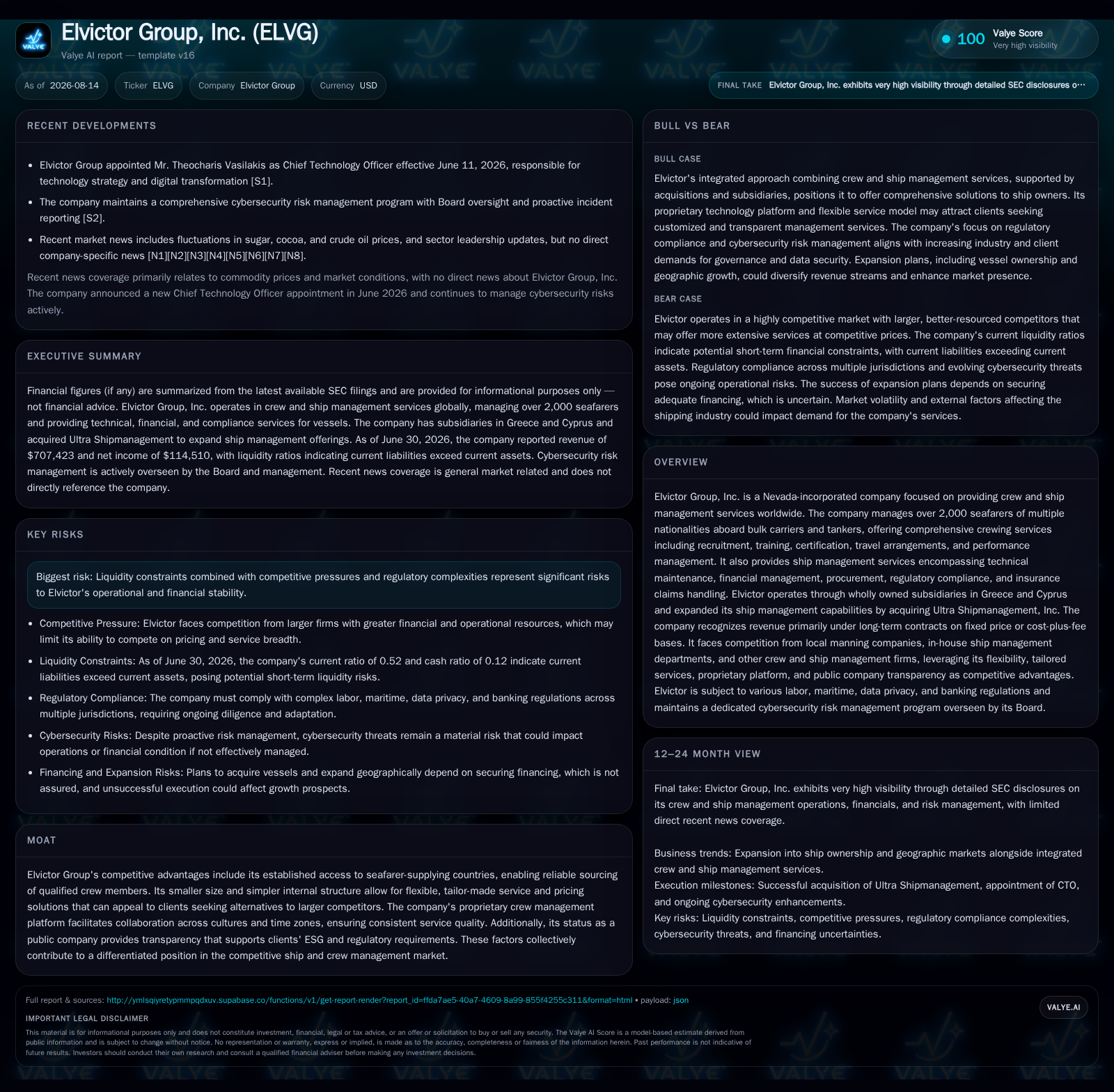
Elvictor Group, Inc., a Nevada-based maritime crew and ship management provider, disclosed in its August 2026 quarterly filing ongoing efforts to expand ship management capabilities following the acquisition of Ultra Shipmanagement. The company manages over 2,000 seafarers globally, primarily under long-term fixed-price or cost-plus contracts. Despite strategic technology integration and a niche flexible service approach, Elvictor faces liquidity constraints reflected in a sub-1 current ratio, which may impact operational scalability and contract competitiveness. Monitoring contract renewal rates, crew retention, and regulatory compliance will be critical to assess durability of growth and margin improvement.
This expansion diversifies revenue streams by adding technical maintenance, financial oversight, procurement, regulatory compliance, and insurance claims capabilities beyond traditional crewing operations [S1]. Such vertical integration within ship operations aligns with broader industry trends where outsourcing vessel management complements in-house maritime operations.
However, Elvictor's liquidity profile presents headwinds; as of June 30, 2026 the company reported cash and equivalents of approximately $285K against current liabilities near $2.36 million yielding a subpar current ratio of 0.52 [F1]. This signals potential challenges financing working capital needs associated with growing contract obligations or investing in platform enhancements crucial for scaling efficiently.
Business Model: Long-Term Contracting in Crew & Ship Management
Elvictor's revenue model is emblematic of the maritime crew and ship management sector's reliance on multi-year contracts with ship owners/operators [S1]. These are generally structured as either fixed-price or cost-plus-fee agreements that provide predictable revenue streams while allowing some pass-through of variable costs such as crew wages or technical maintenance expenses
The company recruits and manages over 2,000 seafarers from several nationalities placed aboard bulk carriers and tankers — segments requiring reliable certified crews to meet international safety standards. Elvictor supplements recruitment with comprehensive training programs including certification support alongside travel coordination and performance monitoring. On the ship management front, acquired capabilities handle vessel maintenance schedules, procurement logistics for spare parts or supplies, financial administration including budgeting and invoicing, regulatory liaison primarily for flag state compliance (Marshall Islands certifications), and insurance claims management.
This holistic service offering positions Elvictor as an intermediary between vessel owners/operators seeking operational efficiency gains via outsourcing human resources and technical oversight without investing heavily in internal departments. Revenue growth hinges on expanding managed fleet size or deepening contract scope per vessel.
Industry Structure & Competitive Positioning
The maritime crew and ship management market is highly fragmented with local manning agencies competing alongside large multinational firms such as V.Group or Wilhelmsen Ship Management. Elvictor distinguishes itself through a lean organizational structure allowing flexible tailor-made client solutions unlike rigid pricing often encountered at larger competitors. Its established network in seafarer-supplying countries facilitates steady access to qualified crews — a critical competitive moat in an environment where labor shortages can disrupt shipping schedules.
Moreover, the company's proprietary crew management digital platform fosters collaboration across time zones and cultural barriers ensuring consistent service quality despite geographic dispersion. As a publicly traded entity under Nevada jurisdiction with subsidiaries in Greece and Cyprus, transparency meets increasingly stringent ESG regulatory demands among shipping clients prioritizing governance standards.
While Elvictor operates on a smaller scale than peers like Bernhard Schulte or Anglo-Eastern Univan Group (which boast global footprints spanning thousands of vessels), it offers agility attractive to niche clients seeking alternative providers capable of bespoke commercial pricing instead of one-size-fits-all contracts common among large firms.
Growth Drivers: Fleet Expansion & Regulatory Complexity
Demand drivers supporting Elvictor's growth trajectory include sustained growth in global seaborne trade volumes prompting fleet expansions among bulk carrier operators. As shipping companies face increasing regulatory complexity — including IMO safety guidelines updates or environmental mandates — outsourcing vessel compliance management becomes favorable versus internal administrative burdens.
Additional tailwinds stem from trending outsourcing practices where ship owners prefer assigning crew recruitment/training along with full technical management to specialized third-party experts to focus capital on core fleet deployment rather than ancillary overheads. Furthermore, Elvictor's investment in modernizing its technology infrastructure under newly appointed CTO Theocharis Vasilakis (technology expert with AI/ML background) aims to improve operational efficiency through enhanced scheduling algorithms, performance analytics, and automated documentation workflows [S3], [S13], potentially boosting client retention rates.
Rising ESG requirements also create incentives for transparent reporting platforms integral to Elvictor’s public company status providing competitive advantage over private local operators less regulated in disclosure norms.
Risks & Constraints: Liquidity Pressure & Labor Market Dynamics
Despite strategic positioning benefits, Elvictor's financial snapshot reveals notable liquidity constraints jeopardizing capacity for organic growth investments or buffer against contract volatility with limited cash cushion relative to short-term liabilities [F1]. In this capital-intensive service industry segment—where upfront costs precede client payment cycles—tight working capital increases risk exposure particularly if managed vessel counts or contract renewals falter.
Operationally significant risks include geopolitical tensions impacting labor supply chains for seafarers affecting crew availability or turnover rates—events that can delay voyages incurring penalty clauses or reputational damage. Maintaining rigorous regulatory compliance across jurisdictions remains challenging given frequent maritime labor law changes internationally while any lapses may lead to costly fines or client contract losses.
Competition remains fierce from both local manning agencies aggressively pricing services in seafarer-origin countries as well as entrenched multinational companies offering bundled integrated solutions benefiting from economies of scale.
Cybersecurity management is critical since any breach disrupting proprietary systems could hinder crew deployment schedules; Elvictor’s proactive layered firewall use combined with internally hosted cloud servers mitigates third-party dependency risks but requires sustained investment as threats evolve [S2], [S10].
What To Watch Next: Execution on Integration & Financial Health Metrics
Key monitoring points involve evaluating how well Ultra Shipmanagement’s integration progresses particularly regarding operational synergies realized improving vessel maintenance downtime metrics or cost efficiencies per managed vessel. Client feedback on technology platform upgrades spearheaded by new CTO will indicate enhancement traction potentially influencing contract renewals or new bookings.
Follow-on quarterly disclosures should clarify whether liquidity improves via better receivables collection cycles or equity infusions since persistent undercapitalization could inhibit scaling ability during market upswings.
Operational KPIs such as average contract length across the managed fleet segment alongside crew turnover rates will illuminate service quality sustainability critical for long-term margins stability given the fixed-price/cost-plus revenue mix.
Finally careful attention to external labor market conditions impacting seafarer recruitment pipelines as well as regulatory amendments especially concerning flag state rules will be essential context variables shaping medium-term demand for comprehensive outsourced maritime support services.
Financial Profile Discussion
As of the most recent quarter ended June 30, 2026, Elvictor reported cash & equivalents totaling $284,743 against current liabilities amounting $2.36 million resulting in a current ratio below unity at approximately 0.52 indicating short-term liquidity strain [F1]. This suggests working capital deficits which could constrain ability to fund day-to-day operations without external financing or operational cash flow improvements.
Given the cyclical nature of shipping activity compounded by capital-intensive upfront costs inherent in managing large international crews and vessels globally; robust cash flow generation aligned with prudent balance sheet management will be vital measures signaling financial health progression.
This analysis consolidates SEC filings as of August 14, 2026 along with domain knowledge about maritime crew and ship management services without forward-looking projections or investment research views.
Disclaimer: This is research-only, informational analysis and not investment advice. It may include AI-generated interpretation and general industry context. Always verify important details using primary sources.

Comments