
Alpha Modus Holdings Advances Patent Licensing and Commercialization Amid Financial Strain
Q2 2026 filing highlights focus on expanding AI-driven retail patent portfolio, commercialization of Alpha Cash financial services platform, strategic partnerships, and liquidity challenges.
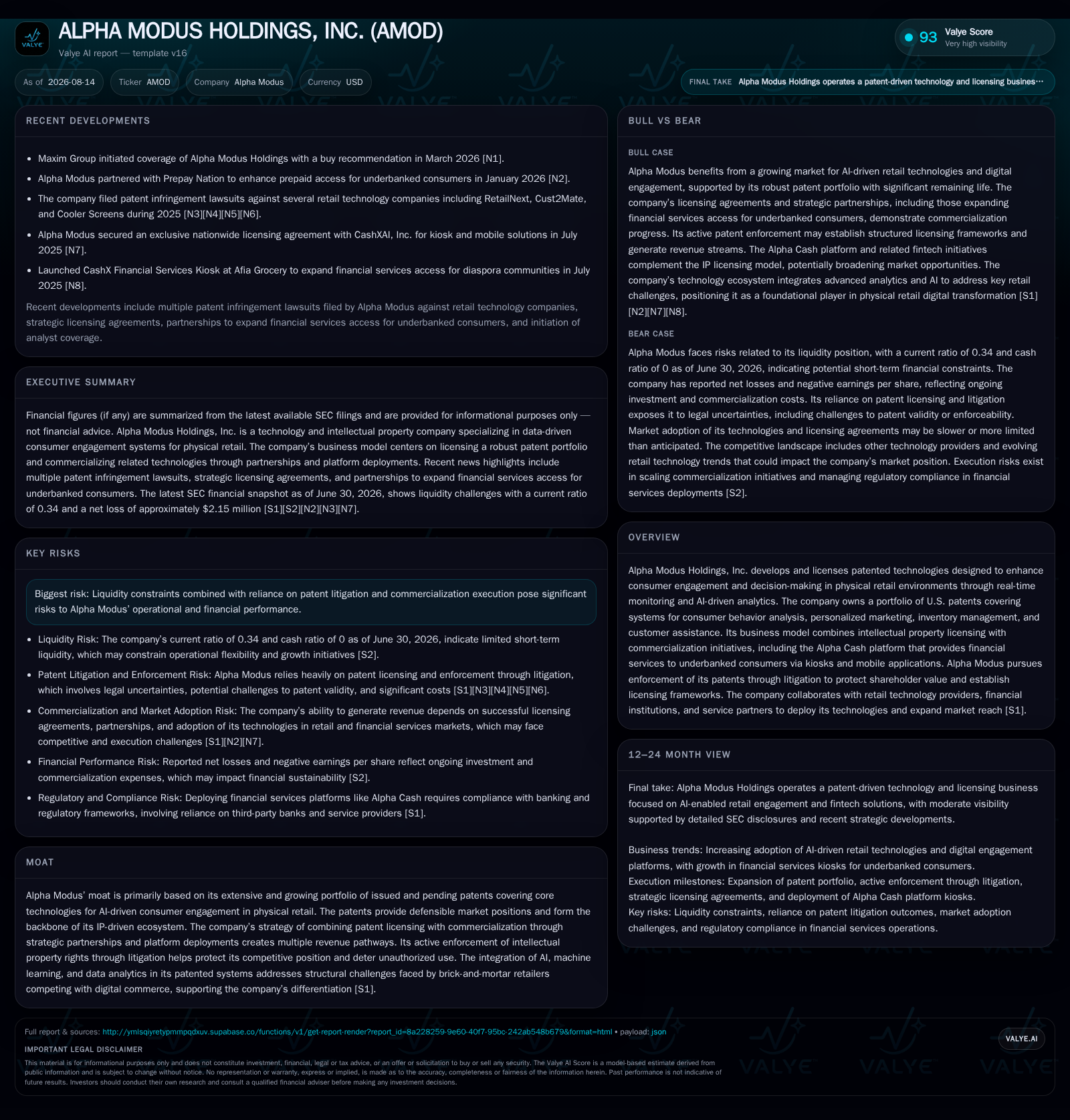
Alpha Modus Holdings, Inc. continues to develop and monetize its intellectual property portfolio centered on AI-powered consumer engagement technologies for physical retail. The latest quarterly filing underscores ongoing patent licensing efforts and commercialization through its Alpha Cash platform targeting underbanked consumers via retail kiosks and mobile apps. Despite strategic partnerships supporting deployment and licensing expansion, the company faces significant liquidity constraints with a current ratio of 0.34 and persistent operating losses that raise execution risks. Growth hinges on successful pilot expansions, enforcement outcomes, and scaling financial services offerings amid competitive pressures in retail technology.
Recent Operating Update
Alpha Modus Holdings’ Q2 2026 report filed August 14 details continued advancement of its intellectual property licensing program alongside commercialization efforts through its subsidiary Alpha Modus Financial Services (AMFS) [S2][S1]. The company emphasizes monetizing its expanding U.S. patent portfolio covering AI-driven systems for real-time monitoring and analysis of consumer behavior within physical retail settings. These patented technologies facilitate personalized marketing, dynamic planogram optimization, digital engagement platforms, inventory management enhancements, and customer assistance alerts aimed at increasing brick-and-mortar retail effectiveness via data-driven insights
Concurrently, Alpha Modus is piloting its Alpha Cash platform—an integrated kiosk and mobile app solution delivering financial transaction services like check cashing, bill payments, money transfers, prepaid products, and digital content purchases targeted at underbanked consumers through retail distribution channels [S6][S16]. This approach seeks to diversify revenue by combining traditional IP licensing royalties with direct fintech product commercialization
A notable organizational change was the July 2026 termination without cause of the Chief Revenue Officer [S3]. This move may reflect strategic realignment or intensified focus on overcoming commercialization scaling challenges during evolving market conditions
Business Model Analysis
Alpha Modus operates as an intellectual property owner specializing in patented AI-enabled analytics systems designed for retailers, consumer brands, advertising technology firms, and other commercial entities. Its core revenue model centers on licensing fees derived from third parties embedding Alpha Modus’ patented technologies into their products or services. Licensing agreements often include royalties tied to commercial usage volumes.
The company supplements this with direct commercialization through AMFS’s Alpha Cash platform—a proprietary financial services ecosystem deployed via kiosks and mobile applications within retail environments catering to convenience-oriented and underbanked consumers. Revenue here stems from transaction fees and commissions associated with various payment-related services.
Alpha Modus also actively pursues patent enforcement litigation funded internally or through arrangements such as those with Alpha Modus Ventures LLC. Enforcement efforts aim to protect royalty income streams by addressing unauthorized use of core patented inventions [S21]
Success depends on expanding active licensing agreements while scaling commercial deployments—particularly progressing pilot programs into phased national rollouts backed by banking partners and technology integrators. The combined licensing and commercialization strategy positions Alpha Modus to leverage both recurring royalty revenues and transactional cash flow generation [S16][S12]
Industry Structure & Competitive Position
Operating within the technology intellectual property licensing sector focused on AI-enhanced retail engagement solutions, Alpha Modus occupies a niche intersecting patent holding companies (e.g., InterDigital), AI analytics providers for retail applications, retailer-facing digital signage/kiosk integrators (e.g., VSBLTY Groupe partnership), and financial service platform operators targeting underserved consumers.
Its competitive moat derives from a robust portfolio anchored by the foundational '571 patent issued in 2019 plus continuations covering innovations such as real-time shopper analytics via computer vision, dynamic digital couponing, smart planogram algorithms, sentiment analysis technologies, and personalized advertising systems [S14][S21]. This IP foundation offers defensible leverage in license negotiations difficult for competitors to replicate without substantial R&D or costly litigation.
Unlike pure patent assertion entities focused solely on licensing or litigation without operational involvement, Alpha Modus integrates IP monetization with commercialization activities—introducing revenue diversification but also operational complexity due to regulatory compliance in financial service offerings.
Nonetheless, rapid advancements in AI-driven retail technologies create competitive pressure from alternative non-infringing solutions potentially eroding licensing opportunities over time. Patent enforcement outcomes remain inherently uncertain given evolving USPTO policies and judicial interpretations affecting protection scope [S24].
Growth Drivers
Key structural growth catalysts include:
- Increasing adoption of AI analytics tools: Surveys indicate over half of retailers deploy AI-powered signage and targeting tech in stores—a primary market for Alpha Modus’ patented systems [S17].
- Expanding digital influence on physical retail: Digitally influenced U.S. retail sales are projected near $4.2 trillion by 2025 with significant contribution from real-time engagement leveraging AI analytics [S17].
- Growth in underbanked consumer segment: The Alpha Cash platform addresses this demographic via kiosk-based financial services expected to grow at approximately 19% CAGR through 2028 per market research [S17].
- Ongoing strengthening of IP portfolio: Additional issued patents enhance bargaining power in licensing discussions.
- Strategic partnerships: Collaborations with Dollar General for pilot deployment; DXC Technology for enterprise integration; VSBLTY Groupe for embedding licensed tech into computer vision solutions support ecosystem expansion critical for scaling reach [S12][S16].
- Potential positive patent enforcement outcomes: Favorable litigation results or settlements would validate the IP monetization model by reinforcing royalty income streams.
Risks & Watchpoints
Material risks temper growth expectations:
- Liquidity constraints are severe; Q2-end current ratio near 0.34 reflects a substantial working capital deficit with current liabilities exceeding assets by over $6 million—raising concerns about sustaining operations absent additional financing or rapid revenue improvements [F1].
- Persistent operating losses exceeding $5 million annually highlight profitability challenges requiring successful monetization acceleration [F1][S1].
- Dependence on effective patent enforcement introduces uncertainty due to potentially protracted legal processes or unfavorable rulings that could reduce anticipated royalties.
- Execution risk around commercialization scale-up is elevated given regulatory complexities governing financial service platforms subject to federal/state oversight [S16][S27].
- Concentration risk in core patents exposes vulnerability if key intellectual property is invalidated or circumvented by alternative technologies.
- Potential dilution risk from future capital raises needed to fund operations or litigation activities.
- Management transitions, including recent CRO departure without cause may disrupt sales momentum impacting topline growth timing [S3].
What to Watch Next
Investors should focus on:
- Progression of pilot programs with Dollar General and other partners toward broader commercial rollouts providing clearer revenue trajectory visibility [S16].
- Updates regarding negotiations tied to collaborations like SurgePays aiming at expanded service distribution within telecommunications or adjacent sectors via Alpha Cash ecosystem [S12].
- Developments in ongoing patent enforcement litigation which could materially affect royalty revenue prospects.
- Management commentary addressing liquidity challenges including potential capital raises or cost optimization initiatives.
- Expansion pace of active licensing agreements across new geographies or verticals beyond traditional brick-and-mortar retail.
- Adoption metrics for AI engagement systems reflecting market acceptance relative to broader digital transformation trends among retailers.
Financial Profile Discussion
Alpha Modus’ balance sheet reveals pronounced liquidity stress as of June 30, 2026—current assets approximate $3.29 million against current liabilities exceeding $9.5 million resulting in a current ratio near 0.34—significantly below levels generally considered adequate for operational flexibility [F1][S2]
Cash reserves remain minimal relative to outstanding debt; best-effort net debt stood near $617 thousand at December 31, 2023 with no subsequent quarter-end updates disclosed explicitly but indicating tight financing headroom given ongoing cash burn primarily driven by R&D expenditures alongside legal expenses related to patent enforcement suits [F1][S1][S10]
Operating losses have historically exceeded $5 million annually underscoring the imperative for accelerated monetization either through lucrative settlement/license deals or scaled transactional revenues from the Alpha Cash platform achieving positive margin contributions eventually [F1][S1]. The company also anticipates increased expenses related to public company compliance post-Business Combination completed late 2024/early 2025 further pressuring cost structures [S1][S4].
Managing these constraints while delivering measurable progress against stated revenue-building milestones will be critical to sustaining operations beyond near term.
This analysis synthesizes publicly filed SEC disclosures emphasizing quantifiable operational updates combined with industry context framing technological IP monetization within AI-powered retail analytics markets. It avoids speculative projections lacking evidentiary basis while highlighting key indicators validating execution progress amid material liquidity risks.
Disclaimer: This report is provided solely for informational purposes based on filings as of August 14, 2026. It does not constitute investment advice.
Disclaimer: This is research-only, informational analysis and not investment advice. It may include AI-generated interpretation and general industry context. Always verify important details using primary sources.

Comments