
Mosaic ImmunoEngineering's Pipeline Expansion Hinges on Financing and Strategic Acquisitions
Development-stage immunotherapy biotech Mosaic ImmunoEngineering pursues clinical-stage asset acquisitions amid critical liquidity constraints.
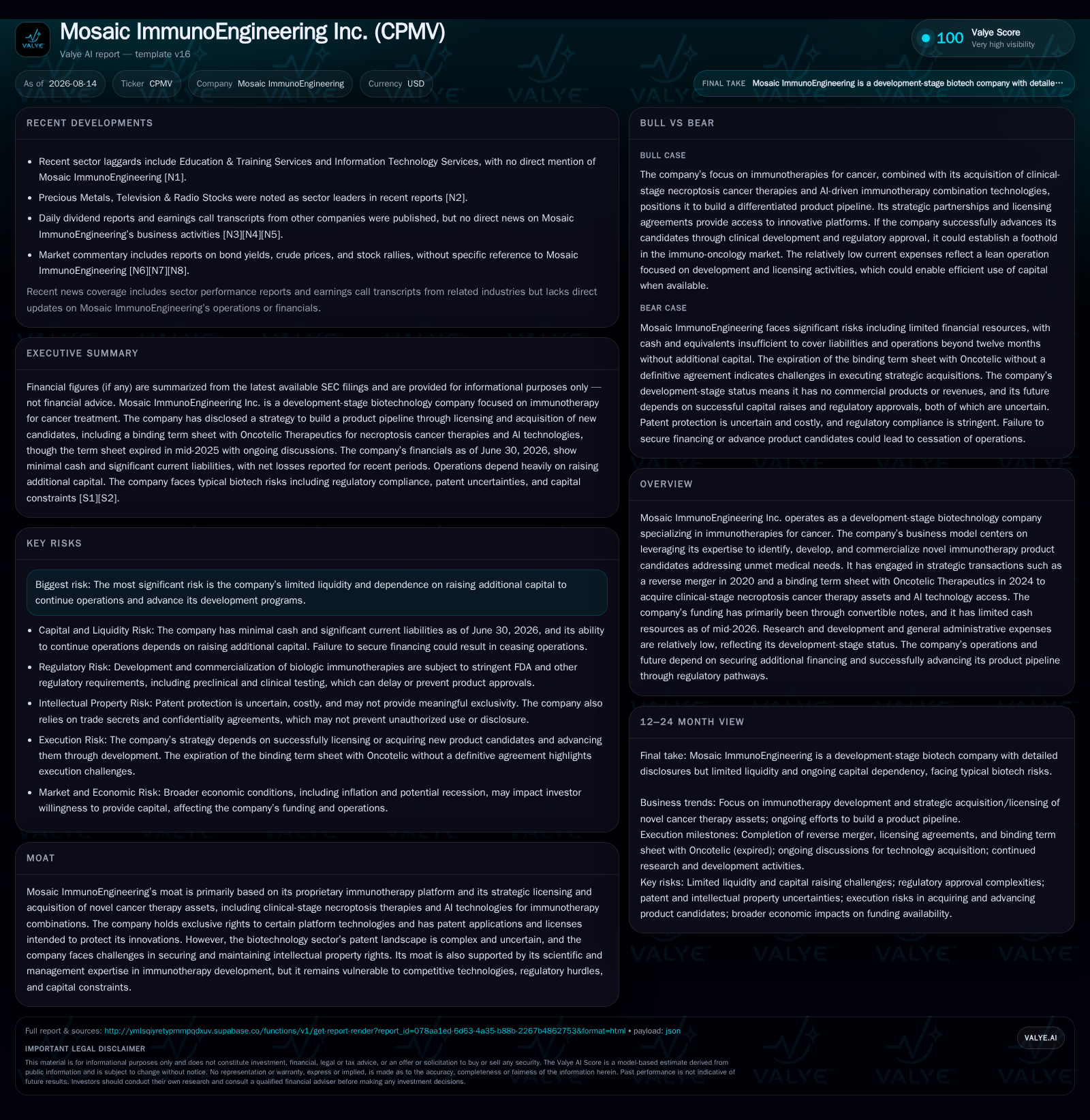
Mosaic ImmunoEngineering Inc. remains a development-stage biotechnology company focused on cancer immunotherapies, leveraging proprietary platforms and strategic transactions to build its pipeline. The company’s binding term sheet with Oncotelic Therapeutics aimed to acquire necroptosis cancer therapy assets and AI technology; however, capital constraints and an expired term sheet pose ongoing risks to advancing its product candidates. While management brings significant immunotherapy expertise, the company's fragile financial position and reliance on convertible note financing highlight the challenge of sustaining operations in the capital-intensive biotech immunotherapy sector.
Recent Operating Update
Mosaic ImmunoEngineering's latest quarterly report dated August 14, 2026 ([S2]) confirms the company remains firmly development-stage with minimal operational advancement amid severe liquidity constraints. As of June 30, 2026, cash reserves dwindled to $26 against current liabilities exceeding $6.3 million ([F1]), yielding an effectively zero current ratio that signals critical financial distress. These conditions have necessitated scaled-back development efforts and raise substantial doubt about the company's ability to continue as a going concern without fresh capital injections ([S2]).
Despite these challenges, Mosaic continues its strategic emphasis on expanding its pipeline through licensing and acquisition of novel immunotherapy candidates. A key initiative was the April 2024 binding term sheet with Oncotelic Therapeutics aimed at acquiring clinical-stage necroptosis therapies related to vascular disruptive agents (VDAs), along with non-exclusive rights to Oncotelic’s proprietary AI technologies for identifying optimal immunotherapy combinations ([S1],[S2]). However, this transaction remains unresolved following expiration of the term sheet in June 2025; ongoing discussions signal uncertainty around finalizing a definitive agreement requiring shareholder approvals and due diligence ([S1],[S2]).
Business Model
Mosaic’s business model is typical for early-stage biotech firms developing cancer immunotherapies: it focuses on acquiring or licensing innovative biologic platforms rather than solely internal discovery. Originally reliant on a license from Case Western Reserve University for the cowpea mosaic virus (CPMV) platform, termination of this agreement in March 2024 forced a strategic pivot toward external asset acquisitions ([S1]).
Revenue generation is currently minimal given no commercial products; value creation depends on advancing candidates through preclinical studies into clinical trials supported by milestone payments from licensing or partnership deals upon successful regulatory progression. Operational expenses are heavily weighted toward research & development and administrative functions.
Margins remain negative as expected without product sales. Key operating variables influencing future revenue potential include pipeline breadth and quality, clinical trial progression milestones governed by FDA regulations, patent portfolio robustness, and timing of regulatory submissions.
Capital raising remains essential for sustaining costly clinical development phases. However, Mosaic’s dependence on convertible notes introduces dilution risk and restrictive repayment clauses complicating merger or acquisition activities critical for pipeline expansion ([S3],[S16]).
Industry Structure and Competitive Position
Within the oncology biotechnology sector focused on immunotherapies, Mosaic operates in a highly R&D-intensive environment marked by lengthy development timelines before commercialization viability. The company’s viral nanoparticle-derived CPMV platform differentiates it from mRNA-based peers like Moderna or BioNTech but lacks scale compared to established clinical-stage biotechs such as Checkpoint Therapeutics or Iovance Biotherapeutics ().
The planned acquisition of Oncotelic’s necroptosis therapies taps into emerging vascular disruptive agent modalities that complement immune checkpoint inhibitors dominating current cancer treatments. This aligns Mosaic strategically with innovation trends targeting tumor microenvironment resistance mechanisms through combination therapies ().
Intellectual property protection is vital amid crowded patent landscapes for biologics. While Mosaic actively pursues licensing exclusive rights and patent claims, inherent uncertainties around patent validity and litigation risks persist—common challenges across biotech immunotherapy players ([S24]).
Growth Drivers
Potential growth hinges on several factors:
- Successful consummation of asset acquisitions like Oncotelic’s necroptosis therapies would diversify Mosaic’s pipeline with clinically relevant candidates addressing unmet oncology needs.
- Access to AI-driven drug combination discovery technologies could accelerate identification of effective immunotherapy regimens tailored to patient subpopulations.
- Advances in immunotherapy science continue driving investor interest in innovative platforms offering differentiated efficacy or safety profiles compared to conventional treatments.
- Regulatory incentives for breakthrough therapies may expedite approval pathways for novel modalities demonstrating significant clinical benefit.
- Achievement of clinical milestones enabling partnerships or licensing agreements could generate milestone revenues crucial for funding ongoing R&D.
Realization of these growth drivers critically depends on securing adequate capital amidst current near-exhausted cash reserves ([F1]).
Risks and Constraints
Liquidity risk is paramount given critical cash depletion coupled with substantial liabilities. Convertible note financing imposes dilution risk alongside restrictive terms that may hinder strategic transactions or timely equity raises ([S3],[S16]). Without additional funding soon, ceasing operations remains a tangible risk.
Clinical trial setbacks or delays pose binary risks typical in drug development pipelines where scientific failures can rapidly diminish value. Regulatory approval processes for biologics are complex and protracted under FDA oversight frameworks ([S6],[S26]).
Patent disputes over proprietary technologies are frequent in this sector and could result in costly litigation or loss of exclusivity undermining competitive advantage ([S24]). Competition from established blockbuster immunotherapies and evolving scientific paradigms threatens market entry even if Mosaic achieves approvals.
Macroeconomic factors such as inflationary pressures, recession fears in the U.S., post-pandemic shifts in investor risk tolerance further compound capital raising difficulties adding operational strain ([S13],[S16]).
What To Watch Next
Key indicators include:
- Progress toward finalizing or restructuring acquisition agreements with Oncotelic which would materially enhance pipeline breadth.
- Clinical trial initiations or advancements signaling de-risking of product candidates.
- Regulatory filings indicative of human trial commencements.
- Capital raises via equity or debt offerings alleviating going concern uncertainties.
- Patent portfolio developments securing exclusivity rights.
- Quarterly cash burn trends reflecting operational scaling versus contraction contingent on financing availability.
Financial Profile Discussion
Mosaic exhibits financial distress typical of early-stage biotechs lacking commercial revenue streams. As of mid-2026, negligible cash ($26) contrasts sharply with over $6.3 million in current liabilities ([F1]), underscoring immediate liquidity challenges.
Operating losses exceed $600k annually reflecting intensive R&D investment despite curtailed activity due to funding scarcity ([F1]). Primary funding derives from unsecured convertible notes bearing approximately 5% interest that increase expense load while creating shareholder dilution risk if converted under dilutive market conditions ([S3],[S16]).
These notes also carry restrictive covenants complicating corporate transactions like mergers or acquisitions essential for pipeline expansion strategies such as the Oncotelic deal ([S20]).
Operating cash flow remains negative though recent quarters show slight improvements due to cost controls ([S8],[S16]). Without near-term capital infusions or milestone revenues from partnerships, insolvency risk looms necessitating transformational financing events or strategic alliances common among similar-sized peers.
Conclusion
Mosaic ImmunoEngineering typifies nascent biotech ventures combining promising scientific innovations in cancer immunotherapy with acute financial fragility. Its strategy prioritizes external asset acquisitions complemented by AI integration aligned with evolving oncology treatment paradigms emphasizing immune modulation via necroptosis VDAs.
However, sustaining momentum requires urgent resolution of severe liquidity shortages complicated by convertible note constraints restricting corporate flexibility. The outcome hinges significantly on closing key transactions like Oncotelic acquisition amid competitive pressures and regulatory complexity inherent in biologics development.
Disclaimer: This is research-only, informational analysis and not investment advice. It may include AI-generated interpretation and general industry context. Always verify important details using primary sources.

Comments