
Peoples Financial’s Loan Portfolio Resilience Tests Regional Credit Dynamics
Latest quarterly filings reveal nuanced credit risk shifts and margin trends influencing Peoples Financial Corp’s regional lending strategy.
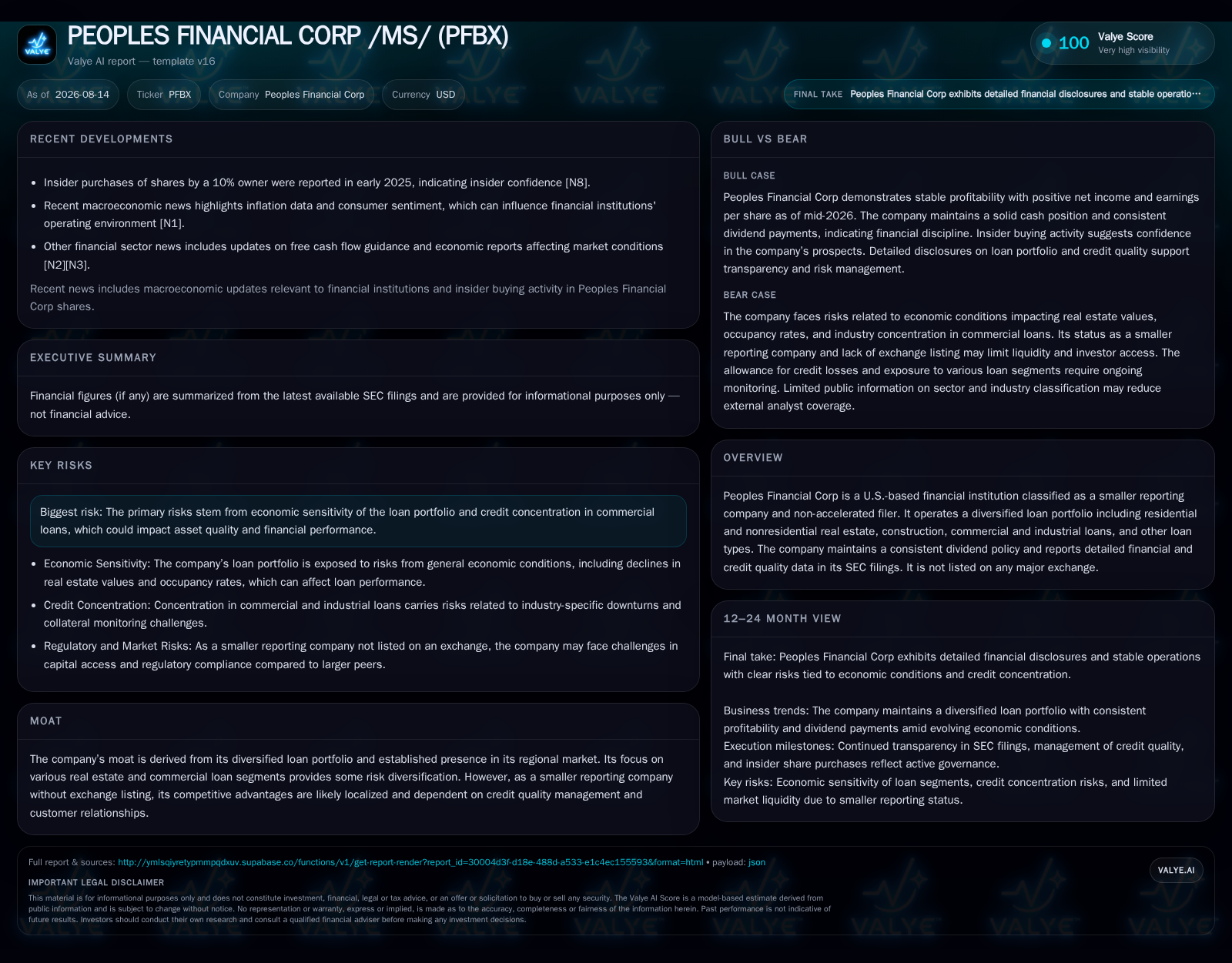
Peoples Financial Corporation’s August 2026 10-Q highlights subtle changes in its diversified loan portfolio with particular attention to residential, construction, and commercial loan segments. These shifts underscore the economic sensitivities embedded in its regional footprint, alongside the adoption of new FASB interim reporting standards improving financial statement transparency. The company’s business model remains anchored in interest income from a range of real estate and commercial loans supplemented by fee-based services, but credit quality management amid regional economic volatility will be critical to sustaining dividend policy and operational efficiency. Benchmarking against regional peers frames the challenges of scale in maintaining net interest margin and controlling credit losses.
Quarterly Loan Portfolio Shifts Highlight Emerging Credit Risk Nuances
Peoples Financial Corporation’s latest 10-Q for the quarter ended June 30, 2026, provides an updated lens on its core loan portfolio composition, revealing notable nuances in credit risk across various segments [S2]. The company distinctly classifies its loans into residential real estate, construction (comprising both commercial and residential), nonresidential real estate, commercial and industrial (C&I) loans, and other loans. Construction loans carry traditional sector-specific risks such as cost overruns, fluctuating market demand for properties, financing insufficiencies, and valuation declines; residential construction additionally inherits risks akin to those in permanent residential mortgages [S2]. Nonresidential real estate loans pose monitoring challenges given industry concentration risks and the difficulty in evaluating collateral conditions—including occupancy rates—which can lead to cash flow stresses if economic conditions worsen.
For C&I loans, asset obsolescence risks (e.g., inventory or equipment) alongside industry concentration amplify vulnerability to economic downturns affecting cash flow sufficiency [S2]. These discrete loan segment risk profiles illustrate how Peoples Financial’s localized exposure is intertwined with regional economic cycles, underscoring the importance of vigilant credit risk assessment. Significantly, the company recently corrected prior misclassifications involving revolving loan vintage disclosures impacting presentation but not aggregate portfolio risk metrics or allowances [S2]. This amendment enhances transparency on loan seasoning—a crucial metric for credit quality analysis—without altering capital or provision baselines.
Operational Impact of New Interim Reporting Standards
In December 2025, Peoples Financial adopted FASB Accounting Standards Update (ASU) 2025-11 relating to interim reporting under ASC Topic 270 [S2]. This update clarifies the form, applicability, and required disclosures for interim financial statements, streamlining prior guidance complexity. Importantly, ASU 2025-11 introduces a new principle requiring entities to disclose material events occurring after the most recent annual period that may affect financial position or results. While Peoples’ management concluded this HAS no material effect on consolidated financial results thus far, the improved guidance facilitates more navigable interim disclosures for investors focused on understanding quarter-to-quarter variability [S2],[S18]. For smaller reporting entities like PFBX without exchange listing overheads, these clarity-enhancing measures strengthen investor confidence by foregrounding material developments during interim periods rather than relegating them solely to annual reports.
Localized Lending Business Model Balances Income Sources Amid Economic Sensitivities
Peoples Financial operates a traditional community-regional bank model centered on generating interest income from a diversified loan book spanning residential mortgage loans through various real estate construction projects to commercial lending [S1],[S2]. The company supplements this core interest revenue with fee income derived from service charges on deposit accounts and trust department activities—components that together help stabilize revenues across economic cycles [S2]. The localized nature of this franchise imposes operational leverage constraints: fixed costs spread over a limited scale compared with larger peers lead to efficiency ratio pressures.
The combined exposure to residential mortgage products and construction lending means net interest margins (NIM) can be sensitive not only to Federal Reserve rate shifts but also local housing market cycles impacting loan demand and asset quality [S1]. Fee income growth from fiduciary services adds valuable diversification but remains relatively modest compared with total interest revenue streams [S2]. These dynamics situate Peoples within a mainstream regional bank archetype reliant on prudent credit management amid elevated economic sensitivity inherent to its Mississippi-focused footprint.
Competitive Benchmarking Against Regional Bank Peers Illuminates Efficiency Drivers
Viewed against sample peers such as Regions Financial Corporation, Fulton Financial Corporation, and Synovus Financial Corp—which operate broader regional franchises—Peoples faces typical small-scale banking challenges. Its net interest margin sustainability is pressured by a relatively concentrated deposit base requiring active management of the loan-to-deposit ratio to preserve funding cost advantages. Efficiency ratios likely reflect higher per-unit operating expenses given scale limitations relative to larger peers benefiting from technology investments and broader geographic diversification.
Credit loss management thus becomes even more critical at this scale: slight upticks in nonperforming loans or loss provisions disproportionately impact earnings volatility. Furthermore, unlike some peers enjoying extensive trust business penetration or retail branch networks beyond their immediate region, Peoples must leverage customer relationships tightly within its niche. Its competitive moat rests largely on longstanding local customer ties and diversified loan segmentation rather than broad scale advantages.
Growth Rooted in Regional Market Dynamics and Portfolio Diversification
Looking forward, Peoples’ growth prospects are inherently linked to regional employment trends, housing market activity (both residential development and nonresidential commercial property demand), and deposit base expansions from effective community engagement [S1],[S2]. The diversification across several real estate sectors alongside C&I loans creates multiple levers for volume growth but also embeds cyclical risk vectors tied to each segment’s inherent sensitivities.
Expansion outside current markets appears limited by regulatory capital considerations typical for smaller banks not listed on major exchanges; thus organic growth fueled by incremental loan origination coupled with fostering fee-generating deposit services remains paramount. Strategic acquisitions or cross-regional ventures would require substantial capital buffers unlikely at present given conservative balance sheet policies noted in filings. Consequently, leveraging existing sector mix while improving credit quality could underpin sustainable growth without incurring outsized risk concentrations.
Credit Quality Management Underpins Dividend Stability but Faces Macroeconomic Headwinds
A central theme emerging from current disclosures concerns how allowance for loan losses tracks evolving asset quality indicators amid volatile local economic conditions [S1],[S2]. Nonperforming assets remain an important metric capturing stress within higher-risk construction or commercial categories exposed to occupancy or market demand fluctuations.
The company’s consistent dividend policy depends heavily on maintaining stable earnings supported by conservative provisioning strategies designed to absorb potential future charge-offs without impairing capital adequacy [S1]. However, concentrated exposures—particularly within commercial lending where collateral monitoring challenges persist—and ongoing sensitivity of residential portfolios to unemployment elevate downside risks if macroeconomic headwinds intensify locally. Close monitoring of vintage performance metrics following corrected disclosures will offer valuable early warnings regarding emerging credit deterioration.
What To Watch: Credit Metrics, Deposit Trends, And Regulatory Updates Into Q3
Key upcoming milestones include quarterly updates on nonperforming loan ratios across each major portfolio segment; any directional change here would materially influence provision expense requirements [S2],[S3]. Deposit growth trends remain relevant to evaluate funding stability amid competitive pressure from both large national banks and burgeoning fintech lenders innovating disintermediation via digital channels.
Additionally, adoption progress relating to pending accounting standards such as ASU 2025-08 on purchased seasoned loans (effective post-December 2026) will merit attention for impact on credit loss accounting frameworks [S18]. Lastly, regulatory communications concerning capital adequacy requirements could constrain lending deployment if additional buffers are mandated based on heightened concentration risk assessments.
Financial Profile Discussion: Liquidity Strength Offsets Smaller Scale Challenges
From a liquidity perspective, Peoples Financial maintains adequate cash balances classified as cash and due from banks—including federal funds sold maturing within ninety days—providing robust near-term funding flexibility [S2]. Net debt positioning is conservative; using best available current data suggests net debt is modest relative to cash holdings despite total debt approximating $30 million per latest available inputs [F1],[S2]. Interest expense on deposits and borrowings has stabilized around $3.9 million for the first half of 2026 reflecting steady funding cost management.
Overall, liquidity strength provides a buffer against regional market shocks even as scale-related cost structures impose tighter efficiency constraints relative to larger peer groups.
This analysis synthesizes information available from Peoples Financial Corporation’s SEC filings through mid-August 2026 with contextual framing derived from regional banking industry knowledge. It highlights how nuanced shifts in localized economic conditions reflect directly in loan portfolio dynamics impacting credit quality metrics critical for sustaining profitability in a smaller community-focused bank structure. Investors seeking actionable insights should monitor forthcoming quarterly disclosures addressing nonperforming asset trajectories alongside evolving deposit bases given their direct influence on margin resilience and capital deployment capacity.
Disclaimer: This report is an informational analysis based on publicly filed SEC documents as of August 14, 2026. It does not constitute investment advice or research views.
Disclaimer: This is research-only, informational analysis and not investment advice. It may include AI-generated interpretation and general industry context. Always verify important details using primary sources.

Comments