
H&R Block's Strategic Integration of Assisted and DIY Tax Services Drives Fiscal 2026 Growth
In fiscal 2026, H&R Block leveraged its multi-channel tax preparation offerings and expanding financial products to deliver revenue gains and enhanced operational efficiency amid industry challenges.
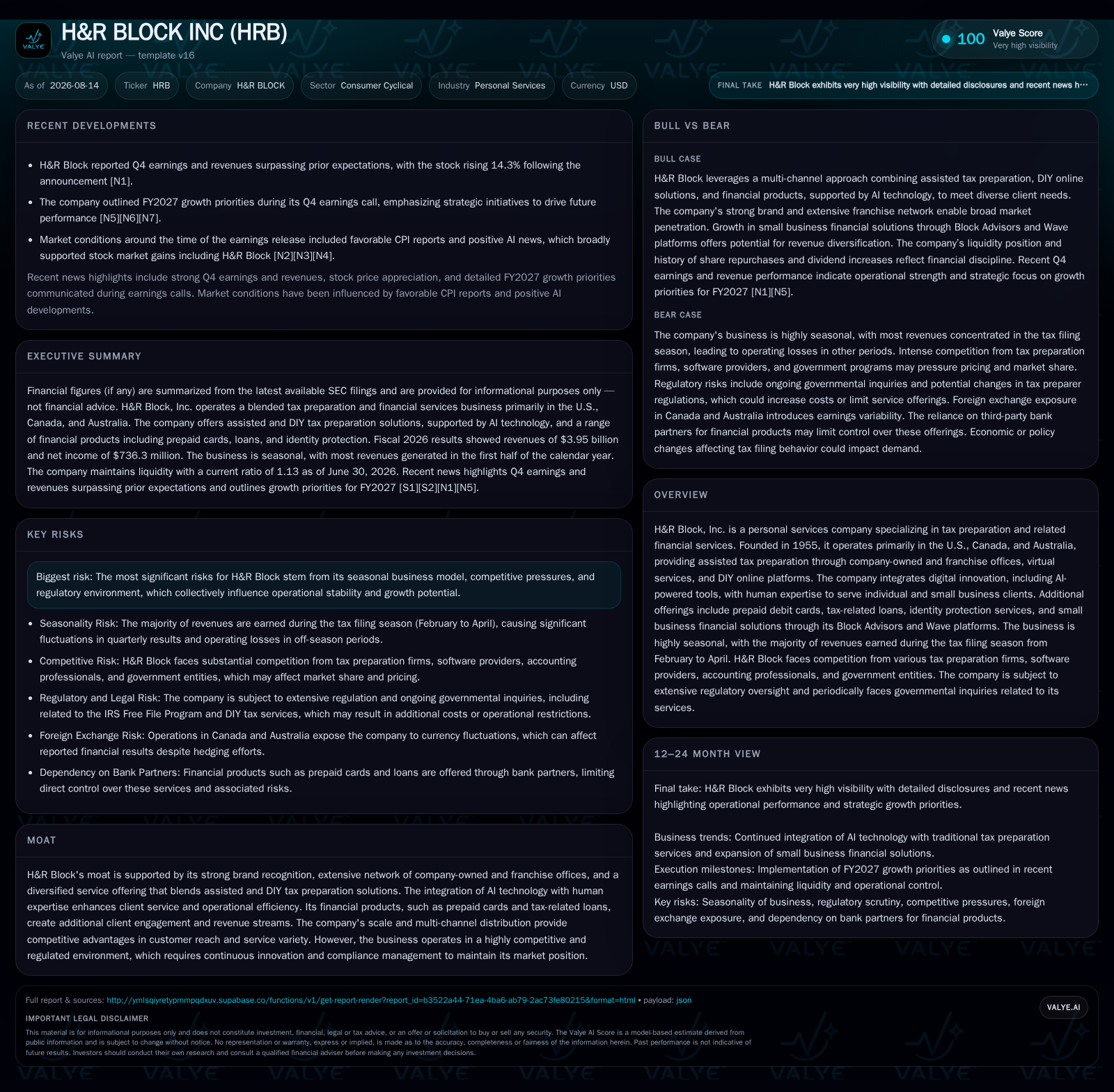
H&R Block’s FY2026 results illustrate growth driven by higher assisted tax preparation volumes and pricing amid franchise acquisitions that shift revenue from royalties to company-owned operations. The company’s balanced approach between in-person assisted services and growing DIY digital platforms, including subscription and pay-per-return models, supports diversified revenue streams. Seasonality remains a key factor in cash flow cycles, but recent operational restructuring aims to smooth resource allocation year-round. Expansion of financial products and small business services through Wave enhances client engagement. Regulatory scrutiny and competitive dynamics remain watchpoints that require ongoing innovation and compliance focus.
Fiscal 2026 Bright Spots: Revenue Growth Fueled by Assisted Services Expansion
H&R Block posted a 4.9% increase in total revenues for fiscal 2026, reaching nearly $3.95 billion, propelled primarily by gains in U.S. company-owned assisted tax preparation services [S1]. Assisted tax prep revenues climbed $147.7 million or 6.1%, reflecting both a rise in net average charge per return by 4.0% and a 2.0% increase in company-owned return volumes [S1]. This suggests underlying pricing power likely supported by increasingly complex tax codes driving demand for professional services, alongside solid customer retention.
At the same time, international revenues benefited from favorable currency exchange trends while the Wave® platform showed robust subscription revenue growth alongside higher payments volume, diversifying H&R Block’s revenue base beyond individual tax season spikes [S1]. The company's ability to blend physical offices with virtual channels creates differentiated client access that supports sustained volume improvements.
Franchise Acquisition Effects: Shift From Royalties to Company-Owned Revenues
A strategic theme in FY2026 was the acquisition of franchise offices which led to decreased royalties revenue by $7.4 million (-3.9%) while boosting direct company-owned tax preparation revenues [S1]. This acquisition strategy converts formerly franchised return volumes into directly controlled operations—reducing reliance on franchisee performance but raising capital expenditure exposure.
This shift potentially enhances operating margins through greater control over service quality and customer experience but introduces risks related to integration effectiveness and the need to manage an enlarged office network profitably [S1]. The tradeoff is nuanced: while royalties provide recurring cash flow with minimal capital input, company ownership offers deeper long-term strategic flexibility at higher fixed cost commitment.
Balancing Act: Integrating Assisted Services with Growing DIY Digital Platforms
While assisted services drove notable top-line growth, the DIY segment remained comparatively flat with a slight $0.9 million increase (+0.2%) in revenues from online paid returns filings [S1], reflecting mature market penetration amid intense competition from leading platforms like Intuit’s TurboTax.
The company sustains a balanced multi-channel approach where assisted returns offer higher pricing and client touchpoints, complemented by DIY subscriptions which generate recurring revenues albeit at lower per-unit yields [S1]. The Wave platform further diversifies income streams toward small business clients requiring bookkeeping and payroll—a segment experiencing secular growth as new enterprises form.
This hybrid model mitigates risks inherent in pure-play DIY providers facing margin pressure due to heavy marketing spends or aggressive discounting while preserving broader customer engagement across demographics with varying service preferences.
Harnessing Seasonality: Operational Efficiency Through Revenue Peaks
The personal services tax industry is inherently seasonal, concentrating majority revenues within the February-to-April filing window which significantly influences expense profiles including surge hiring of temporary staff, technology infrastructure usage spikes, marketing efforts, and working capital cycles.
In response to these challenges, H&R Block initiated workforce restructuring post-fiscal year end aimed at transitioning toward a more stable year-round leadership model within their field offices comprising approximately 200 job reductions targeted by Q3 FY27 [S14]
Managing expenses efficiently during off-peak periods while sustaining readiness for peak intake is critical KPI territory for the company’s continued margin expansion initiatives given wage inflation pressures noted in rising compensation costs (+$104.7 million or +3.6% increase) including occupancy and technology investments [S1]
Financial Products Maturation: Supplementing Core Tax Preparation Revenues
H&R Block expands financial products integrated with its core offerings to deepen client relationships and diversify revenue beyond filing fees [S1]. However, Emerald Card prepaid debit card revenues declined slightly (-5.6%), while interest income from Emerald Advance loans modestly increased (+5.9%) suggesting mixed traction against competition from broader fintech players
Conversely, identity protection services demonstrated strong double-digit growth (+14.3%), indicating rising consumer demand for security solutions linked to increasing concerns over data breaches during tax season [S1]. These ancillary products represent meaningful cross-selling opportunities that can extend lifetime value beyond discrete filing seasons if effectiveness scales.
Competitive Environment: Positioning Against Leading DIY Providers and Traditional Tax Firms
Market competition spans large DIY software platforms such as Intuit TurboTax—dominant in subscription revenue generation—and traditional franchises like Jackson Hewitt known for dense physical office networks providing human-assisted returns.
H&R Block leverages established brand equity combined with extensive geographic coverage (6,802 company-owned plus 1,814 franchise offices) plus a growing digital footprint offering virtual consultations alongside online platforms anchored by AI enhancements—supporting resilience against shifting consumer preferences toward self-service models [S1,N2].
Its hybrid strategy reduces subscriber churn typical at DIY providers through multiple channels serving varied customer segments while encouraging switching costs via integrated financial products.
AI Integration: Enhancing Customer Experience and Process Efficiency
Technological adoption plays a pivotal role as H&R Block integrates AI tools to streamline tax pro review workflows and improve digital self-service interfaces aiming to accelerate return completions without sacrificing accuracy or compliance standards [N2,S1].
These efficiencies help offset rising labor costs—compensation being the largest operating expense contributor—and enhance scalability for seasonal intake surges. Metrics such as reduced turnaround times or improved customer satisfaction scores would validate these investments as durable competitive advantages.
Watchpoints: Regulatory Risks, Seasonality Challenges, and Franchisee Dependence
Regulatory uncertainty remains material as governmental inquiries related to IRS Free File Program participation and aspects of the firm's DIY business could lead to adverse rulings or increased compliance expenditures impacting future profitability [S6,N3].
Seasonality confines significant cash inflows within short windows creating liquidity rhythms requiring prudent working capital management despite strong balance sheet liquidity positions discussed later.
Franchise acquisition strategies carry execution risk around retention of acquired personnel and integration complexities influencing local market share sustainability.
Monitoring KPIs like franchise office renewal rates alongside regulatory developments represents critical risk management actions.
Growth Opportunities: Small Business Solutions via Wave® Platform Expansion
Wave’s steady subscription increase (+12.3%) coupled with payments volume growth reflects promising uptake among small businesses seeking integrated bookkeeping payroll advisory services—markets benefiting from ongoing SME formation trends across geographies served [S1]
Wave connects with the broader ecosystem by linking accounting outputs with payment processing creating sticky relationships that may yield higher-margin retention opportunities compared to pure tax prep alone.
Competition includes niche financial SaaS peers but H&R Block’s multi-channel brand presence can be leveraged effectively here.
Financial Profile Discussion: Cash Flow Strength Amid High Seasonal Concentration
As of March 31, 2026, H&R Block held $867 million in cash plus an additional $19 million in restricted funds on its balance sheet supported by total current assets exceeding $1.28 billion against $981 million current liabilities—a current ratio approximating 1.3 signaling adequate near-term liquidity despite cyclical pressures [S2,F1]
Long-term debt stands near $1.49 billion following redemption of October 2025 notes with refinanced senior notes extending maturities out to September 2032 supported by an amended revolving credit facility tantamount to $1.5 billion maturing July 2030 enhancing refinancing stability [S4,S5]
Robust net income ($736 million FY26) alongside improved EBITDA ($1.06 billion) corroborates solid cash-generating capacity enabling dividend increases (12% per share rise recently declared) coupled with share repurchases signaling confidence in capital return potential amidst steady operational scaling [S1,S11,F1]
Seasonal cash compression remains inherent owing to early-year outflows before peak filing revenue recognition but prudent working capital policies mitigate liquidity risk substantially.
This analysis reflects information available through August 2026 SEC filings ([S1]–[S29]) complemented by secondary news sources ([N1]–[N3]) contextualized within personal services tax preparation industry frameworks derived independently from sector knowledge layers without speculative assertions beyond verifiable evidence herein presented.
Disclaimer: This is research-only, informational analysis and not investment advice. It may include AI-generated interpretation and general industry context. Always verify important details using primary sources.

Comments