
Loan Artificial Intelligence Corp.'s Acquisition Path in Early-Stage AI Tech Faces Capital and Execution Risks
The development-stage company targeting AI hardware/software acquisition must overcome liquidity and competitive pressures to realize value.
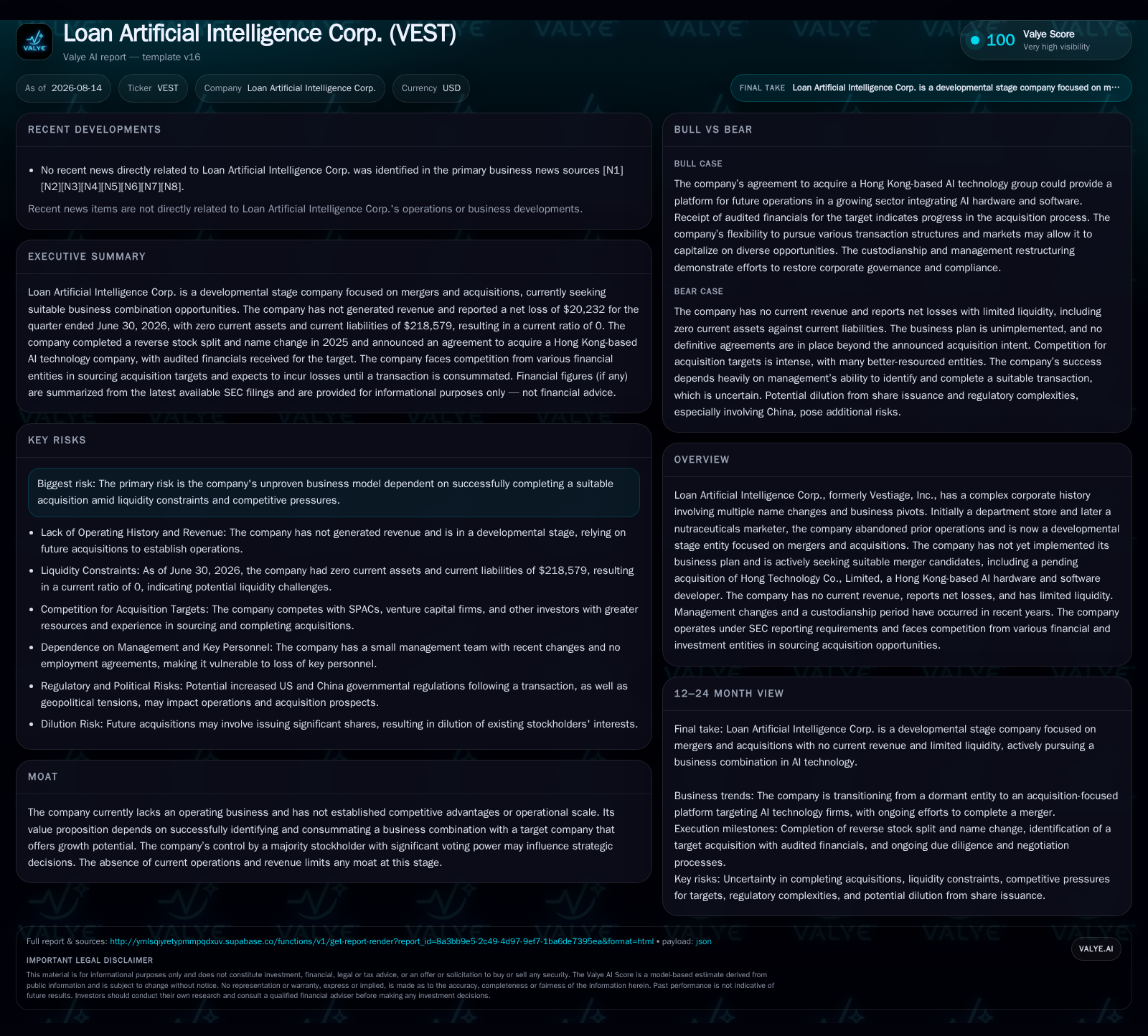
Loan Artificial Intelligence Corp. (VEST) remains a developmental stage entity with no current revenue, focused on a pending acquisition of Hong Technology Co., a Hong Kong-based AI hardware and software firm. The latest quarterly filing confirms minimal liquidity, no ongoing operations, and continuing net losses. The company’s strategy centers on closing this deal to establish operating scale but faces significant risks including capital constraints, competitive acquisition landscape, regulatory exposure linked to China operations, and management execution uncertainty. Successful acquisition integration would mark a critical inflection point for the company’s business model viability.
Recent Operating Update: Continued Development Stage Status with Ongoing Acquisition Negotiations
Loan Artificial Intelligence Corp. (ticker: VEST), formerly Vestiage, Inc., remains a developmental stage entity as of its latest quarterly filing dated August 14, 2026. The company reports no revenue or ongoing business operations and sustained net losses of approximately $79,336 reported through December 31, 2025 [F1]. Its current assets stand at zero against liabilities exceeding $218,000 as of June 30, 2026; this severely constrained liquidity position highlights immediate funding pressures faced by the company [F1][S2].
Operationally, VEST is actively pursuing a transformative business combination with Hong Technology Co., Limited—a Hong Kong-based firm specializing in intelligent hardware integrated with artificial intelligence software and automated system applications for diverse market segments including consumer and industrial sectors [S3][S15]. This potential acquisition represents the company's primary pathway to transition from a defunct holding shell into an operating technology platform.
Negotiations with Hong Technology have advanced through key commercial term finalizations and audit milestone achievements. Notably, audited financial statements under Hong Kong's SME Financial Reporting Standard were obtained for the relevant subsidiaries for fiscal years ending December 2023 and 2024—an important prerequisite for transaction progression [S3][S5]. Nevertheless, no definitive agreement has yet been executed; the closing remains contingent upon customary conditions such as completion of due diligence, regulatory approvals particularly related to cross-border issues involving China jurisdictions, and shareholder consents [S5][S15].
Business Model Analysis: Development-Stage Acquisition Vehicle Focused on AI Tech
As a developmental stage acquisition vehicle rather than an operating company selling products or services directly to end customers, Loan Artificial Intelligence Corp.'s business model depends fundamentally on sourcing and closing a suitable merger or acquisition target that can deliver growth potential within AI hardware/software sectors. Historically dormant aside from legacy nutraceuticals marketing that was abandoned by prior management in 2015 [S1], VEST's corporate lineage involves multiple pivots—from department store roots through nutraceuticals to its current AI-focused M&A strategy.
Revenue mechanics will hinge entirely on the successful consummation of the proposed transaction with Hong Technology Co., after which the combined entity intends to generate income through sales of intelligent hardware integrated with AI-enabled data analytics platforms targeted at consumer devices, enterprise systems, and industrial automation applications [S3]. Monetization could arise from product commercialization, recurring software licensing or subscription revenues associated with automated system applications, or long-term data services contracts. Until closed, however, all financial metrics remain hypothetical.
Key operational drivers include volume and price realization of intelligent hardware units sold post-acquisition, software adoption rates among customers (enterprises/industrial users), licensing fee escalations based on product enhancements, and cost efficiencies achieved through integration of acquired technology with existing platforms. Margin variability will depend heavily on supply chain optimization for hardware components versus high-margin software modules.
Customer adoption dynamics in this sector typically involve long sales cycles driven by technical validation requirements and switching costs; thus post-merger integration milestones related to R&D consolidation and sales channel establishment are critical early performance indicators.
Industry Structure and Competitive Positioning within Technology Investment Vehicles
Within the broader Technology Investment and Acquisition industry segment focused on emerging AI technologies, companies like Loan Artificial Intelligence Corp. compete primarily among special purpose acquisition companies (SPACs), business development companies (BDCs), venture capital-affiliated funds targeting AI startups, private equity firms focusing on tech buyouts, and investment banks facilitating technology sector mergers.
VEST currently lacks scale operationally or financially relative to better-funded peer SPACs such as Churchill Capital or Social Capital Hedosophia which have successfully closed sizable tech acquisitions leveraging strong investor networks. Moreover, established BDCs possess dedicated capital pools enabling agility in competitive bidding scenarios. This places VEST at a disadvantage when facing rivals in identifying attractive targets where negotiation leverage often favors buyers able to close quickly with ample financing ahead of contingencies.
Additionally, governance complexity arises from significant shareholder voting power concentration by a majority stockholder controlling upper-tier entities—potentially complicating independent board oversight needed during sensitive acquisition negotiations [S15]. Past board inactivity led to judicial custodianship between 2021–2022 handled by Small Cap Compliance LLC—a scenario reflecting prior governance instability but since resolved via reconstitution of management structures [S1][S6][S18].
Growth Drivers
The core growth impetus derives from rising global demand for artificial intelligence-powered intelligent hardware solutions addressing automation needs across sectors including smart consumer electronics and industrial IoT deployments. Consolidation trends encourage mergers among fragmented startups developing complementary AI software tools paired with hardware platforms—favoring acquirers positioned strategically like VEST intends to be post-merger.
Capital markets environment supporting equity raises enabling funding acquisitions has improved moderately after recent volatility dampened tech IPO volumes overall; nevertheless accessing sufficient private placements remains paramount given VEST’s lack of direct revenue streams currently. Strategic partnerships with financial investors can further expand deal pipeline breadth enabling more target evaluations within compressed timeframes.
Technological innovation pace also compels smaller developers toward sales/acquisitions rather than scaling independently—a dynamic that may provide deal flow opportunities especially within Hong Kong / China tech ecosystems where government incentives stimulate AI development but regulatory risks heighten transactional complexity.
Risks and Watchpoints
Liquidity scarcity is arguably the most immediate constraint—zero current assets versus substantial short-term liabilities implies urgent need for capital raises not guaranteed given limited historical operating cash flow generation or investor track record [F1][S2][S12]. Failure to raise needed funds could stall acquisition closure or push the company toward operational curtailment.
Competition from more capable bidders with deeper pockets or stronger networks heightens target sourcing risk; smaller players like VEST often face protracted deal cycles increasing cash burn without offsetting revenues.
Chinese regulatory uncertainty presents compliance burdens including pre-merger government notifications under PRC M&A rules plus national security reviews specifically impacting foreign investor acquisitions in technology fields deemed sensitive—introducing timing unpredictability or deal derailment threats [S11][S13]. Post-acquisition integration challenges also loom large given absence of internal operational track record managing complex tech business platforms.
Equity dilution risks accompanying capital raises planned via private placements tied directly to merger financing may erode existing shareholders’ value markedly if share issuance is inflationary beyond initial expectations [S10][S15]. Governance stability will remain under scrutiny especially relative to past custodianship episodes.
What To Watch Next
Key milestones include formal execution of definitive agreements finalizing conditions precedent including audit completion confirmation scheduled around mid-2026 quarters [S3][S15]; any delays here would materially shift expected timeline.
Monitoring private placement closings introducing strategic investors who sponsor post-acquisition operational scaling represents critical validation step clarifying company’s liquidity outlook post-merger execution.
Regulatory filings signaling requisite governmental clearances from Chinese authorities directly impact feasibility metrics especially given cross-border nature of transaction structure.
Follow-up corporate governance updates about board composition changes or appointment of experienced management personnel capable of navigating post-close integration risks will offer insight into organizational preparedness.
Financial disclosures updating working capital status periodically will signal whether cash burn remains sustainable allowing uninterrupted pursuit of planned acquisitions before revenue-generating operations emerge.
Financial Profile Discussion
At June 30, 2026, Loan Artificial Intelligence Corp.'s balance sheet reflects zero reported current assets juxtaposed against current liabilities totaling approximately $218,579—the resulting current ratio of zero starkly illustrates the precarious liquidity position preventing self-sustaining operations absent external funding support [F1][S2]
The company continues recording consistent operating losses due principally to administrative costs incurred maintaining public reporting compliance under SEC rules compounded by expenses tied to evaluation activities related to its pending acquisition [S1][S12]. Audit firm opinions expressed substantive doubt regarding borrower's going concern status referencing insufficient available capital resources necessary to meet near-term expenses without new cash inflows through financing events [S12].
Despite these challenges, management maintains efforts directed toward securing privatized financing rounds exempt from registration requirements intended exclusively to fund transactional commitments associated with acquiring Hong Technology Co. Limited and related working capital demands anticipated post-closing [S9][S10][S15]. Given absence of operational cash inflows historically or presently projected until acquisition closure completes formally executing the business plan dictates continued negative cash flow reliance on successful capital raises.
This analysis anchors exclusively on disclosed SEC filings up to August 14, 2026. It discloses no investment research views but aims solely at delineating Loan Artificial Intelligence Corp.'s current strategic positioning within its developmental stage M&A trajectory amid prevailing industry contexts and internal financial constraints.
Disclaimer: This is research-only, informational analysis and not investment advice. It may include AI-generated interpretation and general industry context. Always verify important details using primary sources.

Comments