
China Foods Holdings Expands Multi-Channel Health Product Distribution Amid Regulatory and Liquidity Challenges
Latest quarterly disclosures confirm China Foods’ strategic pivot to integrated traditional health products and personalized consulting within a complex Chinese regulatory backdrop.
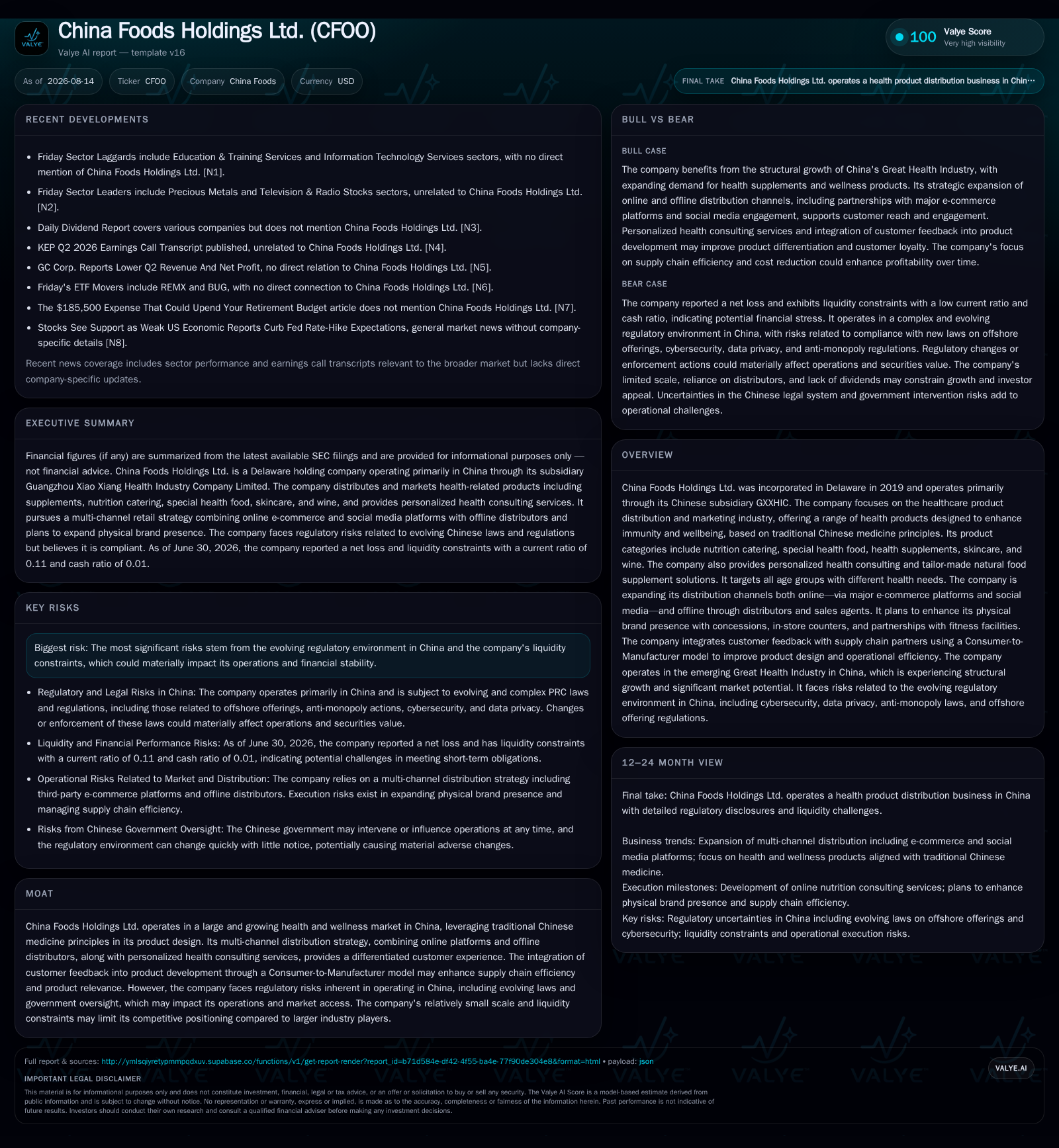
China Foods Holdings Ltd., operating through its Chinese subsidiary GXXHIC, continues developing a multi-channel distribution model blending traditional Chinese medicine-based health supplements with personalized consulting. The latest quarterly filing underscores no material change in risk disclosures despite intensifying Chinese regulatory oversight and ongoing liquidity constraints reflected in a low current ratio of 0.11. The company is focusing on expanding online e-commerce presence and offline retail footprint, including partnerships with fitness centers, while leveraging consumer-to-manufacturer (C2M) supply chain integration to enhance product relevance. Persistent regulatory uncertainties and limited scale compared to larger peers create operational risks and may cap near-term growth.
Recent Operating Update
China Foods Holdings Ltd.’s latest quarterly filing dated August 14, 2026 ([S2]) did not introduce new risk factors or material updates beyond restating ongoing exposure to China's evolving regulatory environment. The company continues to conduct business through its wholly owned Chinese subsidiary Guangzhou Xiao Xiang Health Industry Company Limited (GXXHIC), exposed fundamentally to the uncertainties inherent in China’s legal system ([S1]). Despite intense public scrutiny of Chinese ADRs under the Holding Foreign Companies Accountable Act (HFCAA), China Foods has made key auditor transitions in early 2026 to comply with PCAOB auditing standards albeit recognizing continued inspection challenges ([S18], [S27], [S28]).
Public disclosures report no incidents or warnings related to cybersecurity or material legal proceedings ([S9], [S14]). On the financing front, the company remains under liquidity pressure as reflected by its June 30 balance sheet: cash reserves are minimal at $15,923 against current liabilities of $1.625 million pushing the current ratio down to a precarious 0.11 ([F1]). This constraint underlines vulnerability in meeting short-term obligations without additional capital inflows.
Business Model and Strategic Positioning
China Foods operates primarily as a distributor and marketer of health-related products designed according to traditional Chinese medicine principles aimed at improving immunity and overall wellbeing ([S7], [S16]). Its product range includes nutrition catering, special health food items, health supplements, skincare products, and even wine related to lifestyle enhancement themes ([S7]). This diversified portfolio targets multiple demographic segments across age groups.
Revenue derives principally from product sales via a multi-channel distribution framework combining:
- Online e-commerce platforms such as Tmall and Jingdong mall,
- Engagement on popular social media platforms including WeChat, TikTok, Xiaohongshu providing direct healthcare consultation,
- Offline distributors and sales agents,
- Plans for an expanded physical footprint using concessions and in-store counters,
- Partnerships with premium fitness facilities establishing nutrition clubs delivering targeted wellness programs ([S16]).
This multi-faceted approach seeks to deepen customer engagement by fusing personalized health consulting with retail sales—offering pre-purchase advice through digital channels enhanced by after-sales service support ([S16]). A distinctive element in the model is the Consumer-to-Manufacturer (C2M) integration whereby direct customer feedback loops enable supply chain partners to tailor offerings tightly aligned with client needs—a workflow expected to improve both cost efficiency and product relevance ([S3]).
Industry Structure and Competitive Landscape
The company operates within China’s expansive "Great Health Industry," anticipated by external research firms like Frost & Sullivan to surmount RMB 11.4 trillion by end-2026 driven by structural shifts towards preventive health care and wellness consumption ([S19]). Within this ecosystem, growth is heavily weighted towards functional foods and supplements propelled by younger consumers embracing immunity-focused regimes.
China Foods is positioned midstream as both distributor and marketer rather than a primary manufacturer—a role that dictates dependency on upstream suppliers but also allows flexibility across multiple distribution channels targeting both physical retail points and online marketplaces.
Peers encompass a spectrum including global giants such as Herbalife Nutrition known for nutritional supplements; Amway leveraging multilevel distribution networks; Tianjin Tasly Pharmaceutical specializing in traditional Chinese medicine formulations; Alibaba Health Information Technology commanding e-commerce-based health product access; plus Watsons dominating health & beauty retail outlets. Relative to these larger competitors China Foods' scale is limited with markedly constrained liquidity impeding potential rapid growth or larger channel expansion.
Growth Drivers
Structural tailwinds supporting medium-term growth include:
- Rising consumer focus on personal health insurance mediated through nutritional supplements,
- Population aging trend expanding demand for chronic care supportive products,
- Continued digital penetration allowing accelerated scaling of e-commerce sales,
- Integration of heritage traditional Chinese medicine knowledge into modern wellness paradigms gives product differentiation,
- Expansion of personalized consulting creates higher-margin revenue streams reinforcing brand loyalty,
- Government promotion favoring development of comprehensive health industries,
- Urbanization trends enhancing disposable income accessible for premium healthcare products,
- Leveraging strategic partnerships with fitness centers boosts offline brand presence through experiential marketing ([S19], [S16]).
Risks and Growth Constraints
Several significant risks could curtail growth prospects:
- Regulatory complexity: China's swiftly evolving laws around offshore securities offerings, anti-monopoly controls, data security compliance impose unpredictable legal/operational costs which may delay or restrict market activities ([S12], [S15], [S24]).
- Government intervention risks remain high given China's political dynamics potentially disrupting foreign-invested entities or sharply changing permitted business scopes ([S1], [S9]).
- Financial fragility: The acute liquidity deficit shown by their latest balance sheet signals difficulty funding expansion or absorbing market shocks without capital injections ([F1]).
- Competitive pressures from deep-pocketed incumbents who enjoy expansive distribution networks or brand recognition—challenging customer acquisition cost efficiency for China Foods.
- Dependence on third-party e-commerce platforms exposes the company to changing platform policies or fee structures which may erode gross margins.
- Supply chain interruptions related to geopolitical tensions or logistics bottlenecks could impair timely delivery impacting sell-through rates.
- Consumer trust nuances around health claims necessitate stringent quality control lest reputational damage arise publicly.
What to Watch Next
Key operational/red flags defining near-term performance will include:
- Indicators of revenue growth segmented by channel mix (online vs offline) would reveal success levels of multi-channel expansion initiatives.
- Gross margin movements reflecting supply chain efficiencies gained from C2M integration.
- Metrics on repeat purchase rates signaling customer retention especially post-consultation service rollouts.
- Capital raises or improvements in current ratio figures implying easing of liquidity pressures.
- Management commentary on navigation of newly enacted PRC regulations regarding overseas listings or cybersecurity requirements.
- Expansion steps into offline concessions or fitness club partnerships providing tangible evidence of strengthening brand presence beyond digital realms.
Financial Profile Discussion
As per the most recent SEC filing ending June 30, 2026 ([F1]), China Foods holds $15.9K in cash versus current liabilities totaling $1.625 million resulting in an extremely weak current ratio of approximately 0.11. Such acute short-term liquidity risk limits operational flexibility unless remedial financing occurs promptly. No dividends have been declared historically nor are expected given capital retention priorities for core business continuity ([S11]). The Delaware holding structure facilitates cross-border funding between Hong Kong subsidiaries without substantive legal barriers; however underlying PRC foreign exchange controls represent latent potential bottlenecks for repatriation or capital allocation ([S14], [S17]). The recent auditor transition towards PCAOB-approved Dallas-based firm BZ CPA Inc seeks compliance alignment amidst HFCAA audit inspection uncertainties but introduces transitional audit execution risk until stabilization occurs ([S27], [S28]).
In sum, the financial profile supports cautious monitoring related primarily to liquidity management rather than profit generation at this stage.
--
This analysis synthesizes publicly disclosed SEC filings supplemented by industry context without incorporating unverified forecasts or proprietary competitive metrics. It aims solely to elucidate operating realities behind China Foods Holdings Ltd.'s reported data as of mid-2026.
Disclaimer: This is research-only, informational analysis and not investment advice. It may include AI-generated interpretation and general industry context. Always verify important details using primary sources.

Comments