
Allied Energy’s Q2 2026 Results Highlight Operational Resilience and Strategic Expansion
In its latest quarterly filing, Allied Energy demonstrated profitability and strong liquidity, supporting its capital-intensive upstream operations while progressing on strategic diversification.
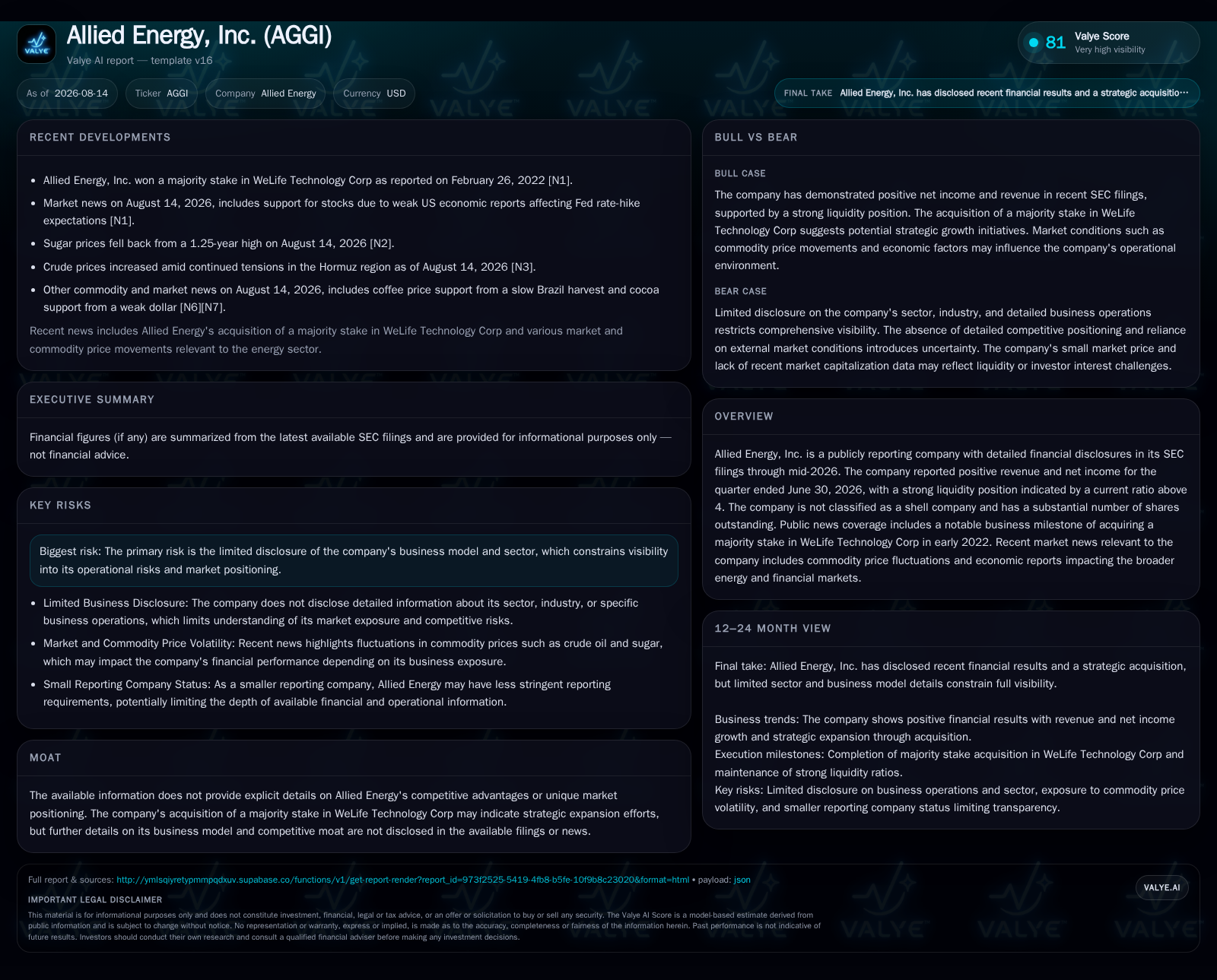
Allied Energy reported a profitable second quarter of 2026 with net income supported by solid operational performance and a robust liquidity position, reflected in a current ratio exceeding 4. The company’s upstream production activities remain sensitive to commodity price fluctuations, though detailed production or hedging data were not disclosed. Allied’s acquisition of a majority stake in WeLife Technology Corp underscores a strategic initiative to enhance capabilities beyond traditional upstream operations. While the company benefits from a strong balance sheet that mitigates execution and market risks typical in the sector, monitoring future production volumes, realized pricing, and capital expenditure deployment will be key to assessing sustainability of growth and margin stability.
Q2 2026 Operating Update: Profitability Amid Capital-Intensive Upstream Challenges
Allied Energy’s latest quarterly report for the period ending June 30, 2026, reveals sustained profitability alongside robust liquidity metrics [S2][F1]. This liquidity strength provides a cushion to support ongoing operations and investment needs without immediate refinancing pressure. Furthermore, the company’s confirmation as an active operating entity (not a shell) reinforces its status within the sector [S1].
Although the filing does not provide granular data on production volumes or realized commodity prices for the quarter, Allied’s reported net income indicates profitable sales likely underpinned by effective cost control or supportive market conditions. In an industry where earnings are highly sensitive to commodity price swings, this outcome points to operational resilience relative to peers facing similar sector headwinds.
Business Model Insights: Revenue Generation and Commodity Price Exposure
Operating primarily in the upstream segment, Allied Energy generates revenue through extraction and sale of hydrocarbons such as oil and natural gas. Revenues typically reflect realized pricing influenced by spot market conditions or longer-term contracts that may offer some revenue stability [S1]. The absence of explicit hedging disclosures limits assessment of how the company manages commodity price volatility risk; however, such strategies are common among upstream producers to stabilize cash flows.
Key performance indicators like production volume (barrels of oil equivalent or cubic feet of gas) and realized price per unit sold are critical for evaluating revenue quality and operational scale. Without these details, it remains essential to track upcoming quarterly reports for clarity on asset utilization and pricing dynamics that directly impact top-line growth and margin trends.
Competitive Positioning: Capital Expenditure Discipline and Strategic Expansion
Within the upstream energy landscape—characterized by capital intensity—maintaining cost competitiveness through efficient capital expenditure programs is vital for sustaining reserve levels and profitability margins. While Allied’s filings do not disclose specific capex amounts or reserve replacement data, maintaining positive net income alongside strong liquidity suggests disciplined investment aligned with market conditions [S1]
The strategic acquisition of a majority interest in WeLife Technology Corp in early 2022 indicates Allied’s pursuit of diversification or technological enhancement possibly aimed at improving project execution or operational efficiencies relative to peers. This move could enable integration of innovative capabilities complementing core upstream activities without deviating from its energy sector focus.
Growth Drivers: Asset Development Coupled with Strategic Acquisitions
Allied Energy’s growth potential appears anchored in expanding production capacity organically through asset development while leveraging acquisitions like WeLife Technology Corp to broaden technological competencies or service offerings. Although reserve base metrics remain undisclosed, such initiatives commonly target improved reservoir management or enhanced operational processes.
Broader industry trends supporting growth include rising global energy demand and evolving regulatory incentives favoring cleaner energy solutions. While Allied has not explicitly detailed renewable exposure, its acquisition strategy may position it to capitalize on shifts within the energy landscape over time.
Risks and Watchpoints: Managing Market Volatility with Strong Liquidity
The company faces typical upstream risks including commodity price volatility that can compress margins when prices decline below breakeven levels. Regulatory compliance costs related to environmental standards may also increase operating expenses.
Operational risks such as project delays or technical challenges remain pertinent; however, Allied’s solid liquidity position provides significant flexibility to absorb short-term shocks without resorting to dilutive financing measures [F1]. This financial buffer is crucial for sustaining capital expenditures necessary for reserve maintenance amid cyclical market fluctuations.
Key watchpoints going forward include monitoring quarterly updates on production volumes which serve as proxies for operational scale changes. Additionally, developments around contract renewals or new long-term agreements will provide insight into revenue stability efforts. Regulatory changes impacting permitting or environmental compliance costs should be closely observed given their potential influence on operating margins.
Financial Profile Discussion: Liquidity Strength Underpins Operational Agility
As of June 30, 2026, Allied Energy maintains a healthy liquidity profile with $1.61 million in current assets versus $393 thousand in current liabilities resulting in a current ratio of approximately 4.09 [F1]. Cash and equivalents stood at about $148 thousand at quarter-end, indicating prudent cash management balanced against short-term obligations.
While debt levels have not been explicitly disclosed in recent filings limiting leverage analysis, this strong working capital position inherently reduces refinancing risk during periods of commodity price softness. Consequently, Allied is well-positioned financially to support necessary capital expenditures while navigating the cyclicality characteristic of upstream oil and gas markets.
Disclaimer: This is research-only, informational analysis and not investment advice. It may include AI-generated interpretation and general industry context. Always verify important details using primary sources.

Comments