
Atlantica’s Quest for a Viable Merger Spotlighted by Latest Quarterly Updates
Atlantica Inc remains a shell company focused on completing a business combination amid pressing financial constraints and execution risks highlighted in its August 2026 10-Q.
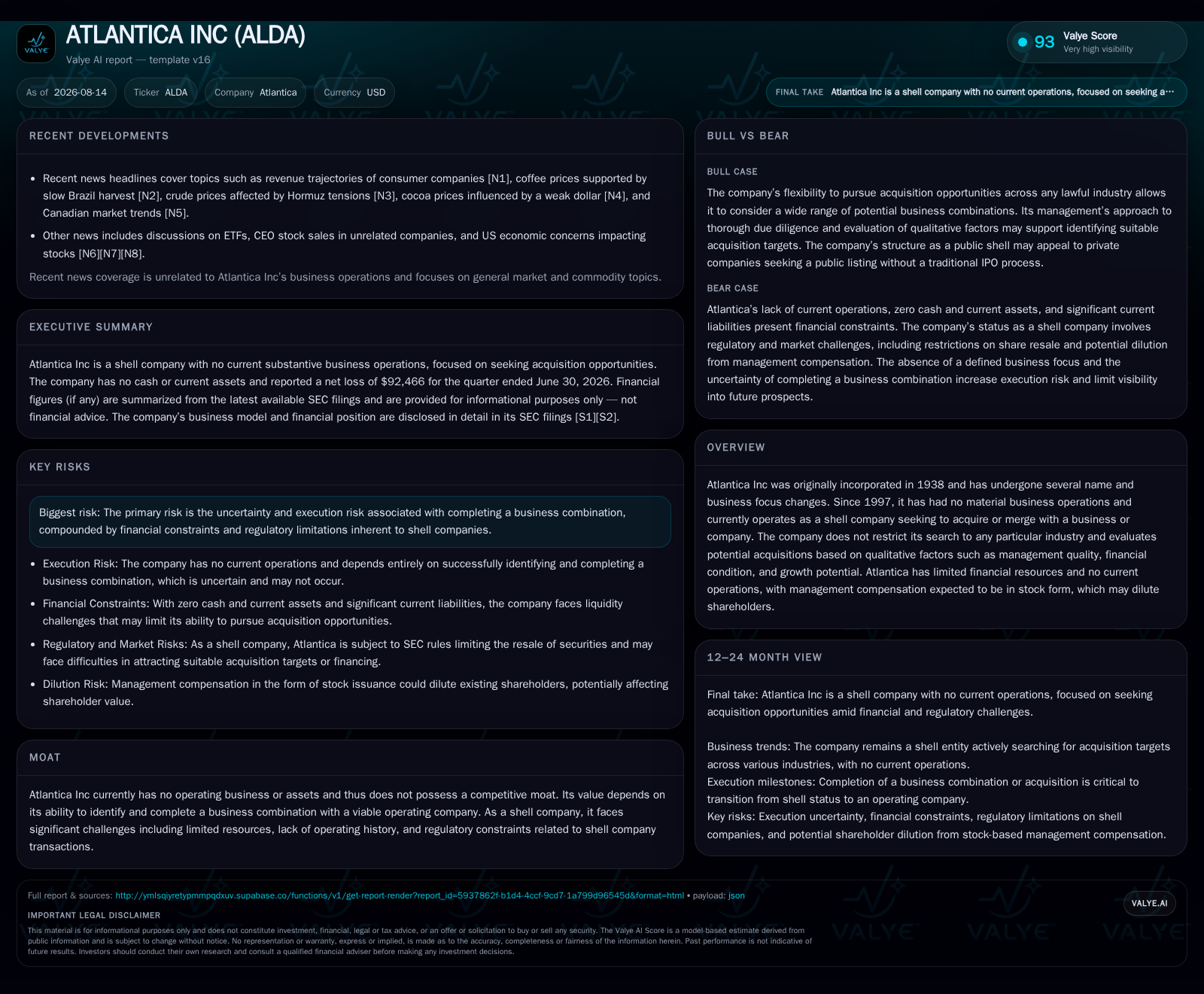
Atlantica Inc continues to operate solely as a shell company with no revenues or assets beyond liabilities, reaffirmed in its latest quarterly filing. Its strategic value depends entirely on the successful identification and completion of a business combination with a private operating entity. Financially constrained and reliant on stock-based compensation for management, Atlantica faces diluted shareholder value and execution risk tied to timing deadlines and acquisition uncertainty. Key near-term investor focus should center on transaction milestones and any capital-raising developments.
Latest Quarterly Filing Reveals Persistent Shell Status and Execution Challenges
Atlantica Inc’s most recent quarterly filing dated August 14, 2026, reinforces its status as an operating shell without commercial activities or revenue generation. The company reported zero cash and equivalents alongside no current assets as of mid-2026, juxtaposed against substantial current liabilities totaling approximately $6.27 million [S2][F1]. This imbalance underscores a precarious liquidity position that must be managed carefully given the absence of operational cash flow.
The financial figures illustrate persistent execution inertia but also accentuate the urgency behind completing a transformative business combination. Without an infusion of capital through acquisition proceeds or alternative financing arrangements, Atlantica faces increased pressure to fulfill its stated corporate purpose before incurring further financial deterioration.
SPAC Archetype Business Model Stresses Reliance on Successful Business Combination
Tracing its corporate lineage back to 1938 with diversified historical focuses, Atlantica now functions essentially as a Special Purpose Acquisition Company (SPAC) archetype shell [S1]. Its core strategy centers around raising capital via an initial public offering (though details of any IPO proceeds are not disclosed) to identify and merge with a private operating company. This de-SPAC transaction is the sole mechanism for value realization.
Management has articulated qualitative screen criteria emphasizing evaluation of target companies based on factors such as quality of leadership, financial health, and growth prospects [S1]. However, due to very limited available resources pre-combination, anticipated management compensation is primarily stock-based rather than cash-based – diluting existing shareholders upon issuance [S1].
This structural setup inherently creates binary outcomes: either Atlantica completes a successful business combination capturing potential upside or it fails—resulting in significant investor losses when trust funds eventually dissipate or regulatory deadlines lapse. The absence of disclosed targets or forward purchase agreements compounds uncertainty surrounding timing and likelihood of success.
Industry Context: Atlantica Amidst Evolving SPAC Market Dynamics and Peer Benchmarks
Within the broader SPAC ecosystem, Atlantica exemplifies the archetype of an inactive shell vehicle positioned between public investors seeking exposure to private company growth via alternative public listing routes. Unlike high-profile peers such as Pershing Square Tontine Holdings (PSTH) or Churchill Capital Corp series known for large-scale deals and well-capitalized PIPE financings, Atlantica's publicly available disclosures lack such evidences of advanced transaction structuring or pipeline transparency.
Market dynamics continue to support SPACs owing to private companies’ appetite for faster and potentially less burdensome access to public markets relative to traditional IPO channels. Atlantica's limited disclosed activity creates challenges in benchmarking its progress against these key sector KPIs.
Capital Structure Tradeoffs: Dilution Pressures and Shareholder Redemption Risks
Key structural considerations emerge from Atlantica's plan to compensate management via equity issuances in lieu of cash given scant financial resources [S1]. Such arrangements typically inflate the sponsor promote stake—a feature often scrutinized by investors due to dilution effects from warrants or common stock issuance.
Concurrently, redemption rights afforded to public shareholders during de-SPAC transactions can materially erode the effective cash held in trust available for acquisition funding. High redemption levels force reliance on PIPE financing (private investment in public equity) at potentially less favorable terms or necessitate renegotiations with target companies.
These intertwined forces create tension between preserving shareholder value and attracting sufficient capital to consummate a deal.
Growth Drivers Centered on Deal Sourcing Capability and Market Conditions for SPACs
Despite uncertainties, several growth drivers underpin Atlantis’s prospects if effectively leveraged. Foremost among these is the quality and experience of its management team in sourcing attractive acquisition targets—an attribute cited by management as central in target appraisal [S1].
Moreover, prevailing market conditions continue favoring SPAC vehicles due to sustained investor appetite for alternative public listings amid evolving capital markets. Innovations in deal structures such as forward purchase agreements or medium-sized PIPE financings have made transactions more flexible and accessible than during earlier SPAC cycles.
If Atlantis can capitalize on these dynamics through securing pipeline exclusivities or partnering with strategic investors, it may improve probability of closing a viable merger transaction within regulatory timeframes.
(Re)Emerging Risks: Timing Deadlines, Financial Leverage, and Regulatory Scrutiny for Shell Companies
The company faces inherent risks rooted in mandated timelines governing SPAC lifecycle completion set by securities regulations—typically requiring consummation within 18-24 months post-IPO absent extension. Failure leads to liquidation triggering complete loss of public investor funds.
Adding complexity is the pronounced financial leverage reflected in Atlantica’s balance sheet void of liquid assets but burdened by over $6 million in current liabilities [F1]. Covering ongoing legal, advisory, administrative fees while expediting transaction diligence imposes financial strain that could accelerate dilution or force distressed mergers.
Furthermore, increased regulatory scrutiny post-pandemic has tightened compliance barriers around valuations, disclosures, conflicts of interest (notably sponsor versus shareholder incentives), elevating execution risk profiles across all SPACs including smaller shells like Atlantica.
'What Success Looks Like'—Near Term Milestones for Transaction Progression and Investor Signals
Investors should focus on identifiable markers indicative of transaction momentum which may mitigate prevailing uncertainties:
- Public announcement of definitive merger agreement outlining target identity and terms.
- Scheduling timeframe for shareholder vote necessary to approve business combination.
- Securing PIPE financing commitments that bolster transaction capital base beyond redemption inflows.
- Progressive regulatory filings evidencing due diligence completeness.
- Any capital injections or amendments reflecting adjustments in sponsor promote or warrant structures.
Tracking these milestones offers tangible signals about Atlantica's trajectory toward becoming an operating enterprise rather than remaining a dormant shell entity [S2].
Financial Profile Discussion: Leverage, Liquidity Constraints, and Implications for Merger Execution
Atlantica’s financial snapshot reveals acute liquidity constraints complicating its acquisition ambitions. As per latest data ending June 2026, no reported cash nor liquid assets exist while recorded current liabilities exceed $6 million [F1]. This scenario paints a picture commonly faced by shell companies awaiting deal closure—the necessity to balance escalating administrative overheads against severely limited working capital reserves.
This condition elevates counterparty risk for advisers engaged in the merger process who may demand upfront fee payments; concurrently it tightens operational runway obstructing extended search periods. Hence the urgency around accelerating deal pipelines becomes paramount both strategically and financially.
The reliance on stock-based compensation schemes further pressures shareholder dilution metrics raising governance concerns around sponsor-shareholder alignment until business combination completion is secured [S1]. In sum, without prompt transactional success or external capital infusion efforts such as rights offerings or amendments granting additional sponsor equity participation rights could increase dilution risk substantially.
This analysis synthesizes Atlantica Inc's disclosed quarterly status within the wider context of SPAC industry dynamics underscoring critical execution risks balanced against conditional growth levers. Investors should closely monitor formal transaction developments alongside capital structure evolution given their material bearing on outcome probabilities absent traditional operating revenues or assets.
Disclaimer: This article does not constitute investment advice; it solely aims to analyze documented information regarding Atlantica Inc based on publicly available SEC filings and industry frameworks.
Disclaimer: This is research-only, informational analysis and not investment advice. It may include AI-generated interpretation and general industry context. Always verify important details using primary sources.

Comments