
Protagenic Therapeutics Advances Clinical Pipeline Amid Funding Challenges
Protagenic progresses its proprietary neuropeptide PT00114 into late-stage clinical development while confronting critical liquidity constraints and the need for strategic partnerships.
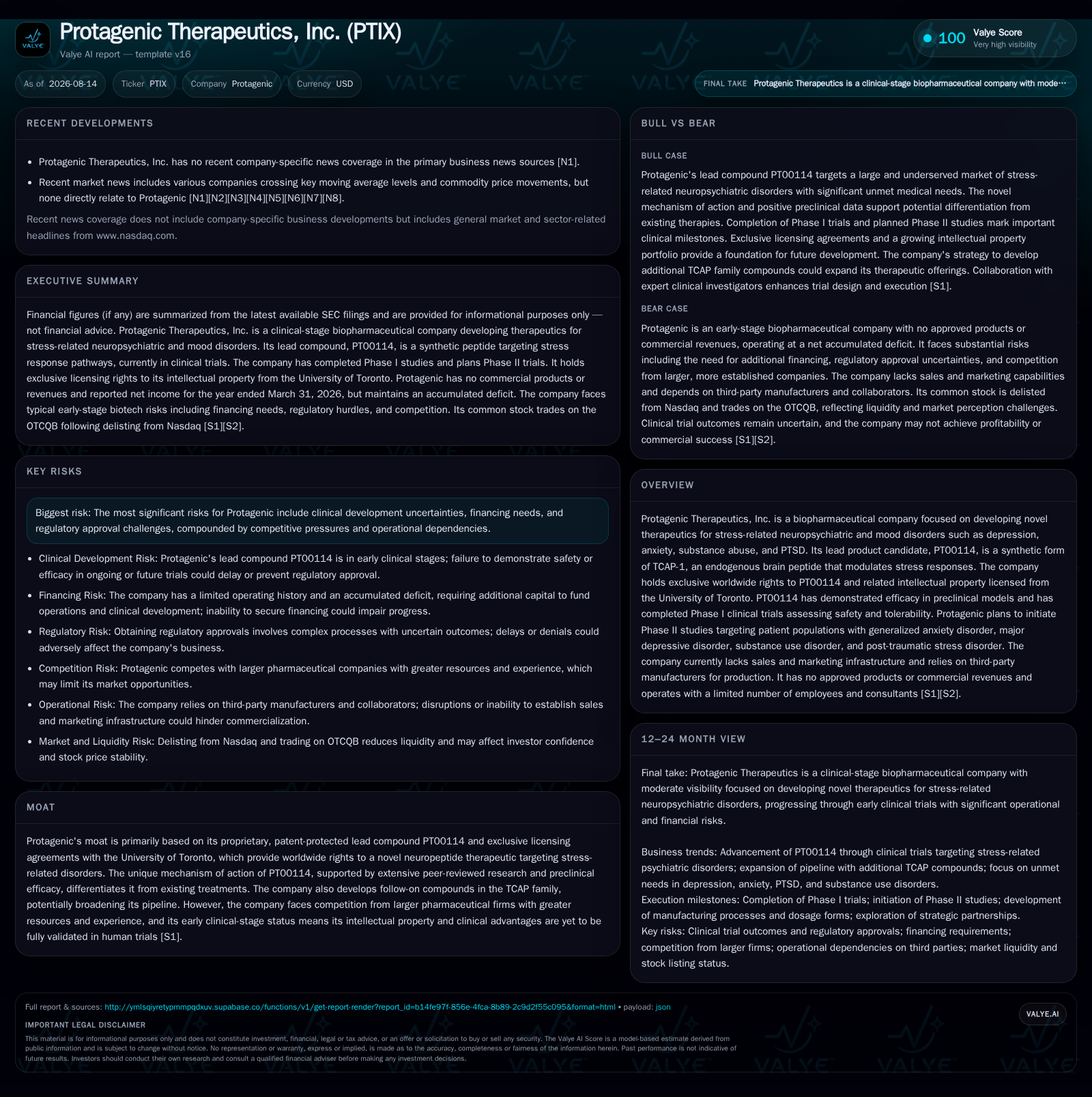
Protagenic Therapeutics, a clinical-stage biotech focused on stress-related neuropsychiatric disorders, has completed Phase I trials for its lead compound PT00114 and plans to initiate Phase II studies in late 2026. The company leverages exclusive licensing from the University of Toronto for its patented TCAP-1 analog technology but currently lacks commercialization capabilities and faces intense competition from larger pharma. With cash runway projected only through Q3 2026, financial sustainability hinges on successful fundraising or collaborations. Pipeline diversification within the TCAP family and regulatory progress remain key near-term value drivers.
Emerging Clinical Milestones in Neuropsychiatric Drug Development
Protagenic Therapeutics has transitioned from early safety assessments toward clinical proof-of-concept work with its lead drug candidate PT00114. After completing Phase I multiple-dose safety and tolerability studies in healthy volunteers by December 2025, the company announced plans to initiate randomized Phase II trials targeted at treating generalized anxiety disorder (GAD), major depressive disorder (MDD), substance use disorder (SUD), and post-traumatic stress disorder (PTSD) starting in late 2026 [S1][S2]. This progression materially de-risks the compound compared to purely preclinical stages, advancing time-to-market potential contingent upon successful patient enrollment and demonstration of efficacy.
Given PT00114's novel mechanism—a synthetic analog of the endogenous brain peptide TCAP-1 that modulates overactive stress responses—clinical validation is crucial. Efficient patient recruitment and retention will be key operational KPIs to watch, as delays here historically elongate development timelines and increase cash burn in neuropsychiatric R&D [S4]. The move into Phase II represents a pivotal point where positive efficacy signals could substantively increase the compound’s valuation by reducing technical risk.
Patents, Licensing Exclusivity, and the Intellectual Property Edge
Protagenic's intellectual property backbone derives from an exclusive worldwide license agreement with the University of Toronto, granting rights to PT00114 and related TCAP-family peptides through patents issued in the US, Canada, EU (including Germany, France, Great Britain), and Hong Kong [S1][S15][S27]. This patent portfolio provides a meaningful moat by establishing technology exclusivity over a novel neuropeptide therapeutic class targeting stress pathways—a mechanism distinct from conventional monoaminergic antidepressants or anxiolytics.
Maintaining this license requires ongoing diligence including milestone reporting and commercial efforts; failure risks losing exclusivity as licenses convert from exclusive to non-exclusive status, substantially harming competitive positioning [S15]. The IP estate also amplifies leverage in future partnering or out-licensing negotiations. Intellectual property litigation remains a material risk given the biotech industry's litigious environment where competitors may assert infringement claims or file overlapping patent applications [S9][S16], but Protagenic appears focused on defending its position through continued innovation within the licensed platform.
Navigating Competitive Dynamics in Stress Disorder Therapeutics
The therapeutic space Protagenic targets—stress-related neuropsychiatric disorders such as treatment-resistant depression (TRD), SUD, GAD, and PTSD—is both large in unmet need yet sparse in innovative pipeline candidates. However, incumbent pharmaceutical companies possess deeper pockets, extensive clinical experience, and established commercial channels [S1][S20]. Protagenic’s challenge lies in differentiating PT00114’s novel peptide modality clinically against established product classes while overcoming limited internal marketing infrastructure.
Given the absence of a direct sales force, Protagenic must either build market access capabilities or forge collaborations with third parties possessing commercial scale [S20]. Pricing power will likely be constrained until clear advantages in efficacy or safety emerge from clinical trials. Early preclinical data suggest a favorable therapeutic potential without addictive properties typically seen in some CNS drugs [S23], but these assertions await confirmation at human trial scale.
Sustaining Growth Through Pipeline Diversification & R&D Strategy
Recognizing the inherent risk in single asset dependency common among early-stage biotechs, Protagenic is developing follow-on compounds within the TCAP peptide family that share similar mechanisms but may address additional neuropsychiatric or potentially neurodegenerative indications [S1]. This strategy spreads scientific risk across multiple candidates while building a more robust long-term R&D pipeline.
Such pipeline breadth can enhance negotiating power with partners and investors but requires consistent capital investment given the extended timelines typical of drug development. Positive preclinical results transitioning into clinical candidates will be important signals for validating this diversification approach.
Funding Constraints Highlight Urgency for Capital & Strategic Deals
The debt burden stands at approximately $3.16 million as of December 2025, contributing to a net debt position near $2.96 million after accounting for cash on hand [F1]. Current assets relative to liabilities yield a current ratio of about 1.5x as of March 2026, indicating a modest short-term liquidity cushion [F1].
This financial profile underscores an urgent need for successful equity raises, debt refinancing under more favorable terms, licensing agreements generating upfront payments or milestone-based funding, or strategic partnerships providing capital injection [S24]. Failure to secure such funding imminently could delay clinical milestones or impair operational continuity.
Regulatory Pathway Considerations and Market Access Planning
Protagenic must navigate complex regulatory environments across multiple jurisdictions because it intends to market PT00114 globally including North America and Europe. Beyond FDA requirements, foreign regulatory pathways often mandate additional testing or documentation which can extend approval timelines [S3][S4]
Furthermore, late-stage development planning necessitates early engagement with payors and clinicians to understand reimbursement dynamics in neuropsychiatry—a historically challenging sector for pricing due to diverse treatment options and evolving healthcare policies [S20][S18]. Given no current internal commercial team exists, contracting market access experts aims at preparing for these complexities ahead of potential product launch.
Near-Term Catalysts & Risks: What to Monitor Next
Key near-term value inflection points include:
- Initiation timing and enrollment rates in planned Phase II trials evaluating PT00114 across multiple psychiatric indications. Delays here would escalate costs and extend timelines.
- Progression updates on pipeline candidates supplementary to PT00114 indicating robustness of broader R&D efforts.
- Announcements confirming new financing rounds or strategic partnerships vital for sustaining operational runway.
- Intellectual property developments such as patent grants or resolution of IP disputes maintaining exclusivity.
- Regulatory interactions shaping trial design acceptability and approval probabilities.
- Monitoring competitive disclosures could indicate shifts in comparative positioning.
Risks include patient recruitment challenges common in CNS trials which may delay enrollment and data readouts; intensified competition from better-resourced incumbents; regulatory setbacks; inability to raise capital without excessive dilution; adverse safety signals undermining trial continuation; or failure to maintain exclusive licensing rights due diligence commitments.
Financial Profile Discussion: Cash Runway Pressure Amid Advancement Costs
The current ratio of approximately 1.5 as of March 31, 2026, suggests limited liquidity headroom beyond immediate liabilities, reinforcing the pressing requirement for fresh capital injection within months following Q3 2026 before clinical programs encounter funding interruptions [F1]. Total indebtedness near $3.16 million further constrains financial flexibility absent refinancing options.
While loss generation is typical for biotechs at this stage absent product revenues or licensing income streams—currently non-existent for Protagenic—the alignment of financing execution with achieving key clinical milestones will materially influence long-term viability prospects. Sustaining momentum demands managing increases in R&D spending efficiently alongside successful capital raises.
This analysis is based solely on publicly available SEC filings including the company’s annual report dated August 14, 2026 ([S1]), quarterly report dated March 9, 2026 ([S2]), associated risk disclosures ([S3]-[S28]), and financial metrics extracted from companyfacts data ([F1]). No investment advice is offered herein.
Disclaimer: This is research-only, informational analysis and not investment advice. It may include AI-generated interpretation and general industry context. Always verify important details using primary sources.

Comments