
Voip-pal.com Raises Patent Litigation Profile While VoIP Service Monetization Remains Elusive
The August 2026 quarterly report accentuates Voip-pal.com's litigation focus amid persistent operating losses and evolving patent enforcement dynamics.
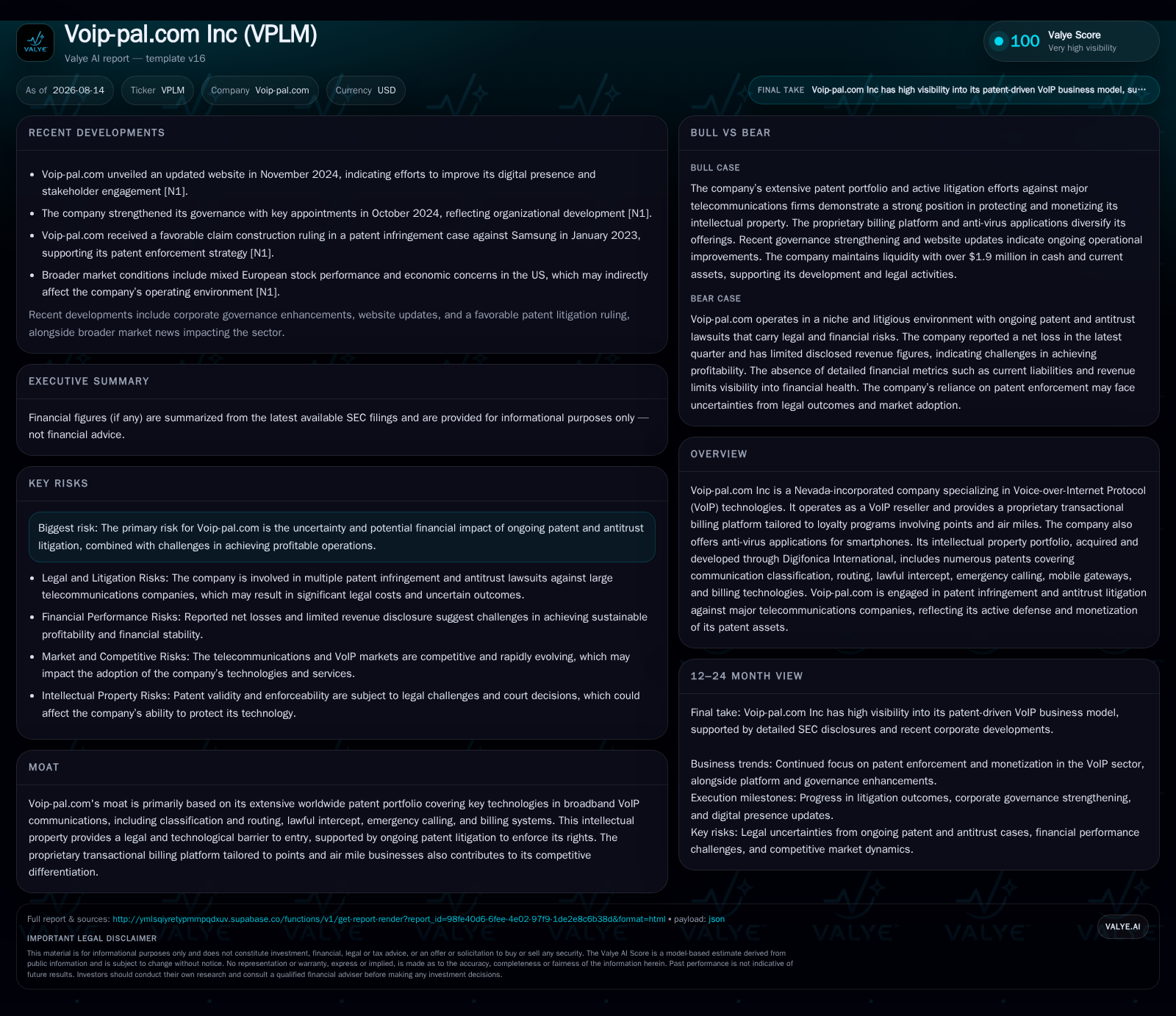
Voip-pal.com's latest 10-Q filing reveals a strategic shift toward emphasizing ongoing patent infringement and antitrust litigation as primary value drivers, even as its VoIP reselling and transactional billing platform continue to struggle with profitability. Recent closures of key patent cases against large telecom defendants highlight a complex legal landscape with mixed outcomes that shape near-term revenue visibility. The company's extensive portfolio of broadband VoIP-related patents underpins its licensing efforts, though recurring operating losses and legal expense volatility remain significant constraints. Monitoring forthcoming court decisions and licensing activity will be critical to assess the durability of Voip-pal's intellectual property monetization strategy.
Q2 2026 Update: Litigation Status Changes Shape Outlook
Voip-pal.com's August 2026 10-Q filing provides an important update on the status of its ongoing legal battles that form the backbone of its valuation proposition. The company disclosed dismissals with prejudice in two high-profile patent infringement suits against Amazon.com Inc. and Verizon Communications Inc., both indicating these particular claims have been closed without further monetary remedies or appeal [S2], [S10]. Similarly, appeals related to T-Mobile infringement claims were voluntarily dismissed following adverse summary judgments at trial level [S12], [S13]. These results reduce some historical uncertainty but also underscore operational dependency on few remaining active litigations. Importantly, several antitrust cases filed by Voip-pal against leading telecom operators remain open yet are still at early procedural stages awaiting court decisions on dismissal motions as of mid-2026 [S8], [S10]. This shifting landscape recalibrates both risk exposure and potential monetization timelines.
With prior patent litigations winding down without final injunctions or damages, Voip-pal now appears to sharpen focus on sustaining valuation through prolonged antitrust actions targeting market competition practices it deems suppressive. However, these lawsuits inherently carry elongated time horizons for resolution and unpredictable cash flow benefits.
Intellectual Property Portfolio as Strategic Moat Amid Legal Battles
Voip-pal’s competitive moat is anchored in its expansive intellectual property portfolio acquired via Digifonica International in 2013 and subsequently expanded through multiple issued patents globally [S1]. The core patents cover broadband Voice-over-Internet Protocol (VoIP) technologies pivotal to routing and classifying communications across heterogeneous network nodes—a fundamental capability enabling diverse service providers to operate interoperably [S23]. Furthermore, issued patents span lawful intercept methods facilitating authorized surveillance compliance (critical for telecom security mandates), enhanced emergency calling transmissions like E911 systems necessary for regulatory compliance in many jurisdictions, as well as mobile gateway innovations improving seamless roaming experiences for mobile subscribers [S15], [S16].
This multifaceted patent base positions Voip-pal uniquely at the intersection of technology innovation and legal defensibility within telecommunications infrastructure. The deliberate involvement in high-stakes litigation reflects an attempt to enforce these rights amidst industry incumbents’ usage of similar underlying technologies without licenses.
However, recent adverse rulings related to certain claims—such as portions found patent-ineligible under Section 101 doctrines—highlight fragility inherent in depending heavily on intellectual property courts for revenue generation [S23]. The breadth rather than depth of the portfolio offers some protection but requires continual legal vigilance.
Balancing Act: Patent Licensing Revenue Against Recurring Service Losses
Despite substantial investment into securing patents and pursuing infringement remedies, Voip-pal's financial disclosures reveal continuing difficulties in scaling recurring revenues from operations beyond one-time or sporadic licensing settlements. The company’s proprietary transactional billing platform aims at specialized niches such as loyalty programs involving points and air miles—an innovative vertical where traditional telecom billing intersects with customer reward ecosystems [S1]. Yet progress towards achieving meaningful commercial traction remains muted.
Operating income reported negative approximately $1.2 million for the quarter ended June 30, 2026—reflecting ongoing cash burn fueled partly by legal expenses required to maintain aggressive litigation postures alongside sparse service-derived revenues [F1]. Net income remains deeply negative trailing prior fiscal years indicative of structural profitability challenges [F1]. This emphasizes that while patent assertions can yield lump-sum license fees or settlements occasionally observed among comparable patent assertion entities (PAEs), they do not reliably substitute for scalable service revenue streams.
The white-label telecommunications reselling model depends extensively on third-party network infrastructure partnerships giving some agility but limiting gross margin expansion potential due to dependence on external wholesale pricing dynamics and tight competition from larger VoIP providers [S1]
Industry Positioning: Peer Context in Telecom Patent Licensing & VoIP Services
In framing Voip-pal’s position within the broader telecommunications patent licensing industry, parallels exist with firms like Acacia Communications or WiLAN which have historically pursued patent assertion as their principal revenue mechanism. Such companies demonstrate that while intellectual property portfolios focused on fundamental communications technologies can create substantial moats through licensing income streams—this model entails inherent volatility linked directly to unpredictable legal outcomes and ongoing contestation.
Conversely, dedicated VoIP service providers with proprietary billing platforms typically rely more heavily on subscriber growth metrics and customer retention rates alongside transaction volume scaling to justify recurring revenue models. Voip-pal straddles these archetypes with a hybrid mix that has yet to fully materialize into sustainable operating cash flows.
The strategic risk is thus twofold: inability to lock-in durable recurring revenues through service offerings coupled with uncertain timing or magnitude of profits from litigation settlements. Regulatory scrutiny towards patent enforcement practices also raises the risk profile compared with peers.
Niche Advantages and Limits of Transactional Billing Platforms in Loyalty Markets
Voip-pal’s transactional billing platform developed for points and air mile businesses addresses a narrowly defined market niche that combines telecommunications usage tracking with loyalty program interoperability; this specialization potentially creates differentiation over generic telecom billing software vendors.[S1]
However, no explicit evidence indicates sizeable merchant acquisition velocity or substantial transaction volume growth sufficient to offset overarching operating losses. While specialized platforms can command premium pricing due to bespoke integrations with loyalty ecosystems, scaling beyond initial customers remains demanding given intense competitive pressures from established SaaS billing providers and large telecom operator systems integrating similar features internally.
Thus, although this vertical may offer long tail stable business if successfully penetrated through partnerships or white-labeling agreements, it currently forms a small slice within an overall business mosaic dominated by volatile litigation outcomes.
Risks Highlighted by Persisting Operating Losses and Legal Expense Volatility
A critical vulnerability stems from substantial negative operating income combined with fluctuating legal expenditures tied to protracted lawsuits. Legal battles require costly expert testimony, extensive discovery processes, and trial preparation expenses—all draining resources before any license royalties or settlements materialize.[F1], [S5]
Additionally, while cash & equivalents stood around $1.91 million as of mid-2023 providing some runway cushion,[F1] no updated liquid asset disclosures post-2023 are available for detailed assessment. This poses questions regarding long-term funding sufficiency if periodic inflows from settlement agreements fail to keep pace with cumulative cash consumption signaling possible capital raising needs or operational retrenchment risks.
Patent invalidation trends under US Supreme Court precedent combined with potential expiration schedules could further erode intangible asset value over time requiring strategic portfolio management or development efforts that the company currently outsources via contractors rather than maintains internal R&D headcount.[S16]
Growth Opportunities Hinged on Litigation Outcomes & Emerging Telco Trends
On the upside, success in ongoing antitrust suits could produce multi-year income enhancements by addressing perceived competitive barriers restraining fair market participation [S8]. Regulatory environments evolving toward stronger intellectual property enforcement may also augment licensing leverage by discouraging infringing behaviors among telecom giants.,
Moreover, increased adoption of broadband telephony globally especially in emerging markets opens windows for greater transactional billing platform utilization alongside demand for reliable lawful intercept technologies amid escalating governmental surveillance mandates.
Technological innovation around mobile gateways facilitating seamless roaming—a core patented feature—remains relevant given ongoing telecommunications mobility trends especially with proliferation of IoT devices requiring optimized roaming protocols.,[S15]
Precise monitoring of case verdicts along with any new announced license agreements constitutes key barometers forecasting whether current IP monetization strategies convert into scalable financial returns.
What to Monitor Next: Legal Milestones, Licensing Deals, Subscriber Growth Signals
Stakeholders should closely watch several near-term indicators: court rulings on pending motions particularly in antitrust cases filed late 2024 and amended through 2025; announcements regarding any multi-party license settlements involving currently targeted Fortune 500 defendants; updates on new customer additions or transaction volume expansions related to the billing platform; transparency around third-party reseller contract terms; changes in legal expense run rates revealed quarterly informing litigation timeline projections; plus managerial commentary concerning capital structure adjustments tied to funding ongoing operations or litigation defenses.[S2], [S10]
Positive news flow around any one dimension could help validate sustainability beyond existing operating loss profiles while adverse developments might reinforce elevated execution risks.
Financial Profile Discussion: Cash Reserves Support Ongoing Litigation Strategy
Cash reserves recorded mid-2023 at approximately $1.91 million provide a foundation for supporting day-to-day operations alongside ongoing lawsuit financing commitments albeit with unclear short-term replenishment pathways unless fresh settlements arise.[F1] Current assets noted as roughly $1.87 million late-2024 indicate balance sheet liquidity was maintained reasonably stable over preceding twelve months but liquidity metrics must be revalidated upon subsequent filings.
Given continued negative earnings trajectory compounded by absence of internal R&D expenditure reflecting minimal direct technology development spend,[S16] there is a pronounced dependency on successful monetization via external licensing or litigation settlements to avoid dilutive capital raises or downsizing imperatives.
This analysis integrates recent SEC filings up to August 14, 2026 ([S2], [S1]) together with companyfacts financial snapshots ([F1]) and industry-level domain knowledge framing the operational challenges faced by Voip-pal.com amidst its current dual-focus model balancing patent enforcement against fledgling service monetization efforts. It underscores the crucial importance of upcoming legal processes and commercial execution milestones in shaping the company's mid-term prospects.
Disclaimer: This report is an analytical briefing based solely on publicly available filings; it does not constitute investment advice nor research views.
Disclaimer: This is research-only, informational analysis and not investment advice. It may include AI-generated interpretation and general industry context. Always verify important details using primary sources.

Comments