
First Guaranty Bancshares’ Consent Order and Portfolio Adjustments Shape Near-Term Outlook
Recent regulatory restrictions and strategic asset portfolio changes reflect First Guaranty Bancshares’ focus on credit risk management amid regional banking challenges.
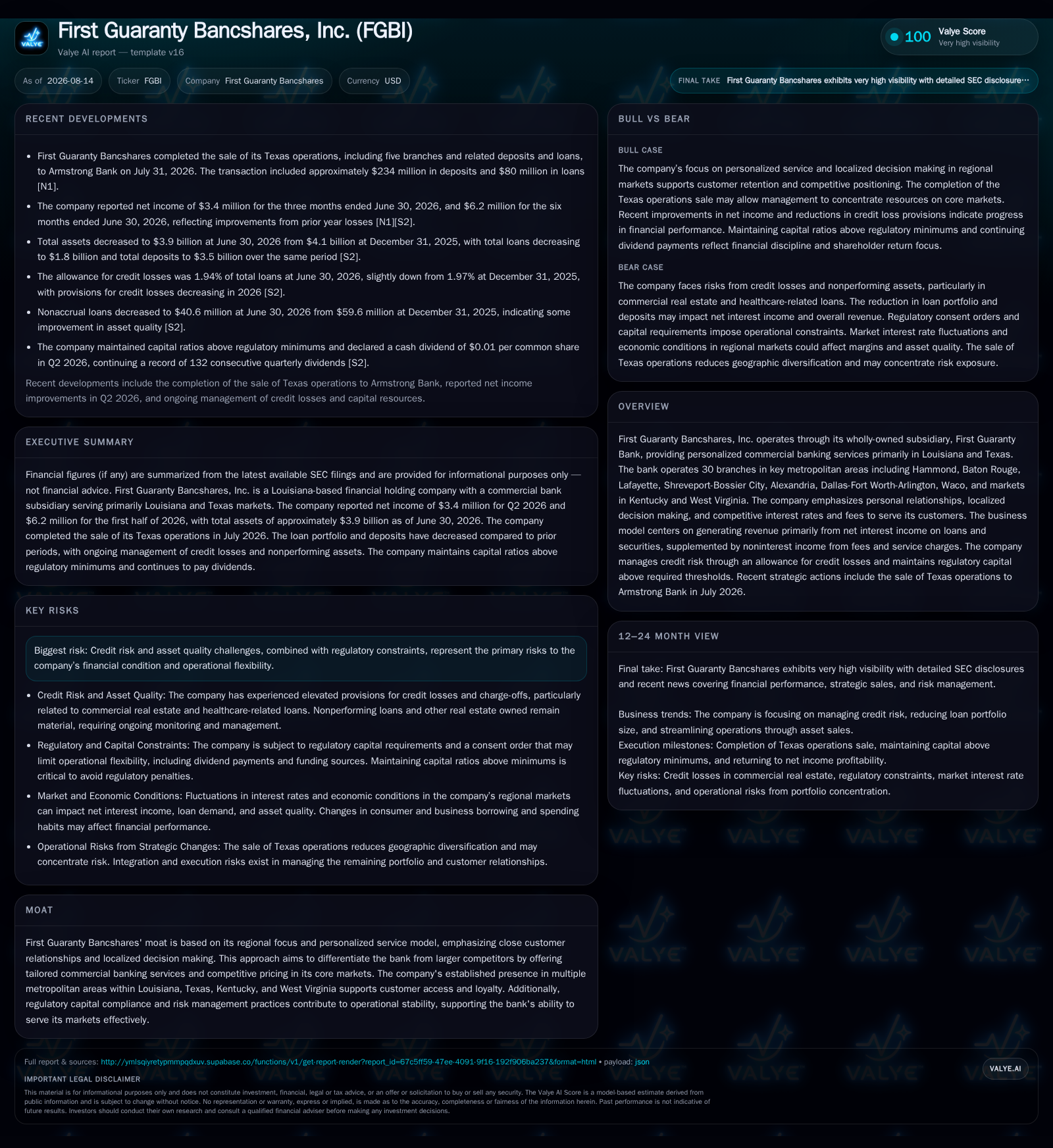
First Guaranty Bancshares, operating primarily through First Guaranty Bank with a focus on Louisiana and Texas, faces headwinds due to an August 2026 regulatory Consent Order that imposes constraints on board oversight, credit administration, capital maintenance, and dividend policies. The bank is managing a shrinking loan portfolio, notably reducing commercial real estate exposure, while sustaining a robust investment securities base and maintaining adequate liquidity through diversified funding sources including Federal Home Loan Bank advances and reciprocal deposit programs. Credit quality improvements alongside decreased provision expense have supported recent profitability despite a challenging operating environment. Monitoring the successful navigation of Consent Order compliance and CRE concentration metrics will be crucial for assessing the path forward.
Recent Operating Developments Reflect Heightened Regulatory Scrutiny
First Guaranty Bancshares’ August 14, 2026 quarterly filing highlights critical developments amid intensified regulatory oversight. On August 7, the bank’s subsidiary consented to a Consent Order issued by the FDIC and Louisiana Office of Financial Institutions requiring enhanced board governance protocols, stricter capital maintenance above regulatory minima, increased monitoring of classified assets and commercial real estate (CRE) concentrations, reinforced credit administration controls, and limitations on dividend payments [S3][S2]. This intervention underscores supervisory concerns about asset quality challenges and capital adequacy that must be addressed decisively.
In a parallel strategic move consistent with addressing regulatory concerns, First Guaranty completed the sale of its Texas operations — five branches along with related loans and deposits — to Armstrong Bank on July 31, 2026 [S2]. This divestiture reflects a tactical retreat from higher-risk or underperforming geographic segments that likely contributed to supervisory scrutiny while reinforcing focus on core Louisiana markets where the bank maintains long-established customer relationships.
Business Model Anchored in Regional Commercial Banking with Localized Service
As detailed in the March 31 annual report, First Guaranty Bancshares operates principally through First Guaranty Bank, a Louisiana-chartered commercial bank providing personalized banking services across metropolitan areas in Louisiana (including Hammond and Baton Rouge), Texas (Dallas-Fort Worth-Arlington), Kentucky, and West Virginia via approximately 30 branches [S1][S2]. The business model centers on cultivating close client relationships enabled by localized decision-making authority at branch level to deliver tailored commercial lending and deposit products with competitive pricing.
Revenue generation depends largely on net interest income—the spread between yields earned on loans and securities versus costs of deposits—supplemented by fees from service charges such as ATM/debit card transactions. Profitability drivers include loan growth or contraction dynamics, deposit mix management affecting funding costs, net interest margin shifts influenced by interest rate changes, and credit risk provisioning.
Competition is primarily from regional peers serving similar customer bases but differentiated here by First Guaranty's emphasis on personal service combined with prudent risk management practices.
Industry Structure Emphasizes Regulatory Challenges for Regional Banks
Regional banks like First Guaranty function as intermediaries linking local depositors to borrowers via branch networks. The sector is sensitive to economic cycles with net interest margins (NIM) heavily influenced by macro interest rate trends. Maintaining credit quality amidst cyclical downturns — especially within concentrated sectors like CRE — is a persistent challenge.
Regulatory capital frameworks enforce minimum ratios; failure results in enforcement actions or consent orders that can restrict dividends and operational flexibility—as evident in this case.
Growth Drivers Moderated Amid Loan Contraction but Credit Quality Improves
The loan portfolio contracted significantly: net loans stood at approximately $1.8 billion as of June 30, 2026—a decline of roughly $305 million from December-end balances [S2]. This reduction reflects deliberate restraint focused on shrinking CRE exposure amid valuation pressures driven by rising rates and post-pandemic market adjustments documented broadly across regional banks [S2]. This controlled shrinkage reduces concentration risk that had drawn regulatory attention.
Nonaccrual loans decreased by $19 million during Q2 to around $40.6 million signaling early stabilization signs despite legacy impaired relationships dominated by large CRE exposures primarily in Louisiana and Texas markets [S2]. The allowance for credit losses declined modestly to $34.3 million (around a 2% coverage ratio), supported by lower provision expenses relative to prior periods helping underpin improved profitability trends [S2].
Offsetting loan contraction has been expansion in investment securities holdings which increased over $200 million since year-end 2025 to reach $1.2 billion at mid-2026 [S2]
Funding Mix Shows Stability Supported by Public Funds Collateralization
Total deposits decreased modestly toward approximately $3.5 billion as of mid-2026 from December levels largely due to reductions in time deposits while noninterest-bearing demand deposits remained stable or slightly increased reflecting active business customer usage [S2]. Public funds deposits grew moderately reaching about $938 million representing over one quarter of total deposits. These public funds are collateralized variably via Federal Home Loan Bank letters of credit or increasingly through reciprocal deposit insurance programs aimed at improving collateral efficiency—critical for liquidity management given seasonal tax-related fluctuations common among these accounts [S2].
The bank maintains borrowing capacity at FHLB totaling nearly $74 million as of June along with outstanding long-term advances totaling $135 million maturing between Q2-Q3 2027—providing a stable funding backbone complemented by short-term federal funds lines exceeding $90 million plus an undrawn discount window facility near $60 million available if needed [S2]. This liquidity profile indicates management’s intent to preserve financial flexibility amid potential covenant or Consent Order constraints.
Financial Performance Shows Early Signs of Stabilization Post Prior Losses
Noninterest expenses remain controlled despite incremental increases related to regulatory compliance costs including legal fees and software amortization linked to ongoing oversight activities under the Consent Order [S2]. Capital management benefited from private placements adding surplus equity alongside stock-in-kind issuances for senior debt interest obligations resulting in modest equity growth near $227 million at mid-2026 despite accumulated other comprehensive loss mainly caused by unrealized losses on available-for-sale securities valuations volatility [S2].
Risks and Watchpoints Centered on Consent Order Compliance & Credit Concentration
Key risks revolve around successful execution of all Consent Order mandates including strengthening board governance frameworks; enforcing tighter credit policies especially curtailing CRE lending exposures—which remain major contributors to legacy asset quality issues—and sustaining capital buffers above regulatory minima without triggering heightened supervisory constraints such as prompt corrective action status limiting dividends or operational flexibility [S2].
Credit risk persists given notable nonperforming assets concentrated largely in specialized CRE sectors like healthcare-related properties, multifamily apartments, and hospitality loans geographically concentrated; these require continuous stress testing coupled with conservative underwriting standards emphasized through explicit LTV limits (~80%) and upfront equity contributions adopted since early-2024 restructurings continuing into current periods aligning risk mitigation with regulator expectations [S2]
Deposit stability amid rising competition from larger national banks offering digital platforms or credit unions poses challenges; managing reciprocal deposits efficiently balancing yield against funding cost becomes increasingly important given sizable public fund presence influencing liquidity profiles during seasonal tax collection spikes observed historically among these accounts types [S2]
What To Watch Next: Quarterly Credit Metrics & Regulatory Milestones Under Consent Order
Upcoming quarters should be closely monitored for loan portfolio trajectory focusing particularly on nonaccrual trends and provisioning levels which serve as leading indicators for asset quality post strategic sales like Texas operations divestiture [S2]. Capital adequacy relative to FDIC-mandated thresholds within the Consent Order framework will clarify runway before potential escalations impacting dividends or share repurchases.
Progress updates on board governance enhancements mandated by regulators will shed light on operational normalization timelines affecting strategic flexibility.
External factors such as regional economic conditions impacting borrower repayment capacity remain pivotal given geographic concentration sensitive to oil price cycles or real estate market dynamics typical in Gulf Coast states.
Financial Profile Discussion
Capitalization meets or exceeds regulatory minimums: tier-1 leverage ratio surpasses required thresholds near or above 7%, tier-1 risk-based capital ratio exceeds mid-teens percent indicating a conservative buffer; however, the Bank may not qualify as 'well-capitalized' under prompt corrective action definitions due to Consent Order stipulations despite numerical compliance otherwise [S2].
Long-term debt primarily consists of Federal Home Loan Bank advances totaling $135 million maturing mid-2027 alongside subordinated notes permitting payment-in-kind options easing immediate cash flow pressures related to principal repayments—reflecting prudent liability management aligned with liquidity preservation objectives under regulatory constraints [S2]. Short-term borrowings remain minimal relative to liabilities reinforcing liquidity strength excluding reliance on brokered deposits which appear limited per filings discussed [S2].
This analysis synthesizes disclosures up through August 14, 2026 while situating insights within broader regional commercial banking industry context emphasizing critical considerations around regulatory compliance impacts on operational flexibility combined with credit risk mitigation strategies shaping First Guaranty Bancshares’ near-term performance outlook.
Disclaimer: This is research-only, informational analysis and not investment advice. It may include AI-generated interpretation and general industry context. Always verify important details using primary sources.

Comments