
Kustom Entertainment’s Strategic Narrowing and Platform Transition Define 2026 Outlook
The company’s recent divestiture of its video solutions division refocuses its business model toward secondary ticketing and live event production amid liquidity pressures.
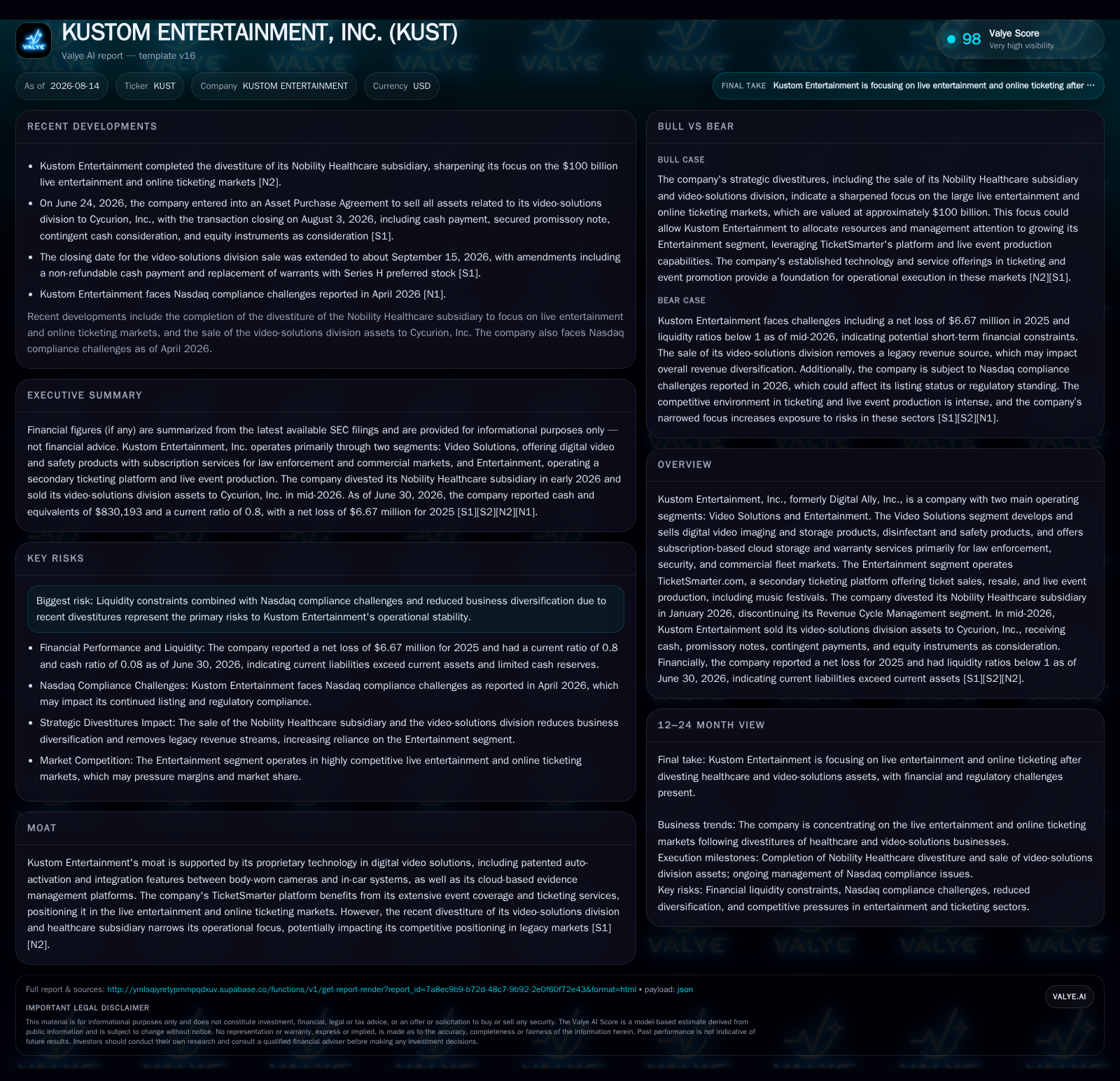
In the latest quarter, Kustom Entertainment completed the sale of its legacy video solutions assets, marking a pivotal strategic shift toward its entertainment segment centered on the TicketSmarter platform and live festival promotion. This transition moves revenue reliance from product and subscription-based sales in digital video imaging to marketplace-driven transactional fees from ticket sales and event production. The company faces near-term liquidity challenges coupled with Nasdaq compliance risks but leverages synergies in its entertainment technology operations, aiming to grow recurring revenue through platform scalability and increased gross merchandise volume. Monitoring public GMV metrics, event attendance trends, and capital management will be critical to assessing execution.
Strategic Pivot Initiated by Video Solutions Divestiture in Latest Quarter
Kustom Entertainment’s August 2026 quarterly filing confirms completion of the strategic asset sale of nearly all video solutions division holdings to Cycurion, Inc. [S2][S3][S6]. The transaction closed officially on August 3, 2026 after a series of amendments since early 2026. Consideration comprises $1.25 million in upfront cash, a secured promissory note with a principal amount of $4.25 million subject to certain security interests on acquired assets, contingent earnout payments up to $1 million based on performance milestones, plus shares of Cycurion’s Series H Convertible Preferred Stock valued at $600 thousand replacing earlier planned warrants issuance. Notably, Kustom retained rights to registration upon resale of these shares under a Registration Rights Agreement detailing public offering expectations.
This divestiture radically reshapes Kustom's business model by shedding its legacy digital video imaging hardware and cloud storage subscription platform that historically served law enforcement and commercial fleet markets—an area combining proprietary body-worn cameras integrated with in-car systems delivering evidence management capabilities [S1][S6]. The shift liberates capital but also eliminates product revenue streams reliant on upfront hardware sales plus periodic subscription renewals for cloud storage—a mix dominated by recurring revenue with some stickiness provided by integration technology features like auto-activation between device systems.
By offloading these divisions to Cycurion—a company presumably focused solely on security technology—Kustom sheds complexity while eroding competitive overlap with companies like Axon Enterprise known for scaling law enforcement tech ecosystems. The asset sale signals confidence that focusing solely on entertainment technology including online ticket marketplaces and event promotion can better deploy management attention if supported by sufficient growth prospects.
TicketSmarter Platform: Driving Core Revenue via Secondary Ticketing and Live Events
Post-divestiture, Kustom centers operations primarily around its Entertainment segment anchored by TicketSmarter.com—a secondary ticket marketplace facilitating both ticket resale transactions and direct sales acquired via partnerships or sponsorship agreements [S1]. Business model mechanics here revolve around transactional service fees charged as a percentage of face value tickets sold through the platform rather than up-front product sales or long-term subscription commitments predominant in the former digital video segment.
The platform's revenue model benefits from variable transaction volume driven principally by digital adoption trends in ticket purchasing combined with consumer preferences shifting steadily toward online access to live events. Live event production extends this footprint; Kustom promotes festivals such as Country Stampede that generate direct revenues from attendees plus ancillary benefits accrued through cross-selling tickets on their marketplace.
From an industry perspective, TicketSmarter aligns operationally nearest to peers like StubHub which dominate secondary ticket resale marketplaces focusing on large-scale distribution networks offering transparency and buyer-seller trust mechanisms. Eventbrite represents another peer archetype specializing more heavily in primary ticket sales combined with end-to-end event management software tools. Live Nation stands apart as an integrated promoter operator running venue partnerships combined with primary/secondary digital ticketing but at vastly larger scale.
For Kustom Entertainment, scaling gross merchandise volume (GMV) across TicketSmarter is essential as it directly amplifies transactional service fee income—the core revenue driver—and profitability hinges on optimizing platform uptime reliability along with investment in user experience enhancements to reduce churn rate among buyers and sellers while managing customer acquisition costs effectively.
Industry Context: Competing Within the Expanding Entertainment Technology Ecosystem
The entertainment technology sector has witnessed accelerating digitization altering how consumers access live experiences—from physical box office purchases shifting entirely online to complex data analytics personalizing marketing outreach post-sale. These dynamics favor scalable marketplaces capable of agile response but impose rigorous requirements for platform security given heightened cyberattack risks targeting user data within increasingly connected ecosystems.
Kustom's move away from hardware integration toward pure software-enabled marketplace functions conforms with broader industry trajectories emphasizing cloud-native architectures delivering superior uptime with lower maintenance overheads. Comparisons with Axon-like providers become less relevant post-divestiture since Kustom no longer competes in law enforcement technology but instead pursues growth against more consumer-facing platforms such as Eventbrite or StubHub where competitive moat depends heavily upon network effects tying users tightly into the platform ecosystem.
Continued investments into mobile accessibility improvements along with diversified content agreements involving venues and rights holders could serve as critical differentiators enabling deeper market penetration. Market trends supporting adoption of digital tickets over physical forms persist structurally providing tailwinds though outcomes remain dependent on external factors influencing live-event attendance.
Recurring Revenue Profile and Customer Behavior Within Entertainment Segment
The shift materially affects revenue composition metrics; whereas the Video Solutions segment historically presented a mix of one-time hardware sales supported by add-on cloud storage subscriptions yielding an annual recurring revenue (ARR) base [S1], the current focus centers largely on less predictable transactional fee income associated with each marketplace trade augmented modestly by event production sales.
Churn dynamics accordingly diverge: subscription renewal rate metrics become subordinate because nearly all income depends on buyer-seller activity volumes subject to market seasonality fluctuations rather than contract renewals. Customer acquisition cost (CAC) profiles face upward pressure given competitive efforts necessary to capture share amid entrenched players possessing deeper capital pools and brand recognition.
Operating leverage implications follow logically; variable costs scale proportionately with GMV expansion though fixed expenses involve maintaining secure platform infrastructure plus marketing programs designed both for attraction and retention purposes amidst growing competition for consumer attention [S2]
Growth Opportunities Anchored in Digital Ticketing Adoption and Festival Production Scale
Growth drivers concentrate around several interconnected vectors: broadening acceptance of fully digital ticket purchasing methods continues apace driven by convenience gains; rising popularity of music festivals alongside other live events fuels overall market sizing; expanding partnerships with venue operators and artist promoters offer pipeline amplification opportunities harnessed through exclusive or semi-exclusive contract arrangements sustaining supply side depth.
Enhancements targeted at user interface upgrades including mobile app accessibility serve dual roles—making customer journeys effortless while reducing friction that could suppress average transaction values or repeat use frequency. Tracking meaningful increases in gross merchandise volume on TicketSmarter serves as an immediate barometer validating effective execution strategies.
Potential expansion into adjacent content or promotional activity domains remains nascent but could yield value-added monetization paths thereby improving lifetime value per acquired customer beyond basic transactional fee capture.
Risks Captured From Liquidity Constraints to Compliance Challenges in a Two-Segment Model
Despite strategic clarity gains post-divestiture liquidity problems emerge as significant risk themes affecting operational flexibility [F1]. As of June 30, 2026 balance sheet snapshots show cash & equivalents roughly at $830 thousand against current liabilities exceeding $10 million resulting in a current ratio near 0.8 well below standard benchmarks signaling short-term working capital pressures
Total reported debt stands comparatively low at around $141 thousand measured at year-end December 31, 2024; however historical timestamps limit definitive conclusions about present leverage levels given ongoing issuance activities including over two million shares granted contemporaneously circa August 7, 2026 aimed at settling accrued obligations owed to consultants/advisors/financing sources likely tied partly to restructuring expenses following asset disposal transactions [F1][S3]
Nasdaq listing compliance remains another constraint typical for smaller-cap firms negotiating resource scarcity confronted also by regulatory scrutiny related to governance disclosures plus financial reporting timeliness imposed stringently amid restructuring episodes.[S2]
Additional risks arise from concentration due to portfolio narrowing eliminating diversification buffers formerly contributed by Video Solutions segment alongside healthcare divestitures earlier in January 2026 [S1]. Competitive landscape intensifies given dominant global platforms maintaining economies-of-scale hard for smaller players like Kustom particularly as technological innovation cycles accelerate pushing continuous feature enhancement expenditures.
Market sensitivity remains pronounced given dependency on discretionary live event attendance prone to macroeconomic factors such as consumer confidence shifts or unexpected disruptors including health crises affecting gathering allowances.
What to Watch: Milestones Across Platform GMV, Event Attendance, and Financial Discipline
Near-term operational milestones include publicly reported GMV progression across upcoming quarterly disclosures evidencing either traction or stagnation within secondary ticket marketplace activity volumes; parallel assessment of average transaction values provides insight into whether platform pricing power strengthens or weakens under competitive pressure [S2]
Tracking event attendance levels tied closely to profitability margins stemming from flagship promotions such as Country Stampede offers concrete evidence reflecting successful integration across ticketing + live experiences leveraged synergistically.
Recurring revenue signals within any residual subscription offerings linked perhaps now marginally into warranty/support services should be monitored for stability amid shifts from previous models embodying higher stickiness versus volatile transaction fees characteristic currently.
Balance sheet evolution encompassing changes in available liquidity alongside any fresh equity issuance or debt facility draws reveal corporate capacity relative to navigating working capital demands as well as potential investments designed to enhance platform scalability holding significant relevance over medium term [S2][S3]
Platform security incidents impacting uptime would constitute negative operational markers threatening reputation critical within digital marketplaces reliant upon uninterrupted user trust inducements offsetting competitors’ encroachment.
Financial Profile Discussion
Disclaimer: This is research-only, informational analysis and not investment advice. It may include AI-generated interpretation and general industry context. Always verify important details using primary sources.

Comments