
Evolution Metals & Technologies Builds Vertically Integrated Critical Materials Supply Chain Amid Liquidity and Execution Challenges
EM&T advances commercial-scale recycling and manufacturing for rare earth and battery materials while facing operational scaling and liquidity constraints.
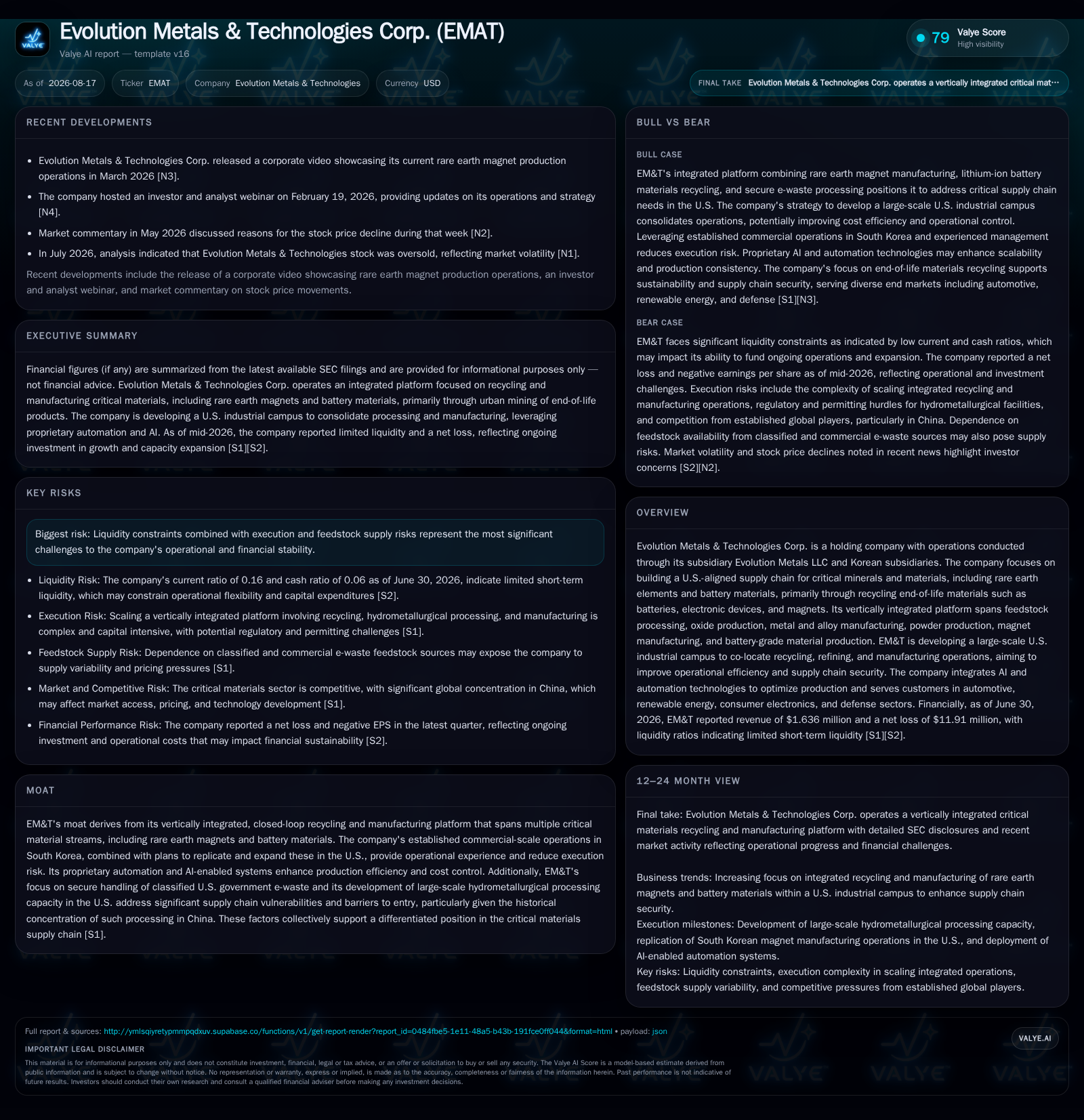
Evolution Metals & Technologies Corp. (EM&T) operates a vertically integrated platform specializing in closed-loop recycling and manufacture of critical materials, including rare earth magnets and battery-grade compounds. The company advances replication of its proven South Korean operations in the U.S., targeting supply chain security for strategic industries. However, near-term liquidity challenges and the complexity of scaling large-scale hydrometallurgical facilities weigh on financial stability and execution risk. Key growth drivers include rising electrification demand, government support for domestic critical materials, and technology integration through AI and automation.
Recent Operating Update
Evolution Metals & Technologies Corp. (EM&T) disclosed in its August 17, 2026 Form 10-Q that it continues commercial-scale operations primarily through its Korean subsidiaries with initial progress toward establishing a large-scale U.S.-based industrial campus integrating recycling and manufacturing capabilities [S2]. This quarter's disclosure did not highlight significant new contracts or capacity expansions but reinforced EM&T's core focus on building an integrated supply chain spanning end-of-life feedstock recycling through finished product manufacturing.
On August 13, 2026, EM&T appointed retired General Thomas A. Bussiere—former Commander of U.S. Strategic Command—to its Board of Directors effective immediately [S3]. His appointment into multiple oversight committees signals heightened emphasis on governance relating to strategic supply chains and potential defense-related applications consistent with the company's involvement in classified U.S. government e-waste processing.
Business Model Analysis
EM&T operates a vertically integrated platform within the critical materials recycling and processing industry designed around urban mining of end-of-life products such as batteries, electronic devices, motors, magnets, and other electronics no longer fit for use but rich in recoverable metals [S1]. The company sources feedstock primarily from classified U.S. government electronic waste streams combined with commercial inputs to extract high-value base metals, precious metals, rare earth oxides, metals/alloys/powders, battery-grade sulfates/carbonates, precursor cathode active materials (pCAM), and permanent magnets.
Revenue generation occurs across multiple value chain segments: sales of recycled raw materials like oxides; intermediate processed metals/alloys/powders; battery-grade compounds suitable for gigafactories; and finished permanent magnets used by automotive OEMs and electronics manufacturers [S1]. This multi-stream monetization approach reduces dependency on any single market segment or material pricing dynamics. EM&T’s business relies heavily on securing consistent feedstock volumes (measured in tons), optimizing recovery rates of critical minerals across hydrometallurgical processing steps, maintaining high operational throughput/utilization rates at processing/refining plants, and delivering near-spec purity/yield levels demanded by customers.
Proprietary artificial intelligence (AI) and automation technologies deployed throughout EM&T's platform aim to enhance process consistency while reducing labor intensity—a key margin lever given the labor- and energy-intensive nature of hydrometallurgical refining processes [S1]. These advanced control systems are embedded from initial feedstock handling to final component assembly.
The company is replicating its mature South Korean magnet manufacturing operations—including sintered and bonded magnet production—to a consolidated U.S.-based industrial campus to accelerate capacity build-out while mitigating scale-up risks via known engineering designs and experienced personnel [S1][S25]. This co-location strategy also bolsters supply chain security by consolidating recycling inputs with downstream manufacturing under one operational umbrella.
Industry Structure & Competitive Position
The critical materials recycling sector is characterized by high capital intensity due to complex chemical processing infrastructure needed for hydrometallurgical extraction of rare earths and battery metals. Historically concentrated in China due to regulatory leniency and resource availability, the industry faces geopolitical pressures favoring domestic reshoring in the U.S., Europe, and allied nations. EM&T positions itself as a differentiated vertically integrated player offering closed-loop recycling solutions that encompass feedstock procurement through finished component manufacture—reducing reliance on primary mining peers or standalone processors.
Peers span primary miners like MP Materials focused on extraction; chemical processors such as Livent Corporation specializing in lithium chemicals; urban mining operators including Li-Cycle Holdings engaged in battery recycling; magnet manufacturers; as well as industrial automation providers advancing AI-driven process controls.
This staged expansion aims to convert established engineering benchmarks into localized U.S. supply security solutions while harnessing operational experience accumulated from over 18 years' magnet production history servicing global OEMs such as Ford, Hyundai, LG, Samsung among others [S25]
Risks & Constraints
Execution risk represents a foremost challenge given the complexity inherent in scaling hydrometallurgical facilities coupled with stringent environmental permitting requirements often experienced across the critical minerals remediation space [S1]. Moreover, feedstock volume fluctuations can materially impact utilized capacity percentages—pressuring margins if input quality or quantity declines unexpectedly.
Financially, despite operational progress evidenced by revenue recognition (~$1.6 million reported as of Q2 2026), EM&T incurred operating losses reflecting early-stage expansion expenses [F1]. The liquidity profile is constrained: the company's current ratio is approximately 0.16 indicating significant current liabilities outweighing liquid current assets substantially [F1], which could pressure short-term solvency absent successful financing or cash-flow improvement.
Competition from entrenched primary miners offering lower-cost bulk raw material extraction remains a strategic threat alongside imported processed materials from established Asian suppliers benefiting from cost advantages or scale economies absent similar regulatory burdens.
Cybersecurity governance is evolving but remains an emerging risk area given increased IT dependency across automated systems within manufacturing facilities necessitating robust policies overseen at the board level [S1]. Regulatory uncertainty surrounding classification of certain waste streams or permitting timelines could further delay capacity expansions.
What To Watch Next
Upcoming milestones include commencement of significant processing volumes at the nascent U.S.-based industrial campus where indicators such as ramped feedstock throughput (in tons processed), steady capacity utilization (%), recovery rate improvements (% material recovered vs input), AI/automation system uptime metrics will reflect operational scaling success or bottlenecks.
Further Board developments involving specialized independent directors with defense or supply chain expertise may influence strategic decisions about classified e-waste relationships or government contracting pathways following General Bussiere’s appointment [S3].
Liquidity developments—particularly new financing rounds or convertible debt draws—and updates on regulatory permits will serve as signals addressing short-term financial risk exposures outlined previously.
Growing order backlog announcements for oxides or finished magnets supplying global automotive OEM gigafactories would validate emerging commercial traction beyond pilot-scale sales volumes reported thus far.
Financial Profile Discussion
As of June 30, 2026 balance sheet data reveal cash and equivalents of approximately $5.4 million against total debt near $3.6 million yielding a net cash position of about $1.8 million [F1]. However, current liabilities exceeding $93 million dwarf current assets close to $14.7 million producing a stretched current ratio around 0.16 which points to pronounced working capital constraints likely tied to accrued vendor payables or project-related obligations requiring resolution either through capital raises or operational cash flow ramp-up [F1].
Operating income remains negative indicating ongoing investment phase reflective of early commercialization alongside facility build-out costs typical among capital-intensive recycler/manufacturers entering scaled production stages [F1].[S2]
Managing this capital structure cautiously while advancing revenue from recycled inputs converted into higher-margin finished products will be essential for sustainable operating leverage going forward.
Disclaimer
This analysis is based solely on publicly available filings and company disclosures as of August 2026 without extrapolation beyond cited evidence. It does not constitute investment advice or research views.
Disclaimer: This is research-only, informational analysis and not investment advice. It may include AI-generated interpretation and general industry context. Always verify important details using primary sources.

Comments