
EQT Strengthens Position with Midstream Expansion Amid Appalachian Demand Dynamics
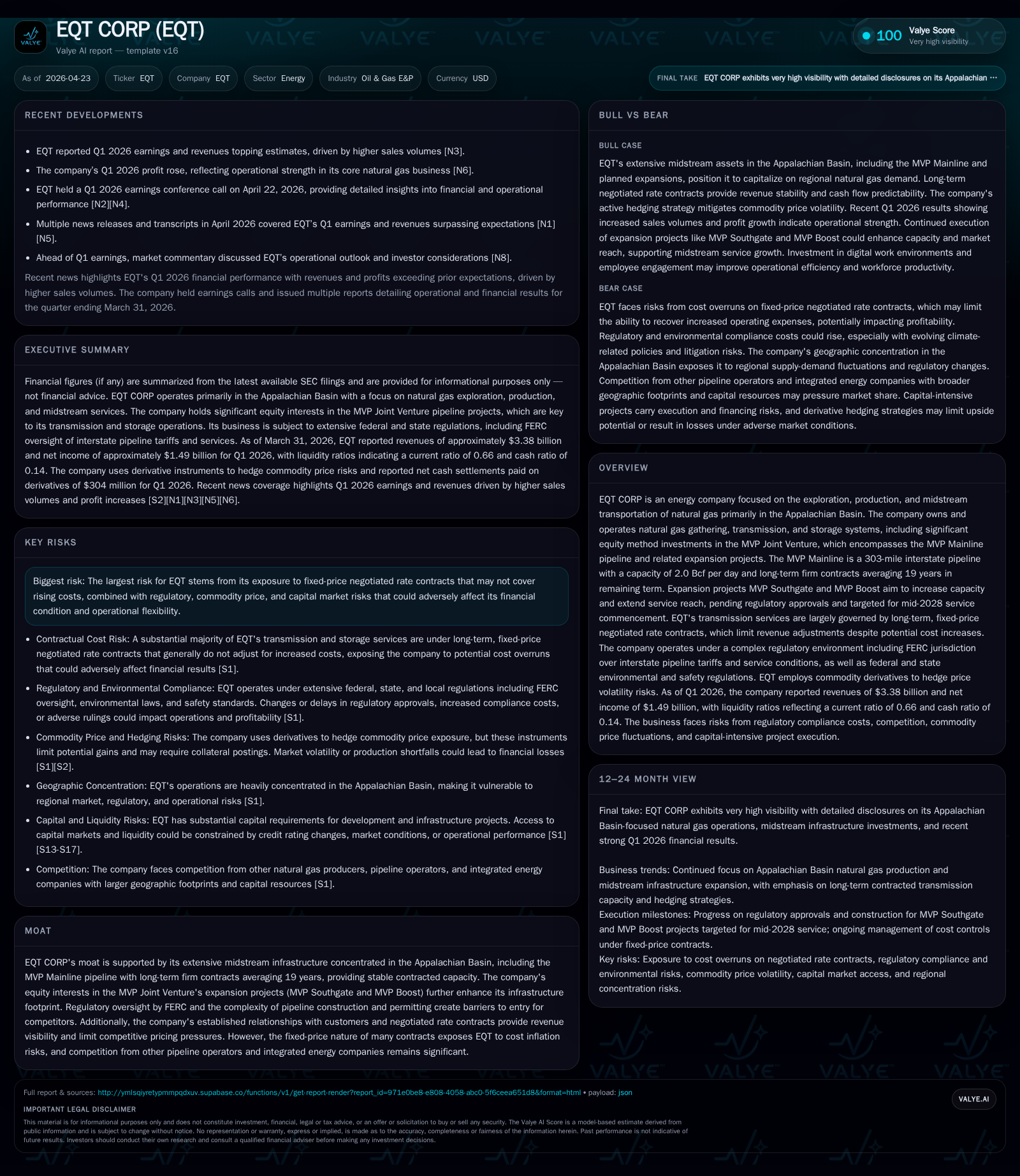
EQT’s Q1 2026 results and ongoing MVP Joint Venture expansions reinforce its midstream stability anchored by long-term contracts despite inflationary and regulatory pressures.
EQT CORP reported strong first-quarter 2026 performance driven by increased volumes on its MVP Mainline pipeline and steady cash flows under long-term negotiated rate contracts. The company’s equity stakes in the MVP Southgate and MVP Boost expansion projects, both targeting mid-2028 in-service dates, underpin its growth strategy within the Appalachian Basin. While fixed-price contracts provide revenue visibility, they also expose EQT to rising operational costs amid inflation and evolving regulatory oversight from FERC. The company’s concentrated geographic footprint and competition in Appalachian gas midstream add layers of complexity to growth execution.
Q1 2026 Operating Update: Performance Highlights and Implications
EQT CORP’s latest quarterly filing dated April 22, 2026 [S2] reveals a continuation of solid operational momentum with revenues benefiting from increased volume throughput on the MVP Mainline pipeline. According to earnings calls and related disclosures [N3][N4][N12], first-quarter 2026 revenues outpaced expectations driven by higher gas transmission volumes sustained through firm transportation contracts.
Operating income surged as well, reflecting improved asset utilization despite ongoing exposure to fixed negotiated rates that restrain upside from tariff escalations. Management commentary underscored progress toward final regulatory approvals for the MVP Southgate and MVP Boost projects, with both slated for mid-2028 start-up contingent on timely permits [S2][S3]. This near-term visibility into capacity augmentation serves as a strategic hedge against regional demand variability.
The quarterly update confirms no material changes to previously disclosed risk factors related to contract structure or regulatory environment [S2]. The lack of upward contract price flexibility remains a constraining factor during input cost inflation but is partially offset by volume growth.
Business Model Overview: Midstream Focus with Appalachian Gas Assets
EQT operates predominantly within the Appalachian Basin, offering an integrated set of midstream services: natural gas gathering from production sites, interstate pipeline transmission, and storage facilities [S1][S6]. The core asset underpinning these operations is the MVP Mainline—a 303-mile, 42-inch diameter interstate natural gas pipeline with 2.0 billion cubic feet per day (Bcf/d) capacity extending from Wetzel County, West Virginia to Pittsylvania County, Virginia [S1].
This pipeline connects through multiple interconnects to third-party interstate pipelines enabling broad market access. EQT’s ownership extends to significant equity-method investments in the MVP Joint Venture (JV), which holds three series representing different project components: Series A (MVP Mainline), Series B (MVP Southgate extension), and Series C (MVP Boost compression additions) [S1].
Such vertical integration from upstream gathering through transmission enhances operational control over gas flows and pricing negotiations with customers. Furthermore, transmission services governed by long-term contracts with creditworthy customers imply steady cash flow generation supportive of capital-intensive infrastructure investment.
Contractual Framework: Long-Term Agreements as a Revenue Base
A defining feature of EQT’s midstream revenue model is reliance on long-term "negotiated rate" contracts approved by FERC which fix prices over the contract term—averaging approximately 19 years remaining on the MVP Mainline agreements as of end-2025 [S1]. This structure provides strong revenue visibility and shields against competitive rate undercutting common in tariff-based recourse rates.
However, these contracts tend not to allow adjustments for rising input costs or inflation unless mutually renegotiated [S1][S19], exposing EQT’s margins to cost pressures from labor, materials, fuel for compression stations, or regulatory compliance expenditures such as environmental mandates. This trade-off means while pricing power over competitors is high due to durable contractual commitments, earnings can be squeezed if contractual rigidity persists amid rising operational expenses.
The preponderance (~95%) of capacity under negotiated rate agreements offers stability but requires careful cost management given limited upside compensation during inflationary periods [S12]. This contract model also minimizes volumetric risk since payment obligations are not directly volume-dependent.
Industry Context: Appalachian Basin Competition & Regulatory Environment
EQT faces competition across its gathering and transmission segments from a mix of independent gas gatherers, major oil & gas companies with diversified basins, vertically integrated energy firms developing proprietary gathering capacities, as well as other midstream operators whose pipelines traverse the Appalachian region [S15]. Firms with multi-basin footprints may possess financial scale advantages absent in more regionally concentrated players like EQT.
FERC remains the primary regulator overseeing interstate transmission tariffs, pipeline certifications, expansions, and storage operations under mandates designed to ensure non-discriminatory access [S17]. For midstream assets like EQT’s MVP system classified as jurisdictional interstate pipelines rather than exempt gatherers [S9], compliance burdens include tariff filing requirements and possibly litigation risk relating to regulatory classification disputes within evolving industry definitions.
Pipeline construction necessitates navigating complex federal, state, and local permitting regimes impacting schedules and capital allocation [S5][S8]. Regulatory delays or unanticipated conditions at permit granting stages present tangible project execution risks for planned expansions.
Growth Drivers: Pipeline Expansions and Market Penetration
Looking ahead, two significant infrastructure projects within the MVP JV portfolio represent major growth catalysts:
MVP Southgate: A contemplated 31-mile-long extension pipeline (30-inch diameter) designed to deliver up to 0.55 Bcf/d into new markets in Rockingham County, North Carolina. Scheduled for service entry around mid-2028 post-remaining regulatory approvals. CAPEX estimates range from $370 million to $430 million (excluding AFUDC). Funding is proportional via equity contributions by JV partners including EQT itself [S1].
MVP Boost: An expansion project adding compression horsepower at three existing compressor stations in West Virginia plus a new station in Virginia projected to increase MVP Mainline capacity by approximately 0.6 Bcf/d. Estimated CAPEX between $400 million and $540 million excluding AFUDC; also targeted for mid-2028 commissioning scenarios assuming successful FERC approval by late 2026 or early 2027 [S1].
These projects not only augment total capacity beyond the current 2 Bcf/d mainline limit but strategically deepen service penetration into southeastern U.S. markets where natural gas demand growth is steady due to power generation needs coupled with industrial uses. Compression additions optimize throughput without immediate construction of additional pipeline mileage—a capital-efficient enhancement strategy.
Challenges Ahead: Cost Inflation, Contract Structure, and Regulatory Risks
Despite solid fundamentals underpinning demand growth prospects in Appalachia midstream operations, several headwinds temper outlook optimism:
Fixed Rate Contracts vs Inflation: The rigidity of negotiated rate contracts leaves EQT susceptible if operating expenses rise; there is no automatic pass-through mechanism akin to traditional recourse tariffs or indexed rate structures [S19]. This cost indiscipline risk demands tight operational controls.
Permit & Regulatory Delays: Pending FERC approvals for MVP Southgate and Boost remain critical timing gates that if deferred could disrupt projected ramp-up schedules or increase carrying costs on invested capital halted in construction staging [S1][S3].
Commodity Price Volatility Impact: Though contracted revenues shield transmission segments directly from market price dips, upstream production declines triggered by low natural gas prices would reduce volumes feeding gathering systems indirectly affecting system utilization metrics [S24].
Competitive Pressures & Classification Disputes: Ongoing debates over classification between regulated transmission versus non-jurisdictional gathering systems could influence future tariff structures or broaden competition especially as integrated producers expand their midstream footprints [S9][S15].
These challenges collectively underscore a nuanced risk-reward balance intrinsic to EQT’s strategy emphasizing stable income via long-term contracted infrastructure offset by exposure to industry-wide macroeconomic uncertainties.
Key Milestones and Forward-Looking Indicators to Watch
Market participants should closely monitor:
- Progress on FERC certifications for both MVP Southgate and MVP Boost projects including any public comments or litigations potentially delaying approval timelines past targeted mid-2028 service commencements [S1][S3].
- Quarterly throughput performance trends on MVP Mainline post-expansion reflecting actual utilization gains versus modeled capacity increments outlined during project planning phases [N3][N4].
- Capital expenditure pacing alongside management commentary during future earnings releases evaluating adherence to budget targets given inflationary environment impacts [N4].
- Contract renewal activity upon existing negotiated rate expirations assessing willingness of customers to extend terms amid evolving market pricing norms.
- Refinancing or debt management developments that may alter interest costs affecting free cash flow available after servicing robust capex commitments [F1][S4][S5].
Financial Overview: Capital Structure, Cash Flow, and Returns
EQT demonstrated strong financial results in fiscal year 2025 affirming operational execution prowess visible in recent quarters:
Historical performance (annual)
| FY | Rev ($bn) | Net ($bn) | CFO ($bn) | OpInc ($bn) | Rev YoY | Net YoY |
|---|---|---|---|---|---|---|
| 2025 | 8.6 | 2.0 | 5.1 | 3.2 | +63.9% | +784.4% |
| 2024 | 5.3 | 0.2 | 2.8 | 0.7 | -23.7% | -86.7% |
| 2023 | 6.9 | 1.7 | 3.2 | 2.3 | -7.9% | -2.0% |
| 2022 | 7.5 | 1.8 | 3.5 | 2.7 |
Source: SEC companyfacts cache [F1].
Capital returns and efficiency (annual)
| FY | Div ($mm) | Buybacks ($mm) | FCF ($bn) |
|---|---|---|---|
| 2025 | 390 | 0 | 2.8 |
| 2024 | 327 | 0 | 0.6 |
| 2023 | 228 | 201 | 1.2 |
| 2022 | 204 | 409 | 2.1 |
Source: SEC companyfacts cache [F1].
Robust top-line growth combined with significant operating leverage boosted profitability substantially year-over-year supporting healthy operating cash flows well above capital investment levels—yielding positive free cash flow (~$2.84 billion) indicative of sustainable internal funding capability for continued infrastructure deployments without aggressive equity raises or debt over-leveraging concerns [F1].
As of Q1-end March 31st, liquidity metrics remain adequate though current ratio below unity (0.66) signals working capital tightness requiring prudent short-term liability management balanced against substantial operating cash inflows realized quarterly [F1]. Total debt outstanding approximates $7.8 billion with investment grade ratings "Baa3"/"BBB-" carrying stable outlooks reinforcing reasonable credit access while cautioning about covenant constraints limiting financial maneuvering latitude under adverse commodity cycles or unexpected cost overruns [S4][S7].
The absence of share repurchases in recent years places dividend payouts as primary shareholder return form supported by consistent net income growth trajectories aligning capital allocation efforts toward reinvestment for future organic expansion through MVP initiatives.
This analysis is based solely on publicly filed documents provided through April 23rd, 2026, including SEC filings [S1][S2][S3] and corroborating earnings call transcripts along with reported financial statements [F1] complemented by recent news data points [N#]. It excludes any proprietary insights or forward-looking information beyond documented disclosures.
Disclaimer: This is research-only, informational analysis and not investment advice. It may include AI-generated interpretation and general industry context. Always verify important details using primary sources.

Comments