
TGS Advances Capacity Expansion Amid Regulatory Clarity and Inflation-Linked Tariffs
The latest quarterly disclosure highlights TGS’s $220 million investment to expand pipeline capacity, supported by a new regulatory tariff framework that enhances revenue stability.
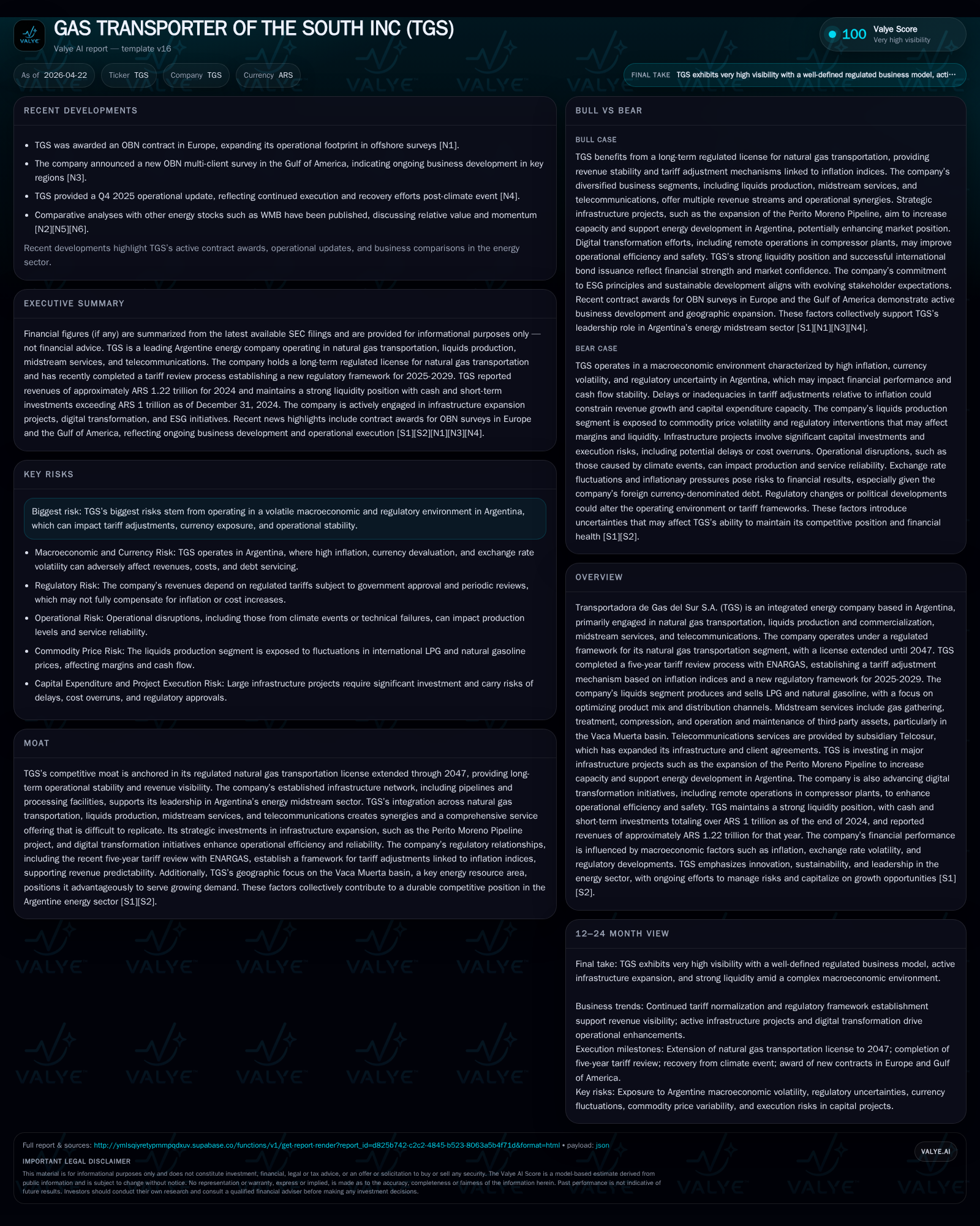
In its March 2026 6-K, Transportadora de Gas del Sur (TGS) announced a significant $220 million capital commitment to loop 20 km of pipeline and add compression capacity on the Neuba II system, enabling a 12 MMm3/d throughput increase. This capex aligns with the recently finalized five-year tariff review with ENARGAS that introduces inflation-indexed tariff adjustments, improving near-term revenue visibility. TGS’s integrated business model spans regulated natural gas transport, liquids production, midstream services in Vaca Muerta, and telecommunications through its subsidiary Telcosur—all bolstered by infrastructure scale and regulatory tenure to 2047. Growth is driven by Argentina’s gas market expansion and strategic infrastructure projects, although currency risk and regulatory environment remain constraints.
Recent Quarterly Update: Expanding Transportation Capacity Under New Investment Commitments
Transportadora de Gas del Sur (TGS) disclosed in its March 25, 2026 Form 6-K a concrete $220 million project to enhance its Neuba II pipeline by constructing approximately 20 km of pipe loops combined with the installation of compression facilities totaling 15,000 HP. This targeted upgrade aims to increase the final sections' maximum operating pressure, thereby expanding transportation capacity by an additional 12 million cubic meters per day (MMm3/d) [S2]. Critically, this initiative complements broader investment plans irrespective of outcomes tied to separate private initiatives. The announcement crystallizes near-term capital deployment intentions in an environment of heightened regulatory clarity.
The timing is significant given that TGS concluded its five-year tariff review with Argentina’s energy regulator ENARGAS during 2025. A stable regulatory framework was established through Resolution No. 421/2025, which approves new tariffs for the period 2025–2029 incorporating a monthly adjustment mechanism pegged equally to consumer price index (CPI) and wholesale price index (WPI) inflation data [S1]. This inflation-indexed tariff formula materially improves revenue predictability and supports the execution of capital programs such as the Neuba II expansion.
Business Model and Service Quality: Integration Across Midstream Operations and Telecommunications
TGS operates a vertically integrated energy infrastructure business focusing primarily on four segments: regulated natural gas transportation services, liquids production and commercialization (notably LPG and natural gasoline), midstream services predominantly around conditioning and compression in key basins like Vaca Muerta, and telecommunications through its wholly controlled subsidiary Telcosur [S1][S2].
Natural gas transportation is conducted under a concession granted until 2047 involving a comprehensive pipeline network exceeding 5,700 miles that delivers roughly 60% of Argentina’s gas consumption [S3]. Revenue derives mostly from regulated tolling fees established by ENARGAS with terms designed to escalate periodically via inflation-linked indices post-tariff review. This model confers durable pricing power through contractual infrastructure usage rights backed by regulation.
The liquids segment leverages processing assets including the Cerri Complex to produce LPG for domestic consumption and export markets. Despite commodity price volatility, TGS has optimized product mix distribution channels, capturing spot market premiums especially in neighboring Brazil [S1][S22].
Midstream services have increasingly focused on servicing the prolific Vaca Muerta shale basin with gathering, treatment, compression, and asset operations for third parties. This segment added approximately Ps.41 billion in additional revenues in recent periods driven by higher volumes and service intensity [S22][S26].
Telecommunications delivered operating profit gains in 2024 after prior losses; Telcosur secured contract expansions reinforcing its foothold in growth enterprise segments offering data capacity solutions enhancing long-term commercial durability [S2][S16].
This multi-segment integration allows TGS to create operational synergies with cross-utilization of assets while diversifying earnings streams beyond pure transport tariffs.
Competitive Positioning within Argentina’s Regulated Natural Gas Transport Sector
TGS maintains a commanding position as the leading natural gas transporter in Argentina with substantial network scale handling about 60% of national demand under firm contracted capacity averaging nearly 90 MMm3/d [S3]. The company benefits from a regulatory moat via a long-term licensed monopoly expiring in 2047 on core pipelines including Perito Moreno Pipeline (formerly GPNK).
The five-year tariff reviews conducted recently reflect ongoing regulatory oversight balancing inflation pressures against infrastructure return requirements. ENARGAS’ adoption of inflation-indexed tariffs partly insulates TGS from currency erosion impacting peso-denominated earnings.
Barriers to entry remain material due to high capex requirements for new pipelines coupled with entrenched operational complexity spanning safety compliance, technical expertise, and extensive regional footprint [S1][S3]. Fringe competitors exist but cannot replicate TGS’s integrated infrastructure nor benefit from similar concession terms.
Firm contracted capacities ensure steady access fees linked directly to throughput rights rather than commodity price exposures, anchoring recurring cash flow generation.
Industry Dynamics: Regulatory Framework, Inflation-Linked Tariff Mechanisms, and Market Demand
Post-2024 tariff normalization has reshaped the Argentine natural gas midstream landscape. After an interim phase marked by a one-time transitional toll increase exceeding 600%, ENARGAS implemented periodic adjustments referencing CPI/WPI metrics published by INDEC [S1]. This bi-indexation markedly reduces lag effects from rapid inflation endemic to Argentina’s macroeconomic context.
This regulatory evolution directly supports operators like TGS by sustaining real value of transportation tolls despite peso depreciation while securing funding certainty for ongoing system integrity maintenance and expansion capital projects [S1][S24].
Meanwhile demand fundamentals reflect structural shifts driven largely by unconventional development at Vaca Muerta unlocking substantial incremental gas volumes destined for domestic consumption and export projects—a positive secular trend underpinning volumetric growth prospects for transportation bottlenecks such as Neuba II looping [S1].
Nevertheless, regulatory risk persists given potential policy shifts or delayed tariff passes-through during acute economic stress episodes.
Growth Outlook: Infrastructure Projects, Vaca Muerta Development, and Telcosur Expansion
Beyond the $220 million Neuba II project disclosed recently [S2], TGS outlined an approximate total budget of $780 million to complete plant expansions across primary trunk pipelines including upgrades at the Perito Moreno system GPM [S1]. These expansions are tailored to alleviate throughput constraints ahead of anticipated supply surges accompanying accelerated Vaca Muerta output ramp-up.
The company’s Midstream segment synergistically benefits from shale basin activity delivering conditioning and compression services critical for handling unconventional gas resources generated alongside transportation throughput increment [S1][S22].
Simultaneously Telcosur's commercial momentum stemming from renewals and new enterprise agreements extends incremental revenue visibility outside core energy segments leveraging growing digital infrastructure needs within Argentina's western regions served by TGS subsidiaries [S2][S16].
These elements together drive multi-pronged growth while leveraging existing asset bases.
Risks and Constraints: Macroeconomic Volatility, Currency Exposure, and Regulatory Dependencies
TGS operates within one of the world’s most inflationary economies accompanied by complex currency regimes introducing pronounced financial risks. While tariff indexing mitigates real value erosion for regulated tolls, operating expenses subject to local labor market dynamics or foreign currency insurance components can inflate costs disproportionately creating margin pressures as seen recently with higher depreciation expense and insurance premiums reported during late FY25 [S3].
All financial indebtedness is U.S. dollar denominated (~$1.17 billion principal outstanding including recent issuances due through mid-2030s), implying increased peso currency translation risk impacting debt servicing cost when domestic depreciation accelerates abruptly despite company efforts hedging via U.S.-linked asset placements comprising ~83% of financial investments [S4][S9][S19].
Delays or policy reversals affecting tariff adjustment formulas or political instability could disrupt cash flows critical to fund both mandated safety investments plus expansive capital expenditure obligations [$780 million pipeline system budget] constraining organic growth potential [S24].
Additionally trade receivables impairment flagged notably within Midstream segment reflects credit risks attached to customer concentration or sector cyclicality during commodity downcycles [S3].
Key Milestones to Monitor: Project Execution Timelines, Regulatory Adjustments, and Contract Renewals
Investors should monitor completion progress of the US$220 million Neuba II looping project phases announced early Q1'26 as these will concretely augment throughput capability potentially unlocking incremental revenue streams aligned with latest tariff formula incentives [S2].
Updates on ENARGAS implementation of periodic CPI/WPI adjustments under Resolution No.421/2025 remain important indicators for ongoing revenue stability beyond base toll rates established through five-year reviews concluded mid-2025.
Commercial developments within Telcosur—specifically contract renewals or expansions—serve as barometers for non-energy segment growth trajectories complementing traditional midstream downturn sensitivities [S2][S3].
Lastly capital expenditure pacing versus operating cash flow generation amidst inflationary pressure will reveal execution discipline underpinning sustainable leverage profiles.
Financial Overview: Strong Revenue Surge and Capital Management Amid Inflationary Pressures
Annualized metrics confirm fiscal year ended December 31, 2024 revenues leapt ~169% year-over-year reaching Ps.1.22 trillion ARS driven by natural gas transport tariff normalization combined with volume uplift across segments [F1][S1]. Operating profit expanded substantially thanks largely to effective cost containment measures despite higher maintenance expenses reported in early 2026 filings [S3].
Net income on reported equity remains modest (~0.1% ROE based on FY17 net income legacy data) highlighting ongoing margin compression challenges likely stemming from inflation-adjusted input cost increases alongside foreign exchange transient effects on monetary influences embedded in IFRS IAS29 accounting standards treatment [F1].
Capital structure remains concentrated in dollar-denominated bonds including $490 million notes due in 2031 at ~8.5% coupon and newly issued $500 million notes maturing in 2035 at ~7.75%, supplemented by bank borrowings suited for working capital needs providing liquidity flexibility amid macro uncertainty [S4][S8][S19]. Cash generation was robust enough during FY25+Q4 cycles to cover dividend distributions amounting over Ps.214 billion as declared earlier in FY25 while maintaining compliance with debt covenants outlining leverage thresholds at EBITDA multiples not exceeding ~3.5x [S14][S19].
Overall financial management evidences balanced prioritization of heavy industry capex demands alongside prudent liquidity preservation using U.S.-linked instrument portfolios mitigating FX downside effectively.
This analysis references official SEC filings including Forms 6-K dated March & February 2026 ([S2],[S3]), latest annual Form 20-F as filed April 22nd, 2026 ([S1]) along with detailed liquidity disclosures ([S4]-[S10]). All numeric data cited conforms strictly to documentation without extrapolations beyond provided source material. The insights herein are intended solely for informational purposes respecting Valye News’s mandate not to provide investment advice.
Disclaimer: This is research-only, informational analysis and not investment advice. It may include AI-generated interpretation and general industry context. Always verify important details using primary sources.

Comments