
FDCTech Expands Regulated Global Footprint and Integrated Fintech Platform Amid Legal and Market Challenges
FDCTech advances its multi-asset trading and payments platform with key acquisitions and licensing while navigating operational risks.
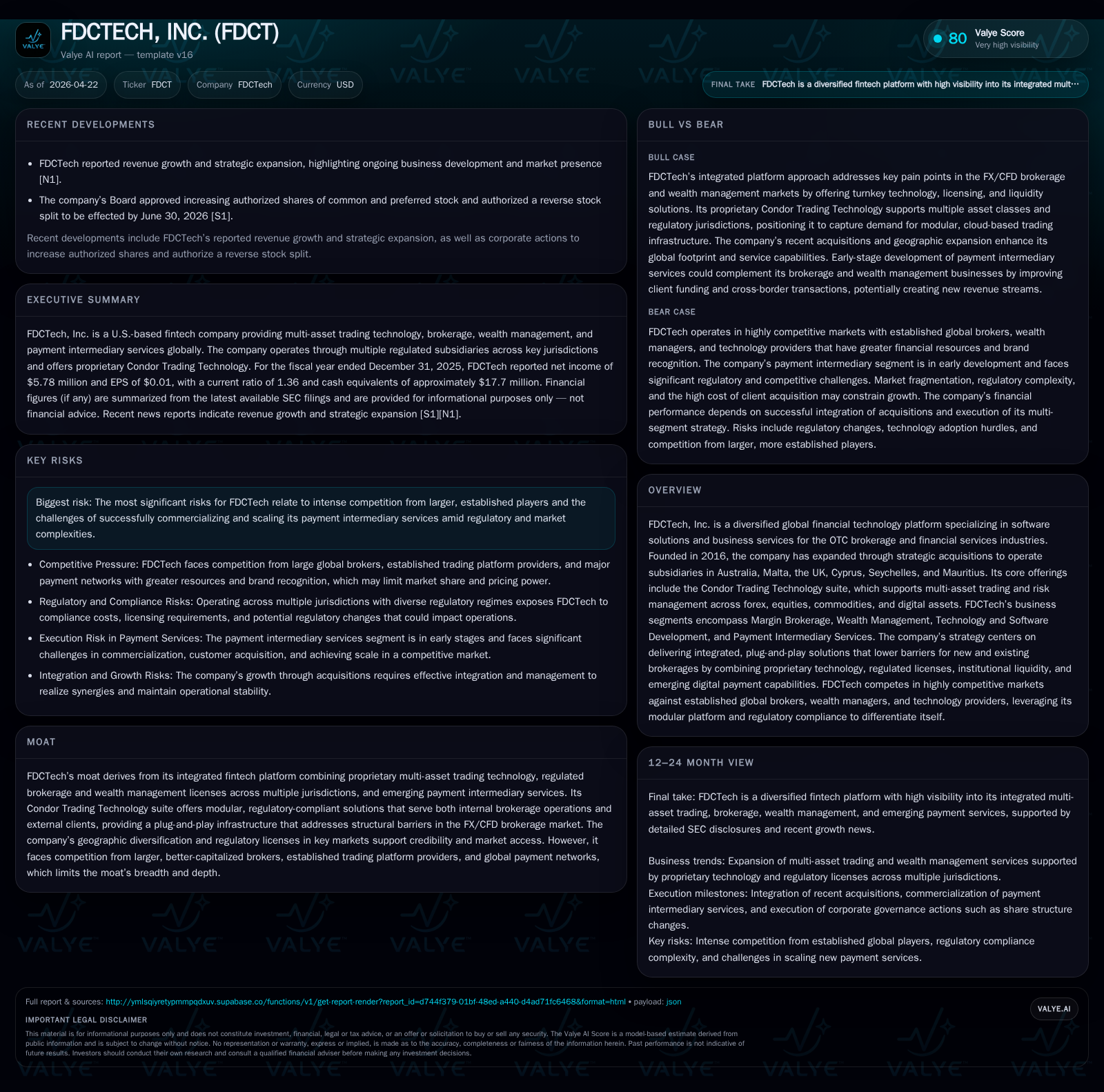
FDCTech, Inc. reported solid operating income growth in its 2025 fiscal year driven by a diversified fintech platform serving OTC brokerage and financial services markets globally. Its recent acquisition of Seychelles-based Alchemy International Ltd. strengthens Asia-Pacific offshore brokerage operations under regulated licenses, supporting expansion in FX, CFDs, and digital assets trading. The company’s proprietary Condor suite underpins core technology and risk management for its brokerages and B2B clients, alongside its nascent payment intermediary business in Mauritius. However, ongoing legal disputes related to acquisitions and intense competition from larger brokers and established trading platforms present execution risks. Future growth depends on scaling new payment services, governance of acquired units, and successful integration across geographies.
Recent Operating Update
FDCTech’s latest SEC filing — the Q3 2025 Form 10-Q dated November 13, 2025 [S2] — serves as the immediate anchor confirming ongoing operational stability without introducing new risk disclosures typical for a smaller reporting company. There were no material updates beyond routine quarterly operational reporting. This steady quarterly backdrop precedes the more comprehensive annual disclosure [S1], which forms the cornerstone for understanding FDCTech’s evolving business model and strategic posture.
Most notably, FDCTech finalized the acquisition of Alchemy International Ltd. (AIL) in late October 2025 [S12,S16,S23,S26]. AIL holds a Seychelles FSA securities dealer license facilitating FX, CFDs, and multi-asset trading targeted at Asian offshore brokerage clients — a critical expansion into emerging yet regulated offshore financial hubs.
This acquisition complements FDCTech’s existing licensed brokerage entities in Malta (Alchemy Markets Ltd.), the United Kingdom (Alchemy Prime Ltd.), Australia (AD Advisory Services Pty Ltd.), Cyprus (Alchemytech Ltd.), Mauritius (Xoala Asia), and Seychelles itself through AIL. The expanded regulatory presence now covers multiple key jurisdictions across Europe, Asia-Pacific, and select offshore centers.
Business Model
Founded initially in 2016 as a back-office technology provider, FDCTech has pivoted into an integrated fintech platform operator specializing in OTC brokerage solutions supported by a proprietary software stack called the Condor Trading Technology suite [S1,S5,S15,S17]. The company generates revenue primarily from four segments:
Margin Brokerage: Through regulated subsidiaries AML (Malta), APL (UK), and AIL (Seychelles), FDCTech offers multi-asset leveraged trading services encompassing forex, CFDs, equities, commodities, bonds, and digital assets to both retail investors and institutional clients globally.
Wealth Management: ADS in Australia manages over $530 million of funds under advice across financial advisory networks under ASIC regulation.
Technology & Software Development: Licensing the Condor Pro Multi-Asset Trading Platform and back-office risk management tools to third-party brokers represents an important B2B revenue driver.
Payment Intermediary Services: Via Xoala Asia in Mauritius holding a Payment Intermediary Services license; it is developing payment gateway, merchant acquiring, cross-border remittance services [S21,S26]. This segment is in early commercial stages but targets synergies between digital payments and brokerage funding.
FDCTech’s core value proposition lies in its "plug-and-play" fintech infrastructure that lowers barriers for startup brokerages by combining proprietary software with regulatory licenses, institutional-grade liquidity access, compliance frameworks, and payment rails [S15]. This vertically integrated model aims to address common systemic constraints faced by boutique brokers such as fragmented vendor relationships, capital intensity for licensing requirements, counterparty risk uncertainty, complex compliance burdens, and slow client onboarding.
The Condor platform offers modular support across asset classes with real-time risk monitoring embedded within both front-end trading interfaces and back-office dealing desks [S17,S21]. Its flexibility allows both FDCTech’s own brokerages to operate efficiently and external clients to integrate customized multi-jurisdictional solutions.
Industry Structure and Competitive Position
FDCTech operates at the intersection of OTC brokerage services, fintech software development for trading technology infrastructure, wealth management advisory services, and emergent payment intermediary markets — each contested by established global players:
Margin Brokerage: Competes with large well-capitalized retail FX/CFD brokers like IG Group, CMC Markets, Plus500 plus regional offshore operators aggressively competing on price spreads and leverage offers. Institutional prime brokers also offer overlapping multi-asset liquidity provisioning [S20].
Technology License Providers: Face competition from global platforms MetaQuotes (MetaTrader series), Spotware (cTrader), Devexperts DXtrade along with institutional-grade vendors Trading Technologies or FlexTrade which dominate established client segments through breadth of asset coverage and low latency execution [S14,S20].
Wealth Management: Australian subsidiary ADS competes with major wealth managers such as AMP or IOOF focusing on scale adviser networks supported by strong compliance outsourcing amid regulatory reforms [S14].
Payments: The nascent Xoala Asia faces an entrenched ecosystem including Visa/Mastercard networks; remitters like Western Union/MoneyGram; fintech disruptors such as PayPal/Wise; plus emerging blockchain-enabled solutions aiming to reduce cost friction in cross-border settlements [S21]. Competitively this segment will require overcoming significant technology integration complexities coupled with stringent regulatory oversight on AML/KYC standards.
Despite these pressures FDCTech differentiates through its vertically integrated model bundling technology platforms with licensed brokerage operations across multiple regulated jurisdictions—offering clients multi-layered compliance assurance alongside adaptable modular software [S14,S15]. However competitive moats remain somewhat narrow given incumbent scale advantages held by larger players with deeper R&D budgets or broader marketing reach.
Growth Drivers and Constraints
Drivers:
- Continued geographic expansion through acquisitions strengthens regulatory footprint enabling offerings tailored to local jurisdictional requirements while supporting cross-border servicing where permissible.
- Increasing demand for plug-and-play turnkey brokerage solutions lowers startup costs/time-to-market appealing to entrepreneurial traders launching FX/CFD ventures or prop firms.
- Rising interest in digital assets alongside traditional financial products fuels need for flexible multi-asset infrastructure supporting seamless risk management across diverse products.
- Emerging payment intermediary services addressing market pain points around slow fund transfers can create meaningful ecosystem synergies if scale is achieved.
- Regulatory reforms favoring outsourced compliance/licensing among mid-sized advisers underpin ADS’s wealth management growth prospects.
Constraints:
- Integration challenges associated with acquisitions especially amidst legacy AML non-compliance issues that triggered legal disputes related to Alchemy Markets Ltd.[S6]
- Intense competition from dominant global brokers/platform vendors limiting pricing power in margin brokerage technology licensing segment.
- Early commercial phase of payment services means uncertain economics combined with regulatory complexity may delay profitability ramps.
- Cross-border marketing restrictions on leveraged products impose limits on potential client reach requiring careful compliance enforcement.
- Dependence on stable capital levels to meet heightened minimum capital requirements as mandated especially within Seychelles securities dealing regulations[S25].
What to Watch Next
Key milestones include:
- Legal Developments: Monitoring progress toward trial scheduled November 2026 concerning withheld payments related to AML acquisition litigation could impact contingent liabilities or reputational factors [S6].
- Payment Services Commercialization: Execution benchmarks around onboarding merchants/customers onto Xoala Asia’s licensed platform along with metrics on transaction volumes/frequency will be critical demand indicators [S21].
- Regulatory Approvals & Compliance Audits: Maintaining multi-jurisdictional licenses without penalties remains essential given past findings impacting financials due to FCA/MFSA/FSA scrutiny[S25].
- Customer Acquisition Pace: Growth rates of new brokerage clients leveraging Condor plug-and-play solutions across Europe/APAC; retention trends versus competitors including MetaTrader ecosystems will be telling of market acceptance [S15,S20].
- Capital Structure Moves: Board decisions regarding reverse stock split ratio finalization before June 2026 could influence liquidity/float characteristics relevant for secondary market dynamics [S7].
Financial Profile Overview
Supported by comprehensive audited numbers for FY 2025 filed April 2026 [F1]:
Historical performance (annual)
| FY | Net ($mm) | CFO ($mm) | OpInc ($mm) | Net YoY |
|---|---|---|---|---|
| 2025 | 6 | -41 | 6 | +7126.6% |
| 2024 | 0 | -7 | -1 | -94.9% |
| 2023 | 2 | 21 | 2 | +242.6% |
| 2022 | -1 | 0 | -1 |
Source: SEC companyfacts cache [F1].
Capital returns and efficiency (annual)
| FY | ROE% |
|---|---|
| 2025 | 25.8 |
| 2024 | 0.6 |
| 2023 | 12.1 |
| 2022 | -78.5 |
Source: SEC companyfacts cache [F1].
These figures indicate a pronounced turnaround from losses reported in earlier years underscoring improved operational efficiency driven by expanded revenues from acquired entities plus enhanced margins.[F1]
However cash flow remains negative significantly impacted likely by investment outlays associated with acquisitions integration costs together with working capital adjustments needed for regulatory funded capital mandates[S23]. The current ratio above unity reflects reasonable near-term liquidity cushioning though tight working capital management will be necessary going forward.
Conclusion
FDCTech presents a case of a dynamically evolving fintech integrator extending footholds via acquisitions into globally regulated OTC brokerage markets while leveraging proprietary multi-asset Condor technology as a strategic pillar tying diverse operating units together under one umbrella.[S1,S17]
The company is positioned to benefit structurally from industry trends favoring lower entry barriers for boutique brokers seeking turnkey tech-liquidity-license stacks paired with growing digital payments volume inside Asia-Pacific emerging centers.[S15,S21]
Nonetheless substantial execution risks persist around litigations linked to historical compliance oversights during M&A deals,[S6] intense competitive forces, nascent stage payment intermediary commercial viability,[S21] plus maintaining compliant operational structures amid shifting international regulation[S25]. Close attention should be paid to legal outcomes scheduled for late 2026 along with traction metrics from Xoala Asia’s payment solutions rollout.
Overall FDCTech embodies an ambitious integrated fintech blueprint targeting structural brokerage ecosystem inefficiencies rather than merely radial product improvements—but translating this vision into scalable profit pools depends critically on deft governance discipline amidst complex multi-jurisdictional operating challenges inherent in high-regulation markets.
Disclaimer: This analysis is provided solely for informational purposes without offering investment advice or recommendations regarding securities of FDCTech Inc.
Disclaimer: This is research-only, informational analysis and not investment advice. It may include AI-generated interpretation and general industry context. Always verify important details using primary sources.

Comments