
Hestia Insight’s Strategic Pivot Highlights Capital and Market Risks Amid Structural Growth Challenges
Latest quarterly report confirms zero revenue, underscoring critical execution risks in AI advisory niche focused on healthcare and biotech.
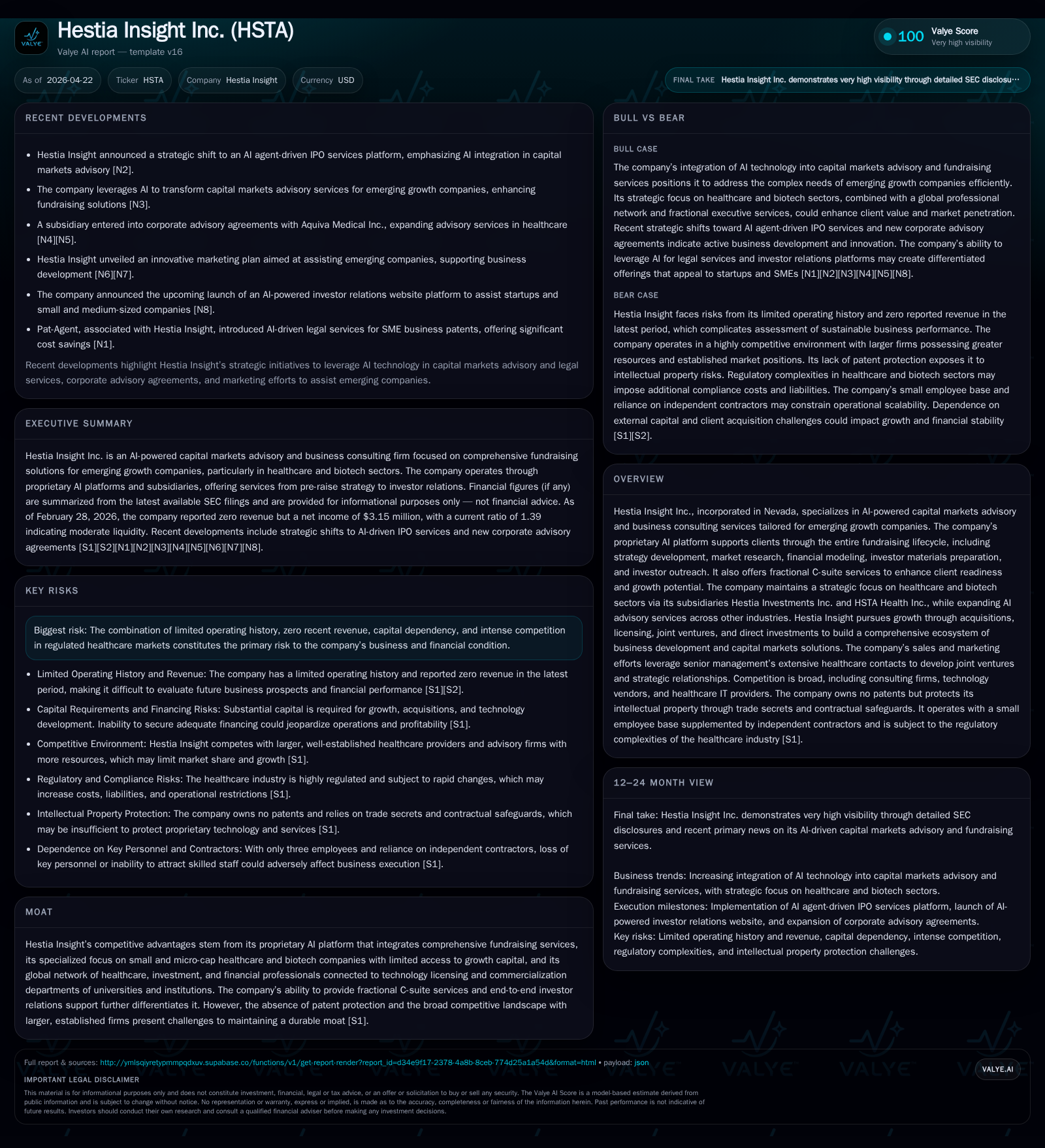
Hestia Insight Inc. reported no revenue for the latest quarter ending February 2026, reinforcing historical trends of limited or minimal top-line generation. The company's proprietary AI-driven capital markets advisory model targets emerging healthcare and biotech companies with fractional C-suite services and end-to-end fundraising support. It competes in a fragmented, highly competitive industry dominated by established consultancies with deeper resources. Growth prospects hinge on acquiring new clients in challenging micro-cap sectors and securing external financing amid operational scaling hurdles. Key near-term indicators revolve around client onboarding, product commercialization via subsidiaries, and capital availability, given ongoing operating losses and cash constraints.
Recent Operating Update
Hestia Insight Inc.'s second fiscal quarter report filed on April 22, 2026 ([S2]) confirms the persistence of operational challenges that have defined the company's trajectory. There were no material changes to previously disclosed risks, maintaining a narrative of ongoing capital dependency and zero recorded revenue for the period ending February 28, 2026 ([F1]). This latest quarterly filing represents a continuation of the company's struggle to translate its AI-enabled advisory services into consistent revenue streams.
This lack of topline contribution in Q2 2026 echoes the previous fiscal year’s total revenue of just $8,000 for FY2025—a precipitous decline from $1.25 million recorded two years prior ([F1]). This near-complete erosion in revenue marks a critical inflection point regarding business model execution amidst the broader ecosystem.
Business Model
At its core, Hestia Insight operates as an artificial intelligence-powered capital markets advisory firm specializing in comprehensive fundraising solutions tailored predominantly for emerging healthcare and biotechnology companies ([S1],[S3]). Its proprietary AI platform facilitates end-to-end capital raising support — encompassing pre-raise strategy formulation (including MVP creation and intellectual property guidance), market research and financial modeling, preparation of investor materials such as pitch decks, due diligence assistance, as well as investor outreach and ongoing relations management ([S18]). Additionally, it augments these offerings with fractional C-suite roles such as Chief Strategy Officer and Chief Financial Officer placements to ensure corporate readiness for transactions.
The company’s strategic emphasis is squarely placed on small- and micro-cap entities within healthcare sectors that traditionally face constrained access to growth capital. Auxiliary subsidiaries like Hestia Investments Inc. and formerly HSTA Health Inc. (recently discontinued post-December 2025) provide targeted execution platforms focused on this space ([S10],[S18]). The decision to shutter HSTA Health likely reflects ongoing financial pressures paired with a strategic reassessment aimed at conserving capital while refining core competencies.
As a firm integrating multiple complementary services across fundraising stages powered by AI insights, Hestia Insight attempts to differentiate itself from conventional advisory providers by offering a seamless ecosystem solution—a potentially valuable proposition for under-resourced startups seeking multifaceted guidance without the overhead of full-time executives or siloed consultants.
Industry Structure and Competitive Position
The market for capital markets advisory services to small-cap biotech and healthcare startups is nuanced but fiercely competitive. Larger consultancies and specialized advisory firms dominate with entrenched relationships, substantial financial backing, diverse offerings that merge regulatory consulting with financial structuring, as well as brand recognition ([S6],[S12]).
Hestia Insight’s moat partially derives from its niche focus coupled with an expansive global network linking healthcare professionals, investment experts, university commercialization offices, and technology licensing entities—an ecosystem designed to facilitate deal flow and provide deep domain expertise ([S3],[S6]).
However, the absence of patent protection on its technology platform limits defensibility against replication by better-resourced competitors. The broad scope of competitors ranges from traditional management consultancies to emerging fintech platforms leveraging alternative data analytics—each vying for early-stage companies’ limited advisory budgets ([S6],[S12]).
Operationally, product quality is anchored in timeliness and depth of relationship management—a factor challenged by the company’s modest team size (three employees supplemented by contractors) ([S12]). Moreover, long sales cycles characteristic of healthcare enterprises create temporal disconnects between service delivery investments and realized revenues ([S9],[S13]). These structural dynamics elevate risk around sustainable client engagement.
Growth Drivers and Constraints
The impetus for growth primarily hinges on expanding client base among startups seeking capital infusion during critical development milestones. Structural demand is underpinned by persistent funding gaps confronting small-cap biotech firms; however, this segment's cyclical nature tied to macroeconomic cycles, investor sentiment shifts toward risk assets, and regulatory approval timings introduces volatility.
Internal constraints chiefly include limited operating history marked by inconsistent revenue generation; reliance on senior management networks underscores concentration risks ([S13],[S15]). Capital constraints significantly restrict the company's ability to scale technological enhancements or broaden service deployment outside its core niche ([S15],[S16]).
The halt of subsidiary operations (HSTA Health) further accentuates the need for strategic prioritization but also reduces operational breadth potentially necessary for diversification into other verticals ([S10]). Client acquisition effectiveness relates directly to reputation building in a deeply trust-driven industry segment—where high-quality deliverables yielding measurable financings serve as essential proof points ([S19]).
What to Watch Next
Key performance indicators revolve around successful onboarding of paying clients generating tangible fundraising aid fees—an area lacking sufficient disclosed evidence currently. Milestones include ramping up AI platform capabilities beyond the healthcare sector while retaining specialized service quality within existing verticals ([S3],[N/A]).
Monitoring cash flow trajectories is crucial; given the company's demonstrated cash burn levels relative to available liquidity (~$17K in cash equivalents at Q2 end), additional funding rounds or financing arrangements will be necessary to sustain operations ([F1]). Execution efficacy in closing strategic partnerships or acquisitions can also provide leverage if aligned with core competencies.
Furthermore, evaluating improvements in internal controls mandated under Sarbanes-Oxley provisions may signal maturation towards operational scalability ([S21]). Finally, any shifts in competitive landscape—such as entry of new disruptive AI-advisory entrants—should be observed closely given Hestia Insight’s modest resource base.
Financial Profile
Historical performance (annual)
| FY | Rev ($) | Net ($mm) | CFO ($) | OpInc ($) | Rev YoY | Net YoY |
|---|---|---|---|---|---|---|
| 2025 | 8000 | -1 | -134272 | -304919 | ||
| 2023 | 1249884 | 1 | -168805 | 851529 | +8232.6% | +137.5% |
| 2022 | 15000 | -2 | -340957 | -348268 | -47.4% | +82.5% |
| 2021 | 28500 | -10 | -209703 | -220195 |
Source: SEC companyfacts cache [F1].
Capital returns and efficiency (annual)
| FY | ROE% |
|---|---|
| 2025 | -807.1 |
| 2023 | 68.3 |
| 2022 | -252.6 |
| 2021 | -421.4 |
Source: SEC companyfacts cache [F1].
The company’s financial history paints a precarious picture:
- Revenue collapsed from over $1.24 million in FY2023 down to $8K in FY2025 — a staggering approximately 99% YoY decline ([F1]).
- Operating income deteriorated sharply into negative territory at -$304K in FY2025 compared with positive $851K two years prior.
- Net losses expanded dramatically reaching nearly -$943K in FY2025 alongside negative returns on equity exceeding -800% indicative of deep value erosion ([F1]).
- Operating cash flow remains negative though improved slightly year-over-year (-$134K vs prior periods), suggesting ongoing cash burn albeit marginally moderated.
- At fiscal Q2 close 2026 (Feb 28), current assets stood at
$429K against liabilities of ~$309K supporting a moderate current ratio (1.39), yet liquid cash was minimal ($17K), underscoring liquidity constraints requiring immediate attention.
These figures underscore structural challenges converting innovative service offerings into profitable growth absent meaningful customer traction or diversification initiatives. Debt or equity raises appear imperative to maintain viability. The high insider ownership concentration (~68%) signals governance centralization which might impact future financing strategies or shareholder influence ([S17],[F1]).
Conclusion
Hestia Insight embodies an ambitious effort marrying AI technology with bespoke capital markets advisory tailored for underserved small-growth biotech sectors. Despite possessing strategic know-how embedded via niche networks and integrated execution models encompassing fractional C-suite roles alongside tech-enabled services, it faces existential risks stemming from negligible revenues, chronic losses, capital limitations, slow sales cycles inherent in healthcare startups, intense competition from established players with superior resources, lack of intellectual property protection for its platform, and operational scale challenges.
Near-term focus should remain sharply on demonstrating tangible value propositions through client successes that translate into repeatable revenues while prudently managing cash outflows amid tightening liquidity buffers. Strategic reallocation post subsidiary shutdown hints at evolved prioritization but heightens pressure to execute flawlessly amid limited operational runway. Absent breakthrough fundraises or disruptive client wins unlocking sustainable growth trajectories soon, continued distress remains likely.
This analysis is based solely on publicly available SEC filings dated through April 22nd, 2026 [S1][S2], complemented by structured financial data [F1]. No investment advice or recommendations are expressed herein.
Disclaimer: This is research-only, informational analysis and not investment advice. It may include AI-generated interpretation and general industry context. Always verify important details using primary sources.

Comments