
SQM Bolsters Lithium and Specialty Chemicals Growth Backed by Strategic JV and Updated Reserves
Latest technical report filings and operational disclosures confirm SQM's reinforced resource base and capacity expansions amid enduring environmental permit uncertainties.
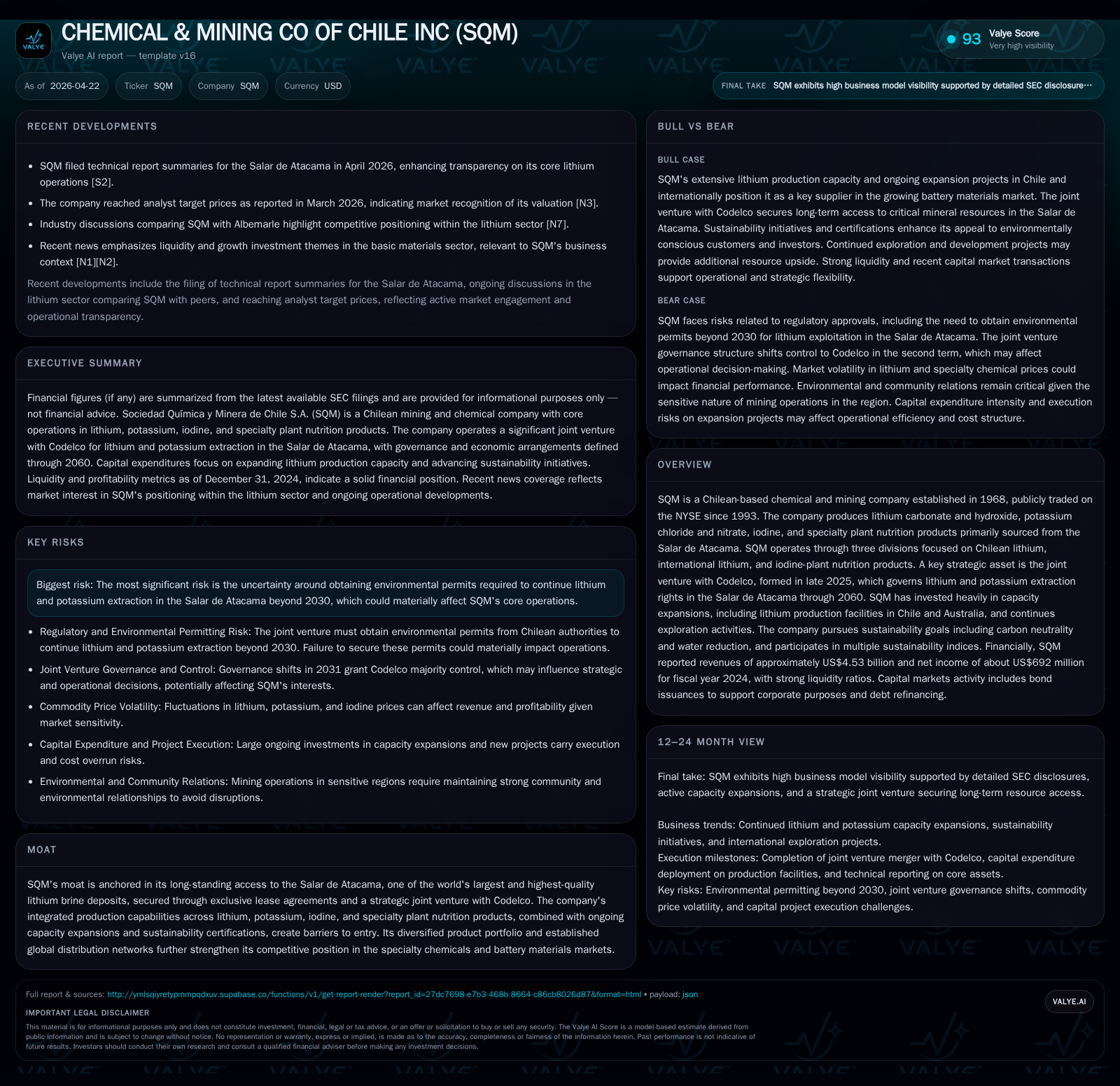
In April 2026, SQM filed updated technical reports reaffirming the robustness of its Salar de Atacama lithium reserves, underpinning ongoing capacity growth initiatives. The company’s diversified product portfolio spans lithium compounds, specialty plant nutrients, iodine, and potassium products, anchored by an exclusive JV with Codelco providing extraction rights through 2060. While SQM capitalizes on strong demand from battery materials and specialty chemicals markets, uncertainties surrounding environmental permits beyond 2030 pose significant risk. Financially, SQM maintains a solid liquidity position supporting aggressive capex spending and operational scaling within a complex regulatory environment.
Latest Operating Highlights Reinforce Resource and Capacity Base
The company’s April 2026 Form 6-K filings [S2], [S3] serve as the cornerstone of its near-term operating narrative. SQM issued updated technical report summaries for its flagship Salar de Atacama lithium brine assets alongside other key mineral properties including Nueva Victoria, Pampa Blanca, and Maria Elena. These reports incorporate findings dated April 13–15, 2026, duly consented by qualified professionals within SQM [S2][S3]. This fresh reserve estimation confirms ample high-grade lithium brine resources extending through the JV term with Codelco to 2060, underpinning confidence in both organic scaling plans and mine life extension.
Operationally, despite the company’s plan to reduce potassium output to prioritize lithium-rich brines due to environmental constraints (noted in annual filings [S1]), lithium production volumes demonstrated a marked uplift with a reported increase of approximately 24% year-over-year reaching nearly 258 thousand metric tons of lithium carbonate equivalent (LCE) in calendar year 2025 [S1]. Revenue from lithium slightly increased by 2.1% to US$2.29 billion despite underlying commodity price pressures [S1]. This aligns with successful ramp-ups at the Mt. Holland joint venture in Australia where concentrator plant operations hit nameplate capacity during 2025 with initial phases of the Kwinana hydroxide refinery commencing scale-up.
Integrated Business Model: Multi-Product Portfolio Anchored on Salar de Atacama
SQM operates a highly integrated multi-division structure encompassing Chilean lithium extraction and chemical processing; international lithium operations primarily via tolling agreements and JV projects; extensive iodine mining plus derivative manufacturing; as well as specialty plant nutrients enriched by its chemical portfolio [S1][S9][S15]. The core asset for Chilean operations is the Salar de Atacama—a world-class brine resource characterized by elevated lithium concentrations coupled with high evaporation rates enabling cost-efficient extraction methods such as heap leaching.
The recently established JV with Chilean state mining giant Codelco ensures SQM access rights extended to mid-century (2060) providing contractual stability amidst a complex regulatory environment . Importantly, potassium chloride production supports both direct sales (though now reduced) as well as feedstock conversion into higher-margin potassium nitrate products sold within specialty nutrition markets. The company retains global distribution capabilities via proprietary offices complemented by distributors tailored to product categories optimizing logistical efficiency across different geographies [S9][S15].
Competitive Advantages within the Global Lithium and Specialty Chemicals Market
SQM’s competitive moat largely derives from several interconnected factors: long-tenured exclusive rights over one of the planet’s purest lithium brine deposits; vertically integrated processing capacity producing both carbonate and hydroxide; diversified product portfolios stabilizing volatility risks; plus explicit sustainability certifications reinforcing brand equity .[S1][S16][S24]
On pricing dynamics, the lithium market benefits from structural demand growth driven by electrification trends globally—especially pronounced in Asia where over 90% of SQM’s lithium revenues are generated [S8]. Despite periodic commodity price cycles impacting revenue levels (notably from year-to-year declines shown in historical figures [F1]), SQM sustains a strong presence supported by operational cost leadership owing to favorable geology and proprietary technology R&D efforts focused on process efficiency improvements [S21]. Meanwhile, its iodine business commands an estimated ~37% share of global iodine market volumes mainly sourced from caliche mineral deposits unique to Chile [S11]. This duality provides resilience against single-market shocks.
Growth Catalysts: Expansion Projects, Joint Ventures, and Sustainability Initiatives
Capital investment remains hefty (~US$2.7 billion planned over three years through 2027), centered on expanding lithium carbonate/hydroxide output domestically while advancing international projects such as Mt. Holland [S25]. The planned ramp-up of hydroxide capacity in Chile from a current ~40k metric tons/year to target ~100k metric tons/year by the end of 2026 exemplifies this effort. Moreover, specialized plant nutrient innovations leveraging potassium nitrate derivatives support margin uplift potentials through targeted premium crop applications across ~100 countries worldwide [S6][S9].
The JV arrangement with Codelco not only consolidates resource governance but also mitigates geopolitical risk exposure common in mining concession renewals—providing crucial multi-decade visibility cited explicitly as a key strategic milestone . Sustainability commitments permeate investment decisions—SQM targets carbon neutrality by employing low-water-use technologies in extraction processes and actively participates in widely recognized environmental indices reflecting adherence to best practices [S24].
Challenges from Environmental Permitting and Regulatory Risks
The dominant existential risk facing SQM emanates from uncertainty regarding renewal or extension of critical environmental permits governing brine extraction at Salar de Atacama beyond currently authorized horizons circa 2030 [S16][S19][S24]. The nature of these regulatory bottlenecks is multifaceted—balancing water resource protections demanded by government agencies against industry’s economic imperatives.
Permit renewal complexity extends beyond mere administrative procedure; it encompasses social licenses involving indigenous community engagement, evolving climate regulations under Chilean law amendments like Law No. 21,455 (on climate change impacts), plus compliance requirements under international trade frameworks such as EU REACH chemical registrations or carbon border adjustment mechanisms affecting fertilizer exports [S16][S19]. Absent clarity or delays in approvals could materially constrain planned capacity expansions or force operational scaling down potentially impacting earnings visibility.
Investor Watchlist: Milestones, Permitting Status, and Market Demand Signals
Going forward through late-2026 into early-2027 attention should focus on:
- Progress reports from new technical studies or reserve re-certifications announced via further filings analogous to April’s technical report disclosures [S2],[S3].
- Outcomes related to formal environmental permit renewals for Salar de Atacama extraction concessions.
- Operational ramp status updates from Stage II expansions at Chilean hydroxide plants plus Mt. Holland refinery efficiency gains.
- Market price trends particularly demand shifts tied to electric vehicle battery supply chains which heavily influence sales volumes and pricing power.
- Ongoing sustainability reporting metrics reflecting water usage reduction achievements or certification renewals that could impact investor perception of operational risk.
Given that two largest lithium customers represent roughly a quarter of revenues highlights concentrated counterparty risks coupled with geographically clustered demand mainly centered in Asia—but balanced somewhat by specialist plant nutrition sales more widely dispersed demonstrating portfolio diversification benefits [S8],[S6].
Financial Overview: Revenue Trends and Capital Structure Supporting Operations
SQM’s fiscal trajectory captured through the latest annual consolidated numbers reveals revenue stability coupled with profitability moderation reflective of commodity price cycles. While revenues slipped significantly between FY2023 ($7.47 billion) to FY2024 ($4.53 billion) per companyfacts data [F1], FY2025 figures indicated marginal recovery with $4.58 billion total revenue inline with previously disclosed results [S1]. Net income moderated accordingly but sustained positive margins supportive of reinvestment.
Liquidity remains ample evidenced by an improved current ratio rising above 3.2 as at December 31st, 2025 compared to about 2.5 at end-2024 fostering confidence amid capital spending cycles [S4]. Long-term debt approximated US$4.2 billion remains manageable given hedging strategies that convert local currency obligations (UF bonds) effectively into USD liabilities minimizing foreign exchange risk exposures [S12–14]. Notably issuance of green bonds signals alignment of financing strategy with sustainability objectives promoting investor appeal.
Historical performance (annual)
| FY | Rev ($bn) | Net ($bn) | Rev YoY | Net YoY |
|---|---|---|---|---|
| 2024 | 4.5 | 0.7 | -39.4% | -25.6% |
| 2023 | 7.5 | 0.9 | -30.3% | -76.2% |
| 2022 | 10.7 | 3.9 | +274.2% | +561.0% |
| 2021 | 2.9 | 0.6 |
Source: SEC companyfacts cache [F1].
Capital returns and efficiency (annual)
| FY | Div ($bn) | ROE% |
|---|---|---|
| 2024 | 0.0 | 13.3 |
| 2023 | 1.5 | 20.8 |
| 2022 | 2.2 | 79.4 |
| 2021 | 0.6 | 18.4 |
Source: SEC companyfacts cache [F1]. *Including quarterly run-rate estimates extrapolated from recent filings.
In conclusion, SQM navigates a nuanced landscape melding robust asset quality backed by JV partnerships and expanding capacity focused on battery-grade materials alongside mature specialty chemicals sectors—all while managing intrinsic external risks driven primarily by permitting uncertainties in Chile’s evolving regulatory framework.
Disclaimer: This is research-only, informational analysis and not investment advice. It may include AI-generated interpretation and general industry context. Always verify important details using primary sources.

Comments