
BestGofer Inc. Faces Operational Delays and Liquidity Constraints While Launching Delivery Platform
Latest quarterly report reveals ongoing pre-operational status of delivery app, reliance on home inspection revenue, and accounting firm changes.
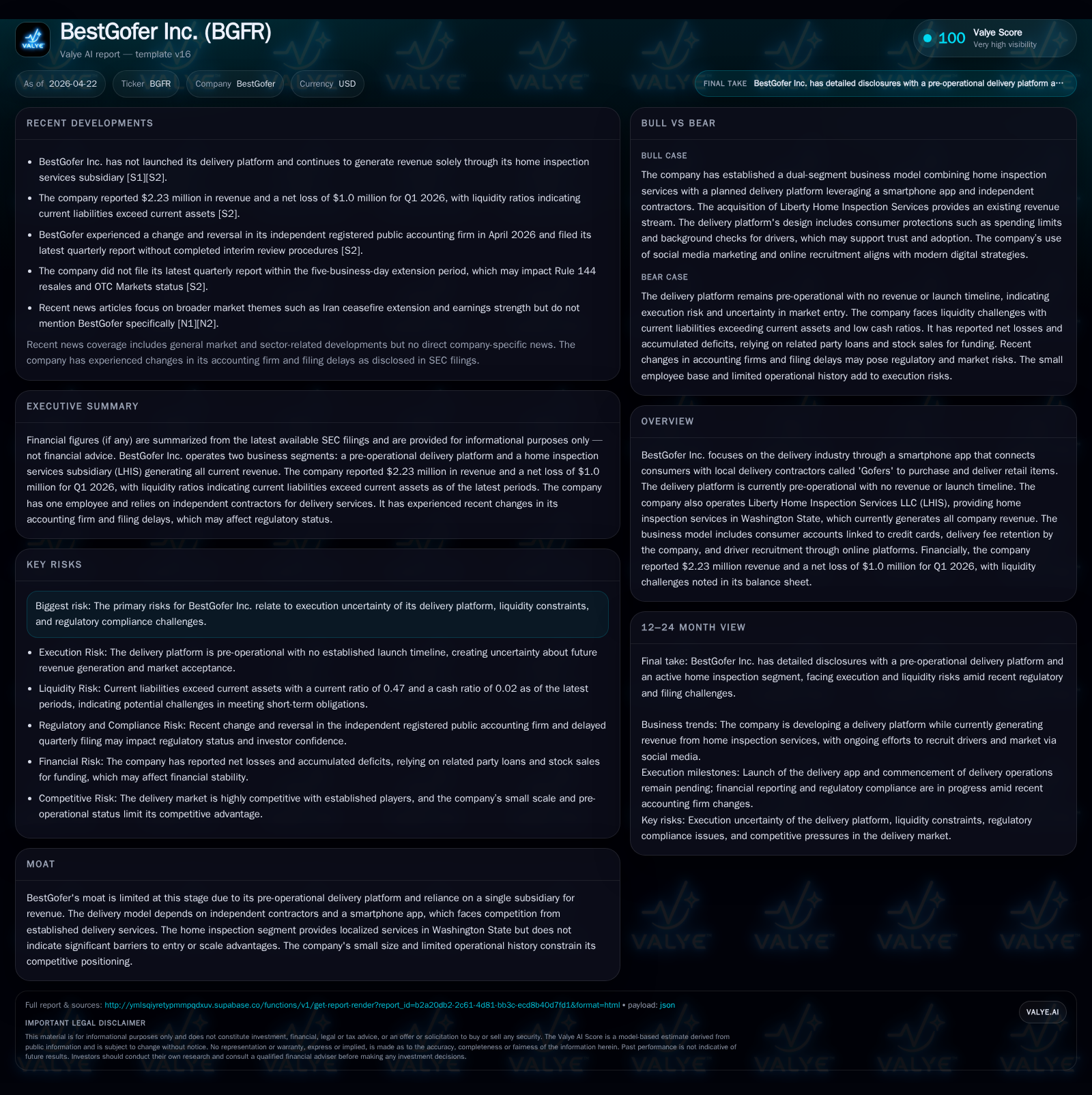
BestGofer Inc.'s latest 10-Q filing for Q1 2026 highlights continued delay in launching its BestGofer delivery platform, with no revenue yet from this segment. All reported revenue derives from its wholly owned subsidiary Liberty Home Inspection Services LLC (LHIS), which operates in Washington State. The company reported a net loss despite modest revenue, with liquidity challenges and a recent auditor change casting execution uncertainties. The business model depends heavily on recruiting independent contractors through digital platforms and monetizing through delivery fees retained partially by the company. Competitive positioning is weak due to the pre-operational stage and small scale, while growth hinges on successful platform launch and capital raising.
Recent Operating Update
BestGofer Inc.'s latest quarterly filing dated April 22, 2026 (10-Q) confirms that the company's flagship BestGofer delivery platform remains pre-operational with no recorded revenues nor established timeline for launch [S2]. The report details that all revenues continue to be generated by its wholly owned subsidiary Liberty Home Inspection Services LLC (LHIS), a provider of residential home inspection services located in Washington State. For the first quarter of fiscal year 2026 ended February 28, revenue amounted to approximately $2.23 million with a net loss nearing $1.0 million, underscoring ongoing investment and operating expenses ahead of the critical delivery app commercialization [F1].
The quarter also saw a significant corporate governance event: a change and reversal involving BestGofer's independent registered public accounting firm in April 2026. This transition resulted in the filing of the quarterly report without completed interim review procedures under SEC Rule 10-01(d), potentially necessitating future amendments should further adjustments arise from continuing audit scrutiny [S16]. Additionally, the filing was submitted after missing the allowed five-business-day extension period under Rule 12b-25(b), risking restrictions on share resales for restricted shareholders and affecting OTC Market status [S16].
Taken together, these developments spotlight both operational delays in deploying the core delivery service as well as financial-reporting uncertainties during this nascent business phase.
Business Model
BestGofer aims to transform retail item delivery by leveraging a smartphone application to connect consumers with local independent contractors known as "Gofers." Through this model, users can request purchase and doorstep delivery of various accessible retail goods—including groceries, restaurant meals, convenience items, liquor, and courier services—with an order cap set at $400 per transaction. The platform mandates consumer accounts linked to credit cards billed upon delivery completion to automate payments and reduce cash handling risks [S4][S6][S7].
The company recruits drivers predominantly via online career portals and requires a criminal background check along with valid driving credentials before contracting them as independent contractors [S7][S8]. Drivers authenticate and manage orders through a dedicated Gofer app that tracks their location in real time for both operational coordination and consumer transparency.
BestGofer retains a fixed 30% portion of each driver's delivery fee under contract terms [S8]. Drivers furnish their own vehicles and purchase goods as authorized within consumer-set spending limits during deliveries—a detail emphasizing trust but also exposing drivers to upfront cost risks mitigated partially by credit card holds [S8]. Customers benefit from the convenience of customizable item requests supported by functionality such as image uploads for precision.
Alongside this emergent delivery platform segment, BestGofer's current revenue base rests solely on LHIS's home inspection services targeting residential real estate buyers, sellers, and brokers within Washington State. LHIS recognizes revenue upon delivering completed inspection reports post-service engagements [S4].
While having two distinct segments diversifies exposure modestly, the core long-term value proposition hinges on successfully operationalizing the BestGofer platform—currently stalled without any commercial activity.
Industry Structure and Competitive Position
The grocery and retail delivery sector operates as a mature but intensely competitive field dominated by established platforms with strong brand recognition like DoorDash, Uber Eats, Instacart, Amazon Flex, among others. Barriers to entry include large-scale technology infrastructure requirements for scalable app-based dispatching systems, extensive driver networks cultivated through recruitment marketing incentives, regulatory compliance complexity pertaining to gig-worker classification, data security measures related to credit card handling, and customer acquisition costs.
Against this backdrop, BestGofer's position is significantly constrained:
- Its app is not yet live or generating revenue; hence it cannot claim market traction or brand presence.
- Dependence on independent contractors exposes it to potential volatility in labor supply without guaranteed exclusivity or loyalty mechanisms.
- The company's localized home inspection operations offer minimal synergy or cross-selling leverage into the broader delivery ecosystem or geographic scale advantages.
- No disclosed unique technology innovations or proprietary algorithms differentiate its routing or pricing strategies from incumbents.
- Early-stage capital limitations restrict aggressive marketing or incentive spending needed to scale driver supply or consumer demand rapidly.
In essence, BestGofer currently functions largely as a development-stage entity attempting entry into an established market with structurally integrated competitors who benefit from network effects that drive better service levels and pricing efficiencies—a critical moat nowadays given consumer expectations around speed and reliability.
Growth Drivers and Constraints
The primary growth driver will be successful launch followed by rapid expansion of the BestGofer app's user base—both consumers willing to pay for convenience delivery and drivers seeking flexible earning opportunities. Scaling requires seamless onboarding processes supported by robust backend technology enabling advanced order matching algorithms while maintaining low friction payment experiences that reassure users wary of fraud or charge disputes.
Additional growth factors include:
- Targeted digital marketing campaigns primarily leveraging social media channels such as Facebook, Instagram, X (formerly Twitter), and Snapchat ([S8]).
- Expanding service categories beyond groceries into verticals like package couriering or specialized items meeting regulatory criteria.
- Building geographical footprints across multiple US cities beyond initial trials.
- Strengthening partnerships potentially with retailers or real estate agencies integrating LHIS offerings as value-adds.
Key constraints emerge mainly from:
- Persistent liquidity shortfalls evident in low cash balances (
$1.9K) against substantial liabilities ($83K) means ongoing capital raises are imperative [F1][S16]. - Regulatory risks around independent contractor classifications could mandate shifted compensation structures increasing unit economics pressure [S5].
- The absence of launched operations prevents accruing network effects which historically define winner-take-most dynamics in gig economy platforms .
- Customer trust building is challenging without demonstrable track records amidst plentiful alternatives offering instant gratification supported by decades-old infrastructures.
- Logistics management complexity spanning multi-item transactions up to defined weight limits adds operational overheads.
Therefore, rather than cyclical demand fluctuations typical in retail sectors exposed directly to macroeconomic swings, BestGofer faces structural execution risks determining whether it can develop differentiated offerings hard enough for sustainable competitive advantage at scale.
What To Watch Next
Future catalysts that could materially affect BestGofer's trajectory comprise:
- Delivery Platform Launch Date: Confirmation of app availability in targeted locales alongside user adoption metrics will validate business case assumptions.
- Driver Recruitment Scale: Disclosures around number of active Gofers contracted would indicate success in building reliable supply capacity enabling consistent service levels.
- Regulatory Developments: Monitoring local/state policies influencing gig worker legislation impacting labor cost models remains essential.[S5]
- Financial Reporting Updates: Given current auditor transition without completed interim reviews (as per April 2026 filings), future amendments may unveil adjustments impacting investor confidence [S16].
- Capital Raising Announcements: Fresh equity or debt financing initiatives needed to fund operating losses ahead of positive cash flow generation will signal survival prospects.
- Expansion Beyond Washington State: Any plans to replicate LHIS subsidiary’s niche outside current geography alongside platform rollouts may broaden future addressable markets.
- Customer Acquisition & Retention Data: Eventually published metrics regarding frequency of use per customer or repeat orders will clarify practical acceptance level vs other incumbents.
Ongoing disclosure vigilance regarding these operational milestones combined with detailed financial updates will provide clearer insight into whether BestGofer can overcome startup status handicaps toward meaningful scale.
Financial Profile Summary
Historical performance (annual)
| FY | Rev ($) | Net ($) | CFO ($) | Net YoY |
|---|---|---|---|---|
| 2026 | ||||
| 2025 | 5260 | -25748 | 3140 | +6.6% |
| 2024 | 0 | -27562 | -1375 | +37.1% |
| 2023 | 0 | -43792 | -2750 | -31.3% |
Source: SEC companyfacts cache [F1].
[F1]
The financial data indicates that BestGofer realized limited revenue exclusively from LHIS in fiscal year 2025 while incurring significant net losses driven by developmental expenditures across corporate functions including technology initiation efforts related to the delivery platform [F1][S4]. Operating cash flows swung positive in FY2025 compared to negative trends previously—likely reflecting better working capital management but not profitability given losses persisted [F1]. Meanwhile, equity remains negative as accumulated deficits continue steepening over multi-year periods despite some capital injections noted through related party financing disclosures [F1][S26].
The current ratio (~0.47) computed from available assets versus liabilities portrays stretched liquidity conditions requiring external funding to support ongoing operations especially investment-heavy software deployment planned ahead [F1][S16]. The auditor change event flagged by management amplifies cautionary signals about near-term reporting clarity given incomplete reviews accompanying recent filings [S16].
Conclusion
BestGofer Inc.'s latest quarterly disclosures paint a cautious picture centered on an early-stage enterprise wrestling with execution risks inherent in launching a competing delivery marketplace platform amid entrenched competition within gig-economy frameworks. While providing immediate revenue visibility via its legacy home inspection subsidiary helps cover short-term operational needs modestly, long-term success depends critically on overcoming internal financial constraints paired with validated consumer acceptance post-app launch.
Investors following this story should prioritize carefully timed updates around commercial rollouts focusing on user engagement metrics alongside rigorous scrutiny of evolving financial statements given recent auditor changes affecting transparency reliability. Structural barriers linked to labor regulation shifts combined with fierce incumbent consolidations suggest this emerging player must leverage innovation or partnership advantages decisively within narrow deployment windows to seek durable footholds.
This analysis is provided solely for informational purposes based on publicly available data as of April 22nd, 2026; it does not constitute investment advice or recommendations concerning the purchase or sale of any securities.
Disclaimer: This is research-only, informational analysis and not investment advice. It may include AI-generated interpretation and general industry context. Always verify important details using primary sources.

Comments