
IMMUNIC Advances Phase 3 Progression with Vidofludimus: Implications for Autoimmune Therapeutics
IMMUNIC’s recent 10-Q and 8-K filings highlight pivotal clinical advancements in its Phase 3 program alongside strategic capitalization moves critical to sustaining its drug development pipeline.
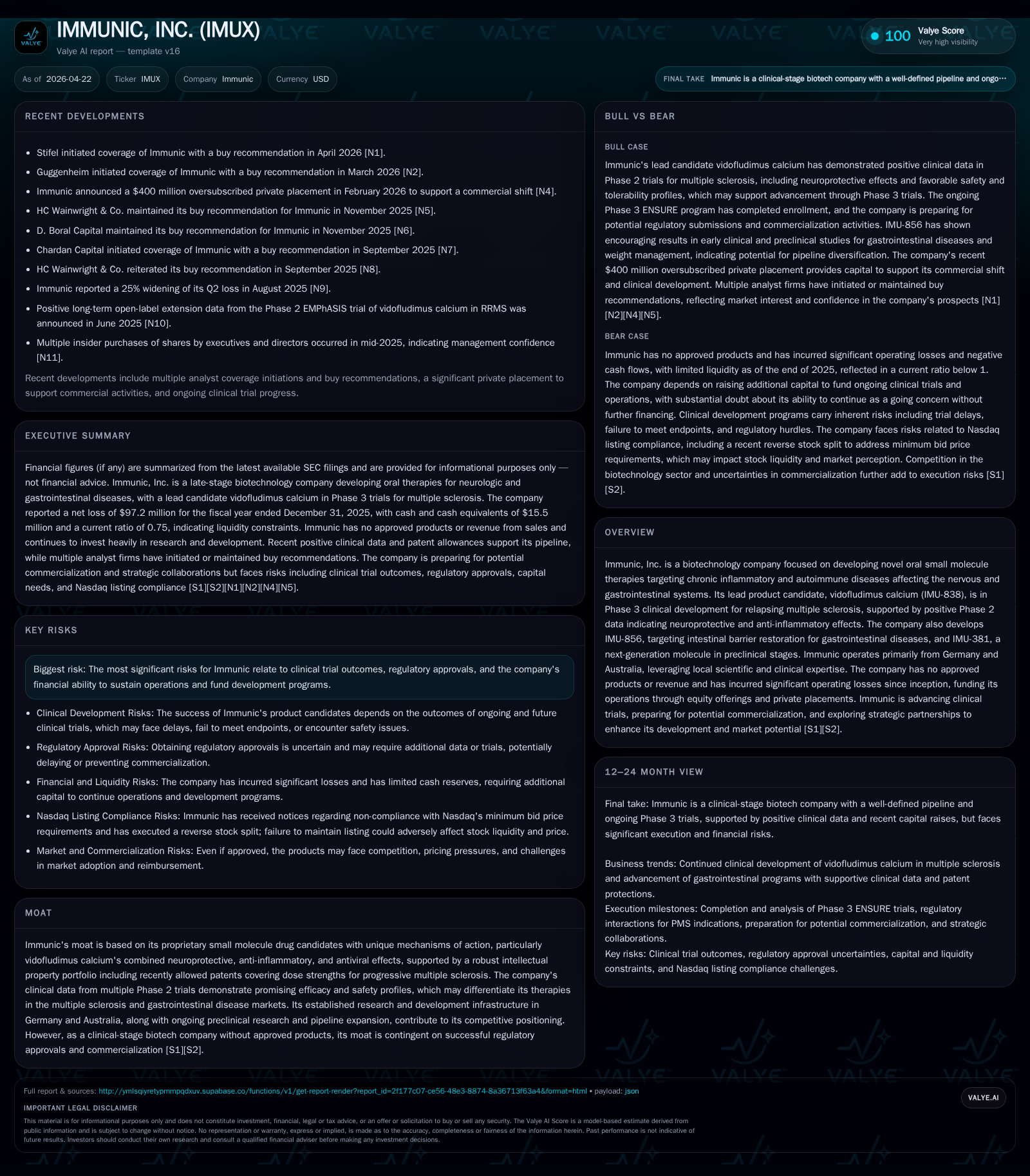
IMMUNIC, Inc. recently reported key progress in the Phase 3 ENSURE trial for vidofludimus calcium (IMU-838), its lead oral small molecule targeting relapsing multiple sclerosis (RMS), reinforcing its differentiated therapeutic profile in autoimmune diseases. A reverse stock split approved in April 2026 aims to address Nasdaq listing compliance and improve trading liquidity, amid ongoing financing challenges highlighted by persistent operating losses and a cash runway constrained to under twelve months without further capital raises. The company’s robust intellectual property, supported by encouraging Phase 2 data on neuroprotective and anti-inflammatory effects, underpins its competitive moat, although developmental and regulatory risks remain substantial ahead of anticipated late-stage trial readouts and subsequent regulatory submissions.
Recent Clinical and Operational Developments: Insights from the Latest SEC Filings
IMMUNIC’s most recent quarterly report filed November 13, 2025 [S2] anchors the current operational update. It outlines ongoing robust progression of its Phase 3 ENSURE clinical program evaluating vidofludimus calcium (IMU-838) for relapsing multiple sclerosis (RMS), entrenching the lead candidate’s pivotal role within IMMUNIC’s pipeline. While explicit interim results are limited in the filing, prior disclosures confirm positive interim signals supporting continued enrollment. Operationally, the company maintains a lean workforce (~90 employees) concentrated in Germany with core R&D infrastructure spanning Munich (Gräfelfing) and Australia.
A salient corporate event disclosed in the April 14, 2026 Form 8-K [S3] is shareholder approval of a reverse stock split at a ratio of one-for-ten shares, effective April 27, 2026. This is a direct response to Nasdaq's notification of non-compliance due to prolonged common stock trading below the $1 minimum bid price [S14], thereby facilitating compliance via consolidation of share price while transitioning trading from the Nasdaq Global Select Market to the Nasdaq Capital Market under the existing symbol "IMUX." This move aims to support stock liquidity fundamentals amid pricing volatility seen across clinical-stage biotech equities.
Further governance updates from the amended 10-K/A filed April 22, 2026 [S1] describe board enrichment by new director Thorvald "Thor" Nagel of BVF Capital Management, bringing deep life sciences investment expertise which could bolster strategic oversight as IMMUNIC navigates late-stage clinical development hurdles.
Additionally noted are enthusiastic analyst coverage initiations: Stifel [N2] and Guggenheim [N3] both issued buy recommendations following recent public presentations that underscore IMMUNIC’s advancing trial data juxtaposed against industry comparators.
IMMUNIC’s Business Model: Oral Small Molecules Tackling Neurologic and Gastrointestinal Autoimmune Diseases
IMMUNIC’s business architecture centers on discovery and clinical progression of novel orally administered small molecules designed to modulate immune pathways implicated in chronic inflammatory conditions primarily affecting neurologic (multiple sclerosis) and gastrointestinal systems. The absence of product revenues is due to all candidates being investigational; thus financial resources drive via equity-based capital raises.
The flagship candidate vidofludimus calcium (IMU-838) is currently evolving through pivotal Phase 3 trials targeting RMS. Notably, positive Phase 2 data have hinted at multi-modal benefits encompassing immunomodulation, neuroprotection against progressive MS pathways, and antiviral activity — a potentially unique combination that may translate into durable clinical efficacy while improving patient adherence relative to injectable MS therapeutics.
Adjacent clinical assets include IMU-856 focused on restoring intestinal barrier integrity with encouraging mechanistic signals such as dose-dependent increases in endogenous GLP-1 observed in early trials involving celiac disease patients [S15]. This raises prospects for pipeline diversification spanning inflammatory bowel disease (IBD), GvHD, possibly extending toward weight management indications based on preclinical appetite modulation evidence.
Similarly, IMU-381 represents a next-generation gastrointestinal-targeted molecule now entering preclinical assessments [S23]. Overall product development strategies leverage multiple geographies with proprietary research platforms centered in Germany complemented by clinical outreach operations in Australia.
Oral small molecule delivery confers competitive advantages: enhanced convenience over parenteral drugs improves patient compliance — critical given therapy duration spanning decades for chronic autoimmune disorders — while potentially reducing administration-related adverse events inherent with biologics or injectable therapies.
Intellectual Property and Competitive Positioning within the Autoimmune Therapeutics Industry
IMMUNIC supports its innovation engine through a comprehensive intellectual property portfolio underpinning both core chemical entities and dosing strategies — notably including recent allowances covering dosing strengths for progressive multiple sclerosis indications [S1]. Such patent protection potentially creates barriers that discourage biosimilar entrants or incremental innovations absent licensing agreements.
Within a fragmented MS treatment landscape dominated by injectable monoclonal antibodies and infusions (e.g., natalizumab, ocrelizumab), the development of orally bioavailable small molecules with multifunctional immunological impact could shift patient preferences due to simpler administration routes coupled with favorable safety profiles evidenced so far.
Phase 2 differential outcomes reflecting neuroprotective plus antiviral activity imply that IMMUNIC's molecules may uniquely modulate both innate immune responses alongside adaptive pathways—a therapeutic niche not exploited fully by existing agents. This nuanced mechanism might translate into competitive differentiation if larger Phase 3 endpoints affirm these clinical benefits.
Moreover, ongoing expansion into gastrointestinal autoimmunity broadens applicability beyond CNS disorders allowing leveraged use of proprietary chemistry platforms across indications bearing overlapping immunopathology; this diversification hedges programmatic risk balanced by focused R&D investments aligned with emerging data.
Pipeline Growth Drivers and Developmental Constraints
Key growth catalysts reside primarily in executing successful completion of the ENSURE Phase 3 twin studies evaluating efficacy, safety, and tolerability versus placebo for IMU-838 in RMS patients [S2]. The timing of full primary endpoint analyses will critically shape regulatory filing strategies across global markets (United States EMA jurisdictions).
Secondary drivers include maturation of IMU-856 programs exploring celiac disease pathophysiology modulation via intestinal barrier restoration mechanisms combined with metabolic control offered by GLP-1 hormonal pathway engagement [S15]. Positive translational biomarker findings warrant expanded trials but depend heavily on successful capital deployment and partnering discussions—highlighting funding constraints as a pivotal bottleneck.
IMU-381 preclinical advancement constitutes longer-horizon upside contingent upon establishing proof-of-concept efficacy coupled with scalable manufacturing routes suitable for clinical translation [S23].
Operational challenges consist of typical biotech risks: patient recruitment delays exacerbated by competitive trial landscapes; possible failure to meet stringent regulatory endpoints; uncertainty around adequate capital access to complete late-stage development cycles; potential regulatory shifts impacting approval criteria; ongoing market reimbursement complexities pertaining to innovative treatment classes.
Capital Structure, Liquidity, and Financial Sustainability
IMMUNIC’s financials exhibit typical attributes of a late-stage biotech firm focused on R&D investment absent product revenues. Operating income deteriorated further in FY2025 reaching negative $103.2 million [F1], reflecting escalating trial costs especially related to ENSURE studies coupled with increasing general administrative expenses due to scaling corporate infrastructure.
Cash reserves at December 31, 2025 stood at approximately $15.5 million against current liabilities exceeding $30 million equating to a current ratio below unity (0.75) indicating liquidity pressures [F1]. Cash burn dynamics reveal operating cash flow outflows magnifying slightly year-over-year (-$85.8 million FY2025 vs -$84.7 million FY2024), underscoring persistent financing needs.
Capital raising activity included multiple equity offerings during early-to-mid-2025 such as the May Offering generating net proceeds around $65 million plus subsequent smaller placements [S16], yet these proved insufficient to extend beyond a short runway without imminent additional funding rounds mandated under the shelf registration statement currently effective since May 2024 ([S24]).
The April 2026 approved reverse stock split emerges as part tactical move addressing Nasdaq compliance but also indirectly affects share count dilution calculations critical for investor perception amidst financing negotiation phases [S21].
Below is a summarized financial snapshot illustrating trends over FY2023 through FY2025:
Historical performance (annual)
| FY | Net ($mm) | CFO ($mm) | OpInc ($mm) | Capex ($) | Net YoY |
|---|---|---|---|---|---|
| 2025 | -97 | -86 | -103 | 161000 | +3.3% |
| 2024 | -101 | -85 | -98 | 264000 | -7.4% |
| 2023 | -94 | -71 | -99 | 334000 | +22.3% |
| 2022 | -120 | -65 | -119 | 112000 |
Source: SEC companyfacts cache [F1].
Capital returns and efficiency (annual)
| FY | FCF ($mm) | ROE% |
|---|---|---|
| 2025 | -86 | 1456.2 |
| 2024 | -85 | -545.4 |
| 2023 | -71 | -323.6 |
| 2022 | -65 | -105.9 |
Source: SEC companyfacts cache [F1].
(all figures sourced from latest audited filings [F1])
Forward-Looking Considerations: Regulatory, Clinical, and Market Milestones to Monitor
Crucial near-term events include anticipated top-line results from Phase 3 ENSURE studies which will dictate subsequent NDA/BLA submission timelines within principal pharmaceutical jurisdictions.[S2]
The success trajectory for IMU-856 pivots on securing further financing or partnerships enabling expanded clinical testing beyond initial biomarker endpoints observed in celiac disease cohorts.[S15]
Regulatory bodies’ reception towards oral small molecules for MS remains cautiously optimistic but competitive pressures from recently approved oral agents mandate clear demonstration of superior or complementary efficacy/safety advantages.
Market-related metrics to watch involve post-reverse split stock performance starting April 27, 2026 impacting trading liquidity,[S3,S21] notably amid macroeconomic headwinds affecting biotech capital markets overall.[N1]
Analyst commentary following Stifel’s initiation ([N2]) signals improving external perceptions potentially bolstering investor confidence if pipeline progress aligns with communicated milestones.
In sum, IMMUNIC stands at a critical juncture where scientific validation must intersect effectively with capital market strategy execution—success here will define its capacity to reshape treatment paradigms across autoimmune neurological and gastrointestinal diseases.
This analysis is based solely on publicly available regulatory filings dated up to April 22, 2026 ([S1]-[S29]) supplemented by news releases ([N1]-[N3]) without any proprietary or nonpublic information.
Disclaimer: This is research-only, informational analysis and not investment advice. It may include AI-generated interpretation and general industry context. Always verify important details using primary sources.

Comments