
Constellation Brands Executes Strategic Portfolio Streamlining Amid Market Shifts
The latest quarterly report reveals the impact of recent divestitures and hedging losses on Constellation Brands' operating cash flow and sets the stage for strategic focus on core premium beverage segments.
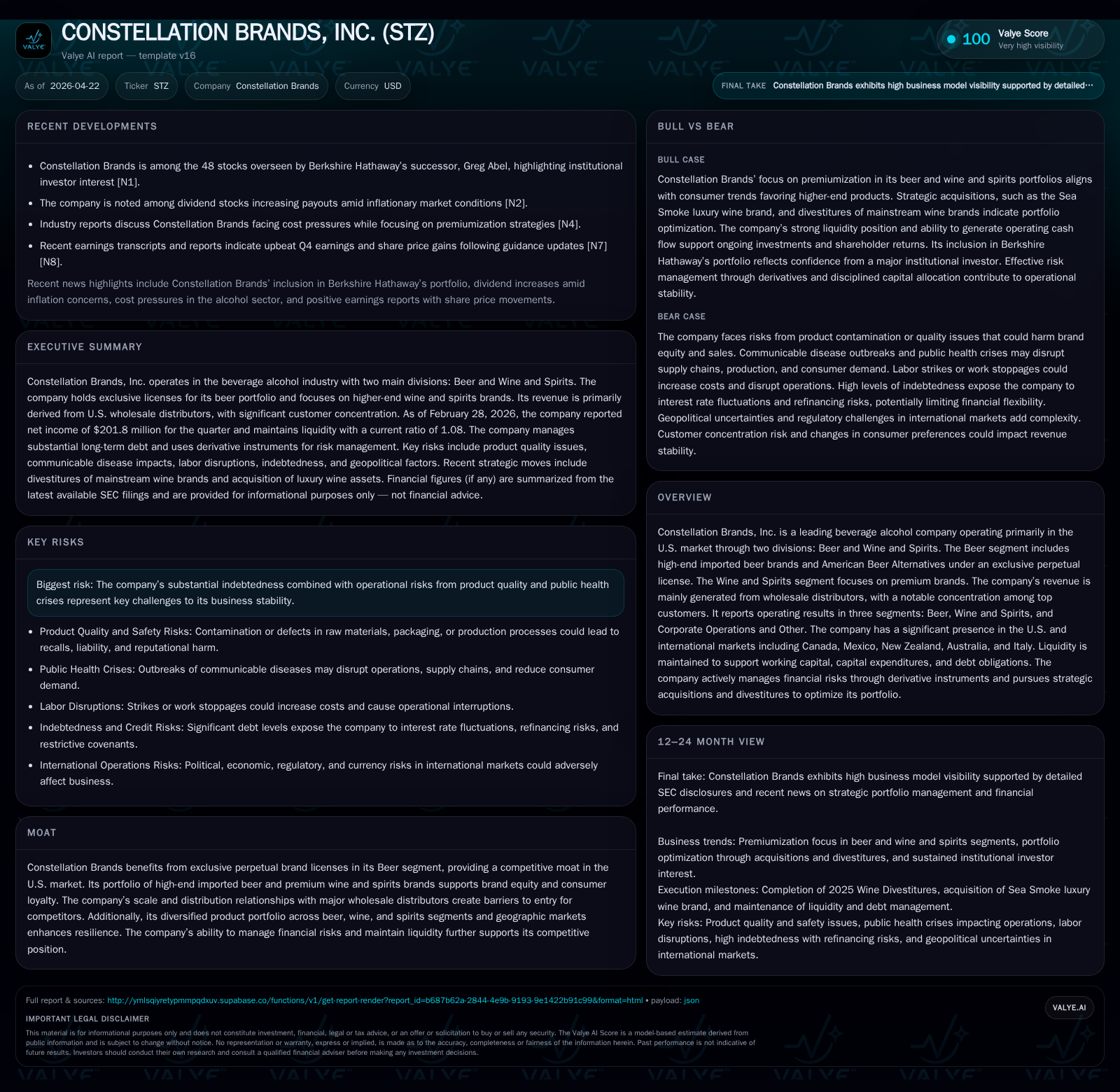
Constellation Brands’ Q3 10-Q filing for fiscal 2026 highlights a mixed quarter where net income rebounded significantly but operating cash flow declined due to working capital shifts and derivative losses. The company’s strategic move to divest certain Wine & Spirits assets in 2025 has materially reshaped revenue composition and improved financial flexibility. Its business model benefits from exclusive perpetual licensing of beer brands alongside a premium wine and spirits portfolio distributed mainly through large wholesale customers, creating pricing power but also concentration risk. Growth is driven by premiumization trends and selective geographic expansion, balanced against financial constraints including elevated debt levels and risks related to product quality and external health events. Investors should watch for upcoming guidance revisions, integration progress of recent acquisitions, and distributor demand trends for signs of sustainable growth.
Latest Operating Update: Implications of Q3 Results and Strategic Moves
Constellation Brands’ most recent quarterly filing (Q3 fiscal 2026 ended November 30, 2025) brings sharp clarity on near-term operational dynamics post its aggressive portfolio realignment. While net income dramatically rebounded to $1.76 billion rejecting the prior year’s loss of $31 million, net cash provided by operating activities declined by $483 million compared to the prior fiscal year period [S2][S1]. This divergence reflects timing differences such as higher accounts receivable in the Beer segment caused by sales/collections cadence shifts; simultaneously, accounts payable dropped in both beer and wine & spirits segments due to lower purchasing activity following last year's Wine & Spirits divestitures.
Further pressuring Q3 earnings was a $58.9 million net loss recorded on derivative instruments classified as cash flow hedges attributed primarily to foreign currency contracts [S2]. Notably, management expects that $97.4 million of net gains (net of tax) will be reclassified from accumulated other comprehensive income (AOCI) into income within the next twelve months – an anticipated relief that tempers this temporary volatility.
April’s subsequent event filing confirmed ongoing impacts from the divestiture actions undertaken during calendar year 2025—particularly the sale of SVEDKA vodka and other wine & spirits assets—which reshaped segment revenue bases yet allowed debt repayment proceeds to improve the balance sheet [S3]. These moves underscore management's shift toward focusing resources on high-margin premium brands within core segments.
Business Model Distilled: Revenue Streams, Brand Portfolio, and Customer Dynamics
Constellation Brands operates through two main business divisions reported as three segments: Beer, Wine & Spirits, and Corporate Operations & Other [S1][S8]. The Beer division centers on a portfolio of high-end imported brands backed by exclusive perpetual licensing rights allowing them to produce, import, market, and sell these beers across the U.S. This perpetual license arrangement is critical because it provides long-term pricing control and competitive insulation against new entrants targeting similar imported beer categories.
The Wine & Spirits segment offers a suite of premium brands positioned at the higher end of their respective categories. Following strategic pruning via divestitures (notably completed in FY2025), this segment has become more focused on fewer but better-performing labels.
Distribution channels predominantly involve third-party wholesale distributors who deliver products downstream to retailers. Sales concentration is evident: Reyes Beer Division (independent entity) accounted for roughly 27.5% of net sales in beer while Southern Glazer's represented about 6.7% in wine & spirits segment revenues during FY2026 [S8]. While such concentration poses some dependency risk, Constellation maintains deep relationships with multiple distributors across broad geographic territories helping mitigate credit risk.
Industry Context: Competitive Moat through Exclusive Licenses and Distribution Scale
The alcoholic beverage industry is fragmented but fiercely contested at premium price points where consumer loyalty hinges on brand heritage and quality perception. Constellation’s moat largely derives from exclusive perpetual brand licenses granted within U.S. jurisdiction that grant it unique rights over select imported beer brands—a scarcity factor unmet by competitors laying claim only to limited term arrangements or domestic-only portfolios [S1][N8].
Additionally, the company’s established scale facilitates favorable terms with major wholesale distributors who control extensive retail networks. Such scale-driven distribution acts as a significant barrier to entry —especially as regulatory frameworks impose complex compliance requirements around production volumes, labeling standards, and interstate shipments affecting new entrants disproportionately.
However, emerging premium craft brands pose an incremental threat demanding continuous innovation or acquisition activity to maintain relevance beyond legacy imports.
Growth Catalysts: Premiumization, Market Expansion, and Portfolio Optimization
Premiumization—the trend whereby consumers trade up toward higher-priced alcoholic beverages offering superior quality or craftsmanship—continues as a primary structural growth driver [N8]. Constellation leverages this via its curated Wine & Spirits offerings alongside imported beers prized for authenticity amid growing consumer sophistication.
Geographically, while the U.S. dominates revenues, targeted presence in Canada, Mexico, New Zealand, Australia, and Italy offers incremental avenues for margin expansion through localized specialization paired with global brand appeal [S1].
Portfolio optimization through recent divestitures has freed capital previously tied up in non-core assets allowing reinvestments into flagship properties or acquisitions such as the Sea Smoke winery acquired in mid-2024—a move aligned with expanding high-margin offerings consistent with evolving consumer tastes.
Headwinds and Constraints: Debt Profile, Quality Risks, and Macro Sensitivities
Despite progress reducing total debt by approximately $929 million or 8% year-over-year to $10.57 billion at fiscal year-end February 28, 2026, leverage remains elevated necessitating vigilant liquidity management especially given interest rate exposure from floating rate instruments [S14][F1].
Risk factors spotlight potential operational disruptions stemming from product contamination or tampering incidents which could damage brand reputation—and broader uncertainties linked to pandemics or communicable diseases disrupting supply chains or altering consumer behavior profoundly [S23]. Inflationary cost pressures likewise constrain margin expansion prospectively.
Labor relations represent another domain requiring monitoring given strikes or work stoppages could impede production flow causing financial consequences.[S23]
Monitoring Milestones: Next-Quarter Guidance, Integration Progress, and Demand Indicators
Looking forward into fiscal Q4 results announced post-April filings will be pivotal in assessing if streamlined focus is translating into durable growth or merely transient earnings improvements amid volatile macro conditions [S3][N1]. Additionally important will be monitoring distributor order patterns (depletions metric) which serve as leading indicators for consumer demand trends controlling inventory replenishment cycles.
Successful integration of niche acquisitions like Sea Smoke coupled with any nascent product innovation pipelines can further test management's ability to capitalize on premiumization tailwinds without overextending operational bandwidth.
Finally, Berkshire Hathaway’s increased stake in Constellation noted recently injects additional investor scrutiny while potentially providing strategic partnership opportunities enhancing business resilience [N2].
Financial Overview: Cash Flow, Profitability, Leverage, and Capital Allocation
Historical performance (annual)
| FY | Net ($mm) | CFO ($bn) | OpInc ($bn) | Capex ($mm) | Net YoY |
|---|---|---|---|---|---|
| 2026 | 202 | 2.7 | 2.7 | 875 | +153.8% |
| 2025 | -375 | 3.2 | 0.4 | 1214 | -195.6% |
| 2024 | 392 | 2.8 | 3.2 | 1269 | +76.0% |
| 2023 | 223 | 2.8 | 2.8 | 1035 |
Source: SEC companyfacts cache [F1].
Capital returns and efficiency (annual)
| FY | Buybacks ($mm) | FCF ($mm) | ROE% |
|---|---|---|---|
| 2026 | 924 | 1794 | 2.5 |
| 2025 | 1124 | 1938 | -5.5 |
| 2024 | 250 | 1511 | 4.0 |
| 2023 | 1700 | 1722 | 2.7 |
Source: SEC companyfacts cache [F1].
Fiscal Year 2026 showcased striking operating income growth rising over sixfold to approximately $2.72 billion versus just $355 million in FY25—a recovery propelled partly by normalization from prior impairment charges alongside operational improvements [F1]. Net income similarly swung positive at nearly $202 million after reporting losses previously (-$375 million).
Operating cash flow declined roughly 15% YoY reflecting working capital headwinds though remained robust at about $2.67 billion; capital expenditures came down meaningfully (-28% YoY) leading to free cash flow around $1.79 billion—a solid cushion supporting shareholder returns [F1][S6].
During FY26 Constellation repurchased shares worth approximately $924 million under an authorized buyback program initiated in April 2025 while maintaining dividend payments indicating strong commitment toward capital return discipline despite elevated debt levels sustained around $10.6 billion albeit reduced versus prior periods [F1][S4][S6].
Liquidity remains ample with a current ratio near parity (1.08x), unused revolving credit facility capacity just shy of $2 billion supplemented by commercial paper programs enabling adaptable short-term funding[F1][S9]. Covenants attached to credit agreements impose caps on leverage ratios providing guardrails amid ongoing deleveraging efforts.[S18]
This analysis is based solely on publicly available regulatory filings dated through April 22, 2026 along with corroborative market sources cited herein. It does not constitute investment advice or recommendations regarding any securities discussed.
Disclaimer: This is research-only, informational analysis and not investment advice. It may include AI-generated interpretation and general industry context. Always verify important details using primary sources.

Comments