
Essential Properties Realty Trust Reports Strong Q1 Growth Driven by Middle-Market Portfolio Expansion
EPRT’s Q1 2026 results highlight revenue and FFO beats anchored in its diversified small-box net lease portfolio to middle-market service-oriented tenants.
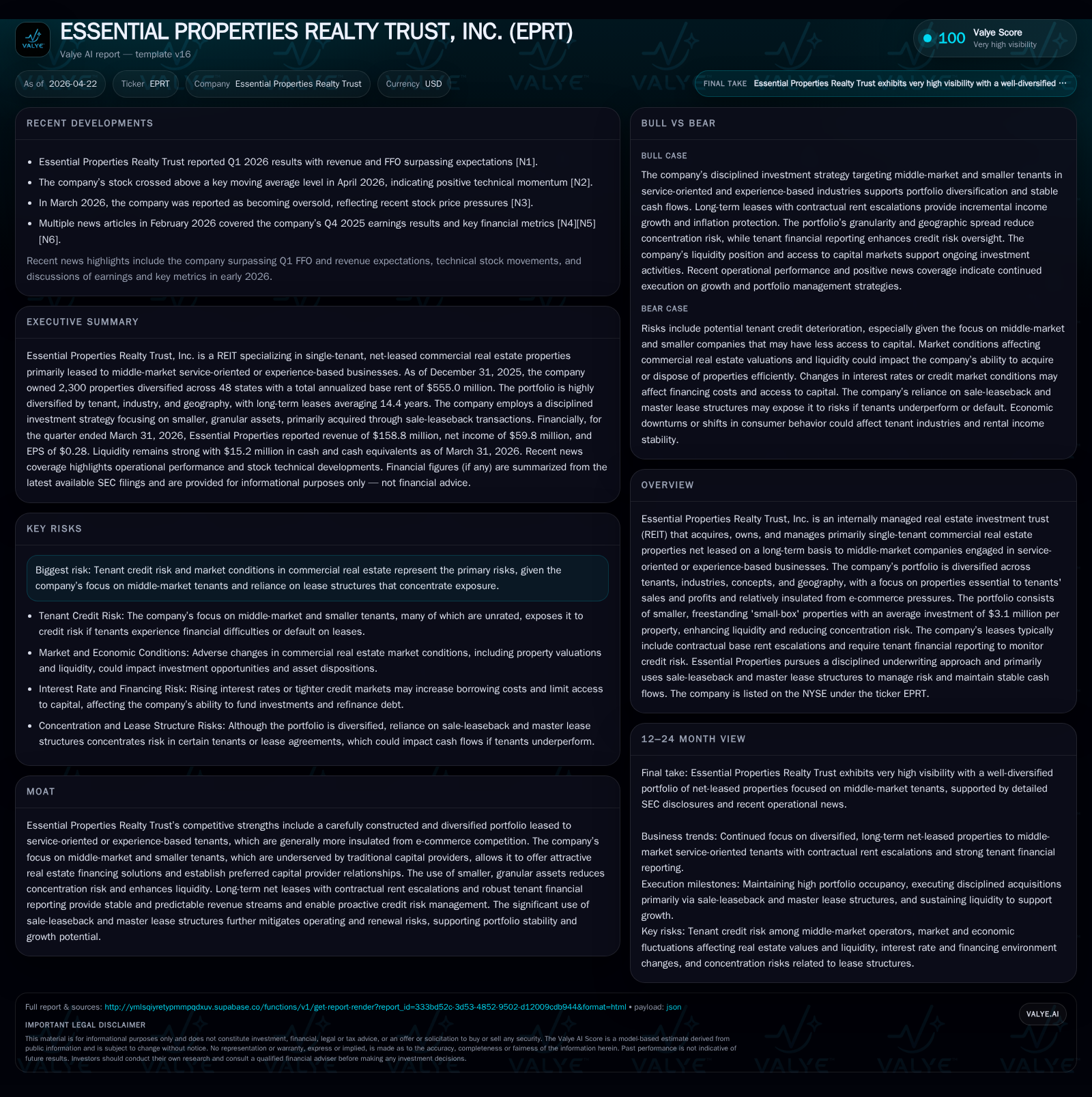
Essential Properties Realty Trust (EPRT) reported robust first-quarter 2026 performance, with rental revenues and funds from operations surpassing estimates. The company’s strategy of owning a granular, widely diversified portfolio of freestanding single-tenant commercial properties leased long-term to middle-market service-based businesses underpins stable occupancy near 99.7% and predictable cash flow. This resilient positioning continues to benefit from contractual base rent escalations and proactive tenant credit monitoring. Going forward, growth will be driven by sale-leaseback investments and expanding master lease structures, balanced against inherent tenant credit risks in the sector.
Q1 2026 Operating Update: Growth Above Estimates
In its latest quarterly filing dated April 22, 2026 [S2], Essential Properties Realty Trust delivered solid financial results for Q1 2026, exceeding both revenue and funds from operations (FFO) expectations as noted in accompanying analyst notes [N1]. Rental revenues strengthened reflecting ongoing portfolio expansion that now encompasses approximately 2,300 assets. Occupancy levels remained notably high at about 99.7%, underscoring durable tenant demand amid a diverse geographic footprint spanning 48 states.
The company's strategic execution in deploying capital into sale-leaseback transactions and master lease agreements was evident in the quarter's performance [S3]. Importantly, there were no material changes to the risk profile disclosed since the prior annual report [S26], suggesting stable credit fundamentals for its middle-market customer base despite broader commercial real estate headwinds.
Portfolio Composition and Net Lease Model: Customer-Centric Real Estate
EPRT operates an internally managed REIT model focused primarily on acquiring freestanding 'small-box' single-tenant commercial properties, net leased long-term to middle-market companies engaged predominantly in service-oriented or experience-based sectors [S1]. With an average investment per property of roughly $3.1 million, the portfolio’s granularity allows the company to mitigate concentration risk and enhance liquidity.
As of FY2025 year-end, leases had a weighted average remaining term of approximately 14.4 years [S1], anchored by net lease structures that obligate tenants to cover property operating costs while providing EPRT predictable revenue streams. Contractual base rent escalations averaged about 1.8% annually across nearly all leases (97.9%), facilitating organic rental growth.
A distinctive element lies in EPRT’s heavy use of sale-leaseback acquisitions—comprising some 95% of investments during the last year—and extensive employment of master leases accounting for nearly two-thirds (66.8%) of annualized base rents [S1]. These features strengthen tenant alignment, reduce renewal risk, and support steady cash flows through economies of scale across portfolios operated by the same tenants.
Tenant financial reporting requirements further empower EPRT to monitor credit quality actively—a cornerstone for underwriting new investments and managing existing exposures [S27].
Competitive Moat Anchored in Leasing Discipline and Tenant Diversification
EPRT differentiates itself by targeting the underserved middle market niche comprising smaller operators who seek real estate financing solutions that traditional capital providers often overlook [S1]. This focus yields strong tenant relationships reinforced through recurring sale-leaseback transactions—82% of new investments made in partnership with previously engaged counterparts in the net lease ecosystem.
Tenant mix diversification is remarkable, involving over 659 unique concepts or brands with none contributing more than roughly 3.4% to annualized base rent as of late 2025 [S1]. This breadth significantly mitigates concentration risk compared to typical single or few large-tenant REIT models.
Furthermore, the portfolio skews towards industries inherently less susceptible to online retail displacement including car washes, medical/dental services, quick service restaurants, education facilities, automotive services, and casual dining—all businesses largely dependent on physical locations critical for customer interactions [S1]. Contractual annual rent escalations embedded within leases provide an effective inflation hedge enhancing income resilience.
Combined with proactive credit risk assessment facilitated by periodic tenant financial disclosures, EPRT's leasing discipline forms a robust moat against volatility inherent in commercial real estate investment trusts.
Industry Positioning: Serving Middle-Market Service-Oriented Businesses
Within the broader commercial real estate landscape, Essential Properties occupies a unique position servicing middle-market tenants requiring specialized real estate products—mostly smaller footprint buildings that are vital hubs for service delivery or consumer experiences [S1]. Such properties avoid direct competition pressures from e-commerce trends that largely afflict larger retail formats.
The supply side for these ‘small-box’ freestanding units tends to be limited relative to demand given barriers in construction scale economics and zoning constraints particularly in suburban or outlying metro areas. Regulatory factors also influence leasing dynamics as specialized health care or automotive-focused facilities demand compliance adherence which limits substitutability.
This niche orientation supports structural rather than cyclical demand durability as many tenants operate businesses essential to daily consumer needs or discretionary spending that funnels through physical venues.
Growth Drivers and Risk Management: Lease Structures and Tenant Profiles
Key growth levers for EPRT include continued deployment into internally originated sale-leaseback deals where tenants unlock capital but retain operational control—facilitating portfolio scale without sacrificing credit quality given established operator relationships [S1] . Master lease arrangements augment stability by consolidating multiple properties under single operators thereby reducing renewal uncertainty.
Rent escalations embedded contractually generate organic income progression shielding EPRT’s cash flows against inflationary cost pressures common in CRE sectors [S27]. The granular nature of holdings provides managerial flexibility for asset sales if needed promoting liquidity management.
However, inherent risks stem from concentration within middle-market enterprises whose credit profiles may fluctuate alongside economic cycles impacting discretionary consumer spending patterns [S26]. The company’s disciplined underwriting combined with robust tenant financial reporting aims to preemptively identify potential weakening conditions enabling timely interventions.
Key Milestones and What Investors Should Monitor Next
Market participants should track quarterly leasing feedback especially tenancy renewal rates alongside actual realized rent escalations published in future filings such as succeeding form 10-Qs [S2], given their direct impact on income sustainability.
Tenant credit health remains critical; updates on delinquency trends or default resolutions hold importance given middle-market risk exposure noted historically but so far contained by management oversight [N4] [S26]. Acquisition pipelines focusing on additional sale-leaseback opportunities or master leasing arrangements also warrant monitoring via press releases or SEC commentaries [S3].
Capital recycling activities including selective asset dispositions could reshape portfolio composition; hence disclosures regarding disposition volume and pricing will serve as indicators of strategic agility amidst evolving market conditions.
Financial Performance Overview: Supporting Stable Growth Narrative
EPRT has demonstrated consistent top-line expansion highlighted by its FY2025 rental revenues reaching approximately $527.5 million—a substantial ~23.9% increase from FY2024—and total revenues surpassing $561 million due to complementary loan interest income gains as recorded in its latest audited figures [F1][S1]. Operating income expanded nearly 29%, driven by portfolio growth while controlled property expenses moderated margin compression risks.
Net income rose around 24.6%, totaling $253 million in FY2025 which affirms profitable scaling alongside operational efficiencies embedded within internally managed structures [F1]. Strong operating cash flow generation at $381 million supports dividend sustainability evidenced by distributions totaling $1.205 per share annually declared for FY2025 completion dates [F1][S7].
Debt management is prudent with roughly $2.53 billion outstanding consisting mainly of staggered unsecured term loans maturing between 2027-2030 alongside senior unsecured notes extending into the mid-2030s timeframe maintaining average interest cost control near ~4.23% after hedging instruments usage described in detail within filings [F1][S22]. Covenants remain comfortably met ensuring financing covenant compliance mitigating refinancing risks over near-term horizons [S21].
Key Financial Metrics Historical Summary:
Historical performance (annual)
| FY | Rev ($mm) | Net ($mm) | CFO ($mm) | OpInc ($mm) | Rev YoY | Net YoY |
|---|---|---|---|---|---|---|
| 2025 | 561 | 253 | 381 | 360 | +24.8% | +24.6% |
| 2024 | 450 | 203 | 308 | 278 | +25.0% | +6.4% |
| 2023 | 360 | 191 | 255 | 243 | +25.5% | +42.2% |
| 2022 | 287 | 134 | 211 | 175 |
Source: SEC companyfacts cache [F1].
Capital returns and efficiency (annual)
| FY | Div ($mm) | ROE% |
|---|---|---|
| 2025 | 234 | 6.0 |
| 2024 | 200 | 5.7 |
| 2023 | 168 | 6.4 |
| 2022 | 142 | 5.4 |
Source: SEC companyfacts cache [F1].
In summary, Essential Properties Realty Trust maintains a robust small-box net lease business catering to resilient service-sector tenants with embedded structural growth characteristics anchored by disciplined leasing practices and geographic/industry diversification. The Q1 performance reaffirms effective execution against these fundamentals while navigating competitive funding environments and macroeconomic uncertainties inherent today.
This analysis is based solely on publicly available information as referenced from SEC filings dated through April 22, 2026, third-party news sources, and validated financial datasets accompanying those disclosures without provision for investment recommendation.
Disclaimer: This is research-only, informational analysis and not investment advice. It may include AI-generated interpretation and general industry context. Always verify important details using primary sources.

Comments