
National Storage Affiliates Trust’s Strategic Path Following Public Storage Deal Announcement
NSA’s recent liquidity disclosures and a transformative merger agreement with Public Storage reshape its strategic and shareholder value outlook.
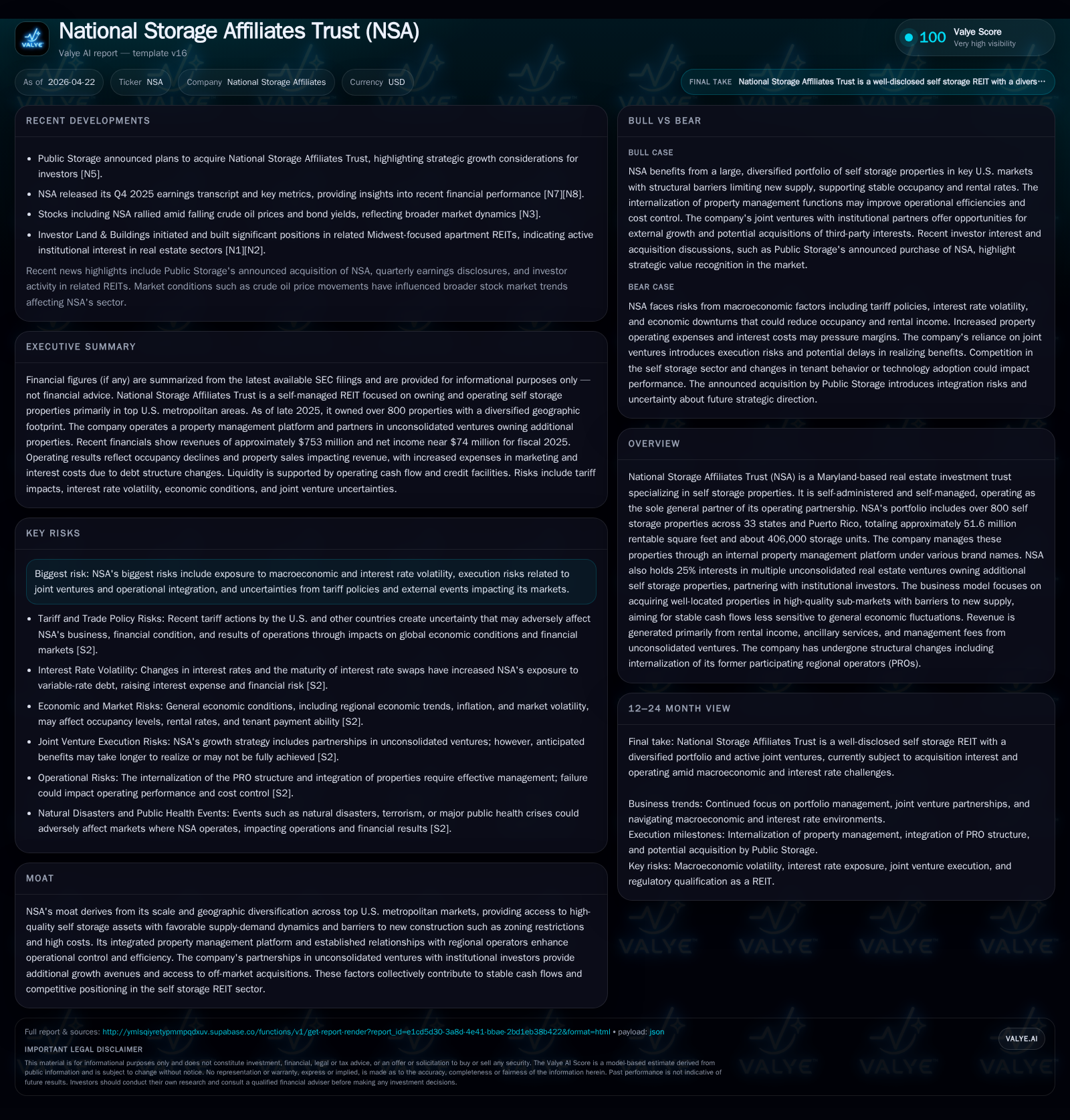
National Storage Affiliates Trust (NSA) disclosed in its November 2025 quarterly report a multifaceted liquidity profile characterized by operating cash flow, significant credit facility capacity, and layered term loans extending into the late 2020s. In March 2026, NSA announced a merger agreement with Public Storage imposing dividend restrictions and requiring shareholder approval, marking a pivotal evolution in its capital allocation and growth trajectory. NSA’s business model leverages scale across over 800 self storage properties, internal property management, and institutional joint ventures, positioning it within a market segment protected by geographic diversification and high entry barriers. While growth is supported by access to off-market deals and NOI-enhancing capex, execution risks around integration and macro uncertainties linger. Key milestones in the merger process alongside industry demand dynamics will steer near-term developments. Financially, NSA maintains strong operating cash flow with manageable leverage but faces pressure from slower revenue trends.
Quarterly Update Anchored on November 2025 Liquidity and Capital Resources
National Storage Affiliates Trust’s latest available quarterly filing dated November 4, 2025 ([S2]) reveals a comprehensive liquidity framework anchored by substantial operational cash flows supplemented by diversified capital sources. The company identifies cash flow from operations as its primary liquidity source — consistent with core REIT models — but supplements this with proceeds from property dispositions (including contributions to joint ventures), equity or debt issuance capabilities, and notably sizeable borrowing capacity under its revolving credit facility.
NSA’s credit structure includes separate term loan facilities with staggered maturities: a $75 million facility maturing in December 2028 with an expansion option up to $125 million; an April 2029 term loan at $100 million; and a June 2029 term loan totaling $285 million with potential expansion to $300 million. These core instruments function alongside a revolving credit line of up to $950 million (with extensions possible through January 2028), positioning NSA with near-2 billion USD in potential total borrowings if expansions are enacted ([S2], [S4], [S6]).
Capital expenditures are categorized prudently into recurring (maintenance-related), value-enhancing (NOI accretive improvements), and acquisition-driven spend identified pre-acquisition. This segmentation underscores disciplined capital allocation aligned with sustaining asset quality while driving revenue growth where feasible.
The company also emphasizes short- versus long-term liquidity demands: short-term needs comprise operating expenses, acquisitions pipeline activity executed through cash or equity units in the operating partnership structures, general administrative costs, interest servicing, and distributions to shareholders as well as members of related unit classes (preferred shares/units). Long-term funding relies on operating cash flows complemented by secured/unsecured indebtedness issuance or equity offerings.
Implications of the March 2026 Merger Filing: Dividend Restrictions and Closing Conditions
A significant development surfaced in NSA’s March 17, 2026 8-K filing ([S3]) — the announcement of a definitive merger agreement whereby Public Storage proposes to acquire NSA. This transaction triggers immediate contractual dividend restrictions: the parent entity (Public Storage) must obtain prior written consent for any dividend or distribution payments outside enumerated exceptions such as routine quarterly dividends capped at $3.00 per share or dividends necessary for maintaining REIT status.
This dividend pause exemplifies standard merger protections designed to preserve capital ahead of closing while balancing shareholder interests through predefined payout thresholds. Furthermore, consummation depends on customary closing conditions including majority affirmative shareholder vote among common shares—a critical execution risk component requiring active investor engagement. Regulatory review considerations compound this timeline complexity.
The announcement elicited strong market reception ([N3], [N9]), reflecting investor optimism about value creation potential via consolidation synergies within the self storage REIT sector dominated by a few large players.
Business Model Overview: Scale, Internal Management, and Joint Venture Strategy
NSA’s business model as presented in its amended annual filing (April 22, 2026) ([S1]) is predicated on ownership and operation of approximately 800 self storage properties distributed across 33 U.S. states plus Puerto Rico—encompassing roughly 51.6 million rentable square feet and roughly 406,000 storage units. This scale allows NSA strategic penetration into diverse metropolitan markets while mitigating localized demand volatility.
Internally managed through a dedicated property management platform rather than outsourced operators (a shift from earlier Participating Regional Operators), NSA accrues operational control advantages facilitating tighter expense management alongside enhanced reporting consistency. The integrated platform supports multiple brand identities tailored regionally—boosting customer retention through differentiated service experiences often masked under broader corporate umbrella brands.
Joint ventures constitute a cornerstone growth mechanism: NSA holds minority (~25%) stakes in numerous unconsolidated real estate ventures operated jointly with institutional investors ([S1]). This structure unlocks access to off-market acquisitions otherwise unavailable through standard bidding processes or constrained balance sheet parameters. It also affords scalability without proportionate increases in funding or leverage risk borne solely by NSA.
Capital expenditure philosophy balances maintenance upkeep limiting deterioration against targeted upgrade projects designed explicitly to enhance net operating income (NOI) through service improvements or expanded product offerings such as climate-controlled units or ancillary retail amenities.
Competitive Positioning within the Self Storage REIT Sector
NSA’s competitive moat derives chiefly from its extensive geographic diversification that spans many top-tier U.S metropolitan markets known for favorable supply-demand dynamics reinforced by zoning constraints limiting new constructions—the industry's quintessential barrier to entry. High land costs combined with regulatory hurdles act synergistically to temper new competitor buildouts where NSA operates.
Brand integration achieves localized scale economies allowing region-specific marketing strategies under distinct but interconnected brands managed via centralized systems—enabling economies without sacrificing market responsiveness or tenant switching costs supporting stable occupancy rates ([S1], [S2]).
Notably, NSA’s partnerships with institutional allies imbue strategic sourcing advantages enabling volume purchasing power or preferential access to acquisition pipelines outside traditional auction processes prevalent among smaller peers.
Compared to other publicly traded self storage REITs such as Public Storage or CubeSmart implied by sector knowledge but not explicitly cited here for NSA's direct competitive base ([S1]), NSA appears positioned in mid-to-upper tier based on portfolio size yet benefits materially from integration efforts transitioning away from PROs—a key differentiator improving operational efficiency over legacy decentralized models.
Growth Opportunities Versus Execution Risks in Acquisitions and Capital Spending
Future growth reflects reliance on two principal channels: accretive acquisitions supplemented by joint venture co-investments leading strategic expansion beyond owned asset base; alongside organic growth fueled primarily through value enhancing capex initiatives intended to elevate rents or increase utilization rates ([S1], [S2]).
Accessing off-market opportunities via joint ventures remains critical given competitive bidding pressures observed broadly in self storage markets—the cost of entry increasing amid shrinking cap rate spreads relative to previously issued decades ([S1]). However execution risks pertain heavily to integration of former regional operator-managed portfolios into unified asset management platforms. Completion delays or unexpected cost overruns could dilute anticipated NOI enhancements or synergies cited when internalizing management operations ([S2]).
Macro headwinds identified include tariff risks—with ongoing uncertainty around import taxes potentially affecting construction cost inflation for expansion projects—and interest rate volatility impacting debt refinancing conditions despite relatively long-dated term loan maturities ([S2]). Tenant credit quality may also be pressured indirectly during economic softness impacting occupancy stability.
Monitoring Upcoming Milestones: Transaction Votes, Synergy Realization, Market Data
Shareholders face pivotal near-term milestones tied directly to the Public Storage merger process including proxy voting scheduled following transaction announcement deadline periods ([S3]). Regulatory approvals will likely trail voting contingencies given industry concentration concerns although no specific filings noted herein beyond standard references ([S3]).
Post-closing synergy realization benchmarks will merit tracking particularly how combined entity captures cost rationalizations within property management frameworks previously duplicated separately between entities—metrics such as same-store NOI progression or general administrative expense trims will serve as forward indicators.
Concurrent monitoring of rental rate trajectories within NSA’s key metro markets alongside overall occupancy levels can illuminate persistence or erosion of current demand fundamentals amid varying macroeconomic backdrops noted in tariff risk disclosures ([S2]). Market reaction post-announcement suggested investor confidence boosted by Evercore ISI upgrades ([N3]), yet sustained momentum hinges on flawless transaction execution.
Financial Health Snapshot: Cash Flow, Debt Capacity, and Distribution Track Record
NSA reported fiscal year-end December 31, 2025 results showing revenues declined moderately by approximately -2.3% year-over-year to $753 million while operating income reflected improvement (up circa +31.7% relative to prior documented data though earlier years cited limited) suggesting enhanced operational efficiencies ([F1]). Net income however contracted sharply (~-33.8%) predominantly influenced by one-off impacts not explicitly detailed here but plausible from mark-to-market effects or transaction-related costs common in transition phases ([F1]).
Operating cash flow remains robust at over $338 million embodying declining yet still supportive free cash generation capacity crucial for servicing debt obligations and maintaining distributions ([F1]). Equity totaled nearly $946 million indicating some balance sheet contraction commensurate with repurchase activities unwinding relative prior years though repurchases halted completely in FY25 after sizable buybacks historically ([F1]).
Debt maturities are well staggered through late decade anchored by senior unsecured notes ranging from sub-3% locked rates on older issuances escalating above recent fixed placements hovering near ~5-6% reflecting rising interest rate environment but tempered via swap overlays reducing effective exposures ([S15], [F1]). Liquidity buffers remain healthy evidenced by recurring revolver availability exceeding half a billion dollars allowing continued flexibility despite ongoing acquisition pipelines.[F1]
Dividend payments held steady at around $175 million reflecting company commitment though legally constrained post-merger announcement; past payout ratios suggest distributions currently consume near half of operational free cash flow highlighting sustainable yield profile barring extraordinary events.[F1]
Historical performance (annual)
| FY | Rev ($mm) | Net ($mm) | CFO ($mm) | Rev YoY | Net YoY |
|---|---|---|---|---|---|
| 2025 | 753 | 74 | 339 | -2.3% | -33.8% |
| 2024 | 770 | 112 | 363 | -10.2% | -28.8% |
| 2023 | 858 | 157 | 442 | +7.0% | +51.0% |
| 2022 | 802 | 104 | 444 |
Source: SEC companyfacts cache [F1].
Capital returns and efficiency (annual)
| FY | Div ($mm) | Buybacks ($mm) | ROE% |
|---|---|---|---|
| 2025 | 175 | 0 | 7.8 |
| 2024 | 172 | 275 | 10.4 |
| 2023 | 191 | 310 | 11.0 |
| 2022 | 196 | 90 | 6.3 |
Source: SEC companyfacts cache [F1].
Overall NSA retains a sound financial position underpinning its strategic initiatives though recent net income fluctuations spotlight sensitivity factors including portfolio repositioning effects and transaction costs associated with both PRO integration efforts and upcoming merger considerations.
This analysis synthesizes recent SEC filings along with sector contextual knowledge focusing on National Storage Affiliates Trust’s evolving strategic landscape post-public announcement of its pending acquisition by Public Storage without providing investment advice.
Disclaimer: This is research-only, informational analysis and not investment advice. It may include AI-generated interpretation and general industry context. Always verify important details using primary sources.

Comments