
Veris Residential’s Strategic Crossroads as Q1 Performance Meets Merger Uncertainty
Q1 2026 results reveal operational challenges for Veris Residential amid a pending $3.4 billion merger and evolving multifamily market dynamics.
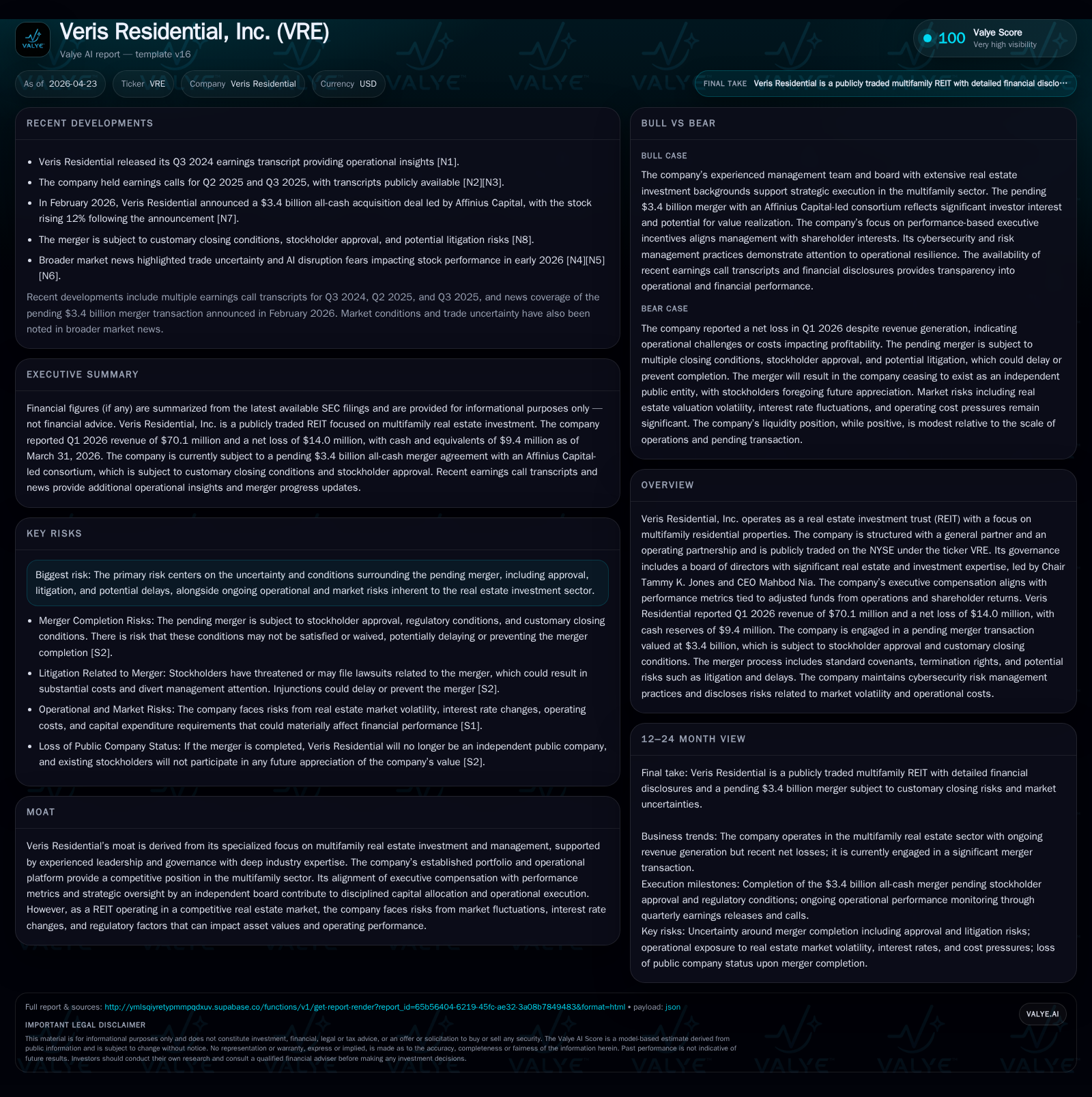
Veris Residential reported Q1 2026 revenue of $70.1 million alongside a net loss of $14.0 million, reflecting the complexities of balancing ongoing operations with the uncertainties tied to its pending $3.4 billion merger. The merger, subject to shareholder approval and multiple closing conditions, introduces risks including litigation and timing unpredictability that overshadow near-term execution. As a multifamily-focused REIT, Veris leverages a specialized portfolio and disciplined governance, yet faces industry-wide pressures such as interest rate sensitivity and regulatory influences on rent pricing. Future growth hinges on demographic trends supporting urban multifamily demand, though the merger’s outcome and operational execution will be critical milestones.
Q1 2026 Operating Update: Merger Developments and Financial Snapshot
Veris Residential filed its latest quarterly report on April 22, 2026 [S2], detailing Q1 revenue of $70.1 million accompanied by a net loss of $14.0 million and cash reserves of $9.4 million at quarter-end [S2]. These results highlight tensions between sustaining operational momentum and addressing complexities introduced by the pending merger transaction valued at approximately $3.4 billion [S2][S3].
The merger agreement mandates stockholder approval by a majority vote of common shares outstanding to consummate the transaction [S3][S8]. Closing conditions also require absence of legal impediments or governmental restraining orders, no material adverse effects on the company since signing, and compliance with covenants restricting disruptive transactions before closing [S3][S8]. There is noted risk of litigation related to the merger which could delay or increase costs substantially [S2][S8][S11].
These merger contingencies impose operational constraints limiting major capital decisions as Veris must maintain "ordinary course" business conduct until closing [S3][S11]. The uncertainty around timing or successful completion adds volatility to near-term execution priorities.
Veris Residential's Multifamily REIT Business Model and Value Proposition
Veris Residential operates principally as a real estate investment trust focused on multifamily residential properties under a publicly traded structure listed on the NYSE (ticker: VRE) [S1]. The company comprises a general partner entity alongside an operating partnership framework allowing consolidated management control [S1].
Revenue generation chiefly stems from rental income across its multifamily residential portfolio which has been built for stable cash flow yield characteristics [S1]. The company's operating strategy includes property acquisition and disposition (capital recycling) to optimize portfolio composition optimized for market dynamics [N1][S1].
Crucially, governance is overseen by an experienced board led by Chair Tammy K. Jones and CEO Mahbod Nia who align executive compensation strongly with adjusted funds from operations (AFFO) metrics and total shareholder returns (TSR), encouraging disciplined capital allocation tied closely to operational performance [S1][S14][S15]. This pay-for-performance model mitigates agency conflicts within the REIT structure.
Tenant quality and retention benefit from exposure across diverse metropolitan regions where demand for rental housing remains structurally sound due to demographic shifts favoring urban living [N2][N3]. The supply-demand imbalance in key markets underpins pricing power despite regulatory scrutiny.
Competitive Landscape and Industry Dynamics in Multifamily Residential REITs
Veris competes within the crowded but fragmented multifamily REIT space characterized by cyclical sensitivity to interest rates which influence borrowing costs impacting valuations [S1]. Regulatory environments vary regionally; rent control policies can compress pricing power in certain markets while supply shortages elsewhere support above-average rent growth.
The company’s moat lies in portfolio specialization combined with managerial capability navigating acquisitions, dispositions, tenant relations, and operational efficiencies to sustain AFFO growth [N1][S1]. However, headwinds include potential increases in cap rates driven by macroeconomic tightening or unexpected downturns in rental demand.
Supply chain issues affecting renovations or construction timelines create additional constraints on expanding or upgrading assets rapidly for premium rents.
Growth Opportunities and Challenges Underpinning Future Demand
Multifamily housing growth prospects remain bolstered structurally by accelerating urbanization trends, shifting household formation patterns favoring rentals over ownership driven by affordability concerns among younger demographics [N2][N3]. This underlies durable rental demand supporting steady occupancy levels.
Operationally, margin expansion pathways include enhanced property management technology adoption plus selective rent increases calibrated against local market elasticities.
Constraints arise primarily from financing market fluctuations that may increase leverage costs or restrict access to capital needed for development or significant asset purchases [S5][S6]. Additionally, evolving regulatory landscapes imposing tighter tenant protections could limit upside rent potential.
Growth strategies will therefore depend heavily on tactical asset rotation—selling non-core or lower-yielding properties while acquiring high-growth market positions—and operational cost management.
Merger-Related Risks and Execution Milestones to Monitor
The pending merger stands as the defining near-term catalyst shaping Veris’s strategic outlook. Stockholder approval remains uncertain given typical hurdles present in sizeable public REIT transactions with multiple closing conditions detailed in the Merger Agreement including satisfaction of standard representations & warranties by both parties [S3][S8][S11].
Litigation threats have materialized post-announcement which could delay deal closure or increase transaction expenses significantly if injunctions arise [S2][S11]. Termination rights are retained by both sides under specific circumstances including if superior proposals materialize or if material adverse changes occur prior to closing [S4][S23]. Parent company has committed debt financing arrangements contingent upon deal completion subject to customary conditions precedent [S5].
Upcoming critical milestones include the scheduled special stockholder meeting vote on the merger proposal along with ongoing regulatory review progress points expected through mid-2026 [N3]. Integration planning remains tentative pending definitive closure.
Due diligence updates published via SEC filings continue to reinforce operational continuity commitments but also highlight that failure to close would leave Veris exposed to residual merger-related disruption without strategic alternatives immediately defined.
Financial Overview Supporting the Operational Narrative
Historical financial data shows Veris Residential has delivered steady top-line growth with FY2025 revenue at $288.4 million representing a +6.4% year-over-year increase from FY2024’s $271.1 million [F1]. Operating income has rebounded sharply compared to prior troughs given improvement in property operations efficiency though recent quarters including Q1 2026 reflect net losses associated partly with merger-related expenses totaling $14.0 million loss after tax [F1][S2].
Operating cash flow improved significantly reaching $75.97 million in FY2025 versus prior years highlighting underlying cash-generative capability essential for REIT status maintenance and dividend sustainability [F1].
Equity increased modestly reflecting retained earnings offsetting distributions whereas share repurchases were minimal indicating cautious capital return stance ahead of transaction closure announcements [F1][S4][S13]. Liquidity remains constrained with only $9.4 million in cash equivalents as of March 31, 2026 due to working capital usage alongside investment pacing pending deal outcome resolution [F1][S2].
Key Financial Trends Table (FY2023-FY2025)
| FY | Revenue (USD M) | Net Income (USD M) | Operating Cash Flow (USD M) |
|---|---|---|---|
| 2025 | 288.4 | 75.2 | 76.0 |
| 2024 | 271.1 | -23.1 | 52.3 |
| 2023 | 279.9 | -107.3 | 45.5 |
Balance Sheet Snapshot - Q1 2026
Historical performance (annual)
| FY | Rev ($mm) | Net ($mm) | CFO ($mm) | Rev YoY | Net YoY |
|---|---|---|---|---|---|
| 2025 | 288 | 75 | 76 | +6.4% | +425.4% |
| 2024 | 271 | -23 | 52 | -3.1% | +78.4% |
| 2023 | 280 | -107 | 46 | -21.2% | -106.0% |
| 2022 | 355 | -52 | 66 |
Source: SEC companyfacts cache [F1].
Capital returns and efficiency (annual)
| FY | Buybacks ($mm) | ROE% |
|---|---|---|
| 2025 | 0 | 6.5 |
| 2024 | 0 | -2.1 |
| 2023 | 0 | -9.4 |
| 2022 | 3 | -4.2 |
Source: SEC companyfacts cache [F1]. *Debt financing arranged but subject to deal closing conditions[S5]
In summary, while Q1 results illustrate short-term profitability pressure exacerbated by transactional investments linked costs, Veris’s underlying multifamily asset base delivers stable recurring revenue fundamentals buoyed by demographic demand tailwinds.
This analysis is based solely on information available from Veris Residential’s SEC filings up to April 22, 2026 and selected recent transcripts without offering investment advice or price forecasts. It aims to objectively assess operational context amid an unfolding corporate transaction with attendant industry considerations.
Disclaimer: This is research-only, informational analysis and not investment advice. It may include AI-generated interpretation and general industry context. Always verify important details using primary sources.

Comments