
Calix Advances AI-Driven Broadband Platform Amid Supply Chain and Market Dynamics
Calix's Q1 2026 reveals growth in platform adoption and AI capabilities, balanced against supply constraints and competitive pressures.
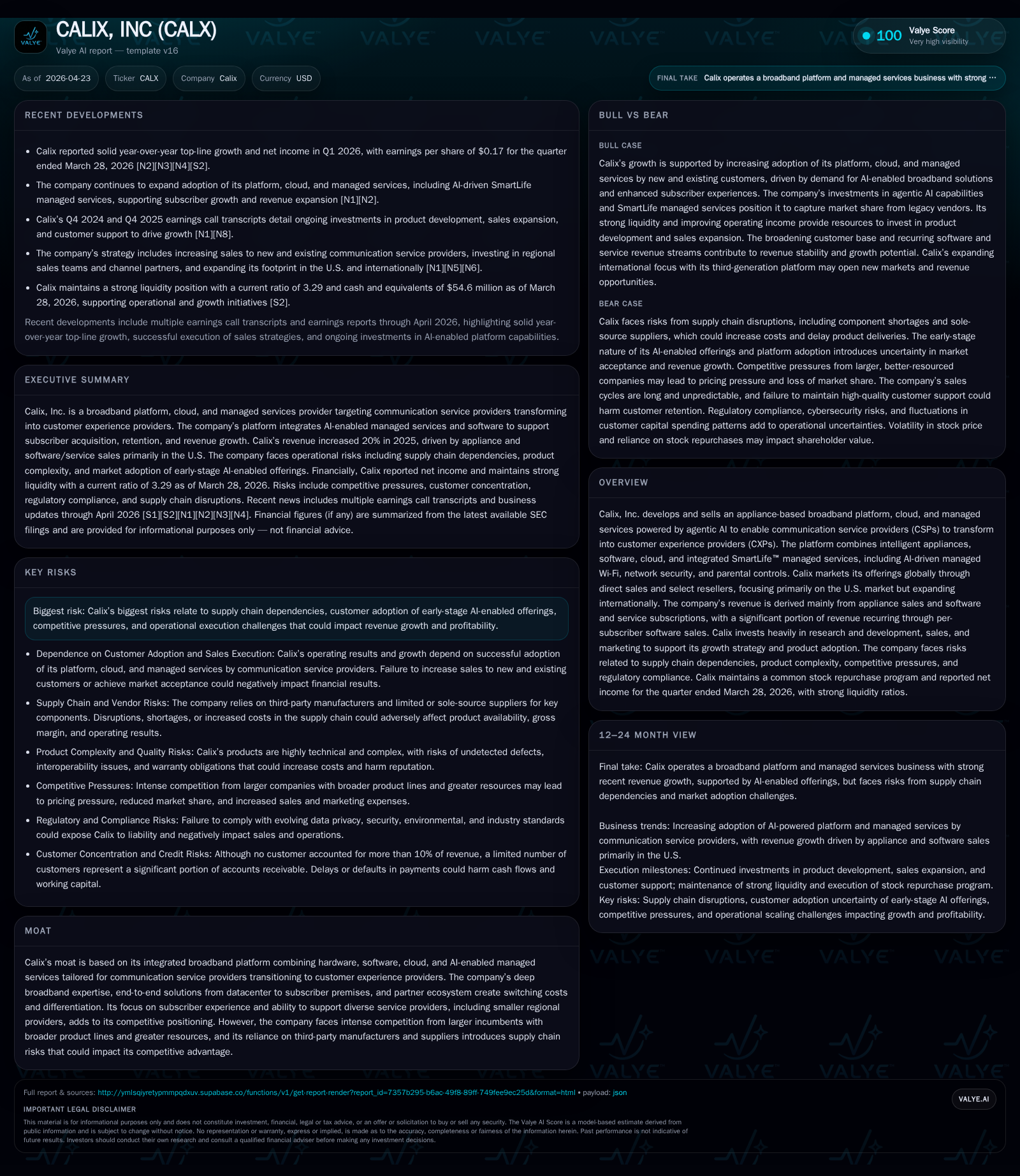
In its latest quarterly filing, Calix reported ongoing expansion of its AI-enabled broadband platform and managed services, driving solid year-over-year revenue growth. The company remains focused on converting communication service providers into customer experience providers through its integrated hardware, software, and cloud offerings. While demand for Calix’s platform appears structurally supported by industry trends such as the BEAD program and rising network complexity, execution risks like supply chain dependencies and competitive pricing pressure loom large. Key near-term metrics to monitor include subscription growth rates, AI technology integration progress, and margin stability amid rising costs.
Recent Operating Update
Calix’s latest quarterly filing for Q1 ended March 28, 2026 [S2], supplemented by its earnings press release and stockholder letter [S3], confirms continued top-line momentum driven by adoption of its comprehensive broadband platform enhanced with agentic AI-powered managed services. The firm highlighted solid year-over-year growth in appliance sales alongside meaningful increases in per-subscriber software and managed service revenue streams. Notably, non-GAAP gross margins showed resilience despite persistent supply chain challenges affecting component availability and costs — a recurrent theme given Calix’s dependence on contract manufacturers [S16].
This filing also reiterates strategic emphasis on supporting CSPs’ transition into Customer Experience Providers (CXPs), leveraging Calix One platform capabilities with cloud deployments including Private Cloud options referenced in recent investor commentary [N1]. The operational disclosures emphasize management’s commitment to accelerating R&D to deepen AI integration across SmartLife™ managed Wi-Fi, security, parental controls, and other subscriber-centric features.
Business Model
Calix operates as a provider of an integrated broadband access solution combining physical appliances ( subscribed CPE devices), cloud infrastructure, software platforms, and data-driven managed services enabled by proprietary agentic AI [S1]. Its revenue primarily derives from two streams:
- Appliance Sales: Hardware offerings sold often upfront to CSPs for deployment at subscriber premises or network edge.
- Software & Services: Recurring subscription fees from delivery of cloud software functionalities such as managed Wi-Fi control, network security suites, analytics insights, and parental controls bundled within the SmartLife package.
The value proposition centers on transforming traditional CSP operations — typically focused on raw connectivity — toward differentiated subscriber experiences that increase loyalty and reduce churn. This is achieved through AI-driven automation capabilities which help optimize network performance and enable new tiers of managed service features.
Strategically, Calix benefits from high switching costs given the end-to-end nature of its platform that involves tight integration between appliance hardware lifecycle management, proprietary cloud operations, and service provisioning workflows. This bundling also aids recurring revenue visibility anchored in per-subscriber contracts.
However, the model is not without complexity risks: it requires continual innovation to maintain relevance against competition offering similar end-to-end suites or modular solutions. Also material are supply-chain dependencies which constrain hardware availability impacting install cycles.
Industry Structure and Competitive Position
The broadband equipment industry remains fragmented yet highly competitive with large incumbents such as Cisco and Nokia commanding significant scale advantages [S15]. These competitors offer expansive product lines across networking layers beyond access hardware, making them formidable in bundling comprehensive solutions.
Calix occupies a niche focused on smaller regional CSPs aiming to evolve into CXPs but faces competition not only from large established vendors but also emerging niche innovators targeting aspects of home networking or cloud-managed services independently. Additionally, commodity price pressures persist as network operators seek cost-effective procurements amidst global tariff uncertainties [S16].
Nonetheless, Calix’s integrated platform approach enhanced with agentic AI capabilities creates differentiation in supporting dynamic network environments shaped by increasing bandwidth demands driven by remote workforces and smart home proliferation [N13]. Its SmartLife ecosystem helps reduce operational complexity for CSPs—particularly those without deep internal digital transformation resources—thus reinforcing customer stickiness.
Calix's moat is reinforced by its growing partner ecosystem that facilitates interoperability while delivering enhanced offerings suited to evolving service provider demands. However, the competitive battleground includes frequent price discounting tactics which could compress gross margins if not offset by higher volume or premium service uptake.
Growth Drivers and Constraints
Growth Drivers:
- Government Broadband Funding: Programs like the U.S. BEAD initiative drive substantial capital expenditures at regional ILECs/ISPs to upgrade infrastructure using Calix-compliant equipment meeting domestic content requirements [S14].
- AI Integration: Enhancing platform intelligence with agentic AI enables new value-added managed services that may command premium pricing and improve ARPU.
- CSP Transformation Demand: Increased market focus on customer experience mandates push CSPs toward platforms offering unified management tools—favoring Calix’s solution.
- Recurring Subscription Upside: Expanding the installed base's conversion to subscription-based managed services promises revenue stability beyond hardware cycles.
- International Expansion: Gradual growth outside U.S., though still small relative to total revenue currently [S4].
Growth Constraints:
- Supply Chain Risks: Heavy reliance on third-party component sourcing causes vulnerability to shortages affecting fulfillment timelines and cost structures [S16].
- Competitive Pressure: Larger incumbents' scale can exert downward pricing pressure; smaller disruptive entrants may erode market shares.
- Execution Complexity: Scaling integration of complex offerings requires precise management of R&D investment allocation to avoid margin erosion.
- Customer Credit Exposure: Extending credit terms exposes Calix to payment delays or defaults impacting working capital [S16].
- Regulatory/Trade Risks: Global tariffs or trade barriers could increase costs or limit certain geographic sales opportunities [S16].
What to Watch Next
Attention should focus on several key milestones:
- Subscription Growth Metrics: Monitoring the rate at which installed appliances convert into recurring service subscriptions will indicate structural revenue expansion potential.
- AI Capability Rollout: Progress in delivering advanced agentic AI features embedded in SmartLife™ portfolio can signal sustained product differentiation.
- Supply Chain Stability: Lead-time improvements or disruption mitigation will de-risk cost pressure scenarios.
- New Customer Wins: Expansion beyond core regional CSPs or entry into larger Tier 1 operators will validate scalability claims.
- Gross Margin Trends: Stability or improvement amidst pricing pressure indicates operational leverage efficacy.
- International Revenue Contribution: Uptick here could diversify dependency on U.S. funding programs.
Financial Profile (Supporting Context)
Calix’s financial trajectory reflects a recovery back to profitability after a loss-making period in 2024. For fiscal year 2025,[F1] shows:
Historical performance (annual)
| FY | Net ($mm) | CFO ($mm) | OpInc ($mm) | Capex ($mm) | Net YoY |
|---|---|---|---|---|---|
| 2025 | 18 | 135 | 21 | 19 | +160.1% |
| 2024 | -30 | 68 | -43 | 18 | -201.4% |
| 2023 | 29 | 56 | 26 | 18 | -28.5% |
| 2022 | 41 | 27 | 53 | 14 |
Source: SEC companyfacts cache [F1].
Capital returns and efficiency (annual)
| FY | Buybacks ($mm) | FCF ($mm) | ROE% |
|---|---|---|---|
| 2025 | 94 | 116 | 2.1 |
| 2024 | 11 | 50 | -3.8 |
| 2023 | 86 | 38 | 4.1 |
| 2022 | 13 | 6.0 |
Source: SEC companyfacts cache [F1].
Key observations include:
- Significant improvement in operating income (+148% YoY) reflecting better margin management coinciding with revenue growth.
- Robust operating cash flow generation exceeding capex significantly (> $115 million free cash flow), underpinning share repurchase programs totaling nearly $94 million in the latest year.
- Strong current ratio (~3.29), implying solid short-term liquidity as of Q1 2026[F1].
- Gross margin gains driven by higher software/service penetration which typically yields superior profitability relative to hardware sales[S9].
- Incremental investment in sales & marketing alongside R&D suggests ongoing funding for growth initiatives critical for sustaining competitive differentiation[S9,S13].
Conclusion
Calix's recent quarterly update underscores tangible progress in solidifying its position as an AI-enhanced broadband platform provider aimed at modernizing CSPs into subscription-driven CXPs. The company balances promising structural tailwinds from government-led broadband expansions with execution challenges stemming from supply chain fragility and aggressive competition. Maintaining momentum hinges on expanding recurring software/service revenues while preserving margin discipline as R&D intensifies around agentic AI capabilities. Market participants should track operational metrics around subscription uptake rates, new customer acquisitions particularly beyond traditional markets, advances in platform functionality including private cloud integrations, and any shifts in supply chain dynamics that impact cost structures or delivery timelines.
This analysis is based exclusively on publicly available information as of April 23, 2026. It does not constitute investment advice or recommendation but aims to provide a comprehensive view of Calix's operational positioning within its industry context.
Disclaimer: This is research-only, informational analysis and not investment advice. It may include AI-generated interpretation and general industry context. Always verify important details using primary sources.

Comments