
United Airlines Charts Recovery with Q1 Surpassing Expectations and Network Efficiency Gains
United Airlines’ Q1 2026 results demonstrate operational resilience through network optimization, fleet strategy, and loyalty program strength.
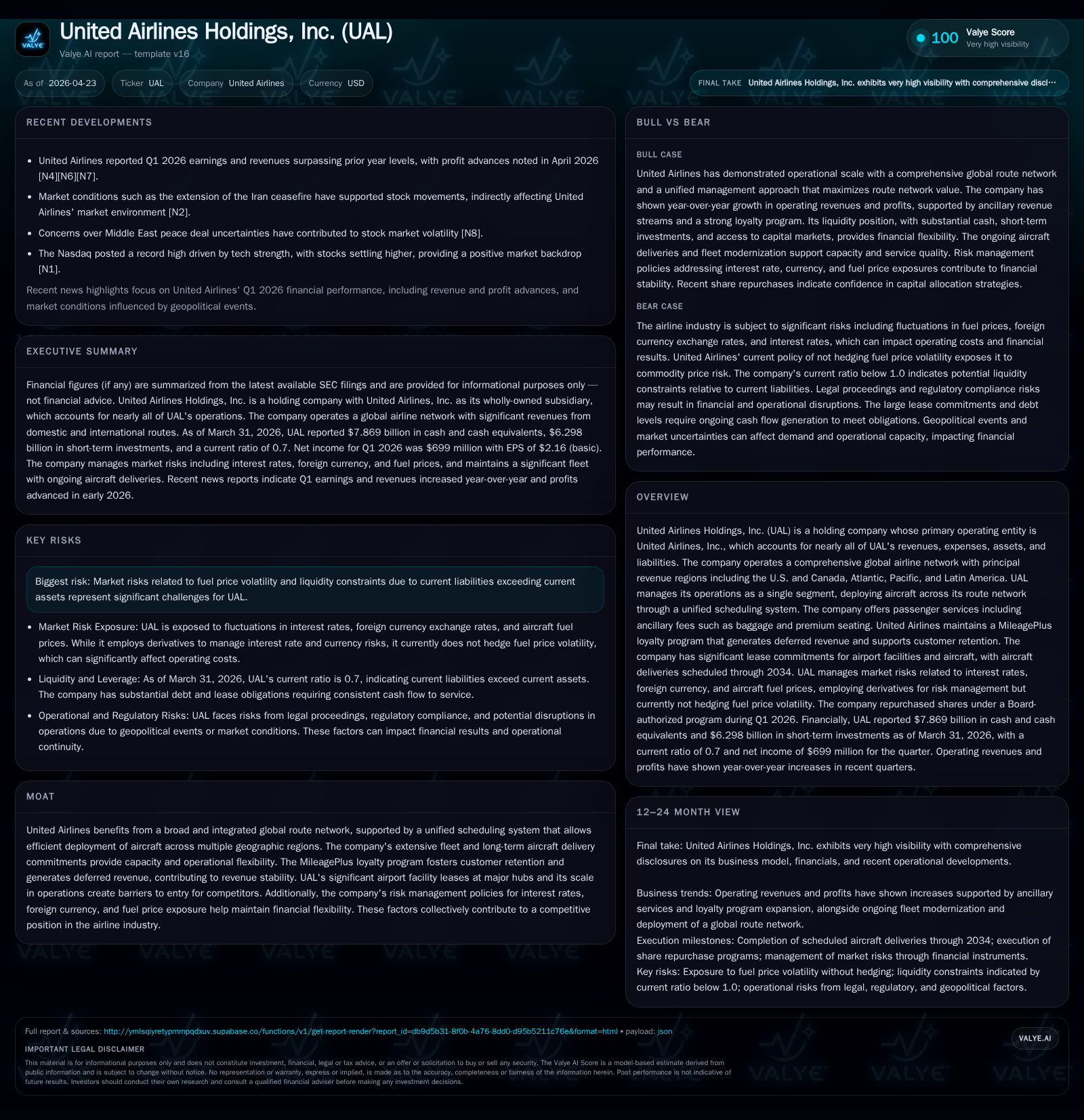
In its latest quarterly filing, United Airlines reported revenue and profitability exceeding consensus estimates, underscoring effective capacity management and network scheduling. The company’s integrated global route system and robust MileagePlus loyalty program continue to constitute key competitive moats. Fleet deliveries scheduled through 2034 alongside ancillary revenue expansion drive growth prospects. Nevertheless, fuel price volatility and a current liquidity ratio below one remain critical challenges. Monitoring booking trends, capital deployment, and further capacity adjustments will be essential to assessing United’s near-term trajectory.
Q1 2026 Operating Update Highlights
United Airlines filed its latest quarterly report on April 22, 2026 ([S2]), detailing operating results that outpaced market expectations according to several contemporaneous analyses ([N3],[N4],[N5]). Reported revenues and net income growth reflect robust passenger demand and disciplined capacity management—both critical as legacy network carriers continue navigating evolving travel patterns post-pandemic. The company flew dynamically adjusted capacity volumes in response to real-time booking trends, optimizing aircraft utilization via its unified scheduling system ([S2],[S3]), a feature that strategically integrates regional and international routes seamlessly.
Notably, share repurchase activity maintained momentum in Q1 with the repurchase of more than 286,000 shares across the quarter under a Board-authorized $1.5 billion program initiated in late 2024 ([S18]). This capital return signals management’s confidence in cash flow generation despite an industry environment rife with fuel volatility and fluctuating demand.
Business Model Nuances and Service Offerings
UAL operates primarily through its wholly owned subsidiary United Airlines Inc., which accounts for nearly all consolidated revenue and expenses ([S1]). The company monetizes a comprehensive global airline network focusing on integrated passenger services supported by ancillary streams such as baggage fees, premium seating charges, inflight amenities, and other non-ticket-related fees ([S15]). These ancillary revenues have grown consistently: from $4.1 billion in 2023 to $4.8 billion in 2025 within Passenger revenue alone [S15], evidencing strategic enhancement of unit economics beyond base fares.
A critical element of United’s model is the MileagePlus loyalty program that not only fosters repeat business but also generates substantial deferred revenue—providing financial smoothing and customer stickiness ([S1]). The deferred nature of loyalty-related revenue improves cash flow visibility while encouraging continued engagement amid competitive pressures from other major carriers.
Fleet strategy remains foundational, with contracts securing diverse aircraft types such as Boeing 787s, Airbus A321neos/XLRs, Boeing 737 MAX variants, and Airbus A350s slated for deliveries through 2034 ([S23]). This long-term capital commitment facilitates both fleet modernization—emphasizing fuel efficiency—and scaling capacity on targeted routes.
Competitive Moat Driven by Network Integration and Scale
United leverages its scale advantage across major U.S. hubs including Chicago (ORD), San Francisco (SFO), Newark (EWR), Houston (IAH), and Los Angeles (LAX). It holds long-term net-rental leases on significant airport facilities extending up to 2057, which structurally limit competitors’ ability to infiltrate these markets swiftly ([S19],[S23]). These hub concentrations underpin high operational leverage but come with fixed cost commitments that necessitate consistent utilization levels.
Operational flexibility benefits from an integrated scheduling system allowing the repositioning of aircraft dynamically between domestic and international flights based on demand fluctuations. This adaptability is pivotal in managing the varied economic cycles across different regions served (U.S./Canada, Atlantic, Pacific, Latin America) ([S1],[S22]).
Risk mitigation initiatives include interest rate swaps and foreign currency contracts to manage exposures affecting financing costs ([S1]), coupled with regular reassessment of fuel procurement policies to address jet fuel price fluctuations despite currently adopting a non-hedging stance ([S6],[S1]). Such financial risk management complements operational integration in preserving profitability under challenging macro environments.
Growth Opportunities Amid Capacity and Fleet Developments
Fleet deliveries form a central pillar for growth; the firm commitment of nearly 584 aircraft over multiple types positions United well to adjust capacity strategically over the next decade ([S23]). Newer generation aircraft improve unit costs by being more fuel efficient—critical given jet fuel accounts for a significant variable expense—and enable network densification or expansion into newly viable longer-haul routes.
Improvements in ancillary product offerings also present incremental upside potential. As consumer preferences evolve towards greater personalization in travel experiences, expanding fare class segmentation alongside inflight service enhancements can broaden margins ([S15]).
International market penetration especially along lucrative Pacific routes is poised for sustained growth supported by enhanced fleet capabilities ([F1],[S22]). Booking trends currently suggest moderate increases in business class demand—a higher yield segment—adding to structural improvements in revenue mix.
However, United remains vigilant about balancing capacity deployment against market demand shifts; actual flown capacity may materially diverge from published schedules as the company continuously updates projections based on near-term travel behaviors ([S2],[S29]).
Risks and Constraints in Fuel Volatility and Liquidity Profile
Fuel price fluctuations impose substantial risks due to United’s decision not to engage systematically in derivative hedging at present ([S1],[S6]). Given that even minor changes per barrel can significantly influence operating margins—especially amid global supply chain tightness—the company’s exposure necessitates close monitoring of geopolitical developments affecting oil markets.
Liquidity metrics warrant attention: as of March 31, 2026, current assets stood at approximately $19.4 billion while current liabilities were notably higher at about $27.8 billion resulting in a current ratio around 0.7 [F1]. This shortfall indicates near-term liquidity stress requiring effective working capital management.
To mitigate this risk profile, United maintains undrawn revolving credit facilities totaling roughly $3 billion alongside proactive debt issuance recently executing senior notes due between 2029-2031 ([S5],[S28]). Compliance with affirmative covenants regarding minimum liquidity levels remains paramount given the cross-default ramifications embedded within agreements ([S7],[S12]).
Labor relations also pose ongoing uncertainty with over 80% of employees unionized; though tentative agreements have been reached recently with certain groups ([S21]), disruptions remain inherent risks impacting operational continuity.
Looking Ahead: Key Operational and Strategic Milestones
Key near-term points include scheduled delivery ramps starting late-2026 into subsequent years featuring models like the Boeing 737 MAX variants and Airbus A321XLRs that will incrementally shift fleet composition toward cost-efficient platforms ([S23]).
Potential enhancements or restructuring within MileagePlus may affect deferred revenue dynamics or customer retention efficacy; regulatory developments concerning aviation emissions or airport slot allocations also merit scrutiny given their impact on operational scale ([S24],[S19]).
Continuous monitoring of booking curves will provide leading indicators for further capacity permutations necessary to maximize load factors without diluting yields.
Financial Overview: Profitability, Cash Flow, and Capital Deployment
The financial snapshot indicates steady topline growth with fiscal year 2025 revenues reaching $59.07 billion—up approximately +4.3% year-over-year—and net income advancing +6.5% reaching $3.35 billion [F1]. Operating income declined -7.5% YoY reflecting margin compression related partly to cost inflation despite revenue growth.
Operating cash flow totaled $8.43 billion versus capital expenditures of $5.87 billion in FY25 yielding free cash flow around $2.56 billion enabling sizable share repurchases ($637 million) which continue under an active authorization [$F1][S18]. Equity improved commensurately reaching nearly $15.3 billion reflecting retained earnings accumulation.[F1]
Historical performance (annual)
| FY | Net ($bn) | CFO ($bn) | OpInc ($bn) | Capex ($bn) | Net YoY |
|---|---|---|---|---|---|
| 2025 | 3.4 | 8.4 | 4.7 | 5.9 | +6.5% |
| 2024 | 3.1 | 9.4 | 5.1 | 5.6 | +20.3% |
| 2023 | 2.6 | 6.9 | 4.2 | 7.2 | +255.2% |
| 2022 | 0.7 | 6.1 | 2.3 | 4.8 |
Source: SEC companyfacts cache [F1].
Capital returns and efficiency (annual)
| FY | Buybacks ($mm) | FCF ($bn) | ROE% |
|---|---|---|---|
| 2025 | 637 | 2.6 | 21.9 |
| 2024 | 162 | 3.8 | 24.8 |
| 2023 | -0.3 | 28.1 | |
| 2022 | 0 | 1.2 | 10.7 |
Source: SEC companyfacts cache [F1].
Financial discipline manifests through sustained capital allocation toward modernizing assets while returning value via buybacks despite cyclical headwinds from fuel price exposure.
This analysis is based solely on publicly available SEC filings as well as referenced news sources without any investment recommendations or forecasts implied or stated herein.
Disclaimer: This is research-only, informational analysis and not investment advice. It may include AI-generated interpretation and general industry context. Always verify important details using primary sources.

Comments