
Armour Residential REIT Leverages Agency MBS Expertise Amid Market Volatility and Financing Complexities
Armour’s Q1 2026 results highlight its adept management of mortgage-backed securities portfolios underpinned by strategic hedging and leveraged financing.
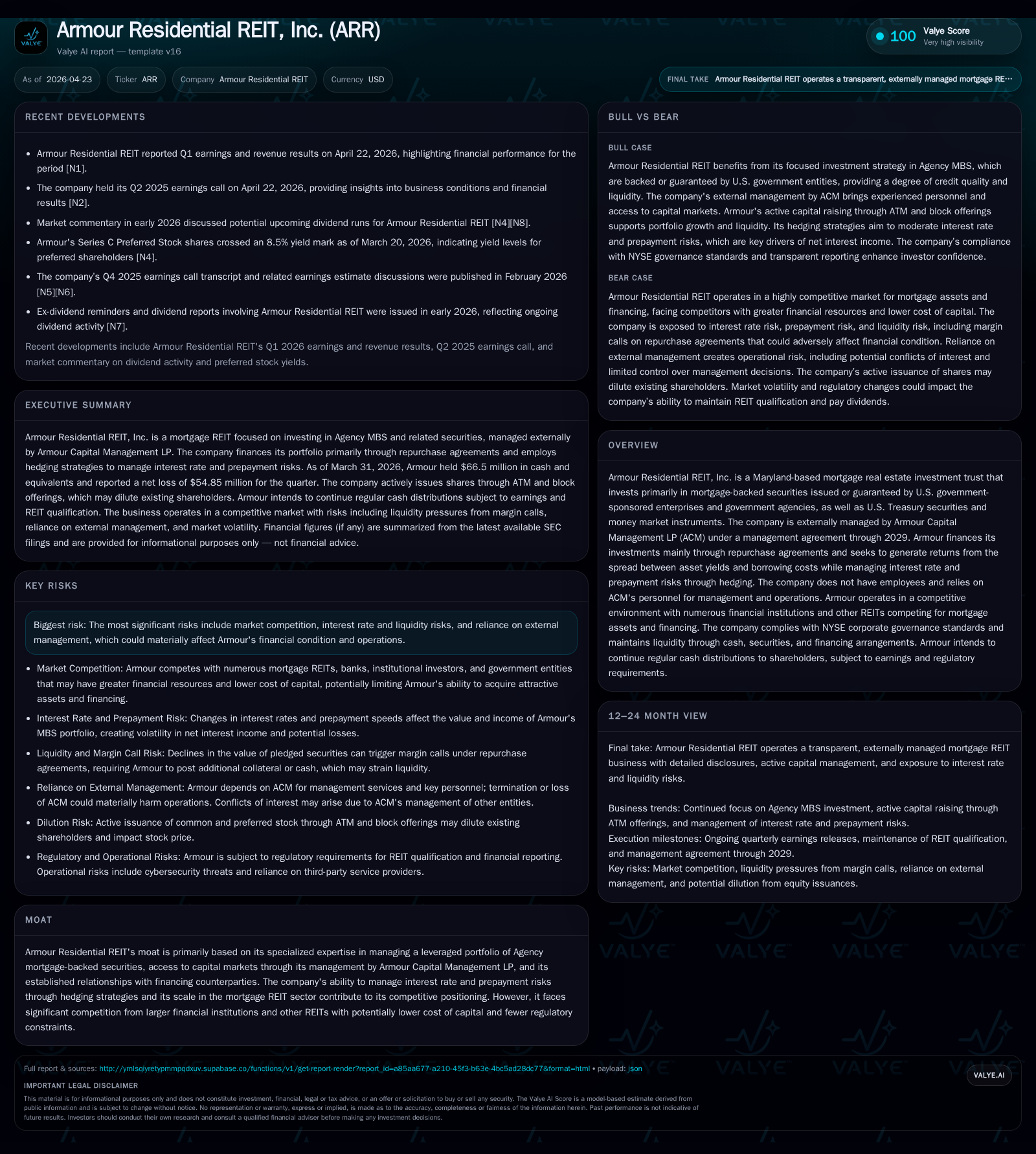
Armour Residential REIT reported a resilient first quarter of 2026, navigating market volatility through active portfolio and risk management anchored in agency mortgage-backed securities (MBS). Externally managed by Armour Capital Management LP, the company relies on repurchase agreements to finance a highly leveraged MBS portfolio. Key drivers include skilled hedging against interest rate risks and selective acquisition of MBS with favorable prepayment profiles, but challenges persist from competitive pressures, regulatory risks, and liquidity demands tied to margin calls. The firm’s growth depends largely on capital market access, asset pricing dynamics, and maintaining financing relationships amid evolving regulatory conditions.
Recent Operating Update
In its latest Form 10-Q filing for the quarter ended March 31, 2026 [S2], Armour Residential REIT highlighted ongoing operational discipline during sustained market volatility affecting repurchase agreement financing costs and collateral valuations. The filing underscores management's efforts to optimize liquidity and leverage while actively managing interest rate and prepayment risks via hedging strategies. Concurrently, an April 22, 2026 Form 8-K [S3] supplemented this update by disclosing no material deviations from disclosed risk factors or operational policies since the last annual report.
Notably, Armour beat Q1 earnings and revenue estimates per market reports [N1], indicating effective execution despite structural sector headwinds. Management commentary on the Q2 2025 earnings call [N2] further revealed confidence in leveraging their agency MBS expertise while navigating competitive pressures from peers such as AGNC Investment Corp., which recorded improved book values year-over-year [N3]. These developments collectively validate Armour's strategic emphasis on robust risk mitigation frameworks during complex financing environments.
Business Model
Armour Residential REIT operates as a mortgage real estate investment trust focusing exclusively on agency mortgage-backed securities guaranteed by government-sponsored enterprises (GSEs) like Fannie Mae, Freddie Mac (both under FHFA conservatorship), and government agencies including Ginnie Mae [S1]. Its revenue generation primarily stems from capturing the spread between yields earned on these mortgage assets and the borrowing costs incurred via repurchase agreements — short-term secured loans where Armour sells MBS collateral with an agreement to repurchase them at a slightly higher price.
This leverage amplifies returns but demands vigilant liquidity management due to margin call exposures triggered by market value fluctuations or principal repayments on MBS portfolios [S5][S13]. The company employs derivative instruments such as interest rate swaps to hedge volatility in borrowing costs against Treasury yields [S6]. This hedging mitigates duration mismatches inherent between floating-rate liabilities and fixed-rate MBS assets.
Acquisitions focus strategically on MBS with favorable prepayment characteristics—attributes like loan maturity, coupon rates, credit quality proxies, geographic diversity, borrower credit profiles—that enable predictable cash flows and limit premature principal amortization that erodes yield [S16]. Armour also manages its portfolio in recognition of intrinsic risks to market liquidity owing to potential changes in GSE conservatorship statuses or legislative interventions impacting mortgage market support.
Externally managed since inception by Armour Capital Management LP under a contract extending through 2029 [S1][S21], Armour conducts no internal operations or employs personnel directly. Instead, ACM delivers portfolio management, trading execution, compliance, risk control, and operational oversight through its dedicated team of approximately 20 employees. This relationship represents both a strength—consolidating expertise—and a vulnerability dependent on ACM’s continuity and resource allocation.
Industry Structure and Competitive Position
Armour sits within the specialized sector of mortgage REITs heavily invested in Agency MBS. This niche faces multi-dimensional competition: large banks with proprietary trading arms, specialist mortgage finance firms, other publicly listed mREITs such as AGNC or Annaly Capital Management, insurance companies deploying substantial fixed-income capital, mutual funds chasing similar yield profiles, as well as government entities exerting policy-driven influence.
Many competitors outscale Armour concerning balance sheet size or benefit from cheaper capital due to different institutional structures or direct government backing absent regulatory constraints imposed on REITs [S23]. The need to maintain taxstatus-conferring distribution levels coupled with adherence to Section 1940 exclusions restricts some flexibility relative to entities with fewer public investor obligations.
Nonetheless, Armour leverages its niche specialization via agile balance sheet management—with leverage ratios around eight times equity—and refined asset selection processes grounded in granular loan-level analytics. Its established lender base diversified across over twenty counterparties—including dominant exposure to BUCKLER providing almost half of borrowings—enhances access albeit exposing Armour to counterparty concentration risks [S6][S15]. Competitive advantages stem from:
- Proficient hedging mix combining bilateral swaps and exchange-cleared futures,
- Selective acquisition tactics balancing premium-priced assets versus prepayment expectations,
- Consistent shareholder engagement via ATM equity offerings sustaining capital adequacy.
However, ongoing sector-wide pressures arise from heightened margin calls during elevated volatility periods—especially around scheduled monthly factor recalls—and evolving regulatory postures pertaining to derivatives clearing mandates required under Dodd-Frank rules [S17]. Furthermore, escalation in repo haircuts can compress return spreads making financing cost control paramount.
Growth Drivers and Constraints
Armour’s growth is structurally tethered to three core factors:
- Capital Access: Regular equity issuances via ATM programs plus preferred stock sales provide necessary fuel for portfolio expansion. While effective in raising net proceeds close to book value (98% realized average), overreliance exposes shareholders to dilution risk if market prices lag intrinsic values persistently [S8][S18].
- Financing Environment: The company’s dependence on repurchase agreements subjects it directly to collateral haircut variability driven by lender risk appetites amidst changing monetary policy regimes. Market disruptions that raise margin requirements or prompt counterparty withdrawals could materially constrict operational agility [S13][S26].
- Portfolio Optimization: Success hinges on timely spotting shifts in prepayment trends linked to refinancing cycles triggered by prevailing interest rates alongside macroeconomic indicators such as GDP growth and employment rates [S16]. Symbiotic hedging strategies must adapt quickly when Fed policies impact swap markets or Treasury curves change shape adversely influencing net interest margins.
Conversely, significant constraints involve systemic risks related to GSE conservatorship outcomes; unpredictable legislative reforms affecting credit guarantees; intensifying competition driving asset pricing compression; concentrated counterparty exposures amplifying liquidity risk; potential loss of managerial expertise since no internal staff exist; plus broader recession threats affecting housing markets driving mortgage defaults impacting cash flows indirectly [S1][S24].
What To Watch Next
Investors should monitor:
- Updates from the Federal Housing Finance Agency and Congress concerning GSE reform trajectory,
- Treasury yield curve movements influencing hedging effectiveness,
- Repo market conditions including haircut level adjustments or margin call frequency signaling tighter liquidity,
- Quarterly earnings reflecting net interest margin stability amid coupon rolloff or prepayment fluctuations,
- ACM staffing stability or potential changes in the external management agreement terms,
- New equity or debt issuance announcements which may affect dilution or leverage ratios,
- Regulatory developments impacting derivatives clearing costs or REIT operational constraints,
- Competitor quarterly performance metrics revealing shifts in sectoral asset allocations.
Financial Profile Summary
Armour’s latest fiscal data ending December 31, 2025 reflects a strong profitability rebound from prior years’ losses — net income surged to $322.7 million from negative $14.4 million in 2024 representing over +2300% YoY improvement [F1]. Operating cash flow declined about -52% YoY but remains positive at $124.2 million illustrating sizable cash generation relative to legacy write-down impacts moderating. Total stockholders’ equity stood at $2.26 billion increasing substantially compared with $1.36 billion prior year evidencing successful capital raises supporting growth initiatives [F1].
Dividends declared totaled approximately $283.5 million for common stock holders maintaining regular distributions aligned with REIT mandates while preferred shares dividends run independently at $12 million roughly consistent with payout targets [F1]. Share repurchases remain modest but growing ($19.9 million in 2025) suggesting opportunistic buybacks complementing dividend policy where share prices trade below book value.
Leverage ratios hover near eight times equity underscoring aggressive financing but consistent with industry norms emphasizing intense reliance on short-duration repo markets complemented by diversified counterparties mitigating individual concentration risk exposures [F1][S18]. Interest rate swap notional amounts have expanded meaningfully contributing higher collateral needs however offsetting underlying asset interest rate sensitivity dynamically managed within current financial covenants [F1][S6].
Historical performance (annual)
| FY | Net ($mm) | CFO ($mm) | Net YoY |
|---|---|---|---|
| 2025 | 323 | 124 | +2341.8% |
| 2024 | -14 | 261 | +78.8% |
| 2023 | -68 | 133 | +70.5% |
| 2022 | -230 | 124 |
Source: SEC companyfacts cache [F1].
Capital returns and efficiency (annual)
| FY | Div ($mm) | Buybacks ($mm) | ROE% |
|---|---|---|---|
| 2025 | 284 | 20 | 14.3 |
| 2024 | 163 | 1 | -1.1 |
| 2023 | 228 | 10 | -5.3 |
| 2022 | 154 | 8 | -20.7 |
Source: SEC companyfacts cache [F1].
Source: Companyfacts SEC XBRL Data Snapshot as of April 22, 2026 [F1]
Disclaimer
This analysis is for informational purposes only based on public filings up to April 22, 2026; it does not constitute investment advice or recommendations regarding Armour Residential REIT securities.
Disclaimer: This is research-only, informational analysis and not investment advice. It may include AI-generated interpretation and general industry context. Always verify important details using primary sources.

Comments