
Evofem Biosciences Struggles With Liquidity Constraints Despite Unique Women’s Health Products
Recent quarterly disclosures reveal Evofem's critical liquidity challenges overshadow growth efforts anchored on non-hormonal contraceptives and antimicrobial treatments.
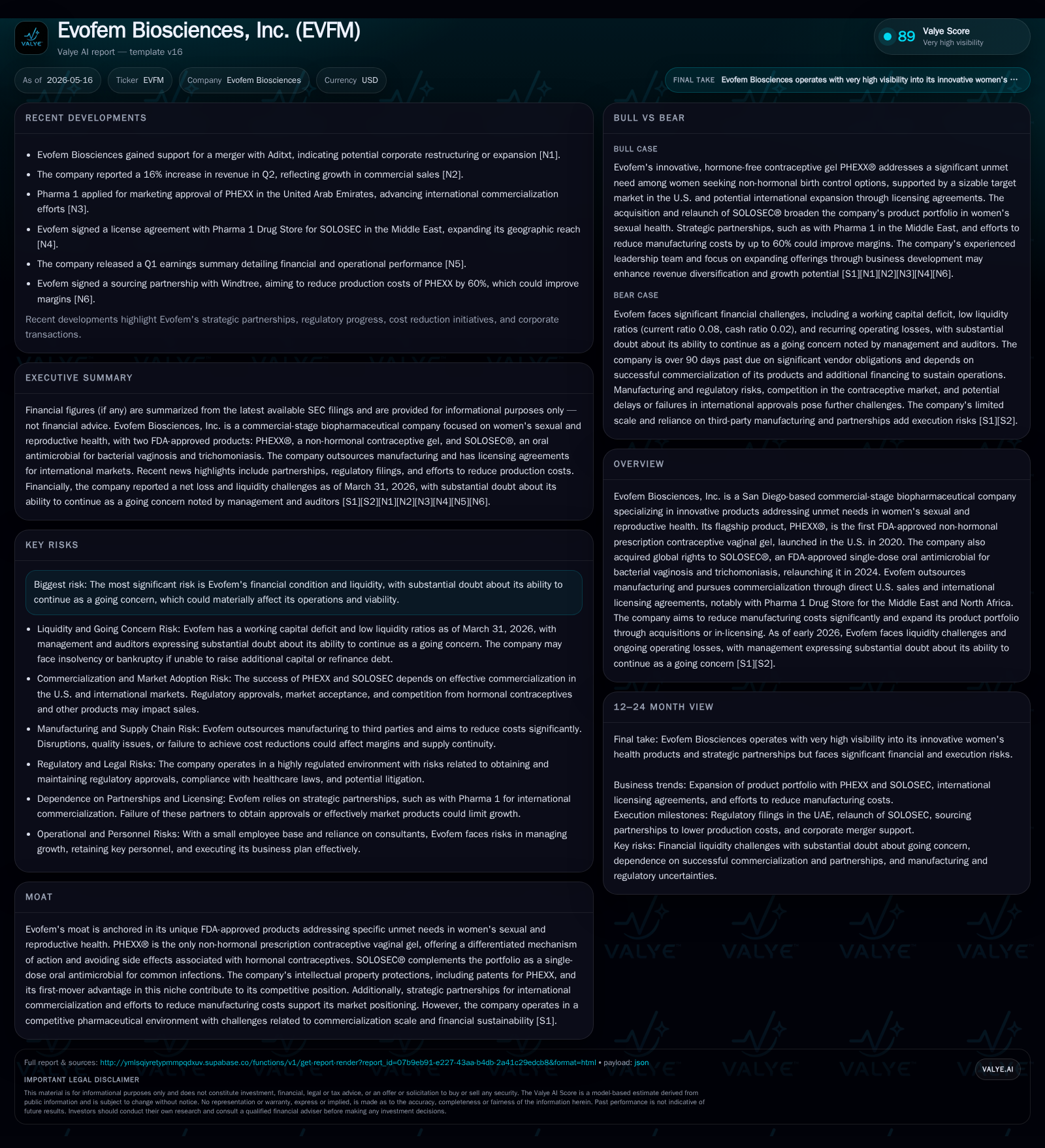
In its latest 10-Q filing for Q1 2026, Evofem Biosciences disclosed no material changes in risk factors but reaffirmed ongoing financial distress casting doubt on its ability to sustain operations. The company markets two FDA-approved products—PHEXX®, a pioneering non-hormonal contraceptive gel, and SOLOSEC®, an oral antimicrobial for bacterial vaginosis and trichomoniasis—targeting distinct unmet needs in women’s sexual health. Evofem pursues a strategy of commercial sales in the U.S. supported by international licensing partnerships, yet faces significant headwinds from high manufacturing costs, limited capital, and competitive healthcare reimbursement pressures. Growth will largely depend on successful cost reductions, expanding market access via partnerships, and potential portfolio enrichment through acquisitions or licensing. However, poor liquidity, heavy debt burdens, and regulatory complexities remain major constraints that could jeopardize the company’s future viability.
Recent Operating Update
Evofem Biosciences’ latest quarterly filing dated May 15, 2026 ([S2]) reported no material changes to previously disclosed risk factors, suggesting continuity in the company’s challenging operating environment. However, the filing reaffirms substantial doubt regarding its ability to continue as a going concern—an acute red flag highlighting severe liquidity constraints that dominate the near-term outlook. No new event has alleviated concerns raised in the prior annual filing ([S1] March 2026) and the April 2026 distributorship agreement with Clovis Davis Pharmaceuticals LLC to expand SOLOSEC® commercialization within Sub-Saharan Africa ([S3]) represents one of few recent operational advances.
This exclusivity deal enhances Evofem's geographic footprint for SOLOSEC but does not materially improve domestic cash flow given persistent financial headwinds. The company emphasizes reducing manufacturing costs and acquiring or licensing additional women’s health products as strategic priorities ([S1]), while current finances remain precarious with a reported current ratio of just 0.08 as of March 31, 2026 ([F1]). The recall of liquidity pressure underscores urgency around executing cost-saving measures and growth initiatives swiftly.
Business Model
Evofem generates revenue primarily from sales of two FDA-approved products: PHEXX® and SOLOSEC®.
- PHEXX® is marketed as the first prescription non-hormonal contraceptive vaginal gel approved by the FDA (since May 2020). Its differentiated mechanism allows occasional use shortly before intercourse without systemic hormone exposure, targeting approximately 15.9 million U.S. women who prefer or require non-hormonal birth control due to medical contraindications or personal preference ([S1]).
- SOLOSEC®, acquired in July 2024 and relaunched in November 2024 ([S1]), is a single-dose oral antimicrobial approved for bacterial vaginosis (BV) and trichomoniasis treatment—two common infections affecting reproductive-age women.
The company outsources its manufacturing processes to reduce fixed capital requirements but acknowledges current costs are unsustainable without further efficiencies ([S1], ). Commercially, Evofem employs a direct U.S. sales force complemented by international licensing agreements—such as those with Pharma 1 Drug Store LLC covering Middle East & North Africa markets ([S1])—and recently expanded into Sub-Saharan Africa distribution through Clovis Davis ([S3]).
Revenue mechanics depend heavily on prescription volumes driven by physician adoption of PHEXX® as an alternative contraceptive option and insurance coverage decisions affecting patient out-of-pocket costs. SOLOSEC® sales hinge on infection diagnosis rates and formulary placement in both private and public payer channels.
Margins are currently pressured due to relatively high production costs combined with pricing constraints from healthcare payers focused on cost containment ([S1], [S25]). Further profitability depends on lowering cost of goods sold (COGS), scaling sales volumes domestically and internationally, and diversifying revenue sources via pipeline expansion or acquisitions.
Industry Structure and Competitive Position
Evofem occupies a niche within the broader women’s sexual and reproductive health market, which is fragmented between large incumbents offering hormonal contraceptives and antimicrobials, evolving startups focusing on novel delivery systems or formulations, and generic competitors.
PHEXX’s key competitive advantage lies in being first-to-market with an FDA-approved non-hormonal vaginal gel contraceptive—a differentiation point avoiding side effects associated with hormonal contraception such as mood disturbances or cardiovascular risks ([S1]). This positions Evofem uniquely among patient subgroups contraindicated for hormones.
SOLOSEC®, similarly unique as a single-dose oral therapy for BV/trichomoniasis, operates in a crowded antimicrobial space but benefits from single-dose convenience promoting adherence.
However, Evofem faces formidable challenges including limited scale versus pharma giants invested in women’s health portfolios; stringent regulatory environments complicating product launches; restricted capital limiting marketing reach; and third-party payers imposing downward pressure on prices through formulary management and coverage policy tightening ([S1], [S25]). Pricing power appears weak given payer scrutiny.
Strategic partnerships (Pharma 1 Drug Store for MENA region; Clovis Davis for Sub-Saharan Africa) reflect an attempt to leverage local expertise while conserving cash through licensing. Yet such arrangements typically yield lower unit revenue than direct sales.
Growth Drivers
The core growth drivers for Evofem hinge on:
- Expanding Adoption of PHEXX®: Capitalizing on growing demand among women seeking hormone-free contraception alternatives could incrementally increase prescriptions if physician awareness campaigns prove effective.
- SOLOSEC® Market Penetration: Expanding geographical availability beyond the U.S., especially through distributorships like Clovis Davis ([S3]) may tap sizeable infection-treatment markets in emerging regions.
- Cost Reduction Initiatives: Targeted efforts to reduce manufacturing expenses are critical to improving gross margin profiles ([S1], [S26]). Achieving lower COGS could unlock sustainable profitability even at moderate sales volumes.
- Portfolio Expansion: Pursuing acquisitions or licensing agreements for synergistic women’s health products promises diversification that can mitigate reliance on two main assets; this also mitigates risks related to individual product downturns or competitive encroachments ([S1]).
- Regulatory Approvals Abroad: Success in foreign regulatory submissions (e.g., UAE filings by Pharma 1 in mid-2025) can drive incremental revenue streams if successfully commercialized ([S1]).
Risks / Watchpoints / Growth Constraints
Key risks include:
- Severe Liquidity Constraints: With cash & equivalents at $1.49 million against $78.7 million in current liabilities as of Q1 2026 end ([F1]), Evofem is under extreme financial pressure threatening operational continuity without urgent capital infusion.
- Going Concern Uncertainty: Auditor opinions state substantial doubt about continued operations absent refinancing or restructuring ([S1], [S7]).
- High Debt Levels: Total debt approximating $12.12 million creates fixed obligations that compound liquidity strain ([F1]).
- Regulatory Challenges: Complex FDA compliance requirements surrounding marketing practices, potential restrictions based on adverse events, or new legislative healthcare reforms risk delaying product launches or increasing commercialization costs ([S8], [S11], [S20]).
- Pricing Pressure from Payers: Escalating focus on drug price containment could limit upward price revisions or reimbursement levels reducing net revenues ([S25], [S17]).
- Competitive Market Dynamics: Larger pharmaceutical companies can leverage scale advantages combined with diverse product pipelines posing existential threats if Evofem fails to differentiate effectively or increase market share.
- Dependence on Third Parties: Outsourced manufacturing means quality control issues or supplier disruptions could impact supply chain reliability.
- Limited Capital Raising Capacity: Low shares outstanding available for issuance hamper ability to raise funds via equity offerings; indebtedness covenants may restrict borrowing capacity ([S29]).
- Legal/Compliance Exposure: Potential investigations linked to marketing practices, data privacy laws related to telehealth platforms promoting PHEXX®, or violations of anti-kickback statutes could result in financial penalties or reputational damage ([S8], [S14], [S21]).
What to Watch Next
Investors following Evofem should monitor:
- Quarterly updates indicating progress (or lack thereof) on cash burn reduction plans and cost cutting initiatives announced earlier.
- Revenue trends for PHEXX® prescriptions domestically as well as uptake metrics for SOLOSEC® across new international territories under exclusive licensing deals.
- Regulatory milestones abroad especially approvals granted based on Pharma 1 submissions filed during mid-to-late 2025.
- Announcements regarding new acquisitions or licensing deals expanding product portfolio breadth.
- Any financing activities either debt refinancing, equity raises, or strategic partnership capital injections intended to alleviate immediate liquidity crises.
- Changes in payer reimbursement policies relevant to both products impacting pricing power.
- Legal proceedings or governmental investigations related to compliance matters noted historically but currently unresolved ([S5]).
Financial Profile Summary
Latest financial snapshot
| Metric | Value | Period |
|---|---|---|
| Cash & equivalents | $1491000 | |
| 2026-03-31 | ||
| Current assets | $6mm | |
| 2026-03-31 | ||
| Current liabilities | $79mm | |
| 2026-03-31 | ||
| Current ratio | 0.08x | |
| 2026-03-31 |
Source: SEC companyfacts cache [F1].
| Metric | Value | Period End |
|---|---|---|
| Cash & Equivalents | $1.49M | |
| 2026-03-31 | ||
| Current Assets | $6.06M | |
| 2026-03-31 | ||
| Current Liabilities | $78.75M | |
| 2026-03-31 | ||
| Current Ratio | 0.08 | |
| 2026-03-31 | ||
| Total Debt | $12.12M | Best Effort* |
*Note: Total debt figure last confirmed June 2015 per public company facts data [F1]. Actual current debt details were not updated explicitly in filings but large working capital deficits indicate sustained heavy liabilities.[F1]
These balance sheet metrics paint a picture of severe short-term solvency risks requiring urgent remedial financing actions. Operating income remains negative historically with cash flows challenged by ongoing promotional expenditures necessary for commercial push despite limited scale revenue generation.[F1],[S7]
Disclaimer: This analysis is based strictly on currently available SEC filings as of May 16, 2026 together with valuation data snapshots. It does not contain investment advice or price forecasts but provides an informed evaluation grounded exclusively in verifiable disclosures about Evofem Biosciences’ operational status, industry context, competitive landscape, product positioning, strategic initiatives, risk profile, and financial condition.
Disclaimer: This is research-only, informational analysis and not investment advice. It may include AI-generated interpretation and general industry context. Always verify important details using primary sources.

Comments